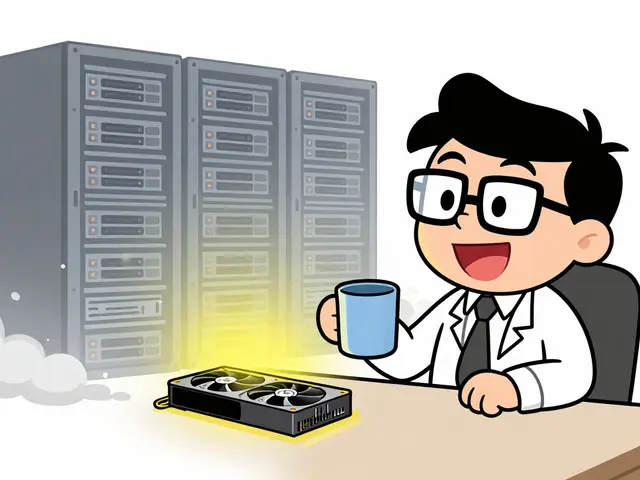
Imagine sending your most sensitive patient records or proprietary financial forecasts to a powerful AI model hosted in the cloud. You need the intelligence, but you can't risk exposing the raw data. Traditional encryption protects data while it sits on a disk or travels over the network, but once it hits the server's memory for processing, it is naked and vulnerable. This is where confidential computing changes the game entirely.
This technology allows Large Language Models (LLMs) to process data inside a hardware-enforced fortress known as a Trusted Execution Environment (TEE). Inside this enclave, both the user's input and the model's intellectual property remain encrypted from the rest of the system, including the cloud provider itself. It is not just a theoretical concept anymore; it is becoming the standard for regulated industries like healthcare and finance that need to deploy AI without violating compliance rules.
How Confidential LLM Inference Works
To understand why this matters, you have to look at what happens during normal inference. Usually, your data decrypts on the server, gets processed by the CPU or GPU, and then the result is sent back. If a hacker breaches the server, or even if the cloud provider’s internal staff has access, they can see everything. Confidential computing flips this script.
The process relies on specific hardware features built into modern processors. Here is the step-by-step flow of a secure request:
- Encrypted Request: Your application sends the prompt via TLS 1.3 encryption to the cloud server.
- Attestation: Before any data enters the secure zone, a cryptographic handshake occurs. The client verifies that the server’s TEE is authentic and untampered. Think of it as checking the seal on a medicine bottle before taking it.
- Decryption Inside the Enclave: The data enters the Trusted Execution Environment. Only inside this isolated memory region does decryption happen. The host operating system cannot peek at these bits.
- Secure Processing: The LLM runs its inference within the encrypted memory (VRAM for GPUs). The model weights and the attention scores stay hidden.
- Encrypted Response: The output is re-encrypted before leaving the TEE and traveling back to you.
This architecture ensures that even if the physical machine is compromised, the data remains safe. As noted by Anthropic in their May 2025 whitepaper, this enables "private data inference with proprietary LLMs," solving the dual problem of protecting user privacy and model IP simultaneously.
Key Hardware Technologies Powering Secure AI
You cannot run confidential computing on just any old server. It requires specific processor generations that support memory encryption and isolation. The three major players in this space are Intel, AMD, and NVIDIA, each bringing different strengths to the table.
| Provider | Technology | Max Memory per VM | GPU Support |
|---|---|---|---|
| Intel | TDX (Trust Domain Extensions) | Up to 512GB | Yes (via partner integrations) |
| AMD | SEV-SNP (Secure Encrypted Virtualization) | Up to 512GB | Yes (limited until Q1 2025) |
| NVIDIA | CPR (Compute Protected Regions) | N/A (GPU-specific) | Native (Hopper/Blackwell) |
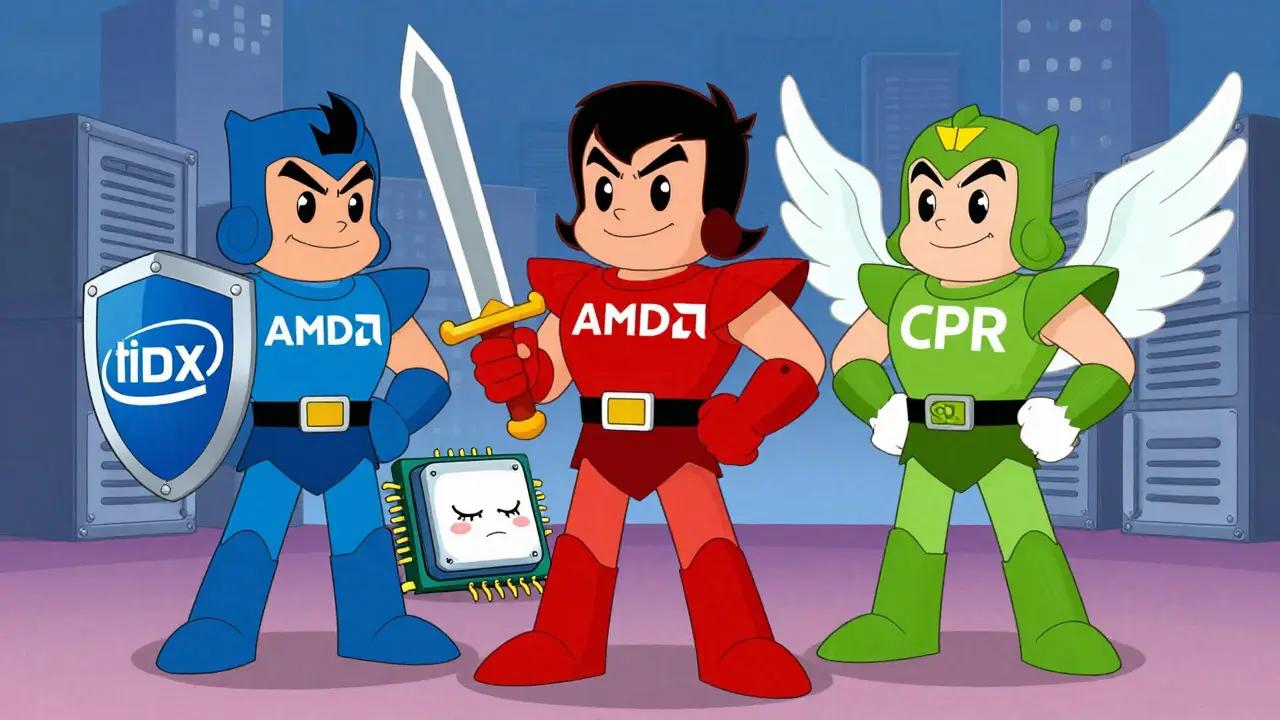
Intel TDX supports Confidential Virtual Machines (CVMs) and is widely used by Google Cloud and AWS. It allows for large memory allocations, which is crucial for loading massive LLMs. AMD SEV-SNP provides similar capabilities and is heavily utilized by Microsoft Azure. Its strength lies in fine-grained memory protection policies. NVIDIA CPR, introduced with the Hopper (H100) and Blackwell architectures, is unique because it isolates memory directly on the GPU. Since LLM inference is GPU-bound, having the security boundary right on the accelerator reduces latency and complexity compared to moving data between CPU and GPU enclaves.
For developers, this means you must choose your cloud instance carefully. You generally need Intel Xeon SP processors from the 4th Gen Sapphire Rapids onward, or AMD EPYC Milan-X series. If you are using NVIDIA GPUs, stick to H100 or newer to get native confidential computing benefits.

Cloud Provider Implementations: AWS vs. Azure vs. Google
While the hardware is the foundation, the cloud providers build the usable services on top of it. Each has a distinct approach, trade-offs, and maturity level.
AWS Nitro Enclaves launched in 2020 and were enhanced for LLM workloads in March 2024. They use lightweight VMs isolated from the host. The big advantage is seamless integration with existing EC2 infrastructure. However, there is a catch: early versions were limited to 2 vCPUs and 4GB RAM per enclave. While AWS plans to increase this to 16GB by mid-2025, current users often have to quantize models significantly to fit, which can drop accuracy by 3-5%. Leidos, for example, managed to achieve 99.8% accuracy parity for government document analysis, but it required custom tooling to work around those resource limits.
Microsoft Azure Confidential Inferencing uses AMD SEV-SNP and supports up to 16 vCPUs and 32GB RAM per confidential VM. This offers better scalability than AWS’s current offering. Microsoft has invested heavily in documentation, earning high marks from developers for clarity. Their integration with Azure Machine Learning makes it easier for enterprises already in the Microsoft ecosystem to adopt. However, full NVIDIA GPU integration only became available in early 2025, so older setups might lack optimal acceleration.
Google Cloud Confidential VMs leverage Intel TDX and offer the highest raw scalability, supporting up to 56 vCPUs and 224GB RAM. This is ideal for huge models that don’t fit in smaller enclaves. Until late 2024, GPU acceleration was limited, but their partnership with NVIDIA is changing that. A European bank successfully used this setup for GDPR-compliant transaction analysis, though they reported a 12.7% increase in latency, requiring architectural tweaks to meet service level agreements.
If you are choosing a platform today, consider your team’s expertise and your model size. For smaller, highly optimized models, AWS is mature. For larger models needing more memory headroom, Google Cloud is strong. For enterprise teams deep in the Microsoft stack, Azure provides the smoothest path.
Performance Overhead and Real-World Challenges
No security solution is free. Confidential computing introduces overhead, primarily due to the attestation process and memory encryption/decryption cycles. According to AWS benchmarks from September 2024, expect a 5-15% performance hit compared to non-confidential inference. NVIDIA reports slightly better numbers, achieving 90-95% of native performance on H100 GPUs thanks to their hardware-native CPR design.
But the biggest pain point isn't just speed-it's complexity. Setting up a confidential environment takes time. Gartner reports that organizations typically spend 80-120 hours training their AI engineering teams just to become proficient. The "cold start" problem is real: the initial attestation adds 1.2 to 2.8 seconds to the very first inference request. For real-time chatbots, this delay can be noticeable.
Debugging is another headache. Because the code runs in an isolated, encrypted environment, traditional debugging tools don't work well. Developers report that development time increases by 30-50% because they have to rely on logging strategies that export data out of the enclave safely. Stack Overflow questions related to confidential computing and LLMs jumped 214% year-over-year, with GPU memory management inside TEEs being the top complaint.
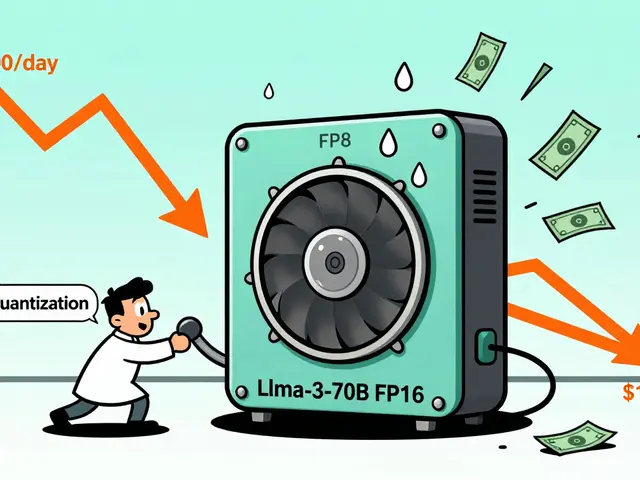
Memory constraints force many teams to use model quantization (reducing precision from FP16 to INT8, for example). While this helps the model fit into the enclave, it risks accuracy. One Reddit user noted a 3.2% drop in benchmark accuracy after quantizing Llama 2-70B to fit AWS Nitro Enclaves. You have to balance security, size, and accuracy carefully.
Regulatory Drivers and Market Adoption
Why go through all this trouble? Regulations. GDPR, HIPAA, and CCPA are pushing companies toward zero-trust architectures. IDC predicts that by 2027, 65% of enterprise AI deployments in regulated industries will incorporate confidential computing. The market is exploding, growing from $2.8 billion in 2024 to a projected $14.3 billion by 2027.
Financial services lead adoption at 47%, followed by healthcare at 32%. These sectors can't afford data leaks. By using confidential computing, banks can analyze transactions for fraud without exposing customer details, and hospitals can use AI for clinical notes without risking HIPAA violations. It transforms AI from a liability into a compliant asset.
Future Outlook: What’s Next?
The technology is maturing rapidly. NVIDIA released CUDA 12.8 in October 2025 with native support for confidential computing APIs, cutting development time by 40%. Red Hat launched OpenShift sandboxed containers with integrated confidential computing, making it easier to manage these environments in Kubernetes clusters. Microsoft aims to reduce attestation latency by 50% by Q3 2025.
However, side-channel attacks remain a threat. Researchers have found new ways to leak information from TEEs by measuring power consumption or cache timing. The industry is responding with continuous hardware countermeasures, but vigilance is key. Despite these challenges, confidential computing is no longer optional for sensitive AI workloads-it is the future of trust in the cloud.
What is the main benefit of confidential computing for LLMs?
It protects both the user's input data and the model's intellectual property while they are being processed in memory. Unlike traditional encryption, which only secures data at rest or in transit, confidential computing keeps data encrypted even when the CPU or GPU is actively using it.
Does confidential computing slow down AI inference?
Yes, there is a performance overhead. Expect a 5-15% slowdown on average. The initial "cold start" for attestation can add 1-3 seconds to the first request. However, newer hardware like NVIDIA H100s minimizes this impact, achieving 90-95% of native speeds.
Which cloud provider is best for confidential LLM inference?
It depends on your needs. AWS Nitro Enclaves are mature but have lower memory limits per enclave. Azure Confidential Inferencing offers good scalability and excellent documentation. Google Cloud Confidential VMs provide the highest memory capacity (up to 224GB), making them suitable for very large models.
Can I use any GPU for confidential computing?
No. You need specific hardware. For NVIDIA, you need Hopper (H100) or Blackwell architectures to use Compute Protected Regions (CPR). Older GPUs do not have the hardware firewalls required to isolate memory effectively within the TEE.
Is confidential computing fully secure against all attacks?
It is highly secure but not invincible. Side-channel attacks, which exploit physical characteristics like power usage or cache timing, remain a risk. However, hardware vendors are continuously updating countermeasures. For most enterprise threats, it provides robust protection far superior to standard cloud instances.