
Imagine training a powerful Generative AI is a type of artificial intelligence capable of creating new content, such as text, images, or code, by learning patterns from vast datasets model without ever seeing the sensitive patient records, financial transactions, or personal messages it learns from. For years, this sounded like science fiction. The industry standard was always the same: collect everything into one giant data lake, scrub what you can, and hope for the best. But with regulations tightening globally and privacy expectations skyrocketing, that old playbook is broken. Enter Federated Learning is a decentralized machine learning approach where models are trained across multiple distributed devices or servers without exchanging raw data. This isn't just a niche academic concept anymore; it’s becoming the backbone of ethical, scalable AI development in 2026.
The Core Problem: Why Centralized Data Fails Modern AI
Traditional AI training relies on centralization. You take data from Hospital A, Bank B, and Car Manufacturer C, move it all to a central cloud server, and train your model there. This creates massive security risks. If that central server gets hacked, every bit of sensitive data is exposed. It also creates legal nightmares. Under laws like GDPR in Europe or various state-level privacy acts in the US, moving data across borders or even between departments often violates compliance rules.
Federated Learning flips this script entirely. Instead of moving data to the algorithm, you move the algorithm to the data. The raw information never leaves its source-whether that’s your smartphone, a hospital’s internal server, or a factory floor sensor. Only the mathematical updates (the "lessons" learned) travel back to a central coordinator. This means you get the collective intelligence of millions of users without the liability of holding their private secrets.
How Federated Learning Actually Works
To understand why this matters for Generative AI, you need to see the lifecycle in action. It’s not magic; it’s rigorous engineering. Here is the step-by-step process:
- Initialization: A global model is created and sent to participating nodes (devices or local servers).
- Local Training: Each node trains the model using its own local data. For example, a bank trains the fraud detection part of the model on its specific transaction history.
- Update Generation: The node calculates how the model parameters should change to improve accuracy. These are just numbers representing weight adjustments, not the actual customer names or account balances.
- Secure Aggregation: These parameter updates are sent to a central server. Crucially, they are often encrypted or noise-added before transmission.
- Global Update: The server aggregates these updates from thousands of sources to create a smarter, more robust global model.
- Distribution: The improved global model is sent back out to all participants for the next round of training.
This cycle repeats until the model reaches the desired performance level. Google pioneered this at scale with Android keyboard predictions, allowing phones to learn typing habits locally while improving the overall prediction engine for everyone. Now, we’re applying this same logic to complex generative tasks.
Privacy Layers: Beyond Just Keeping Data Local
Simply keeping data on-device isn’t enough. Sophisticated attackers can sometimes reverse-engineer sensitive information from the model updates themselves (a technique called gradient inversion). To stop this, federated systems stack multiple privacy-preserving techniques. Think of it like a castle with multiple moats and drawbridges.
| Technique | How It Works | Primary Benefit |
|---|---|---|
| Homomorphic Encryption is an encryption scheme that allows computations to be performed on ciphertexts, generating an encrypted result which, when decrypted, matches the result of operations performed on the plaintext | Computations happen on encrypted data. The server processes updates without ever decrypting them. | Zero-knowledge processing; the server sees nothing. |
| Secure Multi-Party Computation is a cryptographic method that allows multiple parties to jointly compute a function over their inputs while keeping those inputs private | Parties split their data into shares. No single party can reconstruct another’s input. | Prevents any single participant from viewing others' data. |
| Differential Privacy is a system of formally quantifying and limiting the amount of information about individuals that can be inferred from a dataset | Adds statistical noise to model updates. Makes it mathematically impossible to link an update to a specific user. | Protects against re-identification attacks. |
| Trusted Execution Environments is a secure area of a main processor that guarantees code and data loaded inside are protected with respect to confidentiality and integrity | Hardware-level isolation for sensitive calculations. | Prevents software-based tampering or unauthorized access. |
In a robust 2026 implementation, you rarely use just one of these. You might use Homomorphic Encryption during transmission and Differential Privacy during aggregation. This layered defense ensures that even if one layer is compromised, the data remains safe.

Why Generative AI Needs Federated Learning
You might wonder: why apply this to Generative AI? After all, large language models (LLMs) usually need massive, diverse datasets to avoid hallucinations and bias. Here’s the catch: the most valuable data is often the most restricted.
Consider healthcare. A hospital has decades of rare disease case studies. Another hospital has different specialties. Neither can share their raw patient files due to HIPAA and other regulations. With traditional methods, they stay siloed. With federated learning, they can jointly train a diagnostic assistant that understands both specialties. The resulting generative model produces more accurate, nuanced medical summaries because it has "seen" a wider variety of cases, even though no single institution ever shared a single file.
Similarly, in finance, banks want to detect new types of fraud. Fraudsters evolve quickly. By collaborating via federated networks, banks can build a generative model that simulates and detects emerging fraud patterns in real-time, leveraging the collective experience of the entire banking sector without exposing client portfolios.
Challenges and Risks You Can’t Ignore
Federated learning is not a silver bullet. It introduces new complexities that engineers must handle carefully.
Data Heterogeneity (Non-IID Data): In centralized training, data is usually shuffled and uniform. In federated settings, data is "non-independent and identically distributed" (non-IID). One user’s data might look completely different from another’s. If not handled correctly, the global model can become biased toward larger or more active participants. Advanced algorithms like FedAvg and its successors help mitigate this, but it requires careful tuning.
Communication Overhead: Sending model updates back and forth constantly consumes bandwidth. While modern networks are fast, doing this across millions of IoT devices or remote branches adds up. Engineers often compress gradients or use asynchronous updates to reduce this load.
New Attack Surfaces: While you protect against data breaches, you expose yourself to model poisoning. A malicious actor could inject bad data into their local training set, subtly corrupting the global model. Defending against this requires rigorous anomaly detection and validation checks at the aggregation server. Security shifts from protecting a database to verifying the integrity of mathematical updates.
Real-World Applications in 2026
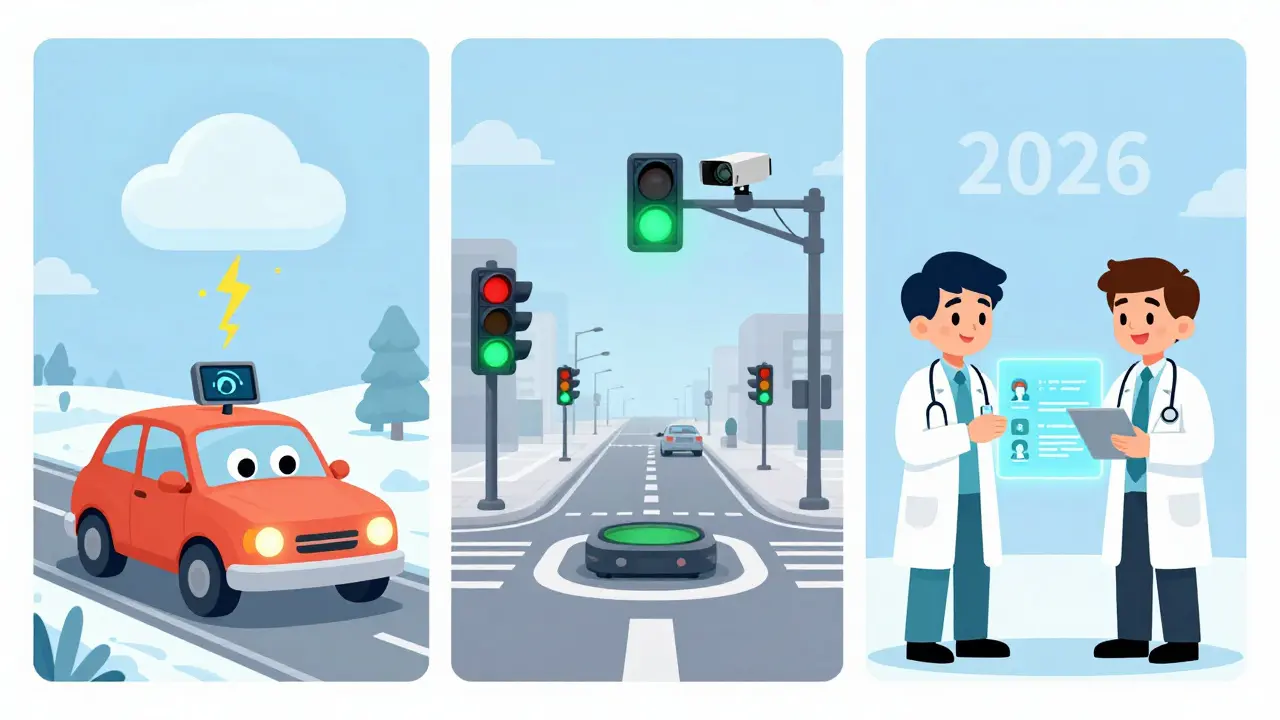
We are already seeing this technology mature beyond pilot projects. In the automotive industry, cars use federated learning to improve autonomous driving algorithms. Your car learns how to handle icy roads in Portland, sends only the driving pattern updates to the manufacturer, and helps improve the navigation system for drivers in Chicago-all without uploading your location history.
In smart cities, traffic lights use federated learning to optimize flow based on local camera feeds. The video footage stays on the edge device; only the optimization parameters are shared. This respects citizen privacy while making urban infrastructure smarter.
For enterprises, the shift is strategic. Companies are building "privacy-first" AI products as a competitive advantage. Customers trust brands that prove they don’t hoard personal data. Federated learning provides the technical proof behind that marketing claim.
Getting Started: A Practical Checklist
If you’re considering implementing federated learning for your generative AI projects, start here:
- Audit Your Data Silos: Identify where sensitive data lives that cannot leave its current environment.
- Choose Your Framework: Look into open-source tools like TensorFlow Federated or PySyft, which provide the scaffolding for decentralized training.
- Select Privacy Mechanisms: Decide which combination of Homomorphic Encryption, Differential Privacy, and Secure Multi-Party Computation fits your threat model and computational budget.
- Plan for Non-IID Data: Ensure your aggregation algorithm can handle skewed data distributions.
- Monitor for Poisoning: Implement strict validation rules for incoming model updates to prevent malicious manipulation.
Federated learning transforms AI from a data-hungry monopolist into a collaborative partner. It allows us to build smarter, more creative generative models while respecting the fundamental right to privacy. As we move further into 2026, the question won’t be whether to use federated learning, but how quickly you can adapt your infrastructure to support it.
Is federated learning completely secure?
No system is 100% secure. Federated learning reduces the risk of large-scale data breaches by eliminating central data storage. However, it introduces new risks like model inversion attacks and data poisoning. Therefore, it must be combined with strong cryptography like Homomorphic Encryption and continuous monitoring to be truly effective.
Does federated learning slow down AI training?
It can be slower than centralized training due to communication overhead and the need for multiple rounds of aggregation. However, advancements in compression techniques and asynchronous updates have significantly reduced this latency, making it viable for many real-time applications.
What is the difference between differential privacy and homomorphic encryption?
Differential Privacy adds statistical noise to data or updates to prevent identifying individuals, sacrificing a tiny bit of accuracy for privacy. Homomorphic Encryption allows computations to be performed on encrypted data without decrypting it, preserving exact accuracy but requiring significant computational power.
Can small companies implement federated learning?
Which industries benefit most from federated learning?
Industries with high regulatory barriers and sensitive data benefit most. This includes healthcare (patient records), finance (transaction history), automotive (driving data), and telecommunications (user behavior). Any sector where data sharing is legally or ethically restricted is a prime candidate.
How does federated learning help with non-IID data?
Non-IID (non-independent and identically distributed) data means each participant's data looks different. Federated algorithms like FedAvg and personalized federated learning techniques adjust weights and biases to ensure the global model generalizes well across diverse data distributions, rather than being biased toward the largest data contributor.