
You know the feeling. It’s 2 PM on a Tuesday, and your support queue is exploding. Not because everything broke, but because fifty people just reported the same database timeout in slightly different words. Your team is burning hours sorting duplicates, misrouting tickets to the wrong teams, and drowning in noise while the real fire burns unnoticed. Traditional rule-based systems can’t keep up with this chaos. They look at tickets in isolation, missing the bigger picture.
This is where Autonomous Ticket Resolution using domain-specific Large Language Model (LLM) agents changes the game. We aren't just talking about chatbots that say "I'm sorry for the inconvenience." We're talking about intelligent agents that understand context, spot relationships between tickets, and resolve issues before a human even opens their laptop. Recent deployments show these systems achieving around 95% accuracy in categorization and routing, cutting resolution times by up to 35%. If you’re still manually triaging tickets, you’re leaving efficiency-and sanity-on the table.
The Problem with Traditional Ticketing Systems
Most legacy IT Service Management (ITSM) platforms rely on rigid rules. If a ticket contains the word "login," it goes to Team A. If it says "server," it goes to Team B. Simple? Yes. Effective? Barely.
These systems suffer from what researchers call "content bias." They analyze each ticket as an isolated event. Imagine a major cloud outage hits Volcano Engine users. Hundreds of tickets flood in. A traditional system sees hundreds of separate problems. It escalates them all, spamming your engineers with redundant alerts. The actual issue-one root cause-is buried under the noise.
Worse, these systems struggle with nuance. A customer might write, "My dashboard is acting weird," which could mean anything from a UI glitch to a critical data loss incident. Without understanding the business impact or the technical context, the system guesses. And when it guesses wrong, tickets bounce between teams, frustrating both customers and analysts.
How Domain-Specific LLM Agents Work
So, how do we fix this? Enter domain-specific LLM agents. Unlike general-purpose models like standard GPT-4, these agents are fine-tuned on your specific historical ticket data. They learn your company’s language, your common failure modes, and your internal workflows.
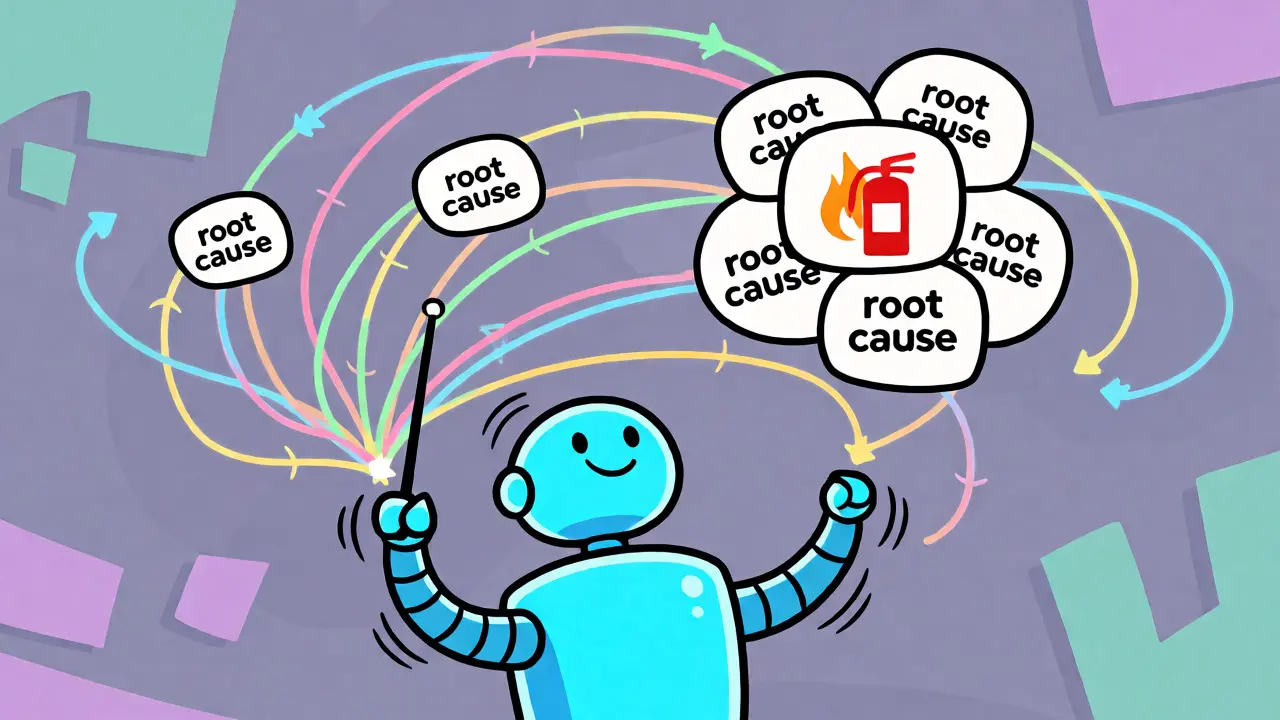
The core innovation isn't just better text classification. It's relationship-driven escalation. As detailed in recent arXiv studies (Zhao et al., 2024), these agents use embedding models to convert ticket descriptions into vector representations. They then calculate cosine similarity between tickets. If two tickets have a similarity score above a certain threshold (typically 0.85-0.90), the agent recognizes they are likely related to the same underlying issue.
Instead of escalating each ticket individually, the agent groups them. It updates the state of the primary ticket and links the others as duplicates or correlated incidents. This approach reduces redundant escalations by 30-40%, according to implementation data from ByteDance. Your engineers get one comprehensive alert instead of fifty fragmented ones.
Key Capabilities That Drive Efficiency
What exactly can these agents do that humans or old software can’t? Here are the three pillars of autonomous resolution:
- Intelligent Categorization and Routing: The agent doesn't just look for keywords. It understands intent. By analyzing the full conversation history, it determines if a ticket is a "System Failure," "Customer Complaint," or "Asset Loss." It routes the ticket to the specific analyst best equipped to handle that category, considering current workload and expertise. Tiger Analytics reported a 22% reduction in misrouted tickets using this method.
- Dynamic Prioritization: Standard SLAs often fail to capture urgency. An LLM agent performs sentiment analysis on user communications. It detects frustration, panic, or urgency in the tone. Combined with business value identification (e.g., "this affects a VIP client"), it assigns priority levels more accurately than static rules.
- Automated Self-Service Resolution: For routine issues, the agent doesn't just route; it resolves. It accesses your knowledge base via Retrieval Augmented Generation (RAG) to provide instant answers. Currently, about 15-20% of tickets are fully resolved through automated self-service channels without human intervention.
Real-World Performance Metrics
Numbers talk louder than hype. Let’s look at what’s actually happening in production environments in late 2025 and early 2026.
| Metric | Traditional Rule-Based System | Domain-Specific LLM Agent System |
|---|---|---|
| Categorization Accuracy | ~70-75% | ~95% |
| Misrouted Tickets | High (Manual re-routing required) | Reduced by ~22% |
| Redundant Escalations | Common during outages | Reduced by 30-40% |
| Time Spent on Triage | High | Reduced by ~35% |
| Resolution Time (Critical Issues) | Baseline | Reduced by 25-35% |
Support analysts at companies deploying these frameworks report a significant shift in their daily work. One analyst noted, "The system's ability to link related tickets during system outages has been invaluable for understanding the full scope of incidents." Instead of answering the same question ten times, they focus on the complex edge cases that truly require human judgment.

Implementation Challenges and Pitfalls
It’s not magic. You can’t just plug in an API and walk away. Successful implementation requires careful planning.
Data Quality is King: About 65% of initial implementations face issues with inconsistent historical ticket data. If your past tickets are messy, unstructured, or poorly categorized, the model will learn garbage. Organizations need to dedicate 2-3 weeks to data cleaning and standardization before training begins.
The "Black Box" Concern: Early adopters often worry about trust. Why did the agent prioritize this ticket over that one? To combat this, transparency features are crucial. Modern systems provide reasoning traces, showing exactly why the LLM made a decision. In one case study, 22% of agents initially expressed concerns about opaque decision-making until these visibility tools were added.
Handling Edge Cases: No model is perfect. Approximately 5-8% of tickets fall into an "Others" category because they are too novel or technically specific for the trained model. These require human review. Don't expect 100% automation. Aim for high-efficiency automation with human oversight for the tricky stuff.
The Future of ITSM with AI Agents
We are moving toward hybrid human-AI workflows. The goal isn't to replace support teams but to elevate them. Gartner projects the market for AI-powered ITSM solutions to reach $4.8 billion by 2026, growing at a 32% CAGR. Already, 35% of large enterprises have implemented some form of LLM-based ticket handling.
The next frontier is tighter integration with knowledge management. Using RAG, agents don't just guess answers; they cite specific documentation pages. This builds trust and ensures accuracy. Furthermore, domain specialization will deepen. Instead of one giant model, companies will deploy specialized agents for network issues, billing queries, and security incidents, each optimized for its niche.
If you run an IT service desk, the question isn't whether you'll adopt this technology, but how quickly you can clean your data to make it work for you. The teams that master autonomous ticket resolution now will be the ones delivering faster, smarter support in 2026.
Do I need a huge dataset to start using LLM agents for ticket resolution?
Not necessarily. While more data helps, modern techniques like Few-Shot Learning and Fine-Tuning allow models to perform well with smaller, high-quality datasets. However, consistency in your historical data labeling is more important than sheer volume. Start with a clean subset of your most common ticket types.
Can LLM agents completely replace human support agents?
No. Current data shows that while 15-20% of tickets can be fully automated, complex, novel, or highly emotional issues still require human empathy and deep technical reasoning. The ideal setup is a hybrid model where AI handles routine triage and resolution, freeing humans for high-value interactions.
How does the system handle new types of errors it hasn't seen before?
Domain-specific agents typically flag low-confidence predictions or tickets that don't fit existing categories as "Others" or "Unknown." These are routed to senior engineers for manual review. Feedback from these reviews is then used to retrain the model, creating a continuous improvement loop.
Is my customer data safe when using external LLM APIs?
Data privacy is a top concern, with 58% of organizations citing it as a challenge. Many enterprises opt for private instances of LLMs or on-premise deployments to ensure data never leaves their secure environment. Always check the vendor's compliance certifications (like SOC 2 or GDPR) before integrating.
What is the typical ROI timeline for implementing autonomous ticket resolution?
Most early adopters report seeing a return on investment within 9-12 months. This comes primarily from reduced labor costs associated with manual triage and faster resolution times leading to higher customer retention rates. Initial setup takes 4-6 weeks, so benefits accrue relatively quickly after launch.