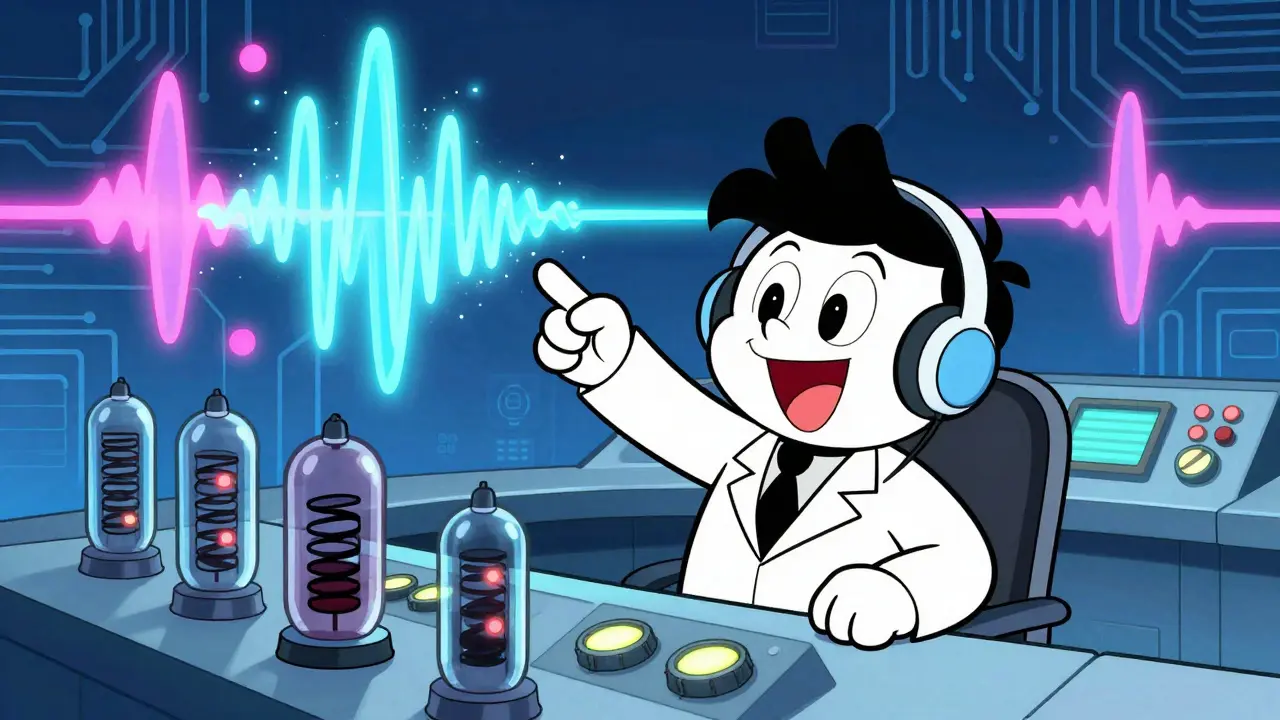
Imagine a world where you can describe a scene-a rainy night in Tokyo with distant sirens-and hear it instantly. Or picture asking your computer to sing a jingle in the style of a specific artist, complete with vocals and instrumentation, within seconds. This isn't science fiction anymore. It’s the current reality of audio generation in generative AI.
We’ve moved past simple robotic voices and repetitive MIDI loops. Today’s models can synthesize hyper-realistic speech, compose complex musical tracks, and generate nuanced sound effects from text prompts or short audio samples. But how does this technology actually work? And what are the real-world implications for creators, developers, and businesses?
In this guide, we’ll break down the three main pillars of AI audio-speech synthesis, music generation, and sound effects-exploring the tech behind them, the tools available, and the ethical hurdles we’re facing in 2026.
The Engine Room: How AI Generates Audio
To understand why AI audio sounds so good now, you need to look at the architecture under the hood. Early systems used rule-based logic or stitched together pre-recorded snippets (concatenative synthesis). That sounded stiff and unnatural. Modern systems use deep neural networks that learn patterns from massive datasets.
There are a few key architectures driving this revolution:
- Transformers: Originally famous for language models like GPT, transformers are now dominant in audio. They handle long-range dependencies well, which is crucial for maintaining musical structure over minutes or keeping speech coherent across paragraphs. Models like Google’s MusicLM and Meta’s MusicGen rely heavily on transformer decoders.
- Diffusion Models: Similar to how Midjourney generates images by removing noise from static, diffusion models for audio start with random noise and iteratively refine it into clean audio waves. Stable Audio uses this approach, allowing for high-fidelity outputs with precise control over duration and tempo.
- Vocoders: In speech synthesis, a vocoder is the final step. It takes a spectrogram (a visual representation of sound frequencies) and converts it into an actual waveform you can hear. WaveNet, introduced by DeepMind in 2016, was a game-changer here, generating raw audio samples autoregressively to achieve near-human quality.
These models don’t just “guess” the next note or word. They analyze millions of hours of training data to understand phonetics, rhythm, harmony, and timbre. The result is audio that feels organic, not algorithmic.
Speech Synthesis: Beyond Robotic Voices
Text-to-Speech (TTS) has come a long way since the clunky GPS navigators of the early 2000s. Today’s TTS systems focus on two things: naturalness and expressiveness.
A typical modern TTS pipeline works in three stages:
- Text Analysis: The system breaks down the input text into linguistic features, identifying punctuation, emphasis, and intonation cues.
- Acoustic Modeling: A neural network predicts the prosody (rhythm and stress) and timbre (tone color) of the voice. This often involves generating a mel spectrogram, which acts as a blueprint for the sound.
- Vocoding: The vocoder converts that blueprint into a playable audio file. Advanced vocoders like HiFi-GAN or WaveNet ensure the output is smooth and free of artifacts.
The biggest leap recently has been in voice cloning. Platforms like ElevenLabs allow users to clone a voice with just a few minutes of reference audio. The model learns the speaker’s unique pitch, accent, and speaking style, then applies it to new text. This is huge for localization (dubbing movies into different languages while keeping the original actor’s voice) and personalized accessibility tools.
However, there’s a catch. While latency has dropped significantly-with some cloud services delivering audio in under 300 milliseconds-prosody errors still happen. If the text lacks clear emotional context, the AI might deliver a heartfelt monologue in a flat, news-anchor tone. You often need to use inline tags or prompt engineering to guide the emotion.
Music Generation: From Loops to Full Songs
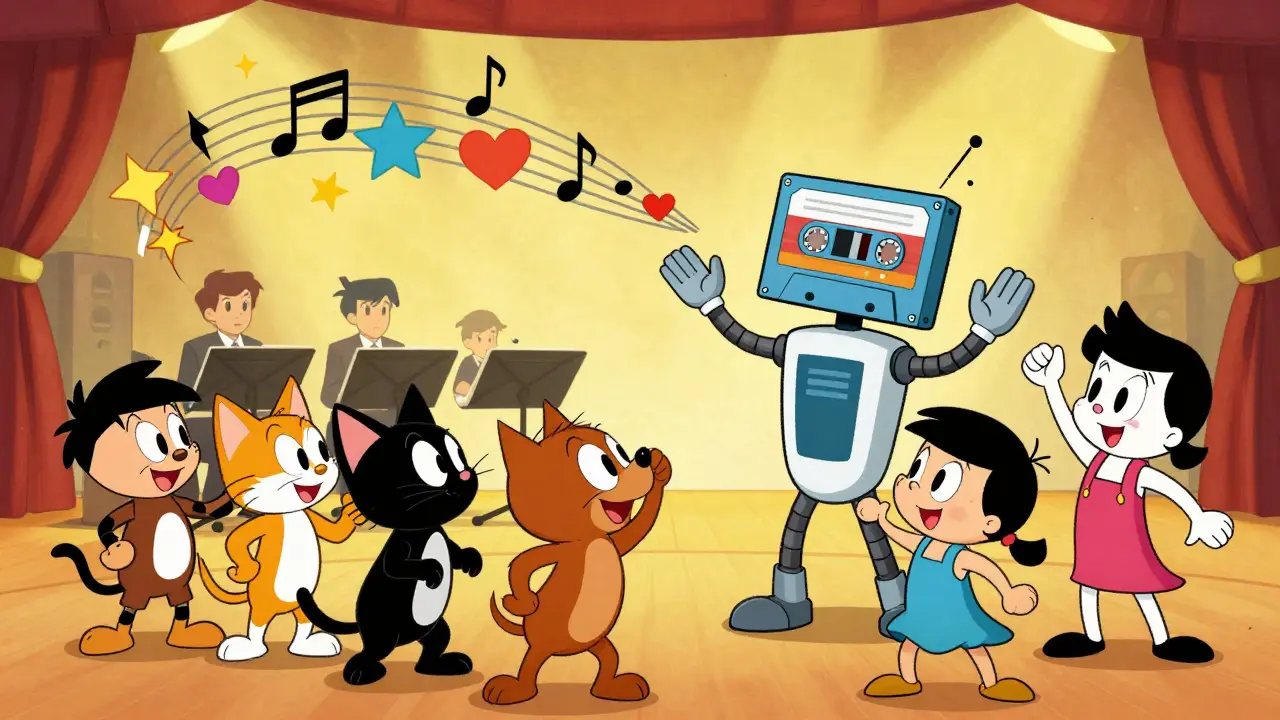
Generating music is harder than speech because music relies on abstract structures like chord progressions, genre conventions, and emotional arcs. There’s no “correct” answer, only aesthetic judgments.
Early attempts struggled with coherence. An AI might generate a beautiful melody but lose track of the key after 30 seconds. Newer models have solved this by using hierarchical approaches.
Take OpenAI’s Jukebox (2020) or Google’s MusicLM (2023). These models encode audio into discrete tokens (similar to how LLMs tokenize text). They then predict the next sequence of tokens based on the previous ones. Because they’re trained on millions of songs with metadata (genre, artist, lyrics), they can mimic styles remarkably well.
Current leaders in consumer-facing music generation include:
- Suno: Known for creating full songs with vocals and lyrics from simple text prompts. It’s incredibly accessible for non-musicians.
- Stable Audio: Focuses on instrumental tracks and soundscapes. It offers more control over BPM, duration, and structure, making it popular for video editors and game devs.
- Soundful: Targets creators who need royalty-free background music quickly, offering customizable stems.
Despite the hype, limitations remain. Most AI-generated songs struggle with long-form structure. A 3-minute pop song needs verses, choruses, bridges, and a dynamic build-up. Current models often produce “generic library music”-pleasant enough for background play, but lacking the surprise and innovation of human composition. Also, vocal clarity can be muddy, and lyrics sometimes make little sense.
Sound Effects: The Invisible Art
If speech and music get the glory, sound effects (SFX) do the heavy lifting in immersive media. Foley artists spend hours recording footsteps, door slams, and rustling clothes. AI can now generate these on demand.
Meta’s AudioGen is a standout here. Trained on diverse environmental audio, it can interpret prompts like “dogs barking in a park with traffic in the background” and generate a realistic stereo mix. This is invaluable for indie game developers who can’t afford a full sound design team.
The challenge with SFX is transients-the sharp, sudden changes in sound (like a gunshot or a glass breaking). AI models sometimes smear these details, resulting in a “mushy” sound. Diffusion-based models are improving this, but achieving crisp, high-frequency detail remains a technical hurdle.
Tools and Pricing Landscape
The market for AI audio tools is booming. Here’s a quick breakdown of the major players and their general positioning:
| Tool | Primary Use Case | Key Feature | Pricing Model |
|---|---|---|---|
| ElevenLabs | Speech Synthesis & Cloning | Ultra-realistic voices, multilingual support | Subscription + Character credits |
| Suno | Full Song Generation | Vocals + Lyrics from text | Freemium / Monthly Sub |
| Stable Audio | Music & SFX | Control over duration/tempo, diffusion-based | Subscription tiers |
| OpenAI (TTS) | API-driven Speech | Integration with LLMs, scalable | Pay-per-character |
Pricing varies widely. For small projects, free tiers often suffice. But for commercial use-like dubbing a documentary or scoring a game-you’ll likely need a paid plan. Always check the licensing terms. Some platforms grant you full ownership of the generated audio; others restrict commercial use or require attribution.
Ethical Challenges and Regulations
With great power comes great responsibility. AI audio raises serious ethical concerns:
- Deepfakes: Voice cloning can be used to impersonate CEOs, politicians, or family members for fraud. We’ve already seen cases of AI-generated phone scams stealing money. Detection tools are being developed, but they’re playing catch-up.
- Copyright: Who owns the rights to an AI-generated song? If the model was trained on copyrighted music without permission, is the output infringing? Lawsuits are piling up against major AI firms. In 2023, the viral track “Heart on My Sleeve,” which mimicked Drake and The Weeknd, was pulled after label complaints.
- Consent: Artists and voice actors are demanding control over their likenesses. Some platforms now allow creators to opt out of training datasets. Watermarking AI-generated content is becoming standard practice to maintain transparency.
Regulators are watching closely. Expect stricter guidelines on labeling AI content and protecting voice likeness rights in the coming years.
Future Trends: What’s Next?
The field is moving fast. Here’s what to watch for:
- Multimodal Integration: Models like AudioGPT aim to combine audio, vision, and text. Imagine a video editor that automatically generates matching sound effects and dialogue based on the visual scene.
- Longer Coherence: Researchers are working on extending music generation beyond 2-3 minutes without losing structural integrity. Think full albums, not just clips.
- Better Control: Future tools will offer granular control over every aspect of the audio-specific instruments, exact emotional nuances, spatial positioning for VR/AR experiences.
Whether you’re a developer building the next big app or a creator looking to streamline your workflow, AI audio is no longer optional. It’s essential. Just remember to use it wisely, ethically, and with a critical ear.
Is AI-generated audio copyrightable?
Currently, the legal landscape is unclear. In many jurisdictions, purely AI-generated works cannot be copyrighted because they lack human authorship. However, if you significantly edit or curate the AI output, you may claim rights to those modifications. Always consult a legal expert for commercial projects.
Can I use AI voices for commercial podcasts?
Yes, most platforms like ElevenLabs offer commercial licenses for their premium plans. Make sure you read the terms of service carefully. Some free tiers explicitly prohibit commercial use. Also, consider disclosing that the voice is AI-generated to maintain trust with your audience.
How realistic is AI voice cloning?
It’s startlingly realistic. With just 1-5 minutes of high-quality reference audio, modern models can replicate a person’s pitch, accent, and speaking style. This realism is why it’s powerful for creative projects but dangerous for malicious uses like fraud.
What are the best tools for generating sound effects?
Meta’s AudioGen and Stability AI’s Stable Audio are top choices. They allow you to generate custom SFX from text descriptions, saving time compared to searching through stock libraries. Look for tools that support stereo output and high sample rates for professional quality.
Will AI replace human musicians and voice actors?
Unlikely in the near future. AI excels at generating generic content quickly, but it struggles with true creativity, emotional depth, and novel expression. Human artists bring unique perspectives and cultural context that AI currently cannot replicate. Instead of replacement, expect collaboration-using AI as a tool to enhance human creativity.
The dramatic shift from robotic monotones to hyper-realistic emotional synthesis is nothing short of a cultural revolution, truly reshaping how we perceive digital interaction. We are standing on the precipice of a new era where sound is no longer just recorded but imagined and manifested in real-time, which feels both exhilarating and terrifyingly profound. The ability to evoke genuine empathy through synthesized voices challenges our fundamental understanding of authenticity and human connection in the digital age.
oh look another tech bro post pretending like this changes anything for actual artists who bleed for their craft its all just noise and corporate greed wrapped in shiny transformer architecture
It is fundamentally imperative that we acknowledge the rigorous mathematical precision required for these diffusion models to function effectively without introducing significant artifacts or latency issues in real-time applications. The assumption that one can simply prompt a model to generate coherent musical structures without understanding the underlying harmonic theory and spectral analysis is a gross oversimplification of the complex neural architectures involved in modern audio synthesis pipelines.
I appreciate the detailed breakdown of the ethical considerations presented here as it highlights the critical need for responsible innovation and clear regulatory frameworks moving forward. It is encouraging to see such a comprehensive overview of the current technological landscape while simultaneously addressing the potential societal impacts with a respectful and measured tone.
When we consider the intricate ways in which voice cloning technology can be utilized to preserve the linguistic heritage of endangered languages or to provide accessible communication tools for individuals with speech impairments, we begin to understand the profound positive potential that lies within these seemingly cold algorithmic processes if they are guided by compassionate intent and inclusive design principles that prioritize human dignity above all else.
Surely you think your indie game needs AI generated footsteps when you could just record yourself walking on gravel outside your house for free?