The Reality Behind the Hype
You’ve likely heard the stat floating around tech Twitter and LinkedIn feeds: vibe coding boosts productivity. The number often cited is 74%, suggesting that nearly three-quarters of developers are shipping faster because they’re letting AI write their code. It sounds like a golden ticket. You type what you want in plain English, hit enter, and the computer does the heavy lifting. But if you’ve actually tried to build something real with these tools, you know the story isn’t that simple.
Vibe coding-formally defined as using natural language prompts to generate code via large language models (LLMs)-has shifted from a novelty to a standard part of the workflow for many teams. Andrej Karpathy, co-founder of OpenAI, coined the term, describing it as a process where you "see things, say things, run things, and copy-paste things." It’s less about writing syntax and more about directing an AI agent. However, the gap between perceived speed and actual delivery time is widening. While surveys show high satisfaction, rigorous studies reveal that without specific skills, vibe coding can actually slow you down.
This article breaks down why that 74% figure exists, who those developers really are, and what it takes to move from "it mostly works" to "it ships reliably." We’ll look at the data from Stanford, METR, and industry leaders to separate the marketing fluff from the engineering reality.
Who Is Actually Winning?
The headline statistic that 74% of developers report productivity gains masks a critical divide: experience level. The benefits of vibe coding are not distributed evenly across the team. In fact, the data suggests that senior developers are the primary beneficiaries, while juniors often face a steep learning curve that initially hampers their output.
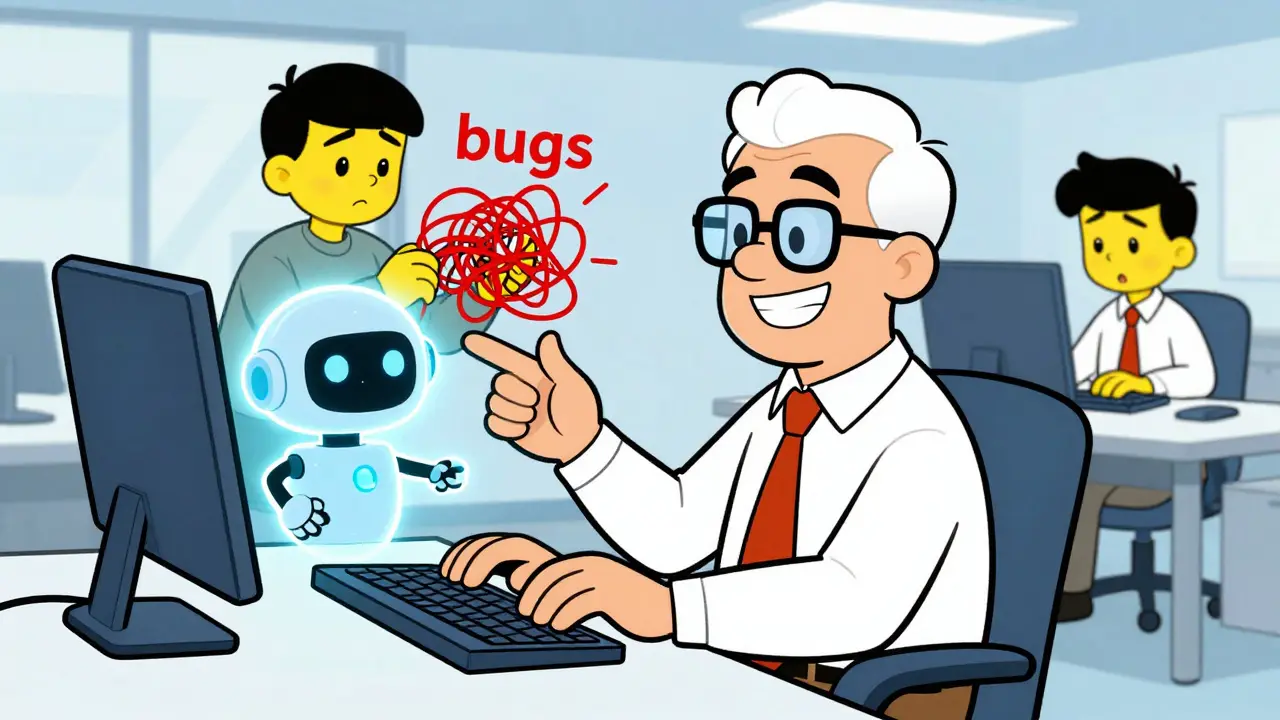
According to a July 2025 survey by Fastly involving 791 developers, senior engineers (those with 10+ years of experience) ship 32% AI-generated code compared to just 13% for junior developers (0-2 years). More importantly, 59% of seniors report that AI helps them ship faster, whereas only 49% of juniors feel the same benefit. Why the difference? Senior developers have the mental models required to verify AI output. They know what correct code looks like, so they can spot hallucinations or logical flaws quickly. Juniors, lacking this baseline, often accept flawed AI suggestions, leading to more bugs and rework later.
| Developer Level | AI Code Shipped | Reported Speed Gain | Primary Risk |
|---|---|---|---|
| Senior (10+ yrs) | 32% | 59% report gains | Technical debt accumulation |
| Mid-Level (3-9 yrs) | Varies | Mixed results | Over-reliance on templates |
| Junior (0-2 yrs) | 13% | 49% report gains | Skill atrophy & debugging delays |
This creates a paradox. Companies adopt AI tools hoping to empower junior staff, but the tools currently amplify the value of senior staff. A junior developer might spend hours debugging code they didn’t write and don’t fully understand, effectively turning them into an editor rather than a programmer. This dynamic raises concerns about long-term skill development within engineering teams.
The Perception-Reality Gap
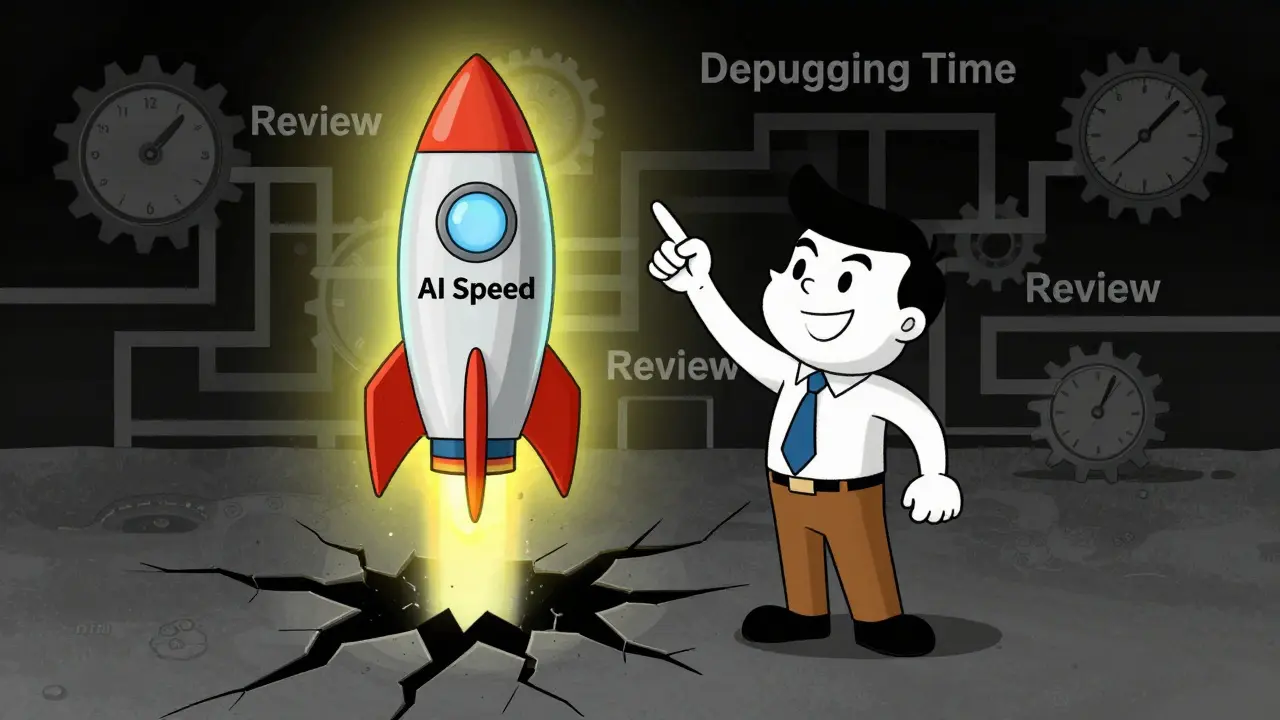
Here’s where the numbers get tricky. If 74% of developers say they’re more productive, why do some projects still miss deadlines? The answer lies in the difference between perception and measured performance. Developers *feel* faster because the typing is done for them. But feeling fast isn’t the same as shipping fast.
A randomized controlled trial by METR in July 2025 provides a stark example. They tracked 16 experienced open-source developers completing 246 real-world tasks. The developers predicted AI would reduce their completion time by 24%. Instead, their actual completion time increased by 19%. That’s a 39-point gap between expectation and reality. The AI generated code quickly, but the developers spent significantly more time reviewing, correcting, and integrating that code than they would have spent writing it themselves.
This slowdown is most pronounced in complex scenarios. Vibe coding excels at greenfield development-building new, simple features from scratch. Stanford University’s study found an 87% success rate for low-complexity tasks. However, when dealing with brownfield applications (existing, complex codebases), the success rate drops to 42%. Debugging AI-generated code in a legacy system can take 2.7 times longer than original development, according to IBM case studies. The AI doesn’t understand the hidden dependencies or business logic embedded in years of prior work; it only sees the text you feed it.
Context Engineering: The New Core Skill
If vibe coding is the tool, context engineering is the craft. The biggest limitation of LLMs is their context window. Performance degrades significantly as the input grows. Stanford analysis shows that accuracy drops from 90% to approximately 50% when context windows exceed 32,000 tokens. Dumping your entire codebase into a prompt doesn’t work. It confuses the model and leads to generic, often incorrect solutions.
Effective vibe coders practice selective context injection. They provide only the relevant files, functions, and error messages needed for the specific task. Developers who master this technique see 35% productivity gains, compared to just 12% for those who rely on broad, unstructured prompts. This requires a shift in mindset. You stop thinking like a writer and start thinking like an architect, defining boundaries and constraints clearly.
IBM’s internal training program highlights this. Engineers who complete a 32-hour "Context Engineering" certification ship 28% more AI-generated code with 40% fewer defects. The key is treating the AI as a pair programmer who needs precise instructions, not a magic wand. Tools like IBM Bob’s "Literate Coding" mode help by allowing developers to review AI-generated changes before they are applied, reducing the cognitive load of understanding machine-written code.
Language Matters: Not All Code Is Equal
Your choice of programming language significantly impacts how well vibe coding works for you. LLMs are trained on vast datasets of public code, but those datasets aren’t uniform. Popular languages like JavaScript and Python have massive amounts of training data, resulting in higher quality AI suggestions. Developers using these languages report 35-40% productivity gains.
In contrast, legacy languages like COBOL or niche frameworks have far less representation in training sets. For these, productivity improvements hover around 8-12%. The AI struggles to find patterns, leading to more hallucinations and syntactically correct but logically flawed code. If you’re working on modernizing a legacy system, don’t expect the AI to carry the load. It will likely require more human oversight than a standard web app project.
This dependency also affects debugging. AI-generated code in popular languages tends to follow common conventions, making it easier for other humans to read. In less common languages, the AI might produce obscure or non-standard solutions that confuse the rest of the team. Always consider maintainability when choosing to accept AI suggestions.

The Technical Debt Trap
The most dangerous aspect of vibe coding isn’t that it’s slow; it’s that it’s easy to create bad code quickly. When you accept AI suggestions without deep scrutiny, you accumulate technical debt. Experienced engineers now report reviewing 37% more code than pre-AI eras, yet struggle to maintain quality standards when 30-50% of that code is machine-generated.
CTOs are increasingly worried about this. A TechRepublic survey found that 43% of CTOs are concerned about the maintainability of AI-generated codebases beyond a three-year horizon. Code written by AI often lacks comments, clear structure, or alignment with broader architectural goals. It solves the immediate problem but may break future ones. To mitigate this, 67% of adopting companies have implemented mandatory AI code audits. These reviews focus not just on functionality, but on readability and long-term sustainability.
Regulatory bodies are catching up too. The EU’s AI Office released draft guidelines in July 2025 requiring "meaningful human review" of AI-generated code for critical systems. This signals a shift from viewing AI as a replacement to viewing it as an amplifier that requires strict governance. You can’t just paste and pray. You need processes.
How to Adopt Vibe Coding Successfully
If you want to join the 74% who see genuine gains, you need a strategy. Here’s how top-performing teams are integrating vibe coding without falling into the productivity trap:
- Start with Greenfield Tasks: Use AI for boilerplate, CRUD operations, and test scaffolding. These are low-risk, high-reward areas where AI shines. Avoid using it for core algorithm design or complex integrations initially.
- Invest in Context Training: Teach your team how to manage context windows. Show them how to extract relevant snippets rather than pasting whole files. This single change can double your effectiveness.
- Mandate Human Review: Implement a policy where no AI-generated code merges without a senior engineer’s sign-off. Focus reviews on logic flow and security, not just syntax.
- Monitor Debugging Time: Track how much time is spent fixing AI-introduced bugs. If debugging time exceeds the time saved in generation, pause and recalibrate your prompting strategy.
- Use Specialized Tools: Leverage platforms like GitHub Copilot, Amazon CodeWhisperer, or IBM Bob that offer features like literate coding or inline verification. Don’t rely solely on chat-based interfaces.
Remember, the goal isn’t to let the AI write your software. The goal is to use the AI to remove the friction of repetitive tasks, freeing you to focus on architecture, user experience, and complex problem-solving. When used correctly, vibe coding transforms you from a typist into a director.
What exactly is vibe coding?
Vibe coding is a development approach where programmers use natural language prompts to instruct large language models (LLMs) to generate code. Coined by Andrej Karpathy, it shifts the focus from writing syntax to directing AI agents through conversation, iteration, and copy-pasting verified outputs.
Is the 74% productivity gain statistic accurate?
The 74% figure represents self-reported perceptions of productivity among developers. However, independent studies like the METR trial show a significant gap between perception and reality, with some developers experiencing slowdowns due to increased debugging and review times. The gain is real for skilled users in specific contexts, but not universal.
Which developers benefit most from AI coding assistants?
Senior developers with 10+ years of experience benefit the most. They possess the necessary mental models to verify AI output, spot errors, and integrate generated code efficiently. Junior developers often struggle with debugging AI-generated code, which can hinder their learning and slow down delivery.
Why does vibe coding fail in legacy systems?
LLMs lack deep understanding of complex, existing codebases (brownfield environments). They operate based on pattern matching within limited context windows. In legacy systems, hidden dependencies and business logic cause AI suggestions to be logically flawed, leading to extensive debugging efforts that outweigh initial time savings.
What is context engineering?
Context engineering is the skill of providing optimal, concise inputs to an AI model. Instead of dumping entire codebases, developers selectively inject relevant files, functions, and error messages. This improves AI accuracy and reduces hallucinations, leading to higher quality code generation.
Does vibe coding increase technical debt?
Yes, if not managed properly. AI-generated code can be syntactically correct but logically fragile or poorly structured. Without rigorous human review and testing, teams accumulate technical debt that becomes difficult to maintain over time. Mandatory code audits and senior oversight are essential mitigations.
Are there regulatory requirements for AI-generated code?
Emerging regulations, such as the EU AI Office’s draft guidelines from July 2025, require meaningful human review of AI-generated code for critical systems. This ensures accountability and safety, preventing full automation of high-stakes software components.
Which programming languages work best with vibe coding?
Popular languages like JavaScript and Python perform best due to larger training datasets, offering 35-40% productivity gains. Legacy or niche languages like COBOL show minimal improvement (8-12%) because the AI has less reference material to draw from, resulting in lower quality suggestions.