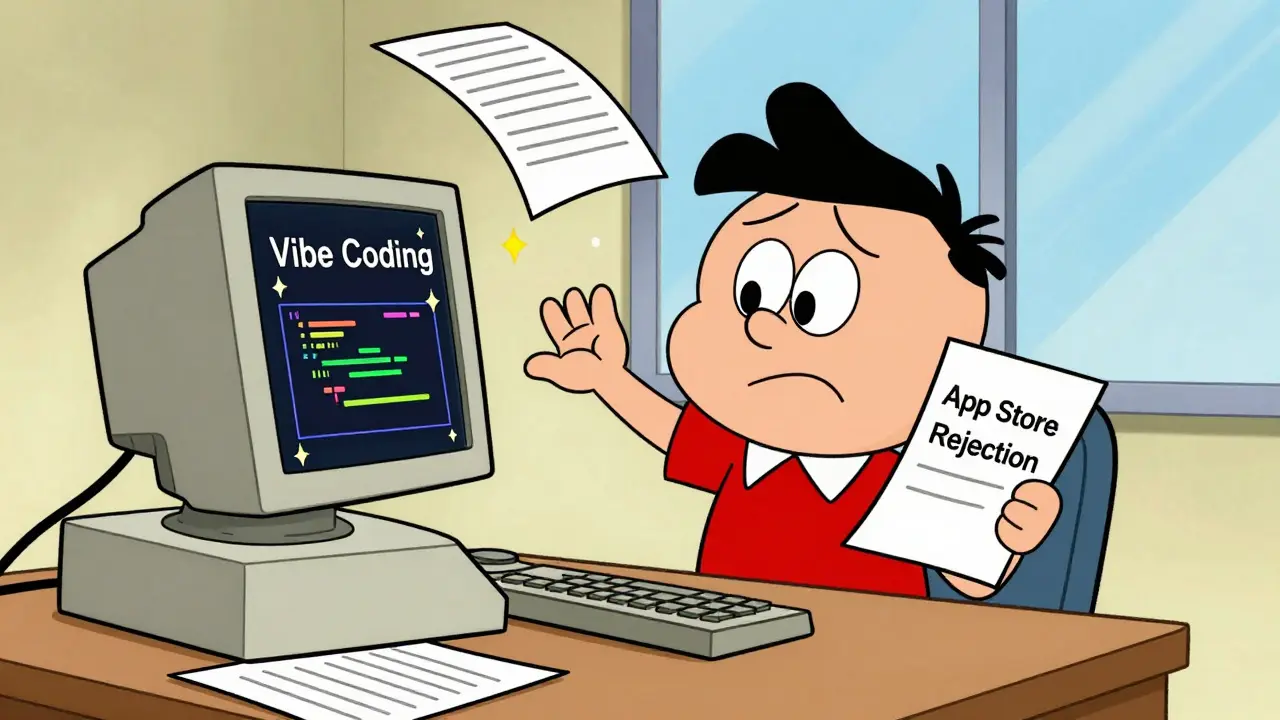
You built your app in an afternoon using Vibe Coding platforms like Vibecode or Vibe Coding AI. The code works. The UI looks great. But when you hit 'Submit' on the App Store or Google Play, you get a rejection email. Not because of bugs, but because your legal paperwork is missing or generic.
This is the hidden tax of democratized development. While tools like Vibe Coding lower the barrier to entry for building software, they create a massive gap in legal compliance. You can’t just copy-paste a template from 2019. The rules have changed, especially regarding how AI processes user data. If you want your app to stay online, you need to understand exactly what your Vibe platform does with your users’ information and reflect that in your documents.
The Compliance Gap in AI-Generated Apps
Let’s be clear about one thing: Vibe Coding platforms generate code, not law. When you use a tool like Vibecode App Builder, you are getting React Native code generated by an AI model. That code might collect emails, process payments, or track analytics. The platform gives you the engine, but it doesn’t automatically write the manual that tells regulators and users how that engine respects their rights.
Many developers assume that because the code is theirs, the legal responsibility ends there. It doesn’t. In fact, it gets more complex. According to data from MobileDevHQ in 2024, roughly 68% of apps submitted with generic, AI-generated privacy policies were rejected by major app stores. Why? Because those policies didn’t mention the specific third-party services-or the AI training practices-actually embedded in the app.
If your app collects personal data, such as login credentials or payment info, you legally need a privacy policy. But if that app was built on a Vibe platform, your policy must also disclose how the underlying AI infrastructure interacts with that data. Ignoring this link is the fastest way to get banned from the Apple App Store or Google Play Store.
What Vibe Platforms Do With User Data
To write a compliant policy, you first need to know what the platform itself is doing. Let’s look at the specifics, because vague statements like "we value your privacy" won’t cut it anymore under regulations like the GDPR or the EU AI Act.
Vibe Coding AI, for instance, collects account information (email, username), profile details, and technical data like IP addresses. More importantly, it logs your "Code Queries" and "Interaction Data." This means every prompt you type to generate code is stored and analyzed. Their privacy policy, effective January 1, 2025, states they use encryption for data in transit and at rest. That’s good news for security, but it doesn’t absolve you from telling your end-users that their inputs are being processed by a third-party AI service.
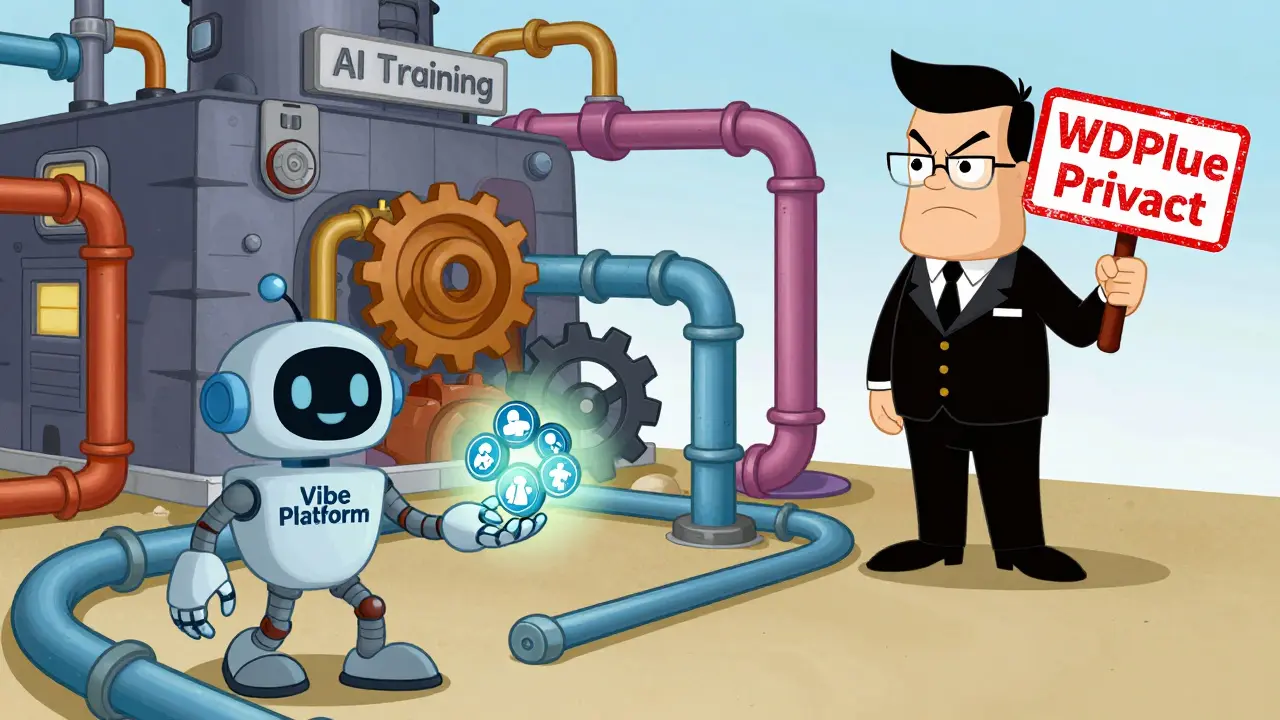
Then there is the issue of intellectual property and training rights. Vibecode’s Terms of Service include a clause that grants them a "non-exclusive, perpetual, transferable... license to use, process, store, and analyze your User Content" for AI training purposes. Crucially, they state that once content is submitted, the effects on AI training are "permanent and irreversible."
This is where most developers stumble. Your app’s privacy policy must disclose this reality. If your users enter sensitive data into your app, and that data flows through a Vibe-powered backend that trains AI models permanently, you need to say so. Hiding this violates transparency requirements in the EU and California.
| Platform Feature | Data Collected/Used | Required Disclosure in Your Policy |
|---|---|---|
| Code Generation (Vibe Coding AI) | Code queries, interaction logs, IP addresses | Third-party processing for AI assistance; data retention periods |
| App Building (Vibecode) | User content submitted for generation | Irreversible AI training usage; perpetual license grant |
| Analytics Integration | Emails, device specs, usage patterns | Purpose of collection; legal basis (consent vs. legitimate interest) |
| Security Measures | Encrypted data storage | Technical safeguards employed to protect user data |
Why Generic Templates Fail in 2026
You might be tempted to use a free online generator or ask ChatGPT to "write me a privacy policy." Stop. Marco Vito Moscaritolo, President of the European Association of Consumer Organizations (BEUC), warned in February 2025 that generic AI-generated policies frequently fail to meet GDPR Articles 13-14. These articles require specific details about data processing purposes and legal bases.
A generic template will say, "We may share data with partners." A compliant policy for a Vibe-coded app must say, "We use Vibecode’s API, which retains a perpetual license to train its AI models on user inputs. This process is irreversible." See the difference? One is fluff; the other is factual and transparent.
The regulatory landscape has tightened significantly. The EU AI Act, fully effective since February 2025, demands explicit disclosures for AI systems. Apple updated its App Store guidelines in June 2025 to mandate explicit disclosure of "AI training practices using user content." Google followed suit in April 2025. If your policy doesn’t address these specific mechanisms, your app gets rejected. Period.
Furthermore, the California Privacy Protection Agency issued enforcement guidance in February 2025 stating that permanently incorporated user data cannot rely on opt-out mechanisms but requires explicit opt-in consent. Since Vibecode’s training effects are "permanent," you likely need active consent from your users before their data touches that system. A cookie banner isn’t enough; you need a clear, affirmative action.
How to Build Compliant Policies for Vibe Apps
So, how do you fix this without hiring a $500/hour lawyer? You need specialized tools that understand the nuance of AI compliance. Services like iubenda have adapted to this shift. Unlike static generators, iubenda asks specific questions about your tech stack. Did you use Vibecode? Does your app collect emails? Do you use analytics?
Here is a step-by-step approach to getting your legal docs right:
- Map Your Data Flows: Before writing anything, list every piece of data your app collects. Email? Location? Payment info? Then, trace where it goes. Does it go to Stripe? Firebase? Vibecode’s servers? You need to know this.
- Identify Third-Party Processors: List every external service. If you used Vibecode to build the frontend, is it still calling their APIs? If yes, they are a processor. Include them in your vendor list.
- Address AI Training Explicitly: Create a dedicated section for "AI and Machine Learning." State clearly if user inputs contribute to model training. If using Vibecode, acknowledge the perpetual license and irreversible nature of this training.
- Implement Consent Mechanisms: For users in the EU and California, implement a consent manager that allows users to opt-in to AI training data usage if required by local law. Don’t bury this in fine print.
- Use a Dynamic Generator: Use a tool like iubenda’s AI Compliance Module (launched March 2025). It automatically generates sections addressing irreversible data usage. Update your policy whenever you add new features or change providers.
Developers who combined Vibe platforms with dedicated compliance tools reported smoother launches. On Capterra, user 'MobileDevPro99' noted in January 2025 that iubenda specifically asks about Vibe-related data processing, catching issues that generic generators miss.
Risks of Non-Compliance
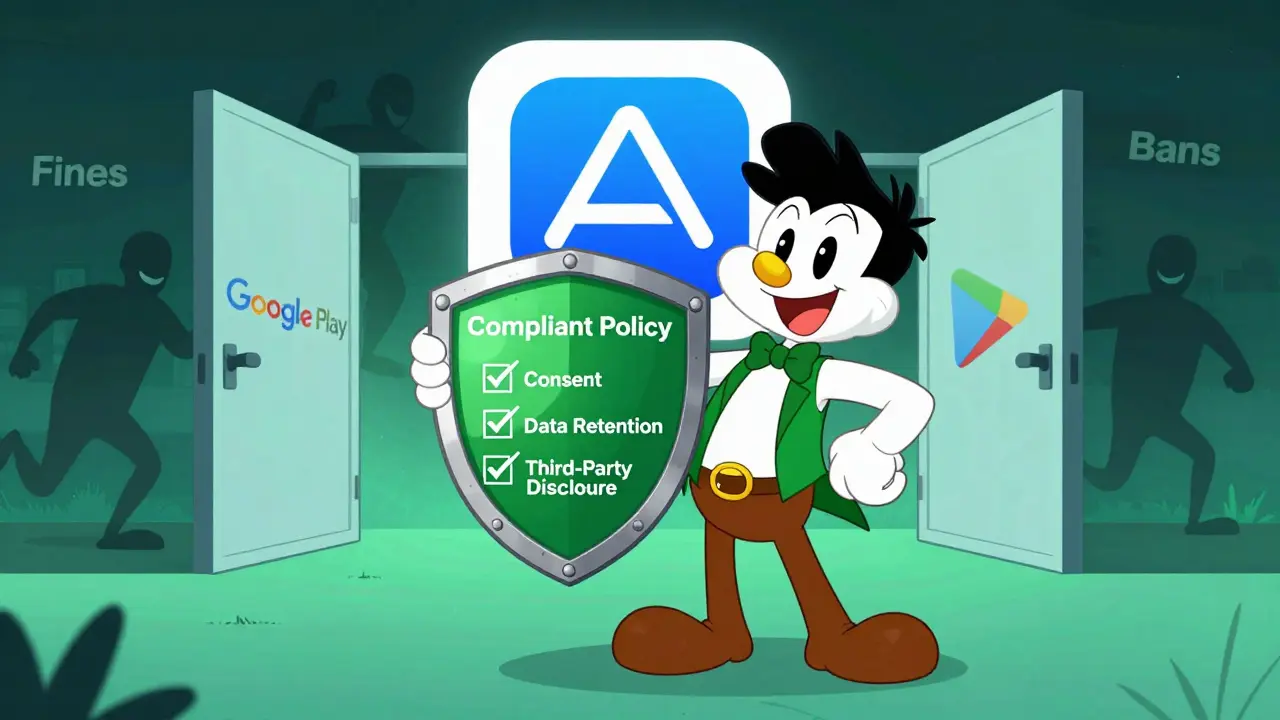
The stakes are higher than just a rejected app. Here is what happens when you ignore these rules:
- App Store Bans: Apple and Google will suspend your developer account if you repeatedly submit non-compliant metadata. This kills your distribution channel instantly.
- Regulatory Fines: Under GDPR, fines can reach up to 4% of global annual turnover. The CPPA in California can impose penalties of up to $7,500 per intentional violation. If you’re processing data without proper consent for AI training, you are vulnerable.
- User Trust Erosion: Users are smarter than we think. If they read a blog post about "hidden AI training" and then check your policy and see silence, they will delete your app. Transparency builds loyalty; secrecy destroys it.
- Intellectual Property Disputes: Vibecode’s ToS notes they "cannot make any guarantees about your ability to own any code created" due to varying jurisdiction laws. If your policy doesn’t clarify ownership and licensing, you risk disputes with enterprise clients who demand clean IP chains.
Best Practices for 2026 and Beyond
As we move deeper into 2026, the expectation is no longer just compliance-it’s clarity. Here are three pro tips to keep your Vibe-coded app safe:
1. Treat Your Policy as Living Documentation. Your app changes. Your dependencies change. Vibecoding.build updated its privacy policy in July 2025 to add sections on "how AI affects your privacy." You should review your own policy quarterly. If you switch from Vibecode to a different framework, update your vendors list immediately.
2. Be Specific About Retention. Don’t say "we keep data indefinitely." Say "we retain user logs for 90 days for debugging, after which they are anonymized." Vibe Coding AI’s policy specifies data retention periods; mirror that specificity in your own docs. Users want to know when their data disappears.
3. Educate Your Users. Add a plain-language summary at the top of your privacy policy. Explain *why* you need data. "We use AI to help you [function], which requires sending inputs to our provider. You can opt out here." This reduces support tickets and builds trust.
The democratization of coding is real. You don’t need to be a senior engineer to build a product. But you do need to be a responsible steward of your users’ data. By treating your Terms of Service and Privacy Policy with the same care as your codebase, you ensure your app survives the gatekeepers and earns the trust of your audience.
Do I need a separate privacy policy if I use Vibe Coding to build my app?
Yes. Even though Vibe Coding generates the code, you are the data controller for your application. You must provide a privacy policy that discloses how your app collects, uses, and shares user data, including any data sent to Vibe Coding’s servers for AI processing.
Can I use a generic AI-generated privacy policy for my Vibe-coded app?
It is highly risky. Generic policies often fail to mention specific third-party processors like Vibecode or Vibe Coding AI. App stores like Apple and Google reject apps with non-specific policies, and regulators like the BEUC flag them for lacking GDPR-required details on AI training and data retention.
Does Vibecode own the code it generates for me?
Vibecode’s Terms of Service state that you own the Created Apps, but they retain a perpetual, irrevocable license to use your input data for AI training. They also note that copyright laws vary by jurisdiction, so they cannot guarantee full ownership of AI-generated code. Your privacy policy should reflect this complexity.
How do I comply with the EU AI Act when using Vibe platforms?
The EU AI Act requires transparency about AI systems. You must disclose that your app uses AI components, explain how user data is processed by these components, and provide clear opt-in mechanisms for any data used in training, especially if the training effects are irreversible as stated in Vibecode’s terms.
What happens if my app is rejected for privacy policy issues?
You will receive a rejection notice from the App Store or Google Play. You must revise your policy to explicitly mention all data collectors, including Vibe platforms, and resubmit. Repeated rejections can lead to account suspension. Using a specialized generator like iubenda can help avoid this by ensuring all necessary disclosures are included upfront.