You just bought a subscription to a shiny new vibe coding platform that turns natural language into working code using large language models. The demos were slick. Your developers are thrilled. But here is the catch nobody talks about in the sales pitch: you don't actually own the logic behind the magic. You are renting intelligence from a third-party Model Provider, and if they change their mind, your application might break overnight.
This isn't hypothetical. In late 2024, a fintech startup faced $450k in remediation costs because their vibe coding vendor swapped underlying AI models without warning, breaking critical compliance features. Traditional software vendor management doesn't cut it here. When the "code" is generated dynamically by an opaque AI model, standard SLAs regarding uptime or bug fixes miss the real risk: model drift, version deprecation, and governance gaps. If you are managing vendors for platforms like ServiceNow Build Agent, Salesforce Agentforce Vibes, or OutSystems, you need a new playbook. This guide breaks down exactly how to manage these relationships so you don't end up with a black box you can't control.
Why Traditional Vendor Management Fails for Vibe Coding
In classic SaaS procurement, you check for SOC 2 compliance, data residency, and maybe API rate limits. Done. With vibe coding, the product is fluid. The output depends entirely on the specific version of the Large Language Model (LLM) running under the hood. If the vendor updates their base model from GPT-4-turbo to a newer iteration, the way it interprets your prompts-and thus the code it generates-can shift subtly but significantly.
Dr. Elena Rodriguez, Director of MIT’s AI Governance Lab, points out that "vibe coding platforms introduce unique governance challenges requiring specialized vendor management protocols due to the dynamic nature of AI-generated code which evolves with each model update." This means your vendor contract needs clauses that traditional software agreements lack. You aren't just buying access to a tool; you are buying predictability from a probabilistic system. Without strict controls, you face "governance theater," where vendors claim enterprise-grade security while audit trails remain incomplete and role-based access fails under load, as noted in recent analyses by Constellation Research.
The Big Three: Evaluating Major Vibe Coding Platforms
Not all platforms treat governance equally. Some prioritize developer speed over enterprise control, while others build governance into the core architecture. Here is how the market leaders stack up when viewed through a vendor management lens.
| Platform | Governance Rating | Code Ownership | Key Risk Factor | Approx. Cost Model |
|---|---|---|---|---|
| ServiceNow | High (Built-in) | Platform-bound | Lock-in to Now Assist ecosystem | $100/user/mo (min 100 users) |
| Salesforce | Medium-High | MCP-compatible | Complexity in non-Salesforce integrations | $125/user/mo (min 50 users) |
| OutSystems | Very High (5/5) | Exportable | High support costs ($150k+/yr) | $1,200/app/mo + support |
| Betty Blocks | High (4.5/5) | Fully Exportable | Smaller ecosystem | Custom Enterprise Pricing |
| Retool | Medium (3/5) | Internal Tools Focus | Limited regulated industry support | Usage-based tiers |
ServiceNow ranks #1 in Gartner's Critical Capabilities for building AI agents, largely because they bake governance directly into the workflow. Their "Vendor Trust Scorecards" automatically track compliance, which is a huge win for procurement teams who hate manual audits. However, this convenience comes at the cost of flexibility. You are locked into their stack. If you want true independence, Betty Blocks offers fully exportable code, meaning if you leave the platform, you take the actual source code with you. That is a massive differentiator for long-term viability.
Negotiating Contracts: The Must-Have Clauses
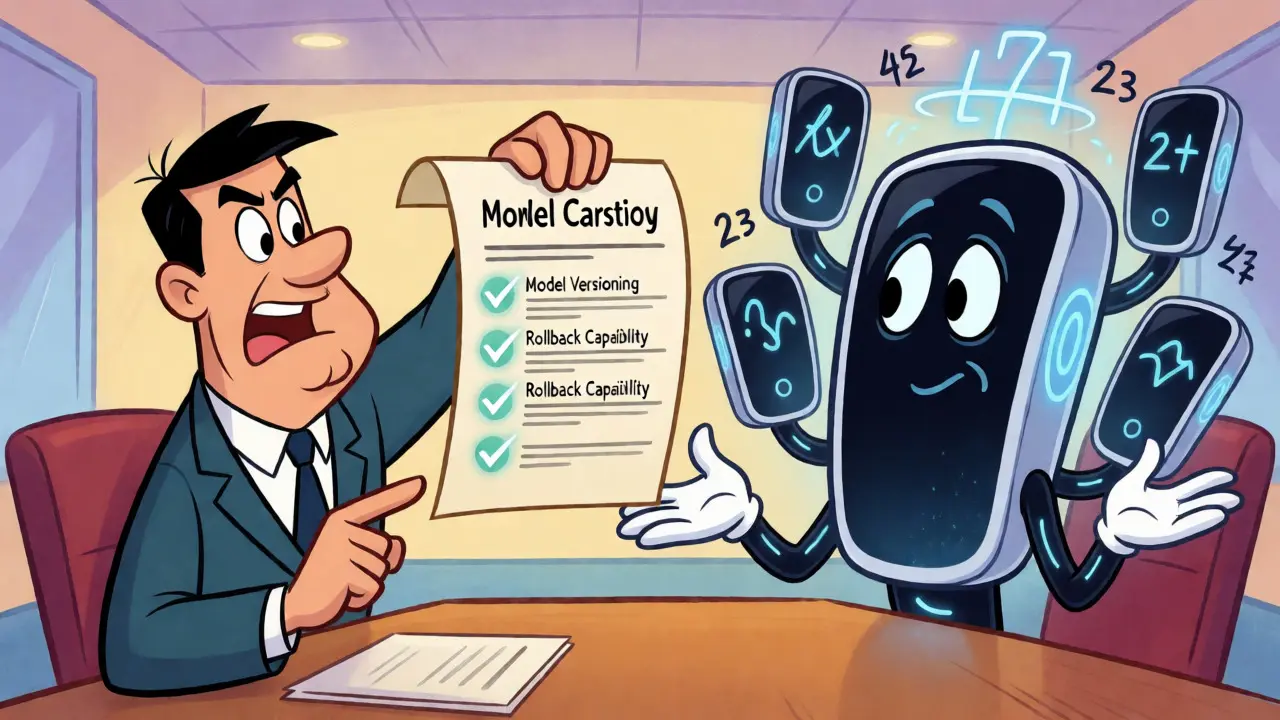
Don't let legal use their standard SaaS template. You need specific protections for AI-driven development. Based on best practices from J.P. Morgan’s internal case studies-which reduced vendor risk assessments from 45 days to 7 days-here are the non-negotiables:
- Model Versioning Transparency: Require the vendor to disclose which specific LLM versions are used for generation. If they switch from Model A to Model B, you need a notification period of at least 14 days (industry average) before the change affects production.
- Emergency Rollback Capability: What happens if the new model hallucinates badly? Your contract must guarantee the ability to revert to the previous stable model version within four hours. No exceptions.
- Governance Evidence Availability: Demand quarterly reports proving that role-based access controls (RBAC) and audit logs are functioning correctly. Don't trust their marketing slide; ask for raw log samples.
- Data Provenance Documentation: Especially for EU operations, you need proof of training data provenance. PwC surveys show 72% of vendors couldn't provide this during Q3 2025 audits. Make it a contractual obligation, not a nice-to-have.
Also, watch out for the "concurrent build-and-sell" trap. J.P. Morgan warns that startups using vibe coding often underestimate capital needs by 30-40% because they assume AI will handle everything. Ensure your vendor supports scaling. A tool that works for a 10-person team often crumbles when rolled out to 1,000 employees. Tibco’s analysis highlights that integration with existing ERPs and CRMs is rarely seamless in vibe-coded projects unless explicitly architected for it.
Security and Compliance: Beyond the Checkbox
Vibe coding tools generate code at unprecedented speed, but that speed introduces new attack surfaces. Legit Security’s 2025 analysis warns that automated security scanning must be integrated directly into the AI generation pipeline. It’s not enough to scan the final app; you need to know if the AI injected vulnerable libraries or insecure patterns during generation.
Salesforce, for instance, integrates Salesforce Code Analyzer directly into their Agentforce Vibes IDE. This allows for real-time inline suggestions and security checks. Compare this to platforms that rely on post-generation scans. The latter approach leaves a window where bad code sits in your repository unflagged. For regulated industries like healthcare or finance, this gap is unacceptable. Retool, while flexible, scores lower on governance for these sectors because its security capabilities are often deemed insufficient for strict compliance regimes without heavy customization.
Furthermore, consider the human factor. Who owns the prompt? If a junior developer writes a vague prompt and the AI generates inefficient or insecure code, who is responsible? Your vendor management strategy should include defining internal standards for prompt engineering and code review, even if the code is "AI-generated." Treat AI output like junior developer output: it requires review, testing, and approval.

Operationalizing Vendor Management
Setting up this framework takes time. Forrester benchmarks suggest 8-12 weeks of dedicated effort to establish effective vendor management for vibe coding platforms. You need staff who understand both procurement and machine learning concepts. A generic IT procurement officer won't spot the risks in a model deprecation notice.
Create a Centralized Vendor Directory specifically for AI tools. Track fields like "AI Model Versioning Schedule," "Governance Evidence Availability," and "Emergency Model Rollback Procedures." Use scorecards to monitor performance. Key metrics to track include:
- Model Change Notification Lead Time: Target >14 days.
- Governance Evidence Completeness: Target >95%.
- Support Response Time for Priority Issues: Industry median is 18.7 hours; aim for <8 hours.
- Documentation Quality: Check if model changes are documented clearly. ServiceNow scores high here (4.2/5), while some competitors lag (2.8/5).
Consider joining consortiums. The Financial Services Vibe Coding Consortium reported a 35% reduction in vendor management costs by sharing assessment frameworks. Instead of every bank negotiating the same governance clauses, they pool resources to define standards that vendors must meet. This shifts power dynamics in favor of the buyer.
Future-Proofing Your Strategy
The market is consolidating. Gartner predicts only 3-4 dominant vibe coding platform vendors will survive by 2027. Niche players focusing on vertical-specific governance will thrive, but generalists may struggle. By 2027, 75% of enterprise contracts will likely include specific AI model versioning requirements. If you wait until then to fix your contracts, you'll be playing catch-up.
J.P. Morgan also warns that vendors without sustainable enterprise-grade governance models could see 40-60% customer churn by 2026. Organizations are shifting priority from initial development speed to long-term operational sustainability. Don't choose a vendor just because they make coding fast. Choose them because they make coding safe, auditable, and reversible.
What is the biggest risk in vibe coding vendor management?
The biggest risk is "model drift" or unexpected model updates by the vendor. Since vibe coding relies on Large Language Models (LLMs), a change in the underlying model version can alter how code is generated, potentially breaking existing applications or introducing subtle bugs without any change to your source code or prompts.
Do I own the code generated by vibe coding platforms?
It depends on the vendor. Platforms like Betty Blocks offer fully exportable code, giving you complete ownership. Others, like ServiceNow or Salesforce, may tie the code more closely to their proprietary runtime environments or require additional steps to extract and maintain it independently. Always verify the code export and maintenance rights in your contract.
How do I ensure security in vibe coding?
Ensure the vendor provides automated security scanning integrated directly into the AI generation pipeline, not just after deployment. Look for features like real-time inline code suggestions with security flags (e.g., Salesforce Code Analyzer) and robust Role-Based Access Controls (RBAC). Regularly audit logs to verify that governance controls are functioning as promised.
What should be in a vibe coding vendor contract?
Include clauses for model versioning transparency (notification periods for model changes), emergency rollback capabilities (ability to revert to previous model versions quickly), governance evidence availability (regular audit reports), and data provenance documentation (especially for regulatory compliance like the EU AI Act).
Is vibe coding suitable for regulated industries?
Yes, but with caution. Platforms like OutSystems and ServiceNow offer strong governance features suitable for regulated environments. However, you must ensure the vendor can provide detailed audit trails and comply with regulations like HIPAA or GDPR. Avoid platforms with weak governance ratings (like Retool for strict compliance) unless heavily customized.