
You are staring at your cloud bill from last month. It hurts. You’re paying premium rates for every token, even the simple ones like "summarize this paragraph" or "extract this date." Meanwhile, you have a powerful GPU sitting in your server rack (or under your desk) doing nothing but idle heat generation. This is the classic dilemma of modern AI engineering: do you sacrifice privacy and cost efficiency for the raw power of commercial APIs, or do you accept lower performance to keep data local?
What if you didn’t have to choose? Hybrid LLM architectures are systems that dynamically route requests between self-hosted open-source models and commercial cloud APIs based on task complexity, sensitivity, and cost. This approach isn't just a buzzword; it’s becoming the standard for production-grade AI applications in 2026. By combining the speed and privacy of local inference with the reasoning depth of frontier models, you can cut compute costs by up to 40% while keeping sensitive data on-premises.
The Core Problem with Single-Tier Systems
Most developers start with one extreme. They either build everything on top of an API like OpenAI GPT-4o or Anthropic Claude, or they try to squeeze a massive model like Llama 3 70B onto a single consumer GPU. Both paths lead to pain points.
Pure API usage is expensive and slow for high-volume tasks. If your app processes thousands of short queries a day, those per-token fees stack up fast. Plus, sending proprietary customer data to a third-party vendor raises compliance red flags, especially in healthcare or finance. On the flip side, pure local setups often hit a wall when users ask complex questions requiring deep reasoning. Your local 7B parameter model might hallucinate or fail to follow nuanced instructions, frustrating users who expect the intelligence level of a frontier model.
A hybrid system solves this by treating these not as competitors, but as complementary tiers. Think of it like a hospital triage system. Minor cuts get treated quickly by a nurse practitioner (your local model), while complex surgeries go to a specialist surgeon (the cloud API). The goal is to send the right workload to the right engine.
Anatomy of a Hybrid Stack
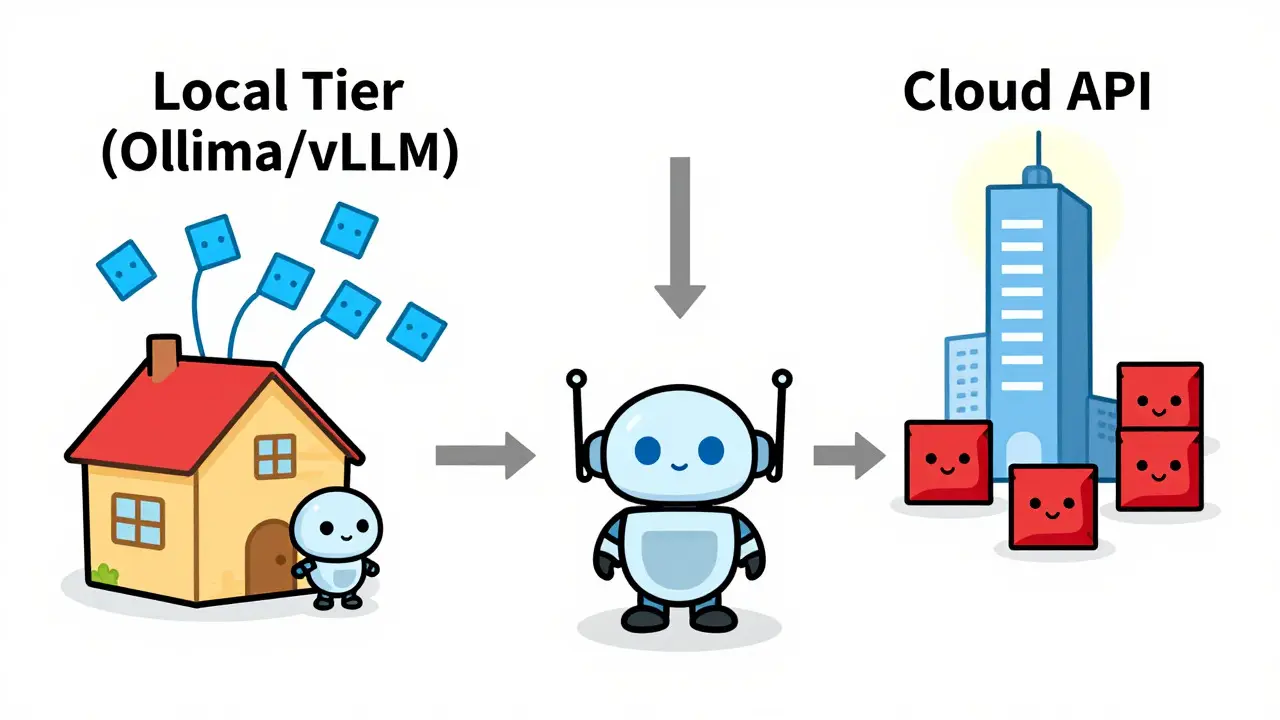
To make this work, you need three distinct layers working in harmony. You can’t just hard-code `if else` statements in your application logic because that creates tight coupling and maintenance nightmares. Instead, successful implementations use a unified gateway pattern.
- The Local Tier: This is where your open-source runtimes live. Tools like Ollama, vLLM, and llama.cpp serve as the backbone here. They expose OpenAI-compatible APIs, meaning your existing code doesn’t need major rewrites to talk to them. For most startups, Ollama is the easiest entry point due to its simplicity, while vLLM is preferred for high-throughput production environments.
- The Cloud Tier: These are your heavy hitters-OpenAI GPT-4o, Anthropic Claude Sonnet, or Microsoft Copilot. You reserve these for tasks that require long context windows, complex logical deduction, or creative nuance that smaller local models struggle with.
- The Routing Layer: This is the brain of the operation. A tool like LiteLLM acts as a proxy. It receives all incoming requests, analyzes them, and decides whether to forward them to the local backend or the cloud API. This layer handles authentication, logging, and fallback logic.
By standardizing on the OpenAI JSON schema across both tiers, you achieve true interoperability. Your frontend application thinks it’s talking to one endpoint. It doesn’t know-or care-that half the requests were processed locally on a Mac Studio and the other half went to a data center in Virginia.
How Smart Routing Actually Works
The magic happens in the router. But don’t overengineer it immediately. Many teams try to build complex machine-learning classifiers to decide which model to use. Resist that urge. Start with rule-based routing.
Research from production deployments shows that simple heuristics handle about 90% of decisions correctly in the early stages. Here are the three primary dimensions you should evaluate for each request:
- Data Sensitivity: Does the prompt contain PII (Personally Identifiable Information)? If yes, force it to the local tier regardless of complexity. Privacy is non-negotiable.
- Task Complexity: Is this a simple extraction task ("find the email address") or a reasoning task ("analyze the sentiment and suggest a reply")? Simple tasks go local; complex ones go to the cloud.
- Token Count & Latency: Short prompts benefit from low-latency local inference. Long-context tasks might exceed your local VRAM limits, triggering an automatic spill-over to the cloud.
For example, a typical traffic split in a mature hybrid system looks like this: 85-95% of requests go to the local Ollama instance, handling summaries, formatting, and basic Q&A. Only 5-15% of the hardest queries hit the expensive cloud API. This ratio alone can slash your infrastructure bill significantly.
| Feature | Local Runtime (e.g., Ollama/vLLM) | Commercial API (e.g., GPT-4o/Claude) |
|---|---|---|
| Cost Structure | Fixed hardware cost + electricity. Near-zero marginal cost per token. | Pay-per-token. Costs scale linearly with usage. |
| Data Privacy | Data never leaves your infrastructure. Ideal for GDPR/HIPAA. | Data sent to third-party servers. Requires trust/compliance checks. |
| Latency | Low network latency, but depends on GPU speed. Can be faster for small models. | Network round-trip time adds overhead. Variable based on provider load. |
| Capability | Limited by model size and quantization. Struggles with complex reasoning. | State-of-the-art reasoning, coding, and creativity. |
| Maintenance | High. You manage updates, scaling, and hardware health. | Low. Provider manages uptime and upgrades. |
Choosing Your Open-Source Runtime
Not all local runtimes are created equal. Your choice depends heavily on your team’s expertise and deployment environment.
Ollama is an MIT-licensed tool that simplifies running large language models on macOS, Linux, and Windows. It’s the darling of the developer community for good reason. Installation is trivial (`curl | sh`), and it comes with pre-configured models. It exposes an OpenAI-compatible endpoint on port 11434 out of the box. For prototyping and mid-sized deployments, it’s unbeatable. However, it may not offer the same fine-grained control over batching and memory management as more specialized tools.
If you are serving thousands of concurrent users, look at vLLM. Built for high throughput, vLLM uses advanced techniques like PagedAttention to maximize GPU memory utilization. It typically runs on port 8000 and was designed from the ground up to support OpenAI-compatible APIs. While steeper in learning curve than Ollama, it’s essential for production-scale inference where every millisecond and megabyte counts.
Don’t ignore LM Studio for desktop-heavy workflows or NVIDIA Triton if you are already deep in the NVIDIA ecosystem. But for most hybrid stacks, Ollama and vLLM cover 90% of use cases.
Implementation Strategy: Start Simple, Then Scale
Trying to build the perfect hybrid router on day one is a recipe for burnout. Follow this phased approach used by successful teams in 2026:
Phase 1: The Static Rule Set
Deploy LiteLLM as your gateway. Configure two aliases: `local-model` pointing to your Ollama instance, and `cloud-model` pointing to Anthropic or OpenAI. Write a simple Python middleware that inspects the request body. If the prompt length is under 500 tokens and contains no keywords flagged as "complex," route to `local-model`. Otherwise, route to `cloud-model`. Log every decision to PostgreSQL. This gives you immediate cost visibility without complex logic.
Phase 2: Observability and Tuning
Once you have logs, analyze them. Are users complaining about quality on local responses? Tighten the rules. Are you still spending too much on cloud? Loosen the thresholds. Integrate Prometheus exporters to track GPU utilization and error rates. If your local GPU hits 90% utilization, automatically trigger a failover to the cloud to prevent timeouts. This dynamic threshold adjustment is key to maintaining reliability.
Phase 3: Intelligent Routing
After months of data, consider training a lightweight classifier to predict task complexity. Or, use a small local model (like Phi-3 or Gemma 2B) as a "router model" that analyzes the user query and outputs a label: `simple`, `medium`, or `hard`. This adds a slight latency penalty (under 5ms) but allows for much smarter distribution than static keyword matching.

Real-World Impact: Cost and Quality
Does this actually work? Case studies from late 2025 and early 2026 suggest yes. One notable implementation combined DeepSeek-7B locally with Microsoft Copilot via API. By offloading frequent, low-complexity tasks to the local model, they reduced GPU dependency and overall compute costs by approximately 40%. More importantly, they maintained a 91% data usability rate, proving that hybrid systems don’t necessarily compromise output quality if routed correctly.
Another factor is latency. Users hate waiting. Local inference eliminates network hops. In tests, routing decisions take less than 5 milliseconds. When 85% of your traffic is handled locally, your average response time drops significantly compared to a pure API setup, making your app feel snappier and more responsive.
Common Pitfalls to Avoid
Even with a solid plan, things can go wrong. Watch out for these traps:
- Ignoring Context Window Limits: Local models often have smaller context windows than cloud giants. If a user pastes a 50-page PDF, your local model might truncate it silently. Ensure your router detects oversized inputs and forces them to the cloud.
- Inconsistent Formatting: Even with OpenAI-compatible APIs, subtle differences in how models format JSON or markdown can break downstream parsers. Always validate outputs from both tiers before passing them to your frontend.
- Security Leaks in Logs: If you log full prompts for debugging, ensure you aren’t storing PII in plain text in your database. Anonymize or hash sensitive fields before writing to Postgres.
- Underestimating Maintenance: Running local models means managing CUDA drivers, model updates, and potential crashes. Budget time for DevOps tasks that would otherwise be invisible with a managed API.
Final Thoughts
Hybrid LLM architectures aren’t just a cost-saving hack; they are a strategic advantage. They allow you to balance the trade-offs between privacy, cost, and performance in a way that single-tier systems simply cannot match. As open-source models continue to improve-closing the gap with commercial offerings-the percentage of traffic you can safely route locally will only grow.
Start small. Pick a runtime, set up a router, and measure. You’ll likely find that your biggest savings come not from replacing the cloud entirely, but from using it sparingly and wisely.
Do I need a powerful GPU to run local models in a hybrid setup?
Not necessarily. For many hybrid setups, handling simple tasks requires only smaller models (7B parameters) which can run efficiently on consumer GPUs like an RTX 3090 or even Apple Silicon M-series chips. High-end GPUs are only needed if you plan to serve larger models (70B+) or handle high concurrency. Start with what you have and scale up as traffic demands.
Which open-source runtime is best for beginners?
Ollama is widely considered the best starting point due to its ease of installation and broad OS support. It abstracts away much of the complexity of CUDA and model loading. Once you are comfortable, you can migrate to vLLM for better performance and scalability in production environments.
How does routing affect application latency?
Routing itself adds minimal latency (typically under 5ms). However, the choice of backend matters. Local models eliminate network travel time, often resulting in faster responses for short prompts. Cloud APIs introduce network overhead but may process complex tasks faster due to superior hardware. The net effect usually improves average latency by reducing cloud calls for simple tasks.
Can I switch between different cloud providers easily?
Yes, this is one of the main benefits of using a gateway like LiteLLM. Because it standardizes requests into the OpenAI format, you can swap between OpenAI, Anthropic, Azure, or Google Gemini by changing configuration variables rather than rewriting code. This protects you from vendor lock-in.
What happens if my local server goes down?
A robust hybrid setup includes fallback mechanisms. If the local backend fails or times out, the router should automatically retry the request against the cloud API. This ensures high availability, though it will temporarily increase costs until the local service is restored.


It is truly inspiring to see how we are finally moving past the binary choice between cost and capability. I strongly encourage everyone reading this to view their current infrastructure not as a fixed state but as a garden that requires pruning and nurturing. By implementing these hybrid strategies you are essentially empowering your engineering team to focus on value rather than just budget management. Remember that every small step toward local inference is a victory for data sovereignty and long-term sustainability. Let us approach this transition with patience and an open heart knowing that the technology is evolving alongside our understanding of it.
Cool story. So basically we're just adding another layer of complexity to hide the fact that we can't afford GPT-5 yet. Love the 'triage' metaphor though very poetic for a stack overflow post.
hey all! i think its worth mentioning that while ollama is great for prototyping vLLM is where u really need to be if ur dealing w/ high concurrency. the paged attention stuff saves so much memory. also dont forget about quantization levels - using Q4_K_M instead of FP16 can make a huge diff in latency on consumer gpus. good write up tho!
I must express my profound concern regarding the operational risks outlined in the 'Common Pitfalls' section. Specifically, the issue of inconsistent formatting across different model tiers is often underestimated by junior developers. If one does not implement rigorous schema validation at the routing layer the downstream application will inevitably suffer from brittle parsing errors. It is imperative that teams treat the output standardization process with the same level of scrutiny as they do the input sanitization. Furthermore, the assumption that rule-based routing handles 90% of cases may prove overly optimistic in dynamic user environments where query intent shifts rapidly.
the router is just a fancy load balancer isn't it
we keep building layers to abstract away the pain of hardware limits
but maybe the real question is why we assume intelligence needs to be centralized or decentralized in such rigid ways
perhaps the hybrid nature is less about cost and more about resilience
letting the system breathe between local silence and cloud noise
i've been running a similar setup with LiteLLM and Ollama. the part about logging decisions to postgres was super helpful for me actually. helped me tune the thresholds way better than guessing. also yeah vLLM is definitely the move for prod once you get past the initial hump.