
You’ve probably heard the warning: adding more languages to your Large Language Model (LLM) makes it worse at all of them. It’s called the "curse of multilinguality," and for years, engineers treated it like a law of physics. If you wanted a model that spoke French well, you couldn’t also expect it to speak Swahili without sacrificing performance. But recent breakthroughs in multilingual data handling are breaking this rule. The truth is simpler-and more actionable-than we thought. You don’t have to choose between breadth and depth. You just need to fix how you allocate tokens.
This isn’t about magic algorithms or secret sauce. It’s about engineering discipline. When you build a pretraining pipeline today, especially with models hitting 1B to 3B parameters, the way you handle non-English data determines whether your model feels smart or scattered. Let’s look at what actually works when you’re juggling hundreds of languages, massive datasets like FineWeb-2, and tight compute budgets.
The Myth of the Curse: Why More Languages Don’t Always Mean Worse Performance
For a long time, the prevailing belief was that mixing English with low-resource languages diluted the signal. Engineers would see benchmarks drop and assume the model was confused by too many linguistic patterns. But comprehensive studies training 1.1B and 3B parameter models on corpora spanning 25 to 400+ languages proved this wrong. The key finding? Combining English with multilingual data does not degrade performance for either group, provided one critical condition is met: sufficient token representation.
Think of it like a buffet. If you put out 50 dishes but only give each person a tiny spoon, they’ll taste nothing properly. But if you adjust the portion sizes so everyone gets enough of what they want, satisfaction goes up across the board. In LLM terms, "sufficient token representation" means ensuring every language has enough presence in the training mix to learn its unique grammar and vocabulary. Once that threshold is crossed, the curse vanishes. In fact, at the 1B-3B scale, adding more languages often enhances generalization because the model learns abstract structural rules rather than memorizing specific word pairs.
| Strategy | Token Distribution | Performance Outcome | Risk Factor |
|---|---|---|---|
| Naive Mixing | Uniform sampling across all languages | Poor performance for low-resource languages; high-resource languages dominate | High resource waste on noisy data |
| Heuristic Balancing | Weighted by population size | Better coverage but still inefficient due to noise | Moderate; ignores data quality |
| Quality-Based Allocation | Weighted by filtered, high-quality token count | Optimal performance across diverse families | Low; requires robust filtering pipeline |
English as the Pivot: A Catalyst, Not Just Another Language
If you’re wondering which language gives you the best bang for your buck, the answer is usually English. Research shows that English acts as an effective "pivot language." This doesn’t mean English is linguistically superior. It means its sheer volume of high-quality, structured data provides a rich foundation for learning general language patterns. These patterns transfer surprisingly well to other languages, even those from completely different families.
Here’s the counter-intuitive part: picking a pivot language from within a specific family (like using Spanish to help train Portuguese) doesn’t consistently beat using English. Why? Because the benefits come from cross-lingual transfer mechanisms that rely on universal syntactic and semantic structures, not just lexical similarity. English’s dominance in web data means it offers clearer signals for these universal structures. So, if you’re building a multilingual model, keep English heavily represented. Use it as the anchor that stabilizes the training process while other languages attach themselves to those learned patterns.

Data Curation: Quality Beats Quantity Every Time
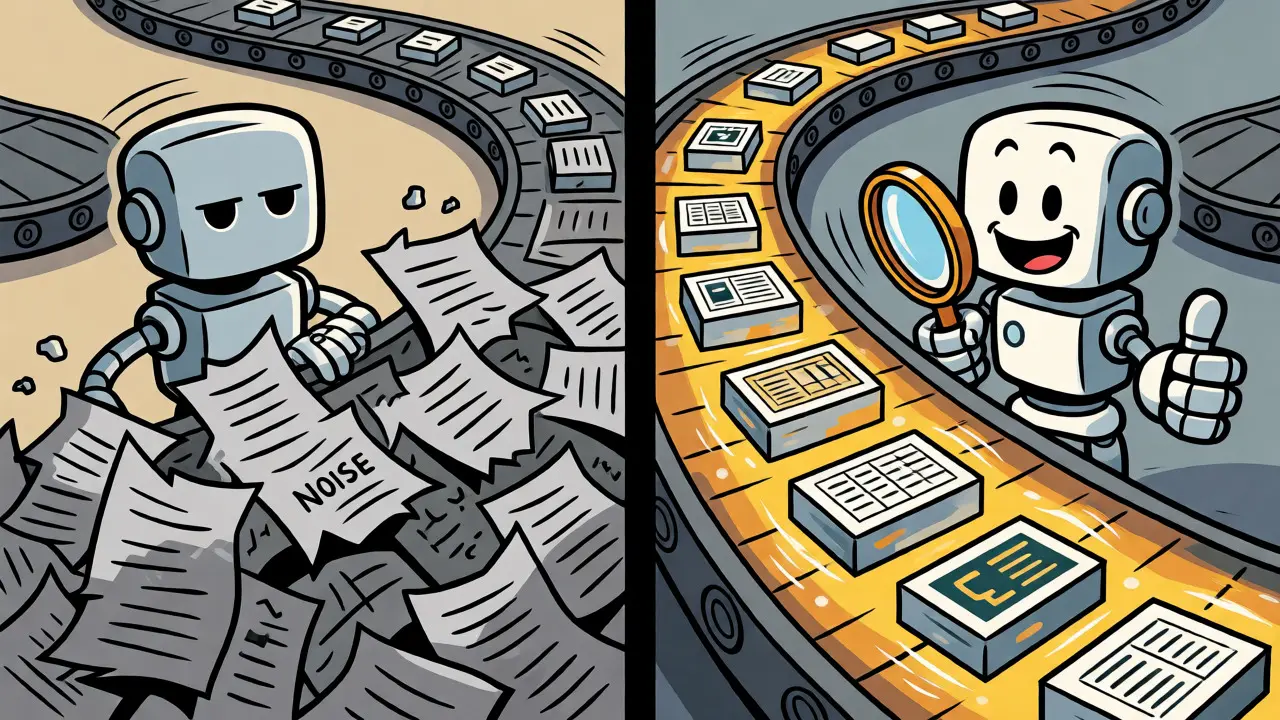
You can throw trillions of tokens at a model, but if half of them are spam, ads, or broken HTML, you’re wasting money. Traditional filtering methods relied on simple rules: remove short lines, check for duplicate URLs, strip out JavaScript. These work okay for English but fail miserably for other languages where scripts vary wildly and web content structures differ. For example, a rule that removes lines under 10 characters might accidentally delete valid sentences in Chinese or Japanese.
The solution is model-based filtering. Instead of rigid rules, use classifiers trained to identify "knowledge-rich" and "structured" data. Recent frameworks leveraging Transformer-based and FastText-based classifiers have shown remarkable efficiency. In ablation studies using the FineWeb-2 dataset, researchers achieved baseline MMLU scores with just 15% of the original training tokens. That’s an 85% reduction in compute costs for similar or better results.
- Structured Data Focus: Prioritize tables, lists, and code blocks. These contain dense information density compared to narrative prose.
- Diversity Sampling: Ensure the filtered set includes varied topics and writing styles, not just news articles.
- Transparency: Use open-source classifiers so you can audit why certain documents were kept or discarded.
This approach shifts the burden from raw scale to smart selection. You’re no longer asking, "How much data do I have?" You’re asking, "How much useful signal is in my data?"
Practical Implementation: From Scratch vs. Continual Pretraining
So, how do you actually implement this? There are two main paths, depending on your resources and existing assets.
Path 1: Pretrain from Scratch. This is the gold standard for maximum control. You start with a blank slate, define your tokenizer, and feed it your curated multilingual corpus. Tools like NVIDIA NeMo streamline this by offering workflows for tokenizer merging and architecture modification. You download base weights, customize the tokenizer to merge bilingual representations, and run continual pretraining. This path is expensive but yields the most balanced models.
Path 2: Continual Pretraining. If you already have a strong English-centric model (like GPT-1.3B or Llama), you don’t need to start over. You can perform continual pretraining on target language data. For instance, teams have successfully adapted English models for Thai by feeding them Thai Wikipedia data. This method is faster and cheaper but risks catastrophic forgetting if not managed carefully. You must balance new language data with replay buffers of original English data to maintain prior knowledge.
The Resource Landscape: Accessing High-Quality Multilingual Data
One of the biggest hurdles used to be access. Proprietary datasets were locked behind paywalls, and public ones were messy. That changed with the release of the largest fully open multilingual dataset, containing over 2 trillion tokens of permissibly licensed content. This includes provenance information, meaning you know exactly where each piece of text came from-a crucial feature for legal compliance and bias auditing.
Projects like FineWeb2-HQ2 exemplify this shift. By focusing on 20 representative languages-including Chinese, German, French, Arabic, and Danish-researchers created a benchmark for what good multilingual data looks like. The takeaway? Don’t just scrape the top 10 languages. Include diverse scripts and resource levels. The synergy from combining distinct linguistic families often produces better results than sticking to closely related languages.
Avoiding Common Pitfalls
Even with the right strategy, things can go wrong. Here are three traps to watch out for:
- Underestimating Tokenizer Impact: A bad tokenizer splits words inefficiently, inflating sequence lengths and reducing context window effectiveness. Always retrain or adapt your tokenizer for your target languages before heavy pretraining.
- Ignoring Low-Resource Noise: Low-resource languages often have less clean web data. Apply stricter filtering thresholds for these languages to avoid teaching the model garbage.
- Static Weighting: Your ideal language mix changes during training. Early stages might benefit from broader exposure, while later stages require focused refinement. Consider dynamic weighting schedules.
Handling multilingual data isn’t about fighting the curse of multilinguality. It’s about respecting the data. Give each language enough room to breathe, filter out the noise aggressively, and let English do the heavy lifting for structural learning. Do that, and your model won’t just survive the multilingual challenge-it will thrive in it.
Does adding more languages always improve model performance?
Not necessarily. While adding languages can enhance generalization, it only improves performance if each language has sufficient token representation. Without adequate data volume per language, the model may struggle to learn distinct linguistic patterns, leading to diluted performance.
Why is English considered a pivot language in multilingual pretraining?
English serves as a pivot language because its vast, high-quality data helps models learn general cross-lingual structural patterns. These patterns transfer effectively to other languages, regardless of their family, making English a stable anchor for training diverse multilingual models.
What is the "curse of multilinguality" and is it still relevant?
The curse of multilinguality refers to the observed degradation in individual language performance as the number of trained languages increases. Recent research suggests this curse is largely mitigated at scales of 1B-3B parameters when proper token allocation and data filtering strategies are employed.
How does model-based filtering compare to rule-based filtering for multilingual data?
Model-based filtering uses classifiers to identify knowledge-rich and structured content, adapting to linguistic nuances across different languages. Rule-based filtering relies on static heuristics that often fail with diverse scripts and structures, making model-based approaches more efficient and accurate for global datasets.
Can I add new languages to an existing English-only model?
Yes, through continual pretraining. You can fine-tune an English-centric model on target language data. However, you must balance new data with original English data to prevent catastrophic forgetting and ensure the model retains its original capabilities while acquiring new ones.