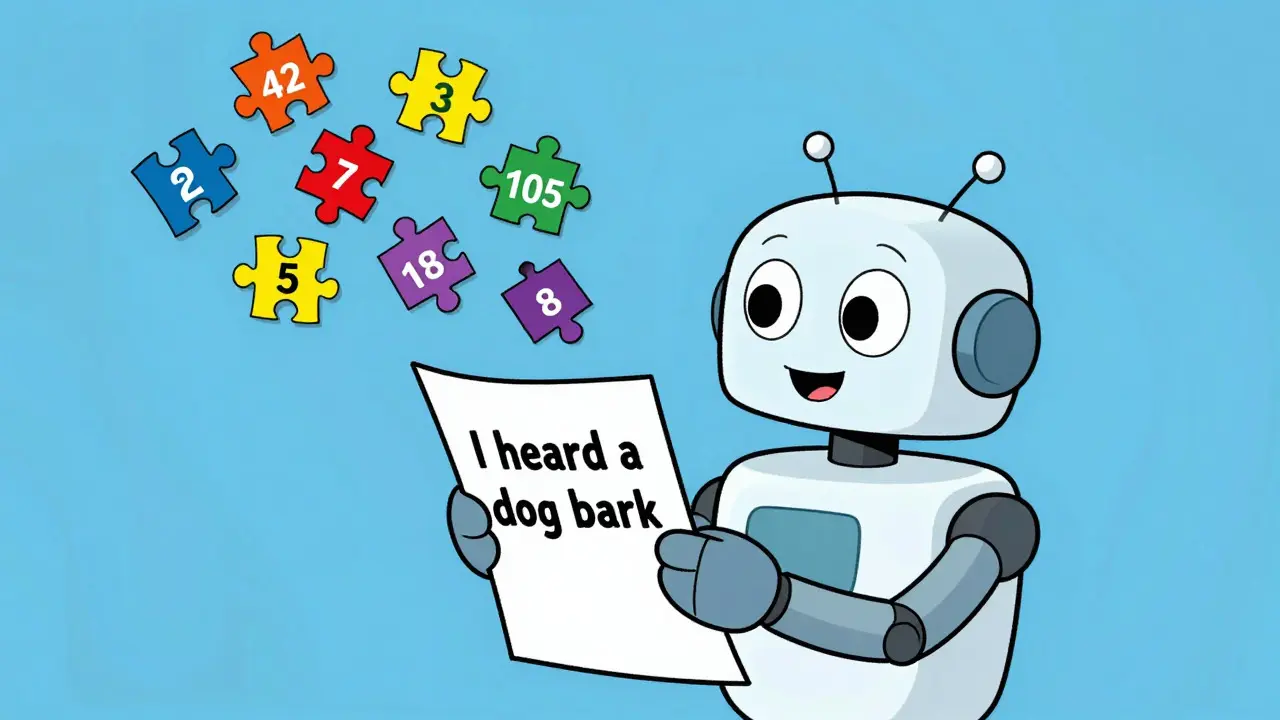
Have you ever wondered why an AI might charge you for more "words" than you actually typed? Or why a simple sentence like "I heard a dog bark" gets broken into tiny fragments before the model even starts thinking? The answer lies in tokens, the invisible building blocks that bridge human language and machine computation. Without understanding how text is chopped up into these units, you are flying blind when it comes to cost, speed, and accuracy in large language models (LLMs).
Tokens are not just words. They are the fundamental atomic units that LLMs process. When you type a prompt, the model doesn't see letters or sentences. It sees a sequence of numbers. Each number corresponds to a specific piece of text stored in the model's vocabulary. This transformation from raw text to numerical IDs is called tokenization, and it is the first critical step in any AI interaction.
The Mechanics of Tokenization: From Characters to Subwords
To understand how text becomes computation, we need to look at the history of this technology. Early natural language processing (NLP) systems tried two main approaches: word-level and character-level tokenization. Word-level tokenization treats every unique word as a token. This seems logical, but it creates a massive problem. If your vocabulary includes every possible English word, plus all its variations, the list grows unmanageably large. For example, BERT uses a vocabulary of about 30,000 tokens, but a pure word-based system might need over a million entries to cover rare terms and proper nouns.
Character-level tokenization solves the vocabulary size issue by treating every letter as a token. But this creates a different problem: inefficiency. To reference a word three positions back in a sentence, a character-based model needs to look back roughly 14 tokens (based on the average English word length of 4.7 characters). A word-based model only needs to look back 3 tokens. This forces the model to use much more memory and compute power just to maintain context.
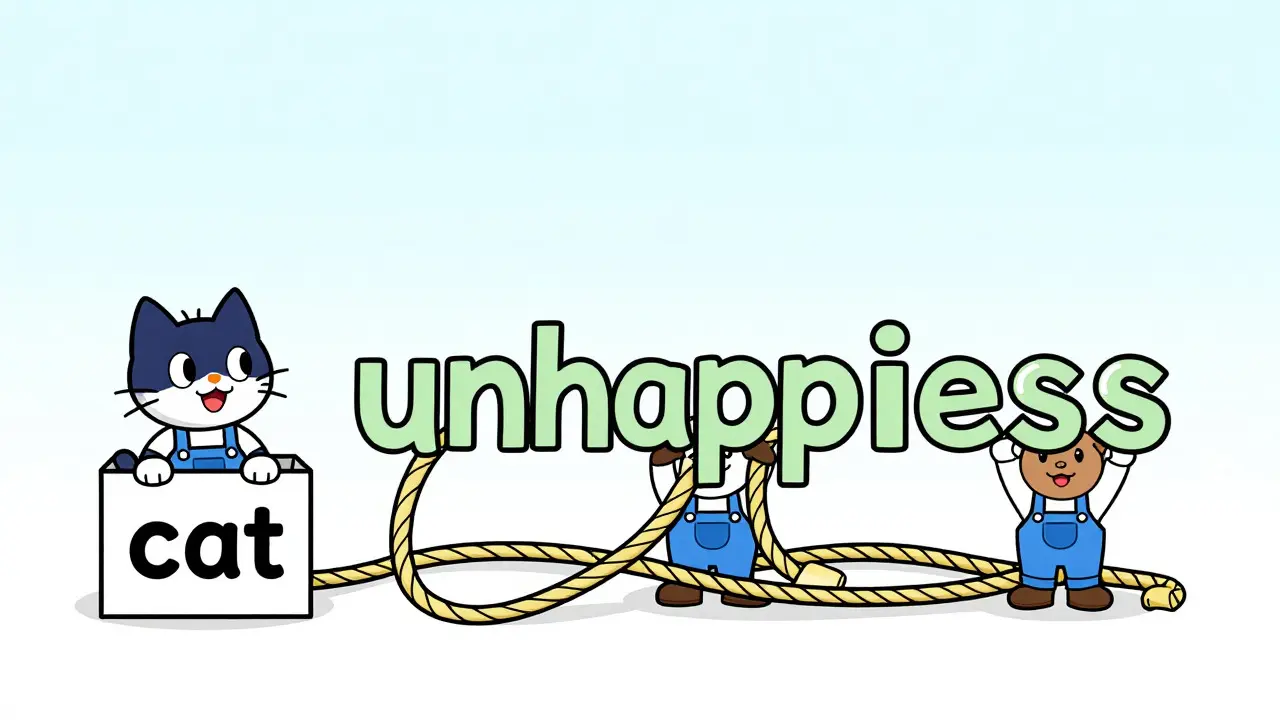
The industry solution is subword tokenization, specifically using an algorithm called Byte-Pair Encoding (BPE). BPE is a compression algorithm that merges the most frequent pairs of characters or subwords iteratively until a target vocabulary size is reached. Developed in foundational research by Sennrich, Haddow, and Birch in 2016, BPE strikes a balance. It keeps common words as single tokens (like "cat") but breaks down rare or complex words into smaller, known parts (like "running" becoming "run" + "ning").
- Whole Words: Common words like "the," "is," or "dog" are often single tokens.
- Subwords: Less common words are split into prefixes, suffixes, or roots. For example, "unhappiness" might become "un" + "happi" + "ness".
- Punctuation: Commas, periods, and spaces are also treated as distinct tokens.
This approach allows models to handle vast linguistic complexity without exploding their memory requirements. As Sean Trott, a cognitive science researcher at UC San Diego, noted, tokens are essentially the model's vocabulary-the things it is trained to recognize and produce.
Vocabulary Size and Model Architecture
The size of a model's vocabulary directly impacts its architecture and performance. A vocabulary is essentially a lookup table that maps strings of text to unique integer IDs. When a tokenizer processes text, it uses a greedy longest-match algorithm to find the best fit in this table.
Different models have different vocabulary sizes, which reflects their design priorities:
| Model | Vocabulary Size (Approx.) | Context Window (Tokens) | Tokenization Method |
|---|---|---|---|
| GPT-4 | 100,000 | 128,000 | BPE Variant |
| LLaMA 3 | 128,000 | 8,192 - 128,000 | SentencePiece / BPE |
| BERT | 30,000 | 512 | WordPiece |
| Claude 2 | ~100,000 | 100,000 | Cl100k_base |
A larger vocabulary means fewer tokens are needed to represent the same text. For instance, GPT-4’s ~100,000-token vocabulary allows it to keep many technical terms and non-English words as single tokens. In contrast, a model with a smaller vocabulary might break those same terms into multiple subwords. However, there is a trade-off. Kelvin.Legal reported in March 2024 that each additional 10,000 vocabulary tokens increases the model's embedding matrix size by approximately 3-5%. This adds to the total parameter count and memory usage.
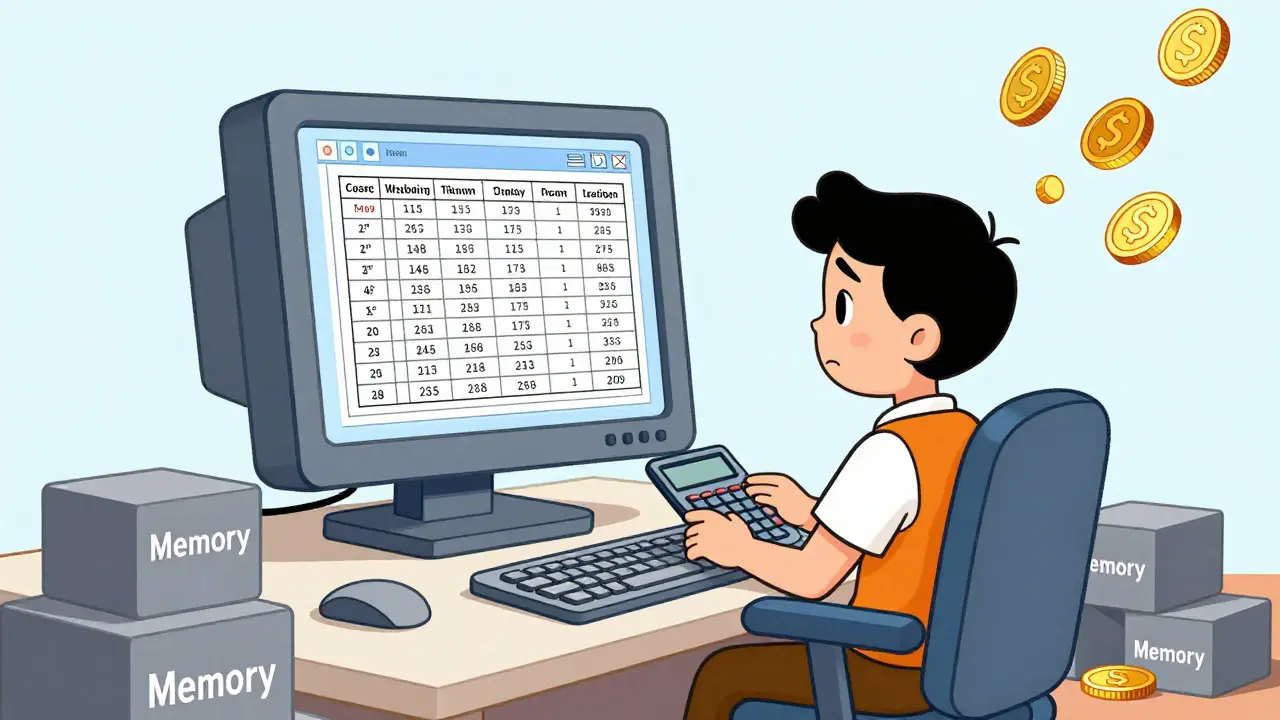
Memory requirements scale directly with token count. Microsoft Learn documents that processing a 10,000-token document can consume about five times more memory than a 2,000-token document, even if the word count is similar. This is because each token requires its own embedding vector-a high-dimensional array of numbers representing the meaning of that token within the model's neural network.
Why Token Count Matters for Cost and Performance
If you are building applications with LLMs, token count is your primary metric for cost and latency. Most providers, including OpenAI and Anthropic, charge per token. As of early 2024, typical pricing structures charge around $0.01 per 1,000 input tokens and $0.03 per 1,000 output tokens. These rates vary by model, but the principle remains: more tokens equal higher costs.
Unexpected token counts are a common pain point for developers. A Reddit survey in November 2023 found that 68% of machine learning practitioners encountered unexpected token spikes when handling specialized terminology. One developer noted that the chemical term "polyethylene terephthalate" was tokenized into five separate tokens despite being a single concept. This fragmentation increases both cost and the risk of the model losing track of the term's meaning.
Context windows also limit what a model can "remember." While GPT-4 supports 128,000 tokens, earlier models like GPT-3.5 were limited to 4,096 tokens. If your document exceeds the context window, the oldest information is dropped. Efficient tokenization helps you fit more meaningful content into that fixed window. For example, optimizing text for token efficiency reduced LLM processing costs by 22-37% across 47 enterprise deployments, according to IBM’s 2024 case studies.
Challenges with Specialized and Non-English Content
Subword tokenization works well for general English, but it struggles with morphologically complex languages and domain-specific jargon. Dr. Emily Bender of the University of Washington has critiqued that subword tokenization creates inherent biases toward frequent linguistic patterns in training data. This can disadvantage less-resourced languages where standard BPE algorithms may not have enough data to form efficient subword units.
For technical content, out-of-vocabulary (OOV) words require decomposition. Systenics AI’s September 2024 benchmarking study observed that technical or non-English content can increase token counts by 20-50% compared to general text. IBM’s 2023 case study showed that medical terminology required 22% more tokens than general language due to frequent splitting of specialized terms.
However, improvements are being made. Meta’s LLaMA 3.1 release in January 2025 introduced improved multilingual tokenization, reducing token counts for non-English languages by 12-18% compared to previous versions. Similarly, GPT-4’s larger vocabulary reduced Spanish text token counts by 18% compared to GPT-3.5, according to developer feedback on Hacker News in March 2024.
Practical Tips for Developers
Understanding tokenization is not just theoretical; it affects how you build your applications. Here are some practical steps to manage token usage effectively:
- Use Official Tokenizers: Never rely on simple word counting. Microsoft Learn warns that simple word counting can underestimate actual token usage by 30-50% for technical content. Use libraries like Hugging Face’s Tokenizers or OpenAI’s tiktoken for accurate counts.
- Inspect Your Tokens: Use tools like the Hugging Face tokenizer visualizer to see how your text is being split. This helps identify unexpected splits in key terms.
- Preprocess Text: If certain terms are critical, consider preprocessing them to ensure they remain intact. For example, replacing hyphenated compound words with underscores can sometimes prevent unwanted splits.
- Monitor Costs: Implement logging to track token usage per request. This helps in budgeting and identifying inefficient prompts.
Nebius’s April 2024 survey of 350 AI engineers indicated that understanding tokenization typically requires 2-3 weeks of dedicated study for proficient implementation. Start small, test with diverse inputs, and always validate against the specific model you are using.
Future Trends in Tokenization
The field is evolving rapidly. OpenAI announced plans for GPT-5 to implement adaptive vocabulary sizing, which could increase token efficiency by 15-20% for specialized domains. This dynamic approach would allow models to adjust their vocabulary based on the input context, potentially solving many current OOV issues.
Gartner predicts that by 2027, 60% of enterprise LLM deployments will implement custom tokenizers optimized for their specific domain language. This shift acknowledges that one-size-fits-all tokenization is insufficient for specialized industries like healthcare, law, and engineering.
While discrete tokenization remains the standard through at least 2030, researchers are exploring alternative representation methods like continuous space embeddings. These methods might eventually supplement or replace traditional tokenization, offering smoother transitions between concepts and better handling of nuanced language.
What is the difference between a word and a token?
A word is a unit of human language, while a token is a unit of computation for an AI model. A single word can be one token (e.g., "cat") or multiple tokens (e.g., "running" = "run" + "ning"). Tokens can also be parts of words, punctuation marks, or even single characters.
How do I calculate the cost of an LLM API call?
Cost is calculated based on the number of input tokens (your prompt) and output tokens (the model's response). Multiply the token count by the provider's rate per 1,000 tokens. Always use an official tokenizer library to get an accurate count, as word counts are often inaccurate estimates.
Why does my technical document have so many tokens?
Technical documents often contain specialized jargon that is not in the model's core vocabulary. These terms are broken down into subwords, increasing the token count. For example, a complex chemical name might be split into 5+ tokens. Using a model with a larger vocabulary or custom tokenization can help mitigate this.
What is Byte-Pair Encoding (BPE)?
BPE is a subword tokenization algorithm that starts with individual characters and iteratively merges the most frequent pairs of characters or subwords from a training corpus. This creates a balanced vocabulary that handles common words efficiently while breaking down rare words into recognizable parts.
Does a larger vocabulary mean a better model?
Not necessarily. A larger vocabulary reduces token count for diverse inputs but increases the model's memory footprint and embedding matrix size. The optimal size depends on the target use case. General-purpose models benefit from larger vocabularies, while specialized models might prioritize depth over breadth.