Imagine handing the keys to your company’s most valuable asset-a proprietary dataset used to train a cutting-edge Large Language Model-to a third-party vendor. Now imagine that vendor gets breached, or worse, accidentally trains their own public model on your private data. In 2026, this isn’t a hypothetical nightmare; it’s a daily operational reality for many organizations.
We are living in an era where Third-Party Risk Management (TPRM) is no longer just about checking if a supplier has insurance. It’s about ensuring that every external entity touching your Large Language Model (LLM) data maintains strict isolation, integrity, and confidentiality. The stakes have shifted. Traditional cyber risks like ransomware are still bad, but the new frontier involves model poisoning, prompt injection via vendor interfaces, and subtle data exfiltration that standard firewalls miss.
Why Standard TPRM Fails for LLM Vendors
You can’t manage AI risk with spreadsheets and annual PDF questionnaires. The old way of doing things assumes static environments. Your vendors’ infrastructure changes weekly. Their access logs shift daily. If you’re relying on a once-a-year security assessment, you’re already behind.
The core problem is complexity. When a vendor handles LLM data, they aren’t just storing files. They might be fine-tuning models, running inference APIs, or managing vector databases. Each of these activities introduces unique vulnerabilities. For instance, a vendor using Vector Embeddings to store your data could inadvertently leak semantic similarities between your confidential records through proximity queries if not properly secured.
Furthermore, the regulatory landscape is tightening. With frameworks like the EU AI Act and emerging US state-level AI regulations, non-compliance by a vendor can become your liability. You need a TPRM strategy that speaks the language of machine learning, not just IT compliance.
Key Risks in LLM Vendor Relationships
Before you can mitigate risk, you must understand what you’re protecting against. Here are the specific threats that arise when third parties handle your LLM data:
- Data Exfiltration via Training: Vendors may use your data to improve their foundational models unless explicitly contractually forbidden. This leads to intellectual property leakage.
- Prompt Injection Attacks: If your vendor provides an API for interacting with your model, attackers might exploit weak input validation to force the model to reveal training data.
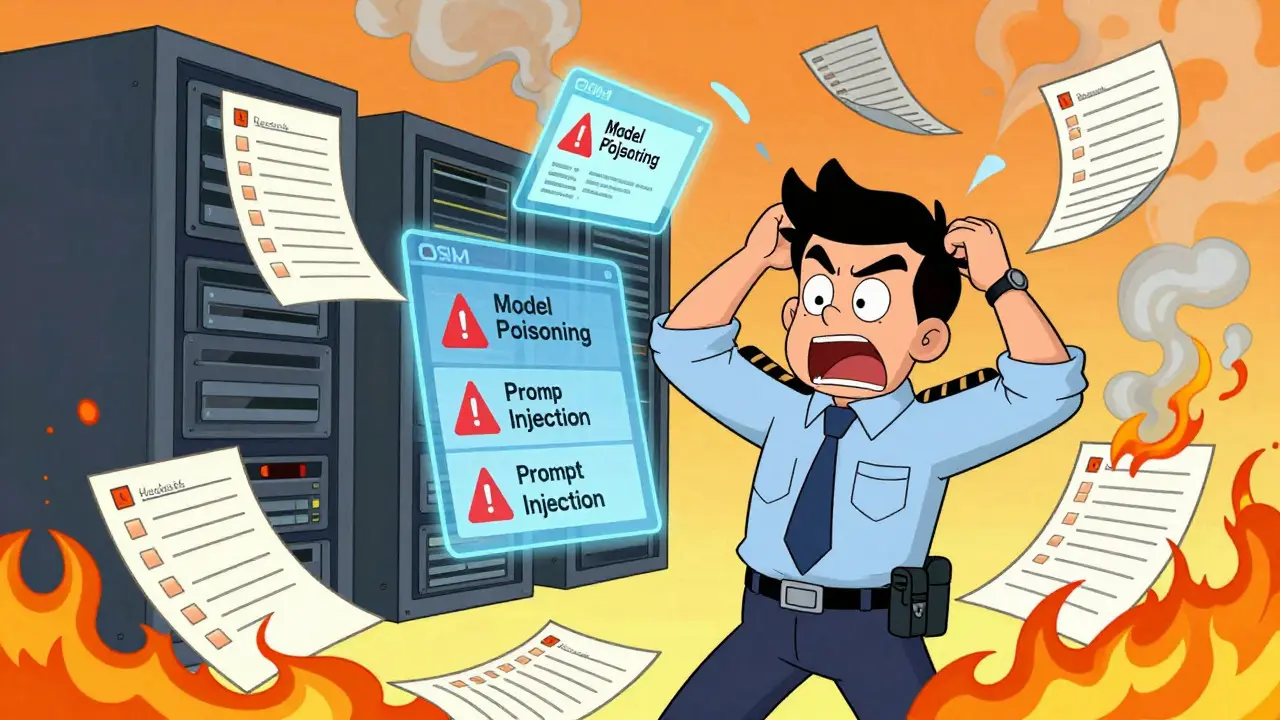
- Model Poisoning: Malicious actors compromising a vendor’s pipeline could inject biased or erroneous data into your fine-tuning process, corrupting your model’s outputs.
- Supply Chain Compromise: Many AI vendors rely on open-source libraries. If one of those upstream dependencies contains a backdoor, your entire LLM ecosystem is at risk.
- Inadequate Access Controls: Shared environments where your data sits alongside other clients’ data increase the risk of cross-tenant leakage.
Building a Robust TPRM Framework for AI
To secure your LLM investments, you need a dynamic, continuous monitoring approach. Here is how to structure your risk management program specifically for AI vendors.
1. Enhanced Due Diligence Beyond Checklists
Stop asking generic questions like "Do you have a firewall?" Instead, demand technical specifics. Ask vendors to detail their Data Isolation Strategies. Do they use dedicated GPU instances? Are embeddings encrypted at rest with customer-managed keys? Require evidence of regular penetration testing focused on API endpoints and model inference layers.
2. Continuous Monitoring & Automation
Static assessments expire the moment they are signed. Use automated tools to monitor vendor health in real-time. Platforms like Vanta or Mitratech offer continuous monitoring capabilities that track changes in a vendor’s security posture. Look for solutions that integrate with your procurement workflow to automatically flag vendors who lose key certifications or suffer public breaches.
3. Contractual Guardrails for AI
Your contracts need teeth. Include specific clauses regarding Intellectual Property Rights for all derived models. Explicitly prohibit the use of your data for general model improvement. Define clear incident response timelines for AI-specific incidents, such as hallucination spikes caused by poisoned data.
4. Technical Controls & Encryption
Enforce end-to-end encryption. Ensure that data is encrypted in transit (TLS 1.3) and at rest (AES-256). Consider using Homomorphic Encryption or Federated Learning techniques where possible, allowing vendors to process data without ever seeing the raw information. This minimizes the attack surface significantly.
Comparison of TPRM Approaches for LLM Data
| Attribute | Traditional TPRM | AI-Specific TPRM |
|---|---|---|
| Assessment Frequency | Annual or Bi-Annual | Continuous / Real-Time |
| Focus Area | Network Security, Physical Access | Model Integrity, Data Lineage, API Security |
| Compliance Frameworks | SOC 2, ISO 27001 | NIST AI RMF, EU AI Act, GDPR |
| Risk Indicators | Breach History, Financial Stability | Model Drift, Prompt Injection Vulnerabilities |
| Contractual Clauses | Standard Data Processing Agreements | IP Ownership, No-Training Clauses, Audit Rights |
Tools and Technologies for Modern TPRM
Managing dozens of AI vendors manually is impossible. You need technology that scales. Several platforms have emerged in 2026 that specialize in this intersection.
Safe Security stands out for its domain-based security assessments. It uses AI-driven due diligence to analyze public data and perform continuous scanning. Its ability to parse complex technical questionnaires using LLMs makes it faster to onboard vendors while maintaining rigor.
Kroll CyberClarity360 offers robust assessment automation. It maps vendor controls against frameworks like NIST CSF and CIS, providing live dashboards for real-time risk visibility. This is particularly useful for large enterprises needing to align AI vendor risks with broader corporate governance.
For startups and mid-market companies, Certa.ai provides end-to-end automation, including background checks and risk scoring. Its workflow orchestration helps streamline the often chaotic vendor onboarding process.
Best Practices for Implementation
Implementing a strong TPRM program for LLM data requires cultural and procedural shifts. Start by categorizing your vendors based on data sensitivity. Not all vendors need the same level of scrutiny. A cloud provider hosting your model poses different risks than a consultant reviewing output quality.
Next, establish a center of excellence for AI governance. This team should include legal, security, and data science experts. They will define the standards and oversee the implementation. Regularly update your risk register to reflect new AI threats. The threat landscape evolves monthly; your defenses must too.
Finally, foster transparency with your vendors. Share your expectations clearly. Provide them with guidelines on secure AI development. When vendors feel supported rather than policed, collaboration improves, leading to better security outcomes for everyone.
Future Trends in AI Vendor Risk
Looking ahead, we expect to see more standardized benchmarks for AI security. Just as SOC 2 became the gold standard for SaaS, we may see an "AI Ready" certification emerge. Regulatory pressure will also drive greater adoption of explainable AI (XAI) requirements in vendor contracts, ensuring that decisions made by third-party models can be audited and understood.
Additionally, decentralized identity and zero-trust architectures will become mandatory for accessing sensitive LLM pipelines. Expect to see increased use of hardware security modules (HSMs) for managing encryption keys associated with proprietary models.
What is the biggest risk when sharing LLM data with third-party vendors?
The biggest risk is unintended data leakage through model training. If a vendor uses your proprietary data to improve their foundational models, your competitive advantage is lost. Additionally, inadequate isolation can lead to cross-tenant data exposure.
How often should I assess my AI vendors?
Annual assessments are insufficient for AI vendors. Implement continuous monitoring using automated tools. Conduct deep-dive technical audits quarterly or whenever significant changes occur in the vendor’s infrastructure or service offerings.
Which compliance frameworks apply to LLM data handling?
Key frameworks include the NIST AI Risk Management Framework (RMF), the EU AI Act, GDPR for personal data, and industry-specific standards like HIPAA for healthcare. Ensure your vendors comply with relevant regulations based on your jurisdiction and data type.
Can I prevent vendors from using my data for training?
Yes, through explicit contractual clauses. Specify that your data is for inference only and cannot be used for model fine-tuning or pre-training. Require technical proof, such as audit logs or isolated environment configurations, to verify compliance.
What role does encryption play in LLM vendor risk management?
Encryption is critical. Use AES-256 for data at rest and TLS 1.3 for data in transit. For higher security, consider homomorphic encryption or federated learning, which allow processing without exposing raw data to the vendor.
How do I choose a TPRM platform for AI vendors?
Look for platforms offering continuous monitoring, AI-specific assessment templates, and integration with your existing security stack. Evaluate their ability to map controls to NIST AI RMF and other relevant frameworks. Safe Security, Kroll, and Vanta are notable options in 2026.