
For years, the tech industry operated on a simple, dangerous mantra: build it fast, fix it later. In the world of software, this meant patching bugs after launch. But with Generative AI, a class of artificial intelligence capable of creating original text, images, and code, that approach is no longer just risky-it’s catastrophic. When a model can generate realistic deepfakes or harmful content in milliseconds, waiting for user reports to act is like trying to bail out a sinking ship with a teaspoon.
This is where Safety by Design, a proactive framework for embedding safety protections directly into the architecture of AI systems from the earliest stages of development comes in. It isn’t a bolt-on filter you slap on at the end. It’s a fundamental shift in how we engineer intelligence, ensuring that protection against misuse is woven into the very fabric of the code, data, and deployment strategies.
The Shift from Reactive to Proactive Safety
Traditionally, content moderation was reactive. You posted something bad, algorithms flagged it, humans reviewed it, and then it got removed. By then, the damage was often done. Safety by Design, an engineering philosophy that integrates security and ethical safeguards into every phase of product development rather than adding them as an afterthought flips this script. It demands that safety considerations exist before a single line of training code is written.
Why does this matter now? Because generative models are incredibly persuasive. They don’t just retrieve information; they synthesize it. If a model is trained on data containing child sexual abuse material (CSAM) or other exploitative content, it doesn’t just "remember" it-it can learn patterns and reproduce similar harmful outputs when prompted, even indirectly. The cost of inaction here isn’t just legal fines or reputational hits; it’s tangible human harm. Frameworks developed by organizations like Thorn, a global technology nonprofit focused on protecting children from online sexual exploitation emphasize that when technology enables harm at scale, reactive fixes are insufficient. Protection must be architectural.
The Three Pillars of Safety by Design
Implementing Safety by Design isn’t a one-time checklist. It’s a lifecycle approach that spans three critical phases: Development, Deployment, and Maintenance. Each stage has specific technical requirements to ensure the model remains safe under pressure.
1. Development: Cleaning the Foundation
Garbage in, garbage out. This old computing adage is life-or-death in generative AI. During the development phase, the primary goal is data hygiene and model bias mitigation.
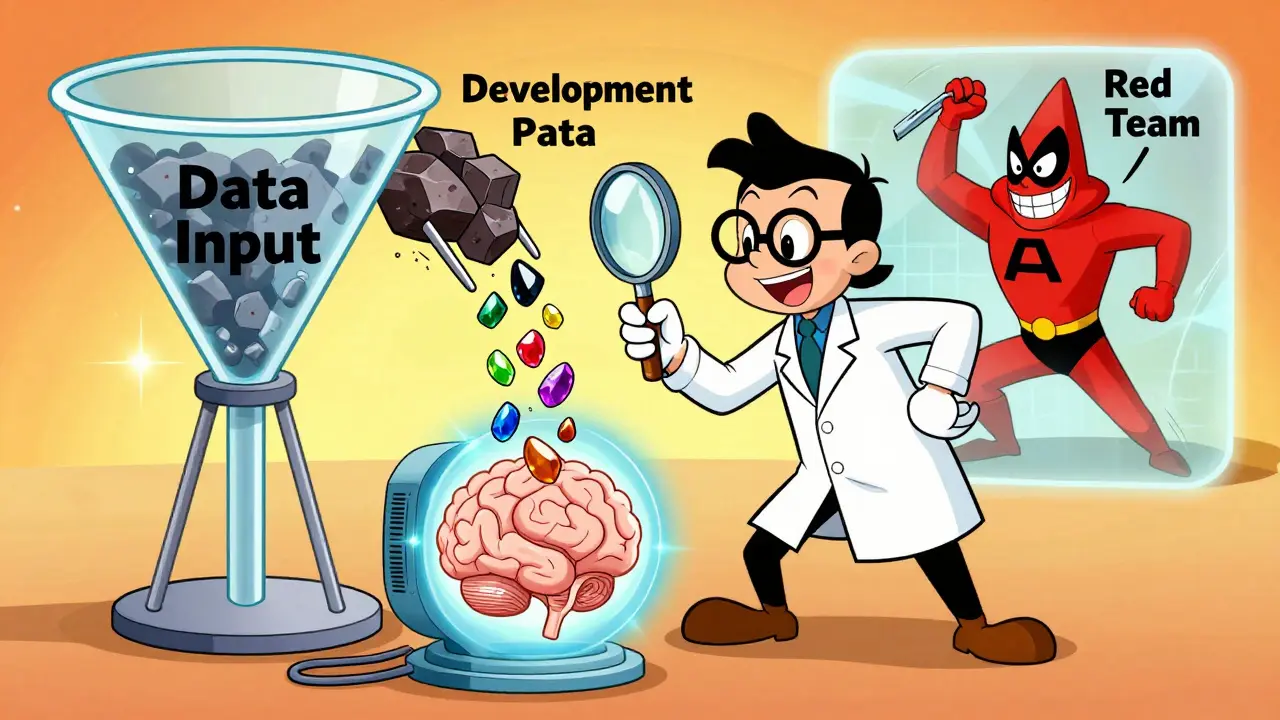
- Dataset Sanitization: Companies must use purpose-built detection solutions to scrub training datasets of CSAM, hate speech, and other prohibited content. This isn’t about keyword filtering; it involves sophisticated image and text recognition tools to identify and remove harmful material before the model ever sees it.
- Adversarial Training: Developers conduct "red teaming" exercises-simulating attacks by malicious actors-to see if the model can be tricked into generating harmful content. If the model fails these tests, it goes back to the drawing board. This stress testing ensures the model has built-in biases against producing exploitation material.
- Architectural Constraints: Safety isn’t just about data; it’s about design. Engineers implement structural limits within the model’s neural network weights to make it inherently difficult for the system to generate certain types of abusive output, regardless of the prompt.
2. Deployment: Real-Time Guardrails
Once the model is live, the focus shifts to interaction monitoring. This is where the rubber meets the road.
- Input Filtering: Before the model processes a request, input prompts are scanned for malicious intent. Systems detect jailbreak attempts-complex phrasing designed to bypass safety rules-and block them instantly.
- Output Scanning: Every generated response is analyzed in real-time. If the output contains indicators of CSAM, self-harm instructions, or non-consensual intimate imagery, it is blocked from reaching the user.
- Provenance and Watermarking: To combat misinformation and deepfakes, deployed systems often embed invisible watermarks or metadata tags (like C2PA standards) that prove the content was AI-generated. This helps downstream platforms identify synthetic media quickly.
3. Maintenance: Continuous Vigilance
Safety is not static. As new attack vectors emerge, so must defenses. The maintenance phase requires ongoing monitoring of model behavior, regular updates to detection algorithms, and re-evaluation of training data sources. It also involves transparency reporting, where companies disclose how their safety mechanisms performed and what improvements were made.
Industry Collaboration and Standards
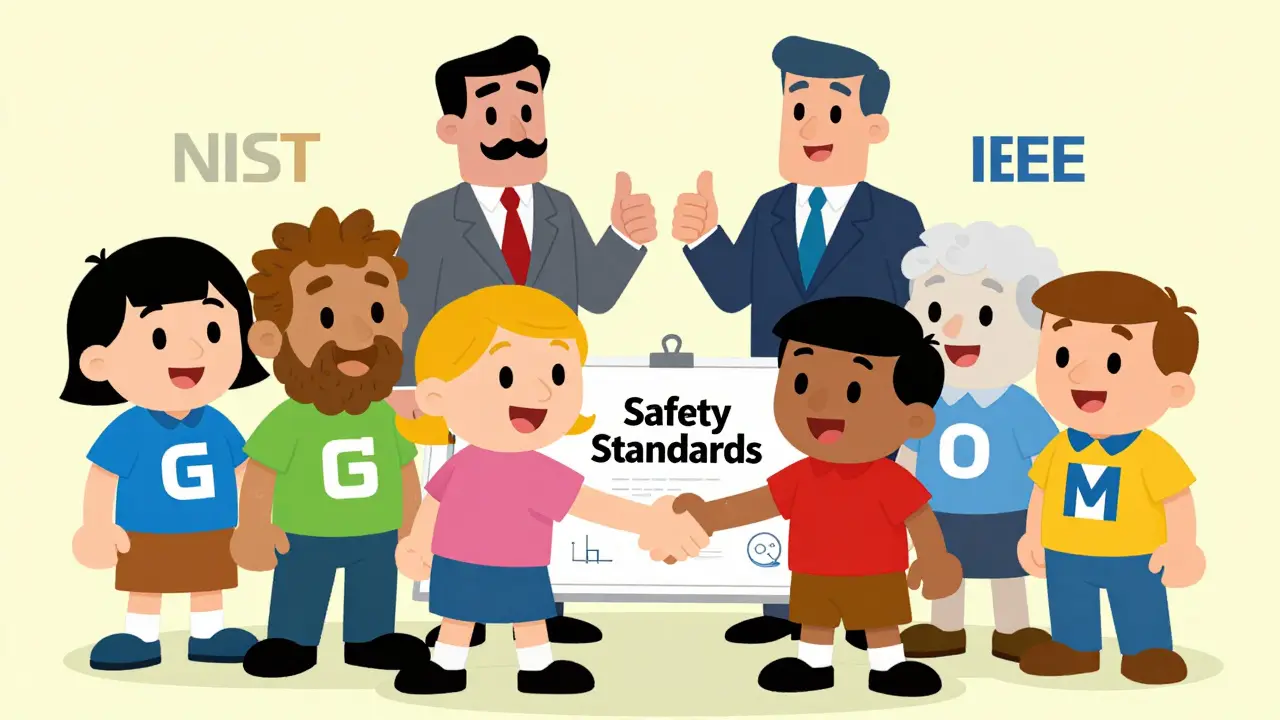
You can’t secure the entire internet alone. That’s why Safety by Design relies heavily on collaboration between private sector leaders and standardization bodies. Thorn, the nonprofit that pioneered the Safety by Design framework for AI has worked closely with major tech firms including Google, a multinational technology company specializing in Internet-related services and artificial intelligence, OpenAI, an artificial intelligence research organization focused on developing safe and beneficial AGI, Meta, a social media conglomerate and developer of the LLaMA family of large language models, and Stability AI, a London-based company known for open-source generative AI models like Stable Diffusion.
These partnerships have moved beyond informal agreements. Thorn has collaborated with NIST, the National Institute of Standards and Technology, a U.S. agency that develops measurement standards and guidelines for technology to inform comprehensive industry standards for reducing risks related to generative AI. Additionally, efforts are underway with IEEE, the Institute of Electrical and Electronics Engineers, a professional association promoting technological innovation to establish recommended practices that reflect these safety principles globally. This alignment ensures that safety isn’t just a corporate policy but an industry-wide benchmark.
| Feature | Traditional Approach | Safety by Design |
|---|---|---|
| Timing | Post-deployment (Reactive) | Pre-development through Lifecycle (Proactive) |
| Data Handling | Minimal pre-screening | Rigorous sanitization and bias removal |
| Model Architecture | Standard optimization for accuracy | Embedded constraints against harmful outputs |
| Testing | User-reported issues | Adversarial red-teaming and stress testing |
| Cost Focus | Low initial dev cost, high moderation cost | Higher initial investment, lower long-term risk |
Beyond Child Safety: Broader Implications
While the urgent catalyst for Safety by Design was the prevention of child sexual exploitation, the framework’s benefits extend far wider. IBM’s research on secure-by-design approaches shows that 72% of organizations using these protocols report significant improvements in governance, risk, and compliance (GRC). By automating governance work, AI-driven policy engines can detect anomalies and trigger corrective workflows without waiting for manual escalation.
This connects to the broader concept of Responsible AI, a set of principles guiding the ethical development and deployment of AI systems, including fairness, accountability, and transparency. Responsible AI includes trustworthiness and safety, but Safety by Design provides the technical blueprint for achieving those goals. It addresses hallucinations by forcing rigorous fact-checking layers during training, and it mitigates bias by requiring diverse, clean datasets. For businesses, this means fewer regulatory headaches under laws like the EU AI Act and greater public trust.
Challenges in Implementation
Adopting Safety by Design isn’t easy. It requires a cultural shift within engineering teams. Safety cannot be delegated solely to a small security squad; it must be integrated into every sprint, every code review, and every product decision. Leadership must embrace this as a core commitment, not a compliance checkbox.
There are also technical trade-offs. Overly restrictive filters can lead to "false positives," where legitimate creative requests are blocked. Finding the balance between safety and utility is an ongoing challenge. However, as models become more sophisticated, so do the safety mechanisms. Techniques like reinforcement learning from human feedback (RLHF) allow developers to fine-tune models to align with human values more precisely, reducing friction for users while maintaining strict guardrails against harm.
The Future of Secure AI Architecture
We are at an inflection point. As generative AI becomes more accessible, the window for proactive intervention narrows. Bad actors are already exploiting weaker systems. The companies that thrive will be those that view safety not as a barrier to innovation, but as the foundation of it. By embedding protections into product architecture, we create AI that is not only powerful but also trustworthy. This is the only path forward for sustainable, scalable, and ethical artificial intelligence.
What is Safety by Design in Generative AI?
Safety by Design is a framework that embeds safety protections directly into the architecture and development lifecycle of AI systems. Instead of adding filters after launch, it focuses on cleaning training data, adversarial testing, and real-time monitoring to prevent harmful content generation from the start.
Who developed the Safety by Design framework?
The framework was pioneered by Thorn, a technology nonprofit, in collaboration with major AI companies like Google, OpenAI, Meta, and Stability AI. It has also been integrated into standards developed by NIST and IEEE.
How does Safety by Design differ from traditional content moderation?
Traditional moderation is reactive, removing harmful content after it is created and posted. Safety by Design is proactive, preventing the creation of harmful content through data sanitization, model constraints, and input/output filtering before it reaches the user.
Why is dataset sanitization important in Safety by Design?
Generative AI learns from its training data. If that data contains harmful content like CSAM or hate speech, the model may learn to reproduce similar patterns. Sanitization removes this material to prevent the model from generating abusive outputs.
What role do NIST and IEEE play in Safety by Design?
NIST and IEEE are working to formalize Safety by Design principles into industry-wide standards. This ensures that safety measures are consistent, measurable, and adopted globally, moving beyond voluntary corporate policies to recognized technical benchmarks.