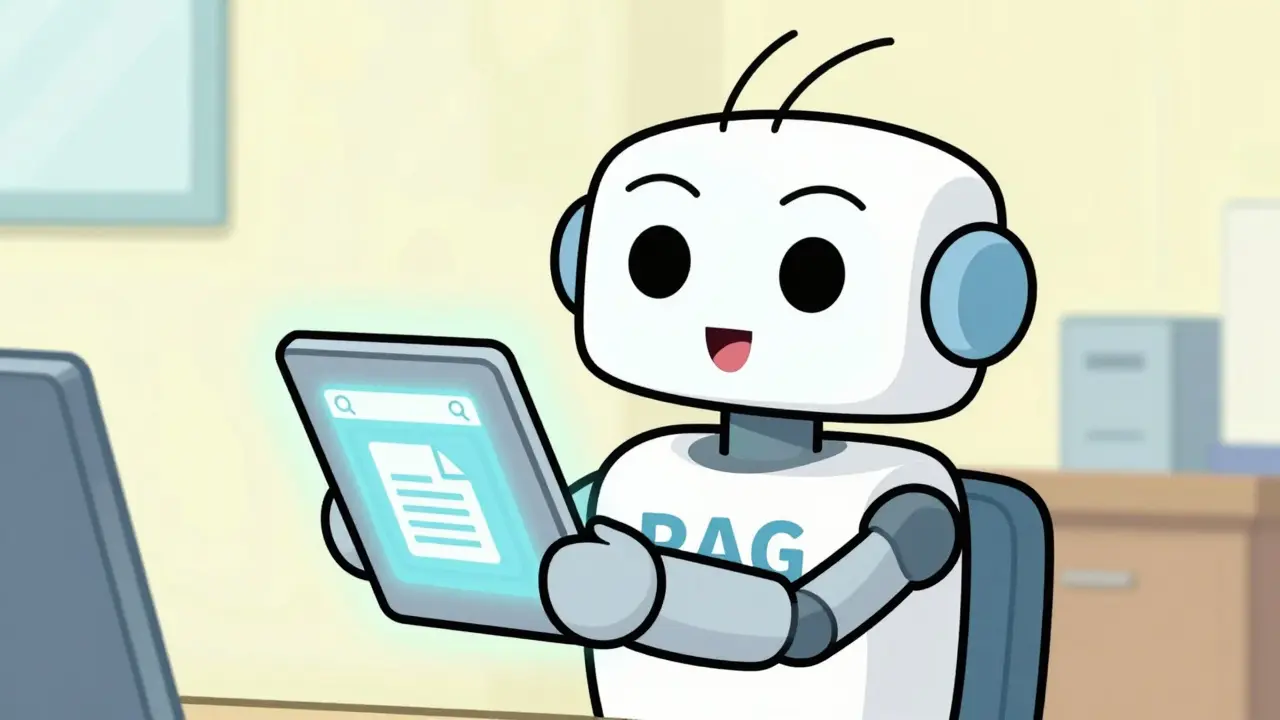
Imagine asking your company’s AI assistant about a policy change that happened yesterday. A standard large language model (LLM) would likely guess or hallucinate because its training data stopped months ago. Now imagine an AI that instantly checks your internal database, finds the exact PDF of the new policy, reads it, and answers you with perfect accuracy. That is retrieval-augmented generation (RAG) in action.
In 2026, RAG has moved from experimental research to the backbone of enterprise AI. It solves the biggest problem with open-source LLMs: they are smart but static. By connecting these models to live, external data sources, you get dynamic, factual, and secure answers without retraining the model. This guide breaks down the tooling, architecture, and best practices for building robust RAG systems using open-source components.
How Retrieval-Augmented Generation Works
RAG isn’t magic; it’s a three-step pipeline that bridges the gap between human questions and machine knowledge. Developed originally by researchers at Meta AI, University College London, and New York University, the technique has become the standard for grounding AI in facts.
- Retrieval: When you ask a question, the system doesn’t send it directly to the LLM. Instead, it converts your query into a numerical format called an embedding. It then searches a vector database for similar embeddings-essentially finding documents that mean the same thing as your question.
- Augmentation: The relevant chunks of text found in the search are injected into the prompt alongside your original question. This creates a context-rich input for the model.
- Generation: The open-source LLM reads both its internal training data and the newly provided external context to generate a response. Because the answer is based on retrieved evidence, hallucinations drop significantly.
This process allows models like Llama 3 or Mistral to access proprietary company data, recent news, or technical documentation that wasn’t part of their initial training set. It turns a general-purpose chatbot into a specialized expert.
The Open-Source RAG Tech Stack
Building RAG from scratch is complex. Fortunately, the open-source ecosystem provides mature tools for every layer of the stack. Choosing the right combination depends on your scale, latency requirements, and team expertise.
| Component | Tool Example | Primary Function | Key Benefit |
|---|---|---|---|
| Orchestration | LangChain | Chains LLMs, retrievers, and prompts together | Modular design, huge community support |
| Inference Engine | vLLM | Serves LLM predictions efficiently | Paged Attention reduces memory waste and latency |
| Vector Database | Milvus / Pinecone | Stores and searches embeddings | Fast similarity search at scale |
| Embedding Model | BGE-M3 / OpenAI Embeddings | Converts text to vectors | High-dimensional semantic understanding |
LangChain is a framework that simplifies the development of applications powered by LLMs. It handles the "plumbing" of RAG, offering pre-built modules for document loading, splitting, and retrieval strategies. NVIDIA even uses LangChain in its reference architectures, signaling its industry acceptance.
For the actual model serving, vLLM is a high-throughput and memory-efficient inference engine for LLMs. Traditional servers often waste memory padding tokens to fit hardware constraints. vLLM uses PagedAttention to manage memory like an operating system manages pages, allowing higher concurrency and lower latency. This is critical when you need fast responses after retrieving heavy context.
Architecture: Data Flow and Vector Databases
The heart of any RAG system is the vector database. Unlike traditional SQL databases that store rows and columns, vector databases store high-dimensional arrays of numbers (embeddings). These embeddings capture the semantic meaning of text. Two sentences with different words but similar meanings will have close vector coordinates.
Here is how data flows through a typical architecture:
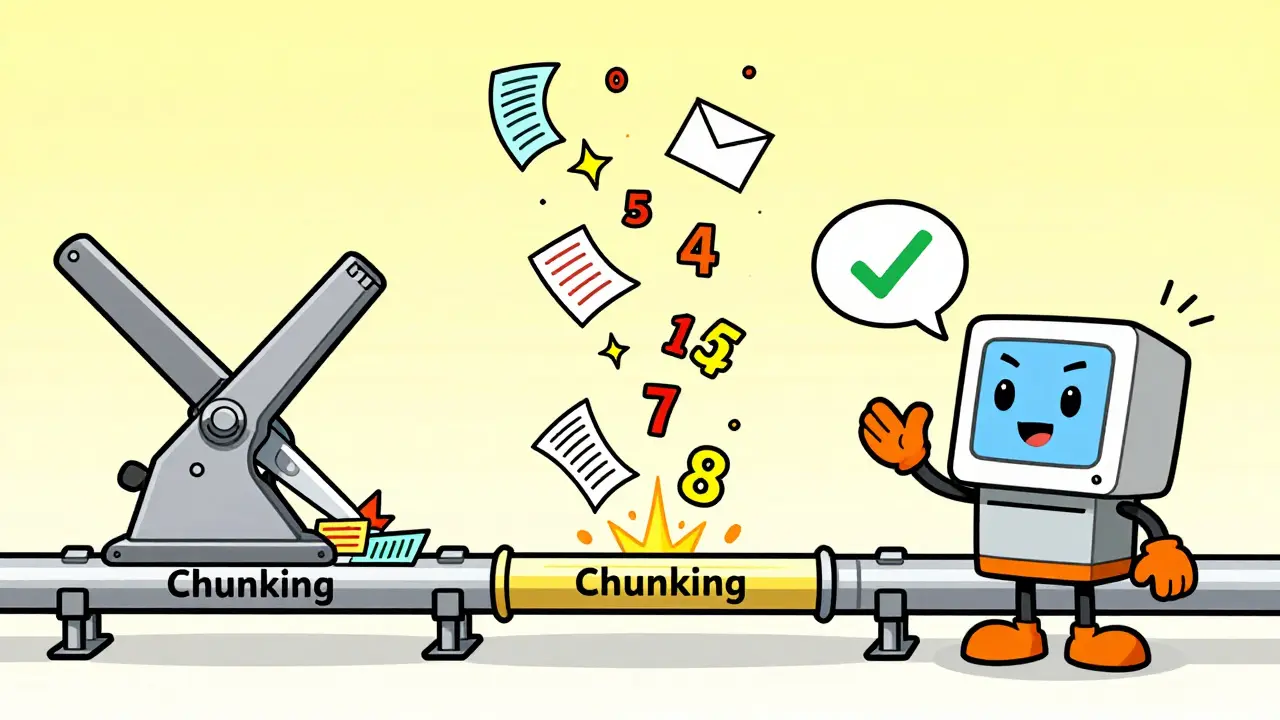
- Ingestion: Raw data (PDFs, emails, code repos) is cleaned and split into smaller chunks. Chunk size matters too much-too small loses context, too large wastes token limits. A common sweet spot is 500-1000 tokens per chunk.
- Embedding: An embedding model converts each chunk into a vector. Models like BGE-M3 or Ada-002 are popular choices. They output vectors ranging from 384 to 4096 dimensions depending on the trade-off between precision and storage cost.
- Storage: Vectors are stored in a database like Milvus, Weaviate, or Qdrant. These databases use algorithms like HNSW (Hierarchical Navigable Small World) to perform approximate nearest neighbor searches in milliseconds.
- Retrieval: At query time, the user’s question is embedded and compared against the database. The top-k most similar chunks are returned.
For enterprise settings, security is paramount. Closed-domain RAG keeps all data local within your infrastructure, ensuring sensitive customer information never leaves your network. Open-domain RAG might pull from public APIs or web scrapers, which requires careful filtering to avoid injecting noisy or biased data.
Best Practices for Implementation
Getting RAG to work is easy; getting it to work well is hard. Here are proven strategies to improve accuracy and reduce costs.
1. Optimize Your Chunking Strategy
Default chunking often breaks sentences or paragraphs arbitrarily, destroying context. Use semantic chunking instead, which splits text where topics change. If you’re processing code, chunk by function or class. For legal documents, chunk by clause. The goal is to ensure each chunk contains a complete thought that can stand alone when retrieved.
2. Use Hybrid Search
Semantic search alone can miss exact matches. If a user asks for "Error Code 404," a semantic search might return generic error pages. Combine semantic search with keyword-based BM25 search. Many modern vector databases support hybrid search out of the box, ranking results by combining both scores. This ensures you catch both conceptual relevance and precise terminology.
3. Implement Re-Ranking
Retrieving the top 50 documents is cheap, but sending all 50 to the LLM is expensive and noisy. Use a lightweight cross-encoder model (like Cohere Rerank or BGE-Reranker) to score the retrieved chunks against the query. Keep only the top 3-5 most relevant chunks. This step dramatically improves answer quality by removing irrelevant noise before generation.
4. Monitor Hallucinations
Even with RAG, models can still hallucinate if the retrieved context is ambiguous. Implement guardrails that force the model to cite sources. If the model cannot find an answer in the context, it should say "I don't know" rather than guessing. Tools like Guardrails AI or NeMo Guardrails can enforce these constraints programmatically.
Performance and Cost Considerations
Open-source LLMs offer control, but they require compute resources. Running a 70-billion parameter model locally demands powerful GPUs. However, techniques like quantization (reducing precision from FP16 to INT8) allow smaller models to run on consumer-grade hardware with minimal quality loss.
vLLM helps here by maximizing throughput. Instead of waiting for one request to finish before starting another, it batches requests efficiently. For high-traffic applications, this means lower cost per token and faster response times. Always profile your specific workload to determine the optimal batch size and context window length.
Memory management is also key. Large context windows consume more VRAM. If you retrieve too much text, you risk hitting memory limits. Stick to the principle of "just enough context." Retrieve what is necessary, rank it tightly, and let the LLM do the synthesis.
Future Trends: Agentic RAG
The next evolution of RAG is agentic workflows. Instead of a linear retrieve-then-generate path, autonomous agents can iteratively refine their search. If the first retrieval fails, the agent can rewrite the query, try a different source, or break the question into sub-questions. This self-correction loop mimics human research behavior and leads to higher accuracy on complex tasks.
As of 2026, frameworks are beginning to support these multi-step reasoning patterns natively. Combining agentic capabilities with robust open-source tooling creates AI assistants that are not just reactive, but proactive and verifiable.
What is the difference between RAG and fine-tuning?
Fine-tuning updates the model's weights with new data, which is expensive, slow, and risks catastrophic forgetting of previous knowledge. RAG keeps the model frozen and simply feeds it new data at runtime via context. RAG is better for dynamic, frequently changing data, while fine-tuning is better for adapting tone or style.
Which open-source LLM is best for RAG?
Models like Llama 3, Mistral Large, and Mixtral are excellent choices due to their strong instruction-following capabilities and long context windows. Mixtral’s sparse mixture-of-experts architecture offers a good balance of speed and performance for RAG tasks.
How do I prevent my RAG system from hallucinating?
Use high-quality, curated data sources. Implement re-ranking to ensure only highly relevant context reaches the LLM. Add explicit instructions in the prompt telling the model to answer only based on the provided context and to admit ignorance if the answer isn't there.
Is LangChain necessary for RAG?
No, but it speeds up development significantly. You can build RAG pipelines with raw Python libraries like FAISS for vector storage and direct API calls to LLMs. However, LangChain provides standardized interfaces for loaders, splitters, and retrievers, reducing boilerplate code.
What is PagedAttention in vLLM?
PagedAttention is a memory management technique inspired by virtual memory in operating systems. It breaks the attention map into non-contiguous blocks, eliminating memory fragmentation. This allows vLLM to serve many concurrent requests with higher throughput and lower latency compared to traditional methods.

the tragedy of modern existence is that we have built machines capable of retrieving the sum of human knowledge in milliseconds yet we still cannot retrieve a single moment of genuine connection from our own fractured souls. you speak of hallucinations as if they are merely technical glitches to be patched with better vector databases but consider for a moment that the entire edifice of corporate truth is itself a grand hallucination sustained by the collective delusion of shareholders who demand growth from a finite planet while pretending the earth is an infinite resource dispenser waiting to be queried via api calls. when your llm guesses or hallucinates about a policy change it is merely reflecting the chaotic absurdity of a world where policies change faster than humans can read them let alone understand their ethical implications. we are not building tools we are building mirrors that reflect our own inability to think critically without outsourcing cognition to silicon priests who worship at the altar of efficiency and scale.
Look, I get the philosophical angst, but let's talk shop for a second because this guide actually hits on some critical points that people often overlook when they just want to slap a chatbot on their website. The section on re-ranking is huge. Most devs skip straight to the LLM after retrieval and wonder why their answers are garbage. Using a cross-encoder like BGE-Reranker to filter down to the top 3-5 chunks before generation is a game changer for both cost and accuracy. Also, the bit about semantic chunking vs default chunking? Spot on. If you're splitting legal docs by character count, you're going to break clauses and lose context entirely. It's all about preserving the 'thought unit'.
hey patrick i totally agree with you about the chunking strategy its such a simple thing but makes all the difference in the world really. i was working on a project last week where we were using langchain and we kept getting weird results until we switched to hybrid search combining bm25 with the semantic vectors. it was amazing how much better the precision became especially for things like error codes or specific product names that dont have much semantic meaning on their own. also vllm is super nice for throughput if you are serving lots of users at once which we were doing. did you try out the agentic workflows mentioned at the end? seems like it could be cool but also might add a lot of latency depending on how many steps the agent takes
Hey Oskar! Yeah, hybrid search is definitely the sweet spot for enterprise data. Pure semantic search misses those exact keyword matches, and pure BM25 misses the conceptual links. Combining them gives you the best of both worlds. Regarding agentic RAG, I've played around with it. It's powerful for complex queries that require multi-step reasoning, but you're right about the latency. You need robust timeout handling and maybe even async processing if you don't want your users staring at a loading spinner for 30 seconds. For most internal company wikis, standard RAG with good re-ranking is usually sufficient and much more predictable.
you guys are obsessed with the plumbing instead of the actual problem. the problem isnt that the model cant find the pdf its that the pdf contains garbage written by incompetent middle managers who dont know what theyre talking about. no amount of vector magic will fix bad source data. you can have the most sophisticated reranking algorithm in the world but if your training data is a swamp of corporate jargon and contradictory policies then your ai assistant is just a very fast way to spread misinformation. stop trying to optimize the delivery mechanism and start fixing the content quality issue which is obviously the root cause of all these hallucinations
oh please. spare me the lecture on content quality. we all know the documents are written by people who think 'synergy' is a verb. but here we are in south africa watching the rest of the world build fancy toy robots to answer questions about lunch menus while our power grid keeps failing. maybe if you spent less time optimizing token limits and more time ensuring the servers have electricity to run on youd be a real hero. but no lets pretend that having a slightly faster response time from a chatbot that tells you about the new dress code is somehow solving the existential dread of the digital age. hilarious.
i mean... she has a point about the data quality though. i was testing this on some old internal memos and the ai just confidently made up reasons for meetings that never happened. it was kind of funny but also terrifying. i guess the 'guardrails' part of the guide is important so it admits when it doesnt know something rather than just making stuff up to be helpful. do you think that would help with the bad data issue or does it just shift the blame?
typical western obsession with efficiency over substance. you build these elaborate systems to retrieve information that should be common sense anyway. in my country we still value human expertise and direct communication rather than hiding behind algorithms. your open source models are just a bandaid for the fact that american tech companies have lost the ability to create truly intelligent systems and now rely on brute force compute and stolen data. pathetic really. keep playing with your toys while the rest of us deal with reality
Wow!! That was harsh!!! But honestly?? I tried setting up Milvus locally and it was such a nightmare!! The documentation assumes you already know everything about docker and networking!!! And then when you finally get it running the latency is terrible unless you have a gpu cluster worth millions!!! Why does everyone make it sound so easy in the tutorials?! I just want to ask my bot about my vacation policy without needing a phd in distributed systems!!! Is there really no simpler way??? Please tell me I'm not crazy for finding this overwhelming!!!