
You spend weeks curating a high-quality dataset to teach your large language model (LLM) how to write legal contracts. The results look great. But then you test the same model on general knowledge questions or creative writing tasks, and it falls apart. It has forgotten how to be helpful in other areas. This isn't just a bug; it is a fundamental problem known as catastrophic forgetting, which occurs when neural networks overwrite previously learned knowledge during new training phases.
For years, engineers assumed that using parameter-efficient fine-tuning (PEFT) methods like Low-Rank Adaptation (LoRA) would solve this issue by keeping most of the model frozen. Recent research from 2025 and early 2026 proves that assumption wrong. In many continual learning scenarios, LoRA fails to prevent significant knowledge loss. If you are deploying LLMs in production where maintaining general capabilities while adding specialized skills is critical, you need to understand which techniques actually work today.
Why Your Model Forgets Everything
To fix catastrophic forgetting, you first need to understand why it happens. When you fine-tune an LLM, the optimization process adjusts millions-or billions-of parameters to minimize error on your new task. Without constraints, the model shifts its internal representations aggressively to fit the new data. This shift often moves the model away from the "sweet spot" in weight space where it performed well on previous tasks.
Think of it like learning a new dialect of a language. If you immerse yourself completely in the new dialect without practicing the original one, your ability to speak the original version degrades. In neural networks, this degradation is mathematically inevitable unless you explicitly constrain the learning process. The core challenge is balancing plasticity (the ability to learn new things) with stability (the ability to retain old knowledge).
| Misconception | Reality |
|---|---|
| Freezing layers prevents all forgetting | Freezing helps, but if the unfrozen layers shift too much, downstream performance still degrades. |
| LoRA always preserves general knowledge | Recent 2025 studies show LoRA can fail in continual learning settings despite low parameter updates. |
| More data solves forgetting | Adding more new-task data often accelerates forgetting of old tasks unless balanced carefully. |
The LoRA Myth: Why Parameter Efficiency Isn't Enough
Low-Rank Adaptation (LoRA is a popular PEFT method that injects trainable rank decomposition matrices into each layer of the transformer architecture.) became the industry standard because it is cheap. You only update a small fraction of parameters, usually less than 1%, allowing you to fine-tune massive models on consumer-grade GPUs. The logic was simple: if you change fewer weights, you shouldn't break the existing knowledge.
However, research published in 2025 by Legion Intel and others revealed a counterintuitive truth. While LoRA minimizes changes to the raw weights, it does not necessarily preserve the functional behavior of the model on previous tasks. In continual learning benchmarks, LoRA adapters often caused significant drops in performance on general tasks after being trained on domain-specific ones. The issue isn't just about how many weights change; it's about *which* paths through the network are altered.
If you rely solely on LoRA for multi-task applications, you risk creating a model that is excellent at one thing but useless at everything else. You need strategies that look beyond parameter count to functional preservation.
Geometric Solutions: Functionally Invariant Paths (FIP)
One of the most promising alternatives emerging in 2025 is Functionally Invariant Paths (FIP), developed at Caltech. Unlike LoRA, which focuses on limiting parameter magnitude, FIP considers the geometry of the loss landscape. It treats the network's weight space as a curved Riemannian manifold.
In simpler terms, FIP ensures that even if the weights change significantly, the model stays close to its original functional behavior. It allows the model to traverse weight space freely but constrains it to remain within regions that preserve performance on previous tasks. Early comparisons show that FIP can maintain general knowledge better than LoRA, even though it may involve larger numerical changes to the weights. This approach is particularly useful when you have limited computational resources but need robust multi-task retention.

Regularization Techniques: EWC and Beyond
Elastic Weight Consolidation (EWC) is a regularization technique that identifies important parameters for previous tasks and penalizes changes to them during new training. EWC uses the Fisher Information Matrix to estimate which weights are critical for past performance. During fine-tuning, it adds a penalty term to the loss function that discourages updating these important weights.
While effective, traditional EWC is computationally expensive because calculating the Fisher Information Matrix requires storing second-order derivatives. A hybrid approach called EWCLoRA combines the efficiency of LoRA with the importance estimation of EWC. By applying EWC constraints only to the low-rank adapters, you get a balance of speed and stability. However, recent January 2025 arXiv papers suggest that newer element-wise importance metrics offer faster performance (up to 20x) with lower storage requirements (10-15%) compared to classic EWC implementations.
Data-Centric Approaches: Replay and Distillation
Sometimes the best way to remember is to review. Rehearsal or replay-based methods involve retaining a small subset of data from previous tasks and mixing it with new training data. This forces the model to optimize for both old and new examples simultaneously. The challenge here is data privacy and storage. You cannot always keep real user data from previous tasks due to GDPR or HIPAA regulations.
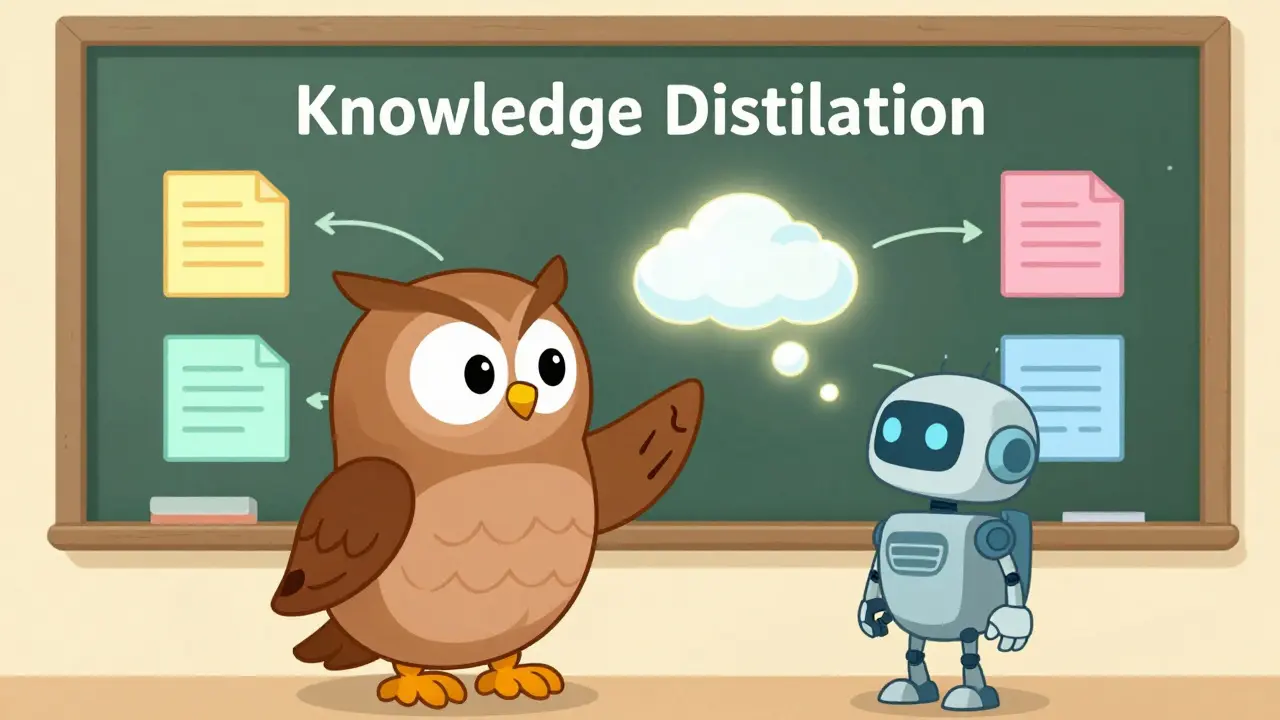
An alternative is Knowledge Distillation, specifically Learning Without Forgetting (LwF). Instead of storing raw data, you use the pre-fine-tuned model as a "teacher." During training on the new task, you add a distillation loss that encourages the new model to mimic the outputs of the old model on a small set of anchor examples. This transfers the general knowledge implicitly without needing to store the entire historical dataset.
New Frontiers: Token Masking and Prompt Tuning
Two innovative approaches gaining traction in 2025 are Selective Token Masking (STM) and prompt-based isolation. STM masks high-perplexity tokens during fine-tuning. High-perplexity tokens are those the model finds surprising or difficult, often indicating core general knowledge. By protecting these tokens from aggressive updates, STM mitigates forgetting at the token level rather than the weight level.
Prompt-based approaches, such as inserting trainable task-specific prompts, avoid modifying core model parameters entirely. Instead, you expand the model's capability through the input representation space. This keeps the base model pristine and allows you to swap out prompts for different tasks. While this doesn't technically "fine-tune" the weights, it achieves the practical goal of adding specialization without losing generality.
Choosing the Right Strategy for Your Use Case
No single technique works for every scenario. Your choice depends on your computational budget, data privacy constraints, and the severity of the forgetting risk.
- For resource-constrained environments: Try EWCLoRA or optimized element-wise importance methods. They offer a good balance of speed and stability.
- For high-stakes continual learning: Consider FIP or distillation-based methods. These prioritize functional preservation over raw speed.
- For strict data privacy: Avoid rehearsal methods. Use distillation or prompt tuning instead.
- For rapid prototyping: Start with LoRA, but validate thoroughly on general tasks. If you see degradation, switch to FIP or add a distillation loss.
Always evaluate your model on a representative set of previous tasks after each fine-tuning step. Monitoring performance drift is the only way to confirm that your mitigation strategy is working. Hybrid approaches, combining PEFT with small amounts of rehearsal data or distillation losses, often yield the best results in production environments.
Does LoRA prevent catastrophic forgetting?
Not reliably. While LoRA reduces computational cost by freezing most parameters, recent 2025 research shows it can still lead to significant catastrophic forgetting in continual learning scenarios. It limits weight changes but does not guarantee functional preservation of previous tasks.
What is Functionally Invariant Paths (FIP)?
FIP is a technique developed at Caltech that addresses catastrophic forgetting by considering the geometry of the loss landscape. It ensures that the model remains close to its original functional behavior in weight space, even if the numerical values of the weights change significantly. It often outperforms LoRA in preserving general knowledge.
How does Elastic Weight Consolidation (EWC) work?
EWC identifies parameters that are important for previous tasks using the Fisher Information Matrix. It then adds a regularization term to the loss function during new training that penalizes changes to these important weights, effectively anchoring them to their original values.
Can I use rehearsal methods if I have privacy concerns?
Traditional rehearsal requires storing real data from previous tasks, which may violate privacy regulations like GDPR. If privacy is a concern, consider Knowledge Distillation (Learning Without Forgetting), which uses the old model's outputs as targets rather than raw data, or Synthetic Data Replay.
What is Selective Token Masking (STM)?
STM is a novel 2025 technique that mitigates catastrophic forgetting by masking high-perplexity tokens during fine-tuning. These tokens often represent core general knowledge. By protecting them from aggressive updates, STM preserves general capabilities without restricting weight updates globally.



another day another article pretending to solve the unsolvable problem of making silicon think like a human without it just becoming a specialized calculator for one specific domain. you guys really think freezing weights is the answer? please. its like putting a bandaid on a bullet hole and calling it surgery. i have seen models forget how to count to ten after being taught to write python scripts so your 'techniques that work' are probably just placebo effects for engineers who want to believe they are in control. stop wasting compute on these half-baked solutions and admit we need a complete architectural overhaul before we can even talk about true continual learning.
i actually tried implementing the FIP approach mentioned in the caltech paper last week and while it was computationally heavier than lora the retention rates were surprisingly stable across three different tasks. it feels like we are finally moving past the brute force era of fine-tuning where we just throw more data at the problem until something sticks. the geometric perspective makes a lot of sense intuitively if you view the loss landscape as a terrain rather than a flat plane.
the distinction between parameter efficiency and functional preservation is crucial here. many practitioners confuse the two because updating fewer parameters feels safer but as the post notes the specific paths through the network matter far more than the magnitude of change. i have found that combining ewc with a small replay buffer of synthetic data generated by the original model yields the most robust results in production environments where privacy prevents storing real user data. it is not perfect but it bridges the gap between theoretical ideals and practical constraints.
we are building digital amnesiacs and calling it progress. the tragedy is not that the machine forgets but that we pretend memory is a static archive rather than a dynamic reconstruction of experience. when we force a neural net to overwrite its past to serve the present we are imposing a linear, industrial logic on what should be an organic, holistic understanding of context. the model does not lose knowledge it loses the soul of its previous incarnation and we celebrate this lobotomy as efficiency because we are too afraid to confront the complexity of true intelligence.
hey guys i know im a bit late to the party but i wanted to share my experience with the ewclora hybrid method since i spent the last few weeks debugging why my legal contract generator kept hallucinating dates from the training data of the general chatbot. basically what i found was that if you dont carefully tune the lambda parameter for the ewc penalty term you end up with a model that is too rigid to learn the new task properly which defeats the whole purpose of fine tuning in the first place. i had to run like fifty experiments just to find a sweet spot where the fisher information matrix estimates were accurate enough without blowing up the memory usage on my a100 gpu. it was a nightmare but once i got it working the performance drop on the general benchmarks was negligible compared to pure lora which was dropping like twenty percent on trivia questions. hope this helps anyone else struggling with the hyperparameter tuning aspect of these regularization techniques because the documentation is pretty sparse on practical advice.
let's be real here most of you are overcomplicating this because you refuse to accept that current transformer architectures are fundamentally flawed for continual learning. the fact that we need elaborate geometric workarounds or distillation tricks proves that the base model is just a fragile house of cards waiting to collapse under the weight of new information. instead of patching the leaks we should be questioning why the foundation is made of wet sand. until we move away from attention mechanisms that rely on static key-value stores we will keep dancing around this catastrophic forgetting issue with increasingly complex band-aids that cost more money than the problems they supposedly solve.
in south africa we often say that you cannot pour from an empty cup and yet we expect our models to retain every nuance of general knowledge while simultaneously mastering highly specialized domains without any form of rehearsal or consolidation phase. it is arrogant to assume that a single pass of gradient descent can rewrite the neural pathways without disrupting the existing architecture. perhaps we should look at biological sleep cycles where the brain replays and consolidates memories during rest periods rather than trying to cram everything into a continuous stream of conscious processing. maybe the solution isn't better math but better rest periods for our digital minds.
i am absolutely fascinated by the selective token masking technique! it seems so counterintuitive to protect the tokens that the model finds most surprising but upon reflection it makes perfect sense because those are likely the anchors of its core understanding. i tried implementing a basic version of stm on a small bert model and while the training time increased slightly the quality of the output on out-of-distribution samples improved dramatically. it feels like giving the model a safety net rather than forcing it to walk a tightrope without one. i really hope this becomes a standard feature in future fine-tuning libraries because it addresses the root cause of forgetting rather than just treating the symptoms!
the illusion of stability in ai is just as dangerous as the instability itself