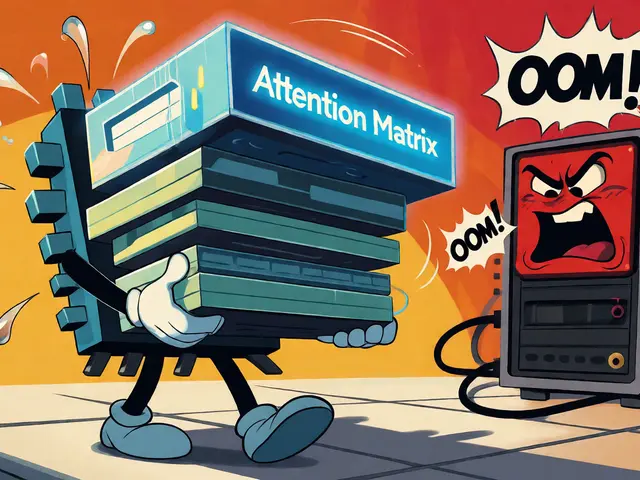
You just spent weeks compressing your large language model. You pruned the weights to cut memory usage and quantized everything down to 4-bit integers to speed up inference. It looks great on paper-faster, smaller, cheaper. But then you run it on a real task, and the results are garbage. The model hallucinates facts, loses coherence, or simply refuses to answer complex questions. This is the classic "compression penalty."
For years, the standard advice was simple: if compression breaks your model, you have to retrain it from scratch or do expensive full fine-tuning. That approach is slow, energy-intensive, and often impractical for teams with limited compute budgets. Fortunately, recent research from 2024 and 2025 has flipped this script. We now know that retraining after compression doesn't have to mean starting over. New techniques allow us to restore lost accuracy with a fraction of the cost, sometimes even improving performance beyond the original uncompressed model.
Why Compression Breaks Your Model
To fix the problem, we first need to understand why it happens. When you compress a model, you aren't just deleting data; you are altering the mathematical function the network uses to make predictions. Two main methods cause most issues: weight pruning, which removes connections (parameters) entirely, and low-bit quantization, which reduces the precision of numbers (e.g., from 16-bit floats to 4-bit integers).
Weight pruning creates sparse models by zeroing out less important weights. If done naively, this disrupts the flow of information through attention mechanisms and MLP blocks, leading to higher perplexity (a measure of how confused the model is). Low-bit quantization, especially aggressive formats like INT3 or INT2, introduces "quantization noise." This noise distorts the subtle gradients the model relies on for nuanced reasoning.
A 2025 study by Apple Machine Learning Research titled "Do Compressed LLMs Forget Knowledge?" revealed a critical insight: compression disproportionately harms knowledge-intensive tasks. Even if general perplexity looks okay, the model might lose access to long-tail factual information. The key question researchers asked was whether this knowledge was truly erased or just displaced internally. Their findings suggest it’s mostly displaced, meaning we can recover it without relearning everything from scratch.
The "Free Lunch": Local Reconstruction After Pruning
If you are using pruning, stop thinking about full-model retraining. A pivotal 2025 OpenReview paper, "A Free Lunch in LLM Compression: Revisiting Retraining after Pruning," demonstrated that careful post-pruning reconstruction can fully restore-and sometimes exceed-the original model's accuracy.
The secret lies in locality. Instead of backpropagating errors through the entire network (which is memory-heavy and slow), the authors recommend reconstructing weights locally within each transformer block. Specifically, they treat the attention heads and MLP modules separately.
- Global Retraining: Updates all parameters simultaneously. High memory cost, high compute cost, diminishing returns.
- Local Reconstruction: Optimizes only the remaining weights in specific layers. Low memory footprint, fast execution, superior accuracy recovery.
This method works particularly well when paired with simple pruning criteria like Wanda (Weight and Activation Aware pruning). Wanda identifies which weights matter most based on both their magnitude and the activation values they process. By combining Wanda with local reconstruction, you get a compressed model that performs better than one created with more complex sparsification algorithms that skip this reconstruction step. It’s called a "free lunch" because you get higher accuracy for significantly less effort than traditional fine-tuning.
Fixing Quantization Errors Without Full Training
Quantization is trickier because the error comes from rounding numbers, not removing them. The APXML advanced course module "Accuracy Recovery for Low-Bit Quantized LLMs" (2024) outlines a hierarchy of fixes, ranging from cheap to expensive.
1. Better Calibration Data
Most people use Post-Training Quantization (PTQ) tools like GPTQ or AWQ. These tools rely on a small calibration dataset to estimate how activations behave. If your calibration data doesn’t match your target workload, the quantization parameters will be wrong, and accuracy will drop. The fix? Use larger, more representative calibration sets. Don’t just grab random Wikipedia pages; use data that mirrors the actual queries your model will face.
2. Post-Quantization Fine-Tuning
If calibration isn’t enough, try short fine-tuning. Unlike full training, this involves running the quantized model for just a few hundred to a few thousand steps on representative data. This allows the remaining parameters to adjust to the quantization noise. It’s significantly cheaper than Quantization-Aware Training (QAT) but recovers a substantial chunk of lost accuracy, especially for 4-bit models.
3. Mixed-Precision Strategies
Not all layers are equally sensitive. Some attention projections or normalization layers break easily under low-bit constraints. A practical heuristic is to keep these sensitive layers at higher precision (INT8 or FP16) while aggressively quantizing the large linear layers to INT3 or INT2. This iterative experimentation balances speed gains with stability.
Compensation Without Gradients: Enter EoRA
What if you don’t want to train at all? NVIDIA Research introduced EoRA (Eigenspace Low-Rank Approximation) in 2024 as a game-changer for production environments. EoRA reframes compression error as a signal that can be compensated for rather than corrected through gradient descent.
Here’s how it works:
- You compress your model (pruning, quantization, or both).
- EoRA analyzes the compression error ($\Delta W$) in eigenspace.
- It adds residual low-rank paths to the model. These are tiny correction matrices that sit alongside the compressed weights.
- These paths are optimized using minimal calibration data, taking only minutes to complete.
Because EoRA doesn’t modify the original compressed weights or require gradient computation, it’s incredibly fast. NVIDIA reports that it consistently outperforms older SVD-based compensation methods across language generation, commonsense reasoning, and math tasks. For teams deploying heavily compressed models where gradient-based retraining is operationally too complex, EoRA offers a scalable, versatile alternative.

Prompt-Based Recovery: Is Knowledge Really Lost?
Remember Apple’s finding that knowledge is often displaced, not forgotten? They proposed a technique called IDP (Input-Dependent Prompting) to exploit this. Instead of adding new parameters via LoRA or fine-tuning, IDP modifies the input prompt to redirect the model’s internal state toward the displaced knowledge.
In experiments, IDP matched or surpassed LoRA-based retraining on knowledge-intensive tasks. More importantly, it saved 21x in extra parameter size and reduced inference latency by 60%. If your primary issue is factual recall after compression, try engineering your prompts before reaching for the GPU cluster. Sometimes, a clever system instruction is all it takes to reactivate dormant knowledge.
| Technique | Best For | Compute Cost | Key Advantage |
|---|---|---|---|
| Local Reconstruction | Pruned Models | Low | Higher accuracy than full retraining; memory efficient |
| Post-QT Fine-Tuning | 4-bit Quantized Models | Medium | Balances cost and accuracy recovery |
| EoRA Compensation | Heavily Compressed (Prune+Quant) | Very Low | No gradients needed; completes in minutes |
| IDP Prompting | Knowledge-Intensive Tasks | Negligible | Zero parameter overhead; lower latency |
| QAT (Quantization-Aware Training) | ≤3-bit Extreme Quantization | High | Highest possible accuracy for extreme compression |
Practical Implementation Checklist
So, what should you actually do tomorrow? Here is a step-by-step workflow to restore accuracy without burning cash.
- Baseline Evaluation: Before compressing, record your model’s perplexity and task-specific metrics (ROUGE for summarization, F1 for QA, pass@k for code). You can’t fix what you don’t measure.
- Compress Carefully: Use Wanda for pruning or AWQ/GPTQ for quantization. Ensure your calibration data represents your target domain.
- Test Immediately: Run the compressed model against your baseline. Identify where it fails-is it factual recall, reasoning, or coherence?
- Apply Targeted Recovery:
- If pruned: Try local reconstruction of attention/MLP blocks.
- If quantized: Try post-quantization fine-tuning for 500-1000 steps.
- If both: Consider EoRA for rapid compensation.
- If factual errors dominate: Experiment with IDP prompting strategies.
- Iterate: Compression recovery is rarely a one-shot fix. Adjust precision per layer, tweak calibration sets, or increase fine-tuning steps until you hit your accuracy threshold.
The era of monolithic, expensive retraining is ending. As models grow larger and compute budgets remain finite, these modular recovery techniques-from local reconstruction to prompt-based redirection-are becoming essential tools in the AI engineer’s toolkit. You don’t need to choose between speed and accuracy anymore. You just need the right recovery strategy.
Does retraining after compression always improve accuracy?
Not always, but properly designed retraining or compensation usually restores most lost accuracy. In some cases, such as local reconstruction after pruning, the recovered model can even outperform the original uncompressed baseline by optimizing the remaining parameters more effectively than the initial pre-training did.
What is the difference between QAT and post-quantization fine-tuning?
Quantization-Aware Training (QAT) simulates quantization during the entire training process, which is computationally expensive but yields the best results for extreme compression (like 2-bit or 3-bit). Post-quantization fine-tuning applies quantization first, then trains the already-compressed model for a short period. It is much faster and cheaper but may not recover as much accuracy for very aggressive bit-widths.
Can I use EoRA with any compression method?
Yes. EoRA is designed to be format-agnostic. It works with weight pruning, low-bit quantization, and combinations of both. It adds residual low-rank paths to compensate for errors regardless of how the compression was achieved, making it highly versatile for mixed-compression pipelines.
Why does my quantized model perform well on perplexity but poorly on tasks?
Perplexity measures next-token prediction likelihood, which can remain stable even if specific knowledge structures are damaged. Task performance, especially on knowledge-intensive benchmarks, relies on precise retrieval of facts and logical consistency. Compression often displaces or erases these specific knowledge pathways, causing a gap between general language modeling ability and specialized task accuracy.
Is local reconstruction harder to implement than full fine-tuning?
Implementation complexity varies, but local reconstruction is generally more resource-efficient. While it requires understanding the internal structure of transformer blocks (attention vs. MLP), it avoids the massive memory overhead of full-model backpropagation. Many modern frameworks support layer-wise optimization, making it accessible for teams with limited GPU memory.