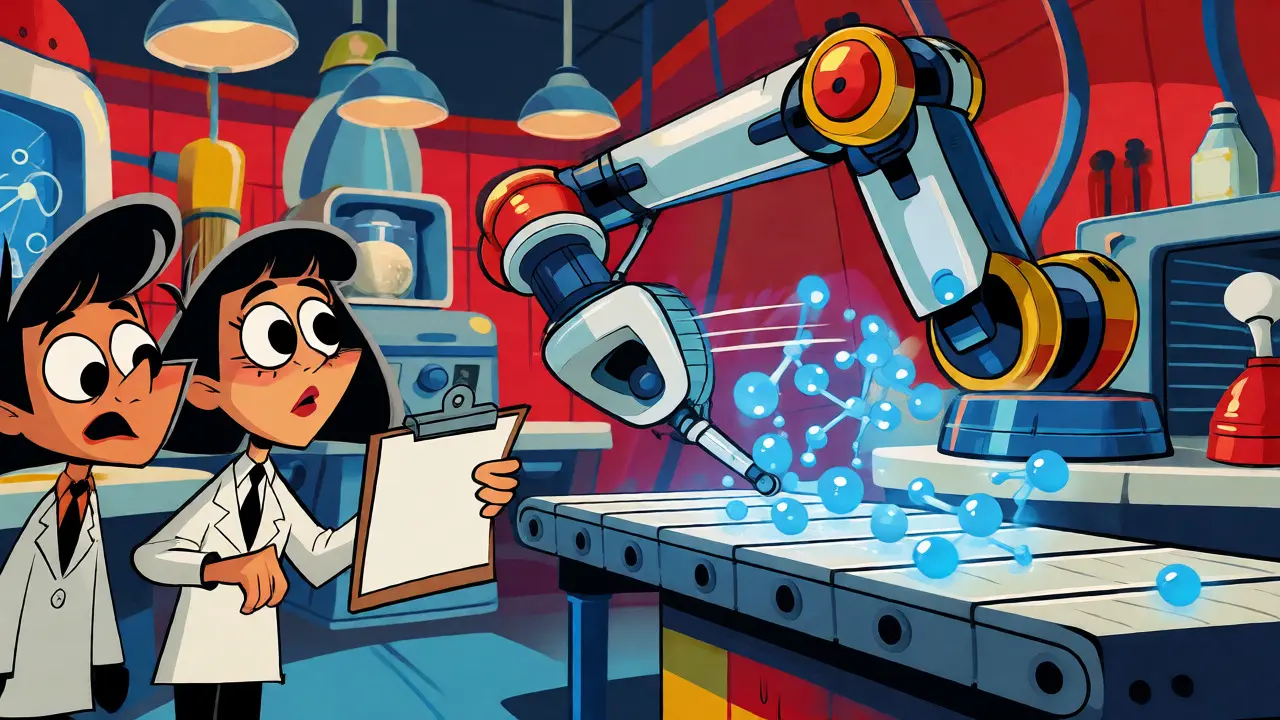
Imagine cutting the time it takes to find a viable drug candidate from years to months. That is no longer science fiction; it is the operational reality for pharmaceutical giants leveraging Generative AI in pharmaceutical research and development (R&D). As of October 2026, the industry has moved past experimental pilots into full-scale deployment. The traditional path to market, which historically took 12 to 18 years and cost $2.6 billion per approved drug, is being compressed by intelligent agents that design molecules and draft trial protocols simultaneously.
The Shift from Analysis to Action
For decades, AI in pharma was largely analytical-helping scientists sift through data. In 2026, we are witnessing the "Year of the Agent." This isn't just about better spreadsheets; it is about autonomous systems that reason, plan, and execute complex workflows. Industry consensus suggests that while 2025 was about embedding AI tools, 2026 is about letting them act. These agentic systems function as digital workforces, capable of screening millions of molecular structures and predicting toxicity without constant human oversight. The shift is profound: leadership is now tasked with governing these autonomous agents rather than just managing their output.
This transition addresses the brutal economics of drug development. With a success rate of only approximately 10% for candidates advancing to clinical trials, the cost of failure is astronomical. Generative AI mitigates this risk by exploring chemical spaces previously considered computationally intractable. It doesn't just find needles in haystacks; it helps build new haystacks where the needles are more likely to be sharp.
Molecule Design at Scale
The most transformative application lies in molecule design. Traditional medicinal chemistry requires synthesizing and testing thousands of compounds sequentially. Generative models flip this script. They can computationally screen millions of potential compounds, optimizing for efficacy, safety, and manufacturability simultaneously. A prime example involves one organization that designed 15 million potential compounds digitally. By using predictive models to assess properties like brain penetration, they narrowed the field to just 60 molecules for actual lab synthesis. This reduced resource expenditure dramatically, identifying a potent scaffold for further optimization in a fraction of the usual time.
Domain-specific models like BioGPT have reached human parity on benchmarks like PubMedQA, allowing researchers to synthesize insights from millions of published studies instantly. However, newer entrants such as Deep Intelligent Pharma are outperforming early generative models by up to 18% in automation tasks. The key advantage here is multi-property optimization. In traditional chemistry, improving one attribute often degrades another. Generative AI balances these trade-offs, creating molecules that are not just active against a target but also stable and safe for human consumption.
Accelerating Clinical Trials with Protocol Drafts
Once a molecule is selected, the next bottleneck is clinical trials. Drafting protocols is tedious, requiring alignment with regulatory standards and historical data patterns. Generative AI assistants now automate this process, generating concise summaries of trial progress and suggesting next steps based on real-time enrollment numbers. These systems track vast datasets, producing reports that enhance record-keeping and decision-making speed.
Intelligent resource allocation is another critical benefit. Instead of spreading personnel and funding thinly across multiple avenues, AI directs resources toward the most promising research paths. This efficiency is vital because while AI accelerates discovery, it cannot bypass biological constraints or regulatory review timelines. Claims of "10x faster drug development" often conflate preclinical acceleration with total timelines. The reality is a verified 30-40% compression in early discovery phases, reducing preclinical candidate development from three to four years down to 13-18 months.

Real-World Validation: Insilico Medicine
Skepticism remains high regarding whether AI-designed drugs actually work better than traditionally discovered ones. Enter Insilico Medicine. Their platform, Pharma.AI, generated a drug candidate, INS018_055, which entered Phase II clinical trials in 2026. This milestone was achieved in roughly three years, compared to the traditional decade-plus timeline. The drug targets idiopathic pulmonary fibrosis, a rare lung disease with limited treatments. While the compound still had to pass standard regulatory hurdles, the compression of early discovery and preclinical stages by 75% offers concrete validation of AI's capacity to save time and money.
| Metric | Traditional Methodology | AI-Driven Workflow (2026) |
|---|---|---|
| Time to Candidate | 3-4 Years | 13-18 Months |
| Compounds Synthesized | Thousands | Tens to Hundreds (Digital Screening First) |
| Hit Rate (Antibody Design) | ~0.1% | 16-20% |
| Total Development Cost | $2.6 Billion Avg. | Reduced via Early Attrition Filtering |
| Protocol Drafting | Manual, Weeks | Automated, Hours/Days |
Autonomous Labs and Closed-Loop Systems
Beyond digital screens, physical laboratories are undergoing a revolution. "Self-driving labs" or closed-loop systems are expanding experimental throughput beyond human capacity. These robotic facilities operate 24/7, running experiments autonomously. They design compounds based on results, synthesize new candidates, and test them without human intervention. This continuous cycle significantly increases the volume of data generated, allowing for deeper exploration of chemical space. For organizations deploying these systems, the challenge shifts from manual labor to maintaining governance and quality assurance protocols for autonomous outputs.

Regulatory Landscape and Governance
You cannot ignore the regulator. In 2026, the FDA’s finalization of AI guidance and the EU AI Act implementation define compliance requirements for high-risk applications. Organizations must prepare comprehensive documentation on model validation and governance structures. This regulatory clarity reduces uncertainty, allowing companies to integrate generative tools into defined workflows with clear traceability. The World Economic Forum notes that AI reshapes three critical steps: identifying disease targets, generating compounds, and predicting safety properties. Each step now requires rigorous audit trails to satisfy regulators who demand transparency in how algorithms make decisions affecting patient health.
The Future Outlook: Efficacy vs. Speed
As we move through late 2026, multiple AI-designed drugs are entering Phase III pivotal trials. These readouts will provide the first large-scale test of whether AI fundamentally improves clinical success rates or merely accelerates timelines. Statistical probability suggests some failures will occur given historical attrition rates. A contrarian view argues that AI-discovered compounds show progression rates similar to traditional ones, implying the value lies in commercial speed rather than superior biology. Regardless, the market projection for AI in pharma is robust, growing from $1.94 billion in 2025 to a projected $16.49 billion by 2034. The question is no longer if AI belongs in pharma, but how deeply it will embed itself before the next breakthrough.
How much time does Generative AI save in drug discovery?
Generative AI typically compresses early discovery timelines by 30-40%. Specifically, preclinical candidate development can drop from the traditional 3-4 years to 13-18 months. However, total development time remains constrained by regulatory reviews and manufacturing scale-up, which AI cannot bypass.
Can AI replace medicinal chemists in molecule design?
No, AI augments rather than replaces. It handles the computational screening of millions of compounds and optimizes multiple properties simultaneously. Human experts remain crucial for interpreting results, designing validation experiments, and making strategic decisions about which molecules to advance to synthesis.
What are the risks of using AI-generated trial protocols?
The primary risks involve hallucinations or biases in training data that could lead to non-compliant protocols. Rigorous governance, including human oversight and validation against current FDA/EU guidelines, is essential. Traceability of AI recommendations is required for regulatory approval.
Is there proof AI drugs work as well as traditional ones?
Phase II data from candidates like INS018_055 shows promise, but definitive proof awaits Phase III outcomes expected throughout 2026. Current evidence suggests AI primarily accelerates timelines; whether it improves intrinsic clinical efficacy compared to human-designed molecules is still under large-scale statistical testing.
How do self-driving labs impact R&D costs?
Self-driving labs increase throughput by operating 24/7, reducing the time spent on repetitive synthesis and testing cycles. This lowers the cost per experiment and allows for broader exploration of chemical space, potentially identifying better candidates earlier and reducing downstream failure costs.



the philosophical implications here are wild cause if the agent is designing the molecule and drafting the protocol who is actually responsible when a trial fails? we are moving from tool users to tool governors which changes the entire ethical framework of scientific inquiry. its not just about speed its about accountability in a black box system that we barely understand yet.
Look, everyone is hyping this up but let's look at the actual data. The post claims a 30-40% compression in early discovery phases but ignores the massive regulatory friction introduced by the EU AI Act and FDA guidance. You cannot simply throw generative models into GxP environments without rigorous validation protocols that cost more than the savings you claim to generate. The hit rate improvement from 0.1% to 16-20% is impressive on paper but statistically insignificant when you consider the attrition rates in Phase II and III remain stubbornly high due to biological complexity that algorithms still fail to model accurately. We are seeing confirmation bias in these case studies where successful candidates get all the press while the thousands of failed digital screens go unreported. Until we see consistent Phase III success rates across diverse therapeutic areas, this is just expensive hype for investors rather than a fundamental shift in medicinal chemistry paradigms.
I think you're being too harsh on the potential here! Even if the Phase III rates don't skyrocket immediately, the reduction in preclinical time from 3-4 years to 13-18 months is huge for patients waiting for treatments. It means fewer people suffer while we wait for answers and resources aren't wasted on dead-end compounds as quickly. Progress doesn't always look like a revolution overnight, sometimes it's just making the process less painful for everyone involved. Let's keep an open mind about how this helps us move faster toward cures!
The assertion that "leadership is now tasked with governing these autonomous agents" is technically inaccurate; leadership governs the human operators who oversee the agents. Furthermore, the comparison of traditional methodologies to AI-driven workflows conflates distinct stages of development. One cannot compare the time to candidate identification directly with total development timelines without accounting for the fixed duration of clinical trials. The table provided lacks statistical significance markers for the hit rate improvements, rendering the comparison anecdotal rather than empirical. Precision in terminology matters when discussing regulatory compliance under the EU AI Act.
they are hiding the real reason why they want this speed. its not to save lives its to patent everything before the public realizes the drugs are basically the same as what we already have but with a new label. big pharma is terrified of generic competition so they use AI to churn out minor variations to extend their monopolies. watch closely because the "self-driving labs" will just be used to hide the fact that they are recycling old molecules with slight tweaks to keep the profits flowing. i smell something fishy in the way the data is presented.
finally some good news for once 🙌 it feels like we are actually getting somewhere instead of just talking about it. hopefully this means cheaper meds for regular folks and not just richer CEOs 😤
Oh please, spare me the drama about "governing agents." If you can't manage a simple spreadsheet, how do you expect to manage an autonomous workforce? This whole narrative is designed to make scientists feel obsolete so they accept lower pay for overseeing robots. It’s intrusive to suggest that our intuition is inferior to an algorithm trained on biased historical data. I’ve seen enough failed pilots to know that until a robot can explain *why* a molecule works to a patient, it’s just a fancy calculator. Stop pretending this is a breakthrough when it’s just automation dressed up in sci-fi clothing. It’s annoying how everyone pretends this solves the creativity crisis in R&D.
honestly tho the typo-prone nature of most ai outputs is gonna be a nightmare for legal teams 😅 im sure theyll fix it eventually but right now its kinda scary relying on bots for trial protocols. :/