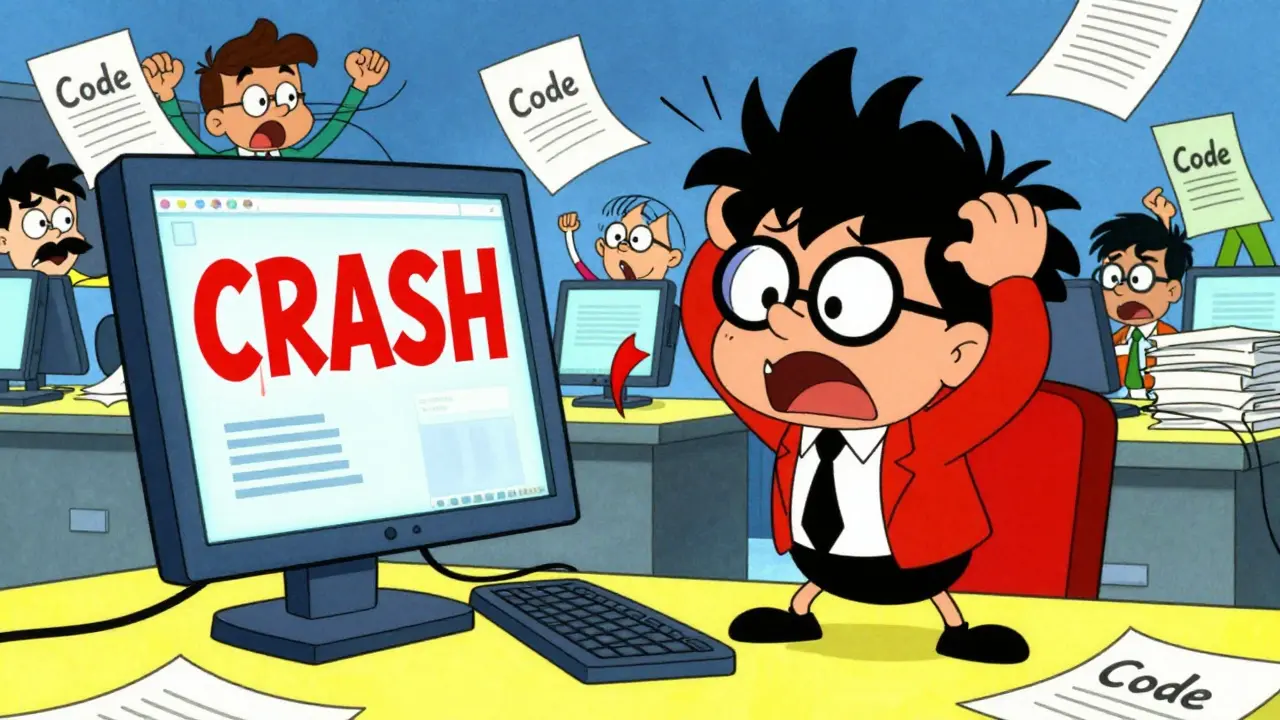
Picture this: you merge a pull request that looks perfect. The tests pass. The linter is happy. But three hours later, the payment gateway crashes because a subtle change in a shared utility function broke a downstream service nobody knew depended on it. In 2026, this isn't just bad luck-it's a symptom of a broken system.
We are drowning in code generated by artificial intelligence. Teams use AI coding assistants to write features faster than ever before. But speed comes with a hidden cost: opacity. When an AI writes code across multiple repositories, who owns that logic? Who maintains it? And crucially, does anyone actually know how those pieces fit together?
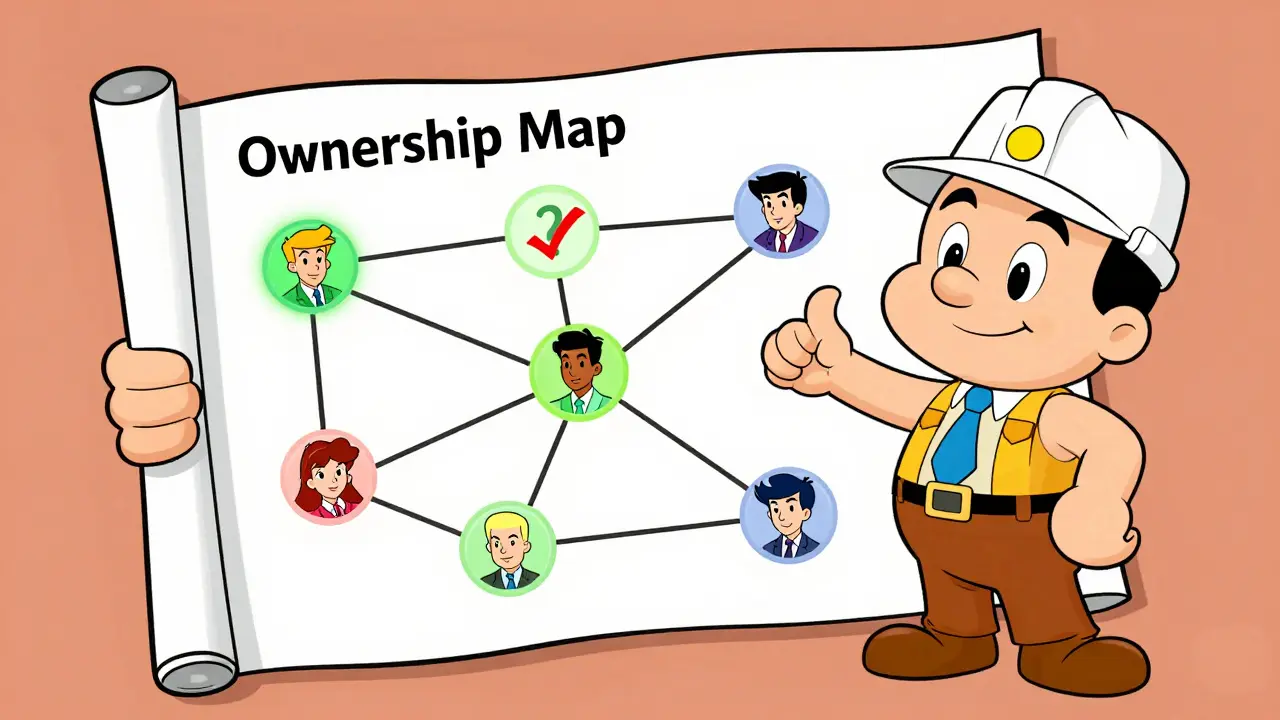
This is where Ownership Maps come in. They are not just diagrams; they are survival tools for modern engineering teams. An ownership map defines exactly who maintains what in your distributed systems, bridging the gap between technical dependencies and human responsibility. Without them, you are flying blind.
The Crisis of Context in Distributed Systems
Let’s look at the numbers. As of May 2026, 84% of enterprise teams managing large-scale infrastructure are relying on basic autocomplete-focused AI assistants. These tools are great for writing snippets, but they have tiny context windows. They don’t understand your entire tech stack. They don’t see the forest for the trees.
When you manage 50 or more distributed repositories, the complexity explodes. A single feature might touch five different microservices, each maintained by a different team. If Service A changes an API endpoint, does Service B break? Does Service C? Traditional documentation rots the moment the code changes. Human memory fails under pressure. This leads to production incidents caused by missed cross-service dependencies.
The problem isn't just technical debt; it's organizational debt. We need a way to map the architecture dynamically. We need to know not just what code exists, but who is responsible for keeping it alive.
What Is an Ownership Map?
An ownership map combines two distinct layers into one actionable framework:
- Technical Dependency Mapping: This is the AI-driven layer. It extracts every import statement, function call, and service interaction across your codebase. It builds a live, interactive graph of how components connect.
- Organizational Ownership Mapping: This is the human layer. It assigns clear responsibility for data, models, prompts, monitoring, and escalation procedures.
Think of it as a marriage between a circuit diagram and an org chart. You can see the current flowing through the wires (code dependencies) and know exactly which engineer is on call if a wire snaps (human ownership).
In AI-assisted development, this distinction is critical. Because AI generates code so quickly, the "author" is often ambiguous. Did the intern write that function, or did the LLM suggest it? The ownership map clarifies that regardless of who wrote the code, a specific human or team is accountable for its behavior in production.
Key Tools Defining the Landscape
Several platforms have emerged to solve this specific pain point. They move beyond simple code completion to offer architectural awareness. Here is how the leading contenders compare:
| Platform | Core Technology | Key Differentiator | Compliance/Certification |
|---|---|---|---|
| Augment Code | Context Engine & COD Model | Live understanding of entire tech stacks; first ISO/IEC 42001 certified AI assistant | ISO/IEC 42001:2023, SOC 2 Type II |
| Moddy (by Moderne) | OpenRewrite Lossless Semantic Trees | Compilation-verified refactoring; semantic accuracy preservation | Enterprise-grade security standards |
| Mapstack | AI-powered spatial mapping | No GIS skills required; instant location insights | Standard cloud security |
Augment Code stands out for its governance focus. Its COD Model (Code Operations Decoder) parses source code to extract every import and call sequence, building interactive maps of system connections. More importantly, it achieved ISO/IEC 42001:2023 certification from Coalfire Certification. This makes it the first AI coding assistant with independently verified AI governance. For regulated industries like finance or healthcare, this isn't a nice-to-have; it's a requirement.
Moddy, developed by Moderne, takes a different approach. It uses Lossless Semantic Trees (LSTs) to ensure that when AI suggests a refactor, the semantic meaning remains intact. It verifies compilation safety across the whole repository. This reduces the risk of introducing bugs during large-scale transformations.
The Five Pillars of AI Control Ownership
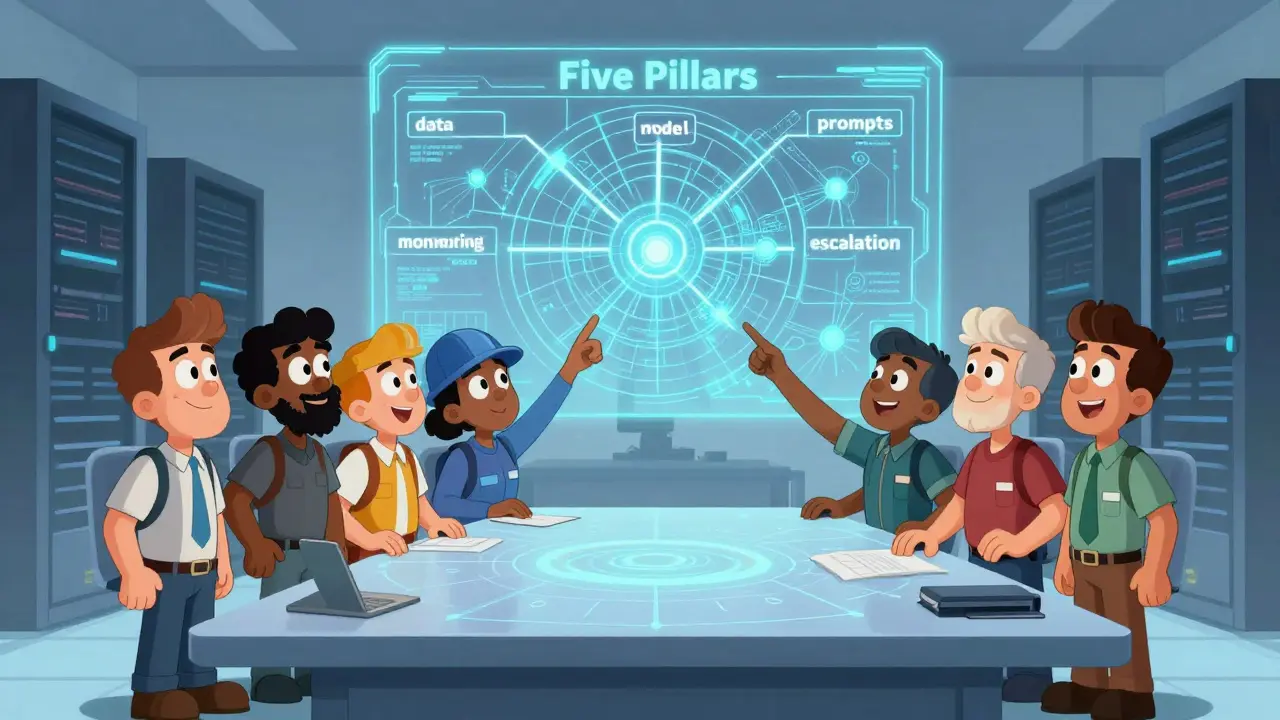
To build a robust ownership map, you must define responsibility across five specific domains. Vague agreements lead to finger-pointing during outages. Be explicit:
- Data Ownership: Who owns the raw inputs and processed outputs? If the AI model hallucinates based on bad training data, who is liable?
- Model Ownership: Who manages the trained AI systems and their configurations? Who decides when to retrain or update the model version?
- Prompt Ownership: Who writes and maintains the instructions given to the AI? Prompt drift is real-changes in wording can alter behavior significantly.
- Monitoring Ownership: Who sets up observability and performance tracking? You cannot fix what you do not measure.
- Escalation Procedures: Who handles system failures? Define clear runbooks for when the AI-generated code fails in production.
This framework prevents the "bystander effect" where everyone assumes someone else is watching the AI. By assigning these roles, you create accountability.
Implementing Ownership Maps: A Phased Approach
You cannot boil the ocean. Start small, validate, then scale. Here is a practical roadmap for implementing ownership maps in your organization:
Phase 1: Validation (Months 1-2)
Select 3-5 representative repositories with well-understood dependency patterns. Assemble a team of 5-8 senior developers who know these architectures inside out. Use your chosen tool (like Augment Code or Moddy) to generate dependency graphs. Then, compare the AI-generated maps against the known architectural reality.
This phase establishes baseline accuracy. You will likely find gaps where the AI misinterprets dynamic imports or runtime behaviors. Document these discrepancies. This is your learning curve.
Phase 2: Integration (Months 3-6)
Expand deployment to larger repository sets. Integrate the mapping tools into your CI/CD pipelines. Every time code is committed, the ownership map should update automatically. Flag any new dependencies that lack assigned owners. Block merges if critical services are touched without proper notification to dependent teams.
Phase 3: Continuous Monitoring (Ongoing)
Monitor accuracy and compliance metrics. Track how often the AI’s understanding of dependencies matches actual runtime behavior. Refine your prompts and ownership assignments based on incident post-mortems. Treat the ownership map as a living document, not a static PDF.
Navigating Copyright and Legal Ambiguity
Here is the uncomfortable truth: copyright law has not caught up with AI-generated code. Who owns the dependency map itself? Who owns the architectural diagrams generated by the AI? In most jurisdictions, this remains legally ambiguous.
This ambiguity underscores why human validation is non-negotiable. Even if an AI generates a perfect dependency map, human architects must validate that it reflects the intended design. You need a chain of custody for your architectural knowledge. Keep audit trails of who approved which parts of the map. This protects your organization from legal risks and ensures governance compliance.
For open-source ecosystems, community-driven models show promise. Initiatives like OpenStreetMap demonstrate how distributed contributors can collectively maintain complex maps. Applying this model to codebases means encouraging developers to contribute to and validate the ownership map as part of their daily workflow.
Why This Matters for Maintainability
Maintainability is the ability to evolve software without breaking it. AI threatens this by accelerating change while obscuring context. Ownership maps restore visibility. They turn chaos into structure.
Without them, you are vulnerable to "architectural drift," where the system slowly diverges from its original design due to untracked changes. With them, you gain confidence. You know who to call. You know how things connect. You can move fast because you understand the consequences of moving fast.
The future belongs to teams that treat ownership mapping as core infrastructure. Not a side project. Not a nice-to-have. A fundamental requirement for surviving the AI era.
What is an ownership map in AI-generated repositories?
An ownership map is a framework that combines technical dependency mapping with organizational responsibility assignment. It visually represents how code components interact across repositories and explicitly states which humans or teams are accountable for maintaining those components, including data, models, and monitoring.
Why are traditional documentation methods insufficient for AI-generated code?
Traditional documentation becomes outdated quickly because AI accelerates code changes. Static docs cannot capture dynamic dependencies across distributed systems. Ownership maps provide real-time, automated updates that reflect the current state of the codebase, ensuring accuracy.
How does Augment Code differ from other AI coding assistants?
Augment Code focuses on architectural understanding rather than just autocomplete. It uses a Context Engine to maintain a live view of the entire tech stack and holds ISO/IEC 42001:2023 certification for AI governance, making it suitable for regulated enterprises requiring strict compliance.
Who owns the code generated by AI assistants?
Legally, this is often ambiguous. However, operationally, ownership should be assigned to the human team that integrates, validates, and maintains the code in production. The ownership map clarifies this responsibility regardless of the legal status of AI-generated content.
What are the five pillars of AI control ownership?
The five pillars are Data Ownership (inputs/outputs), Model Ownership (trained systems/configs), Prompt Ownership (instructions), Monitoring Ownership (observability), and Escalation Procedures (incident response). Defining these ensures clear accountability.
How do I start implementing ownership maps in my organization?
Start with a validation phase using 3-5 representative repositories. Compare AI-generated dependency graphs against known architecture with senior developers. Then integrate the tools into your CI/CD pipeline for continuous updates and expand to broader repository sets.
Is Moddy suitable for large-scale refactoring?
Yes, Moddy uses OpenRewrite's Lossless Semantic Trees to ensure semantic accuracy during transformations. It verifies compilation safety, making it ideal for safe, large-scale refactoring across enterprise codebases.
What is architectural drift and how do ownership maps prevent it?
Architectural drift occurs when a system's actual structure diverges from its intended design due to untracked changes. Ownership maps prevent this by providing real-time visibility into dependencies and enforcing accountability for changes, allowing teams to detect and correct deviations early.
Hey everyone! I really like how this breaks down the scary stuff into simple steps. It feels like someone finally said what we all think but are too afraid to admit in meetings. We need more of this inclusive approach to tech docs so nobody gets left behind when the AI takes over the coding. :)
Oh my gosh, you have no idea how much this resonates with me on a deeply personal level because I remember one time back in 2023 when a single line of code broke our entire staging environment and it was just devastating for everyone involved and honestly it changed my life forever because I started questioning everything about trust and technology and now reading this makes me feel seen and heard and validated in my struggle against the opaque nature of modern software development which is literally killing us slowly but surely and we need to scream about it louder than ever before or else we will all perish in a sea of unowned dependencies!!! :(((((((
I can see why Sandy is feeling so strongly about this. It is easy to get overwhelmed by the scale of the problem. The point about organizational debt is really important though. We often focus so much on technical debt that we forget the human element. If we don't know who owns what, we can't collaborate effectively. It creates friction where there shouldn't be any.
The concept of ownership is fluid anyway. Who really owns an idea once it is shared? The map is just a shadow of the real thing. But maybe that shadow is enough to keep us from tripping over each other in the dark. Interesting perspective.
meh. seems like extra work.
Jeanie; your comment lacks punctuation. And substance. Also; the article is spot on. You should read it again. With glasses. Maybe then you would understand why mapping dependencies is not "extra work" but rather essential maintenance. ;)
Let us examine the implications of ISO/IEC 42001:2023 certification more closely. While Augment Code claims compliance, one must ask if the certifying body has been compromised by corporate interests seeking to standardize surveillance mechanisms under the guise of governance. The Lossless Semantic Trees proposed by Moddy are theoretically sound yet practically suspect given the inherent entropy of distributed systems. We must remain vigilant against the illusion of control provided by these tools. They are merely digital leashes for a beast we do not fully comprehend. Proceed with extreme caution and skepticism. The architecture is a facade. The truth lies in the chaos beneath.
You are wrong about the entropy part Mark. The semantic trees are verified by compilation. This means the code actually works. I have used Moddy in production and it saves hours of debugging time. Stop spreading fear and start using the tools properly. The grammar in your post is also overly complex and hard to follow. Keep it simple.