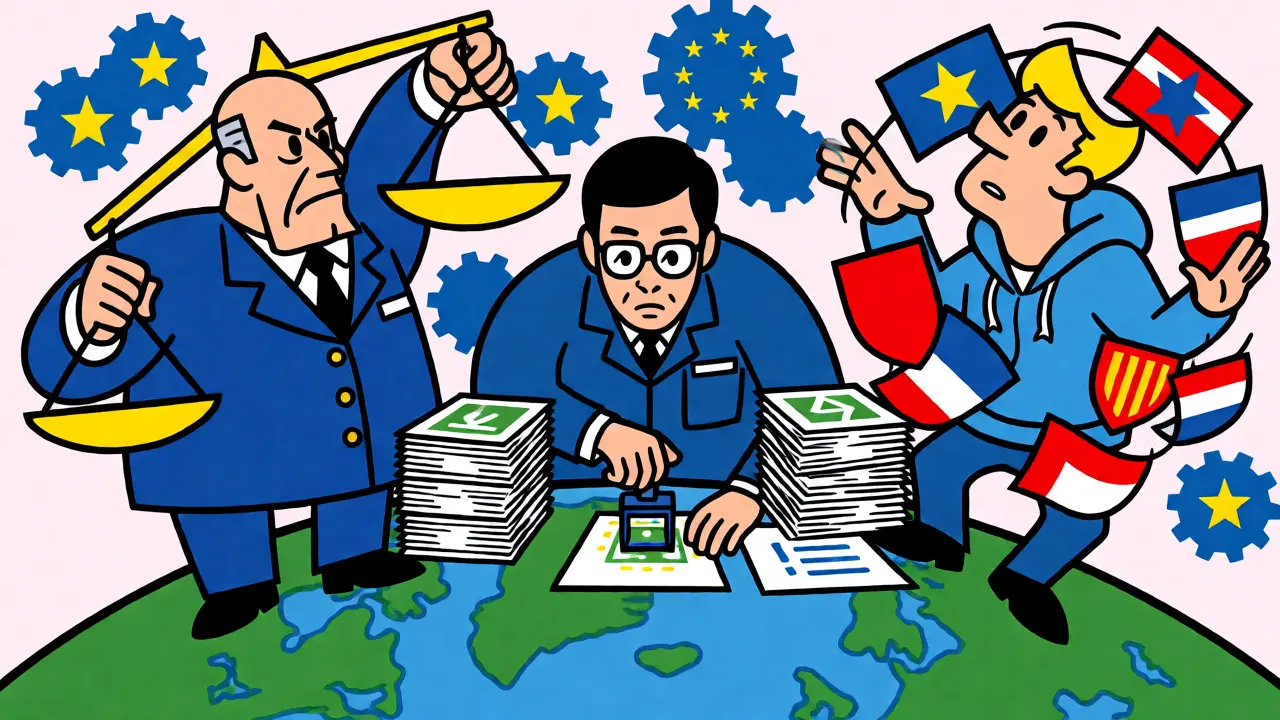
Remember when Generative AI was just a cool demo? Well, that party ended around 2023. By late 2025, the landscape had shifted dramatically. We now have 47 national or supranational regulatory initiatives tracking our algorithms, with 23 of them actively enforcing rules. If you're building or deploying AI today, ignoring these frameworks isn't just risky-it's expensive.
The core problem isn't just "following the law." It's navigating a fragmented world where a model compliant in Brussels might be illegal in Beijing or require different disclosures in California. The World Economic Forum noted in 2025 that 78% of multinational corporations struggle with this fragmentation. So, how do you keep your product legal without drowning in paperwork? Let's break down the major players, the technical requirements, and what it actually costs to stay compliant as we move through 2026.
The Big Three: EU, China, and the US Approach
You can't understand global AI regulation without looking at the three distinct models emerging from the EU, China, and the United States. Each takes a fundamentally different stance on risk and innovation.
The European Union leads with its EU AI Act, which entered into force in August 2024. It’s the world’s first comprehensive legal framework. The EU uses a risk-based approach, classifying AI systems into four tiers: unacceptable (banned), high-risk (strictly regulated), limited risk (transparency required), and minimal risk (voluntary). For generative AI, the focus is heavily on General-Purpose AI (GPAI) models. As of August 2025, providers must conduct systemic risk assessments using 17 specific criteria, including factual accuracy benchmarks and bias mitigation metrics. If your model powers critical infrastructure or employment decisions, you’re in the high-risk bucket, requiring conformity assessments and human oversight mechanisms.
China took a more prescriptive route early on. Its Interim Measures for the Management of Generative Artificial Intelligence Services became effective in August 2023. Unlike the EU’s broad principles, China mandates algorithm registration and requires content alignment with "socialist core values." A key technical requirement here is cryptographic watermarking. Every piece of AI-generated content must carry verifiable provenance metadata. This isn’t optional; it’s how regulators track misinformation and deepfakes. Dr. Ping Zhang from the Chinese Academy of Sciences argued in 2025 that this proactive approach actually accelerated industry maturation, with 87% of surveyed Chinese AI companies reporting better data governance within a year.
The United States remains sectoral and state-driven. There is no single federal AI law yet. Instead, states like California are stepping in. California’s SB 1047, effective January 1, 2025, focuses on safety testing for large foundation models. It requires developers to conduct "red teaming" assessments using at least three independent organizations and report incidents within 72 hours. Meanwhile, the federal government leans on voluntary guidelines. The National Telecommunications and Information Administration released its "AI Accountability Policy Framework" in October 2025, which 41 states have committed to incorporating by mid-2026. Professor Susan Athey warned in Senate testimony that this fragmentation could increase costs by 40-60% for global companies compared to a harmonized system.
Technical Requirements: What You Actually Have to Do
Compliance isn't abstract. It translates into specific engineering tasks. If you think you can just slap a disclaimer on your chatbot and call it a day, think again.
Under the EU AI Act, if your system is high-risk, you need to maintain detailed logs of inputs and outputs for 10 years. That’s a massive storage and retrieval challenge. You also need to prove robustness against adversarial attacks. The European Commission’s July 2025 guidance specifies that bias disparities across demographic groups must remain below 15%. How do you measure that? Standardized evaluation metrics. You can’t just say "it looks fair." You need data.
In China, the Deep Synthesis Regulation mandates that all AI-generated media includes cryptographic watermarks. This means your generation pipeline needs to embed metadata at the bit level, not just add a visible logo. Verifiable provenance is key. If a user shares an image, the metadata should tell them who made it and with what model version.
For those operating globally, the NIST AI Risk Management Framework has become a de facto standard, even outside the US. Colorado’s AI Act references it as an acceptable compliance standard. It breaks down risk management into four functions: Govern, Map, Measure, and Manage. Implementing this fully requires evidence for 127 sub-practices. It’s rigorous, but it helps bridge gaps between jurisdictions because many countries recognize NIST’s authority.
| Feature | EU AI Act | China Interim Measures | US State Laws (e.g., CA) |
|---|---|---|---|
| Primary Approach | Risk-based classification | Prescriptive & Content Control | Sectoral & Safety Testing |
| Key Technical Req. | Systemic risk assessment, logging (10 yrs) | Algorithm registration, watermarking | Red teaming, incident reporting (72 hrs) |
| Transparency Focus | GPAI documentation, copyright training data | User understanding of basic functioning | Consumer disclosure of AI use |
| Enforcement Body | European AI Office / National Authorities | CAC (Cyberspace Admin of China) | State Attorneys General / FTC |
The Cost of Compliance: Budgeting for Reality
Let’s talk money. Compliance isn't free, and it’s not cheap. A senior compliance officer at a European startup admitted in late 2025 that hitting the GPAI deadline forced them to hire three specialists and budget €450,000 for third-party auditing-costs they hadn’t planned for in 2024.
Dr. Anja Kaspersen from the Carnegie Council estimated that compliance costs for high-risk AI developers in the EU hit €1.2 million annually. That’s a heavy lift for SMEs. In fact, 82% of small companies (under 50 employees) reported dedicating over 20% of their engineering resources to compliance, compared to just 37% for large enterprises. Why? Large companies have dedicated teams. Small ones have founders wearing too many hats.
The global AI governance technology market hit $14.7 billion in Q3 2025, growing at 63% year-over-year. Most of that spend goes toward tools that help automate documentation and monitoring. Platforms like Trustible AI are popular, rated 4.6/5 by enterprise users, but they come with a steep learning curve. Expect 3-4 weeks of staff training just to get your team up to speed.
If you’re planning your roadmap, factor in time-to-market delays. A survey by the International Association of Privacy Professionals found that AI developers face an average delay of 5.7 months due to regulatory hurdles. If you’re launching a new feature, build that buffer into your timeline.
Standards and Certification: The Path to Harmony
Despite the fragmentation, there’s movement toward convergence. The OECD’s AI Principles, adopted by 42 countries, serve as a common language. While only 17 of those countries have turned them into binding legislation, most strategies reference them. This creates a baseline for mutual understanding.
A major step forward is the General-Purpose AI Code of Practice, developed jointly by the GPAI and the EU AI Office. By September 2025, 63% of multinational AI companies were using this voluntary framework as their primary compliance benchmark across multiple jurisdictions. It’s becoming the "ISO" of AI ethics-a way to signal trustworthiness without getting bogged down in every local nuance immediately.
Certification is the next big lever. The World Economic Forum projects that interoperable certification frameworks could reduce compliance costs by 35% and boost global AI market growth by $127 billion annually by 2028. Currently, only 32% of countries have mechanisms for mutual recognition of compliance assessments. That gap is closing, though. Expert Support Centres launched in Canada, France, and Japan in late 2025 are helping companies navigate these standards, with participants achieving compliance 30% faster than industry averages.

Practical Steps for Implementation
So, what do you do Monday morning? Don’t try to boil the ocean. Use a phased approach.
- Map Your Systems: Identify which of your AI products fall under high-risk categories in the EU or require registration in China. Start with the NIST AI Risk Management Framework for initial assessment. It takes 80-120 hours for a comprehensive review.
- Prioritize Documentation: The biggest pain point is proving transparency without revealing trade secrets. 43% of EU companies struggle with this. Invest in tools that generate automated technical documentation from your code and training pipelines.
- Implement Watermarking Early: If you generate media, bake cryptographic watermarking into your pipeline now. Retrofitting it later is messy and expensive.
- Train Your Team: Salesforce allocated $8.2 million for AI compliance training across 70,000 employees. You don’t need that scale, but you do need awareness. Ensure your engineers understand why they’re logging data, not just how.
- Engage Regulators: Use regulatory sandboxes. The UK’s AI and Digital Hub offers temporary exemptions for innovators. It’s a safe space to test compliance assumptions before full rollout.
Keep an eye on environmental metrics too. 17 jurisdictions now require carbon footprint reporting for training large models. By 2027, that number is expected to double. Green AI isn't just marketing anymore; it's a compliance checkbox.
Frequently Asked Questions
Is the EU AI Act applicable to non-EU companies?
Yes, if their AI systems are placed on the EU market or their output is used within the EU. This extraterritorial reach means any company serving European customers must comply, regardless of where they are headquartered.
What counts as a 'high-risk' AI system under the EU AI Act?
High-risk systems include those used in critical infrastructure, education, employment, essential services, law enforcement, and migration. Specifically, 27 use cases are listed. If your AI makes decisions affecting people's lives or rights significantly, it likely falls into this category.
How does China's algorithm registration affect foreign companies?
Foreign companies offering generative AI services in China must register their algorithms with the Cyberspace Administration of China (CAC). This involves disclosing basic functioning principles and submitting samples for review. The process can add 4-6 months to launch timelines.
Are there penalties for non-compliance?
Yes. The EU can fine up to 7% of global annual turnover or €35 million, whichever is higher. In November 2025, the French Data Protection Authority fined a major developer €17 million for transparency violations. Other jurisdictions vary, but reputational damage and market access loss are often bigger risks than fines.
What is the NIST AI Risk Management Framework?
It is a voluntary guidance document from the U.S. National Institute of Standards and Technology. It provides a structured approach to managing AI risks through four functions: Govern, Map, Measure, and Manage. Many regions accept it as a benchmark for good practice, making it a useful starting point for global compliance.
Do I need to disclose training data sources?
Under the EU AI Act, providers of general-purpose AI models must provide sufficient information about their training data to allow downstream users to comply with copyright laws. Exact details can be proprietary, but summaries and methodologies must be disclosed.
How long does full compliance take?
The EU AI Office suggests 12-18 months for full compliance with the AI Act. High-risk developers need dedicated teams. Smaller companies may take longer due to resource constraints. Starting early is crucial to avoid last-minute scrambles.
Is watermarking mandatory everywhere?
Not everywhere, but it is mandatory in China for AI-generated content. The EU requires transparency that can be achieved via labeling or metadata, but watermarking is becoming a best practice for provenance tracking globally, especially for combating deepfakes.