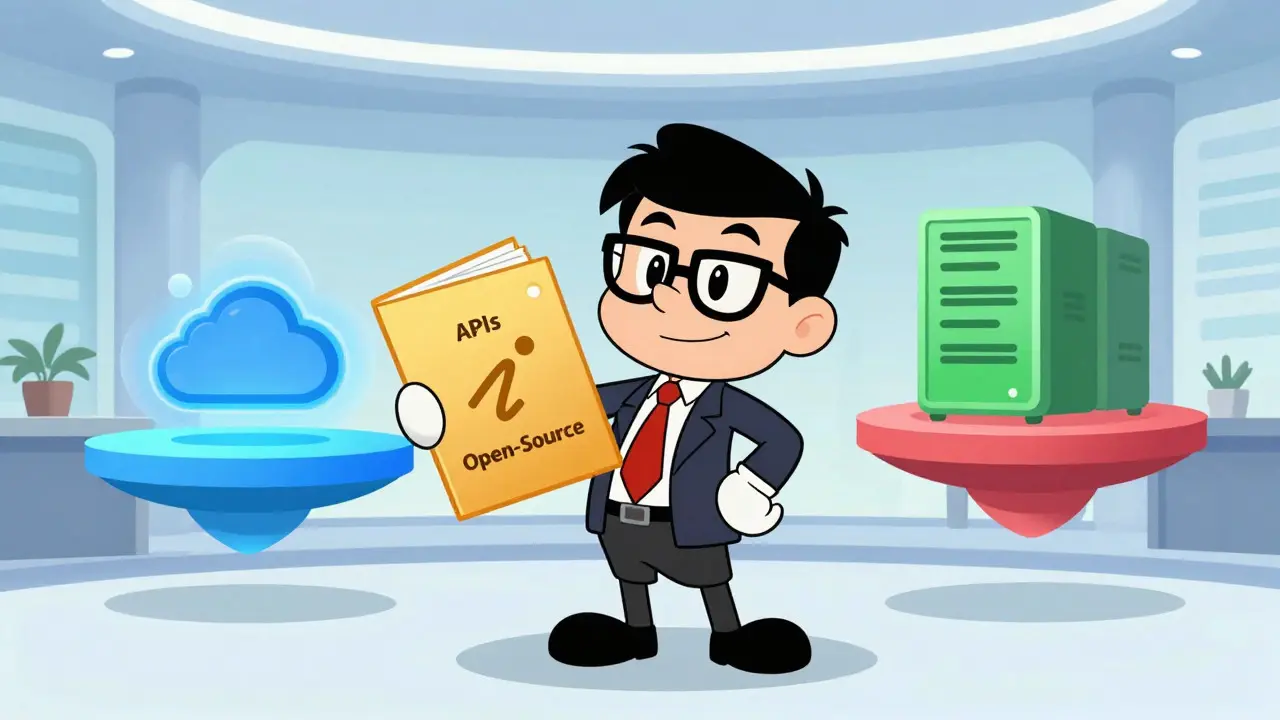
Most companies think they need to pick one "best" large language model. That’s a mistake that costs money and creates risk. In 2026, the winners aren't choosing between GPT-5, Llama 4, or a custom fine-tuned model; they are managing all three like an investment portfolio. This is LLM Portfolio Management, the strategic approach enterprises use to optimize investments across API-based commercial models, open-source foundation models, and custom-built models. It’s about balancing control, cost, accuracy, and compliance for different business needs.
You don’t want your most critical, sensitive data running on a generic public API. But you also don’t want to spend $400,000 building a custom model for a simple customer support chatbot. The goal is to match the right model type to the right job. According to recent CIO surveys, 87% of enterprises now have a formal strategy for this, seeing operational cost reductions of up to 62% while keeping performance high. If you’re still using a single-model strategy, you’re likely overpaying or underperforming.
The Three Tiers of Your LLM Stack
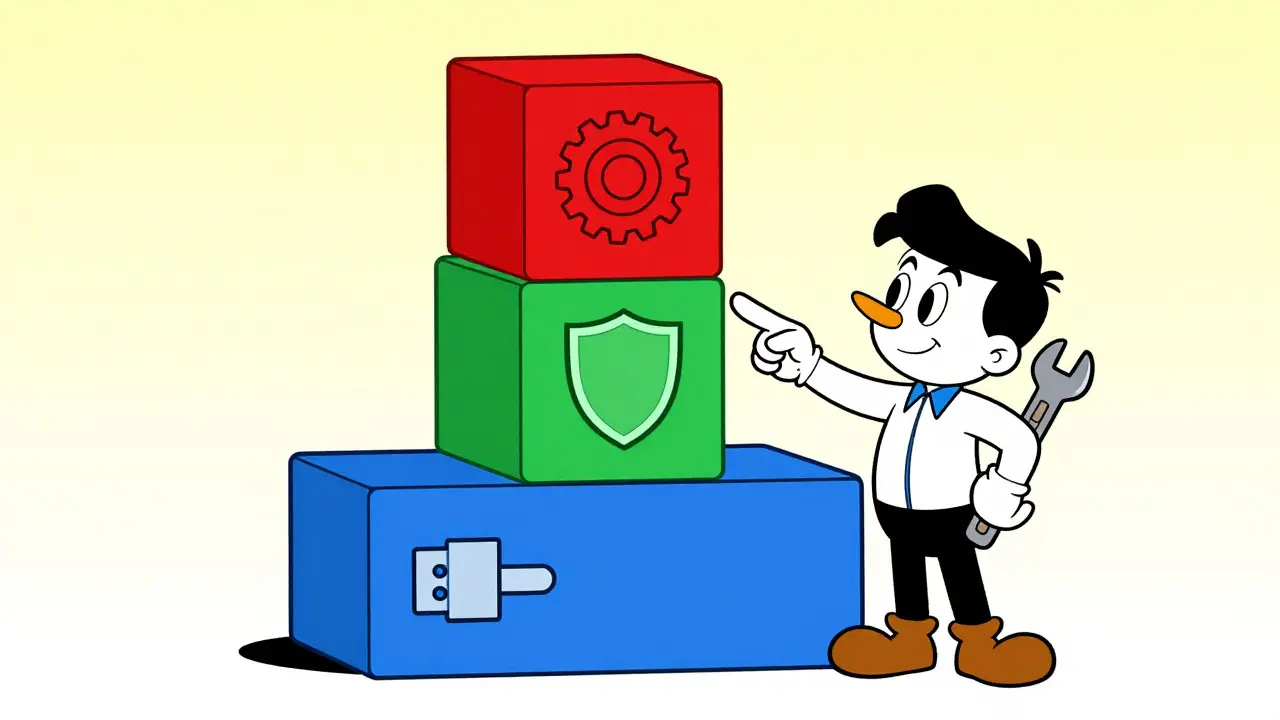
To manage a portfolio effectively, you first need to categorize your models. Think of it as a tiered system where each level serves a specific purpose based on risk and control requirements.
- Tier 1: Mission-Critical (Custom Models) These are fully owned, fine-tuned models used for proprietary research, highly regulated tasks, or core IP protection. You have total control, but the development cost averages $417,000 per model with a 6-9 month build cycle.
- Tier 2: Regulated & Strategic (Open-Source/Fine-Tuned) Models like Llama 4 or Falcon 2 deployed on your own infrastructure. They offer strong data governance (94% of enterprises report full control) and lower long-term costs, but require more engineering maintenance.
- Tier 3: General Tasks (API-Based) Commercial APIs like GPT-5, Gemini 3, or Claude 4. Perfect for general knowledge, content generation, and quick prototyping. They are easy to start with but carry higher per-token costs and data privacy risks.
The key insight here is that no single tier is "better." A custom model might be 18.7% more accurate on specialized tasks than a generic API, but if the task isn't complex enough to justify the cost, it’s a waste of resources.
Cost vs. Control: The Real Trade-Offs
Let’s talk numbers, because this is where the strategy gets real. Many leaders assume open-source is always cheaper. Sometimes it is, sometimes it isn’t.
| Feature | API-Based (e.g., GPT-5) | Open-Source (e.g., Llama 4) | Custom Fine-Tuned |
|---|---|---|---|
| Avg. Cost (Monthly) | $18,200 (at scale) | $28,500 (infra + maint.) | High initial ($417k dev), low marginal |
| Data Privacy Control | Low (78% report compliance issues) | High (94% full governance) | Maximum (Total ownership) |
| Implementation Time | Days | Weeks-Months | 6-9 Months |
| Best For | Chatbots, Content Gen | Healthcare, Finance | Proprietary Research |
Notice the nuance in the cost column. Deploying a Llama 4 70B model on your own servers can actually cost *more* monthly than using the GPT-5 API if your throughput is moderate. However, open-source models show 23.4% lower operational costs over 12 months *if* you have the volume and engineering team to maintain them. For smaller workloads, the API is often the smarter financial choice initially.
On the other hand, control is non-negotiable for many industries. In healthcare, 68% of triage systems run on open-source models because patient data can’t leave the hospital network. In finance, 54% of underwriting tools prefer local deployments. If your industry has strict regulations, your portfolio must lean heavily into Tier 2 and Tier 1.
Building Your Evaluation Framework
You can’t manage what you don’t measure. Most failed LLM implementations happen because teams rely on basic accuracy scores. You need a structured framework that looks at 12 key metrics, not just one.
Here is a practical checklist for evaluating any model in your portfolio:
- Accuracy Thresholds: Define what "good" means. For general tasks, aim for >78% on benchmarks like MMLU-Pro. For domain-specific tasks, set custom baselines.
- Latency: User-facing apps need response times under 2.3 seconds. If your custom model takes 5 seconds, it doesn’t matter how smart it is; users will quit.
- Cost Per 1,000 Tokens: Set targets. Tier 3 should be around $0.0085-$0.015. Tier 1 custom inference costs vary but must be justified by value.
- Compliance Risk Score: Keep this below 15 on a 100-point scale. Higher scores mean more legal headaches later.
Don’t forget Retrieval-Augmented Generation (RAG). It’s the glue that connects your models to your actual business data. 92% of successful enterprises use RAG architectures. Without it, even the best model is just guessing. With it, you can use a cheaper, smaller model and still get high-quality answers by feeding it relevant context from your internal databases.
Step-by-Step Implementation Guide
How do you actually start? Don’t try to boil the ocean. Follow this six-phase approach that works for most organizations:
- Assessment (2-4 weeks): Identify repetitive language tasks that consume at least 15% of departmental effort. These are your quick wins.
- Piloting (4-8 weeks): Pick one use case. Collect 300-500 high-quality examples of inputs and desired outputs. Test both an API model and an open-source model against these examples.
- Evaluation: Use custom evaluators. Don’t just look at exact matches. Does the answer make sense? Is it safe? Is it fast?
- Integration: Connect the winning model to your existing data pipelines. Ensure your data clean rooms are working so raw identifiers don’t leak into prompts.
- Monitoring: Implement observability tools. Model drift is real. If your market changes, your model’s performance might drop without you knowing.
- Scaling & Retirement: Only scale what works. Retire models that no longer meet the threshold. This is crucial for controlling technical debt.
A common pitfall is skipping the "data quality" step. 76% of implementations struggle here. If your input data is messy, no amount of model tweaking will fix the output. Clean your data first.
Governance and Compliance in 2026
Regulations are tightening. The EU AI Act requires model inventory documentation for all LLM deployments. US Executive Order 14110 mandates risk-based categorization. This means you can’t just "shadow deploy" models anymore.
You need a governance framework that includes:
- Model Inventory: A live list of every model in use, who owns it, and what data it touches.
- Risk Categorization: Tagging models as Low, Medium, or High risk based on their impact and data sensitivity.
- Retirement Plan: What happens when a model is deprecated? How do you migrate users without downtime?
Organizations that establish these controls before scaling see 47% less model drift. It sounds bureaucratic, but it saves you from emergency fixes down the line.
Frequently Asked Questions
Is open-source always cheaper than API models?
No. For low-to-medium volume usage, API models are often cheaper because you avoid infrastructure and maintenance costs. Open-source becomes cheaper at high volumes (typically after several million tokens per month) when the fixed infrastructure costs are amortized. Always run a 12-month TCO (Total Cost of Ownership) analysis before switching.
When should I build a custom model instead of fine-tuning an open-source one?
Build a custom model only if you have unique, proprietary data that gives you a competitive advantage and the task is mission-critical. Fine-tuning an open-source model (like Llama 4) is usually faster and cheaper. Reserve full custom builds for cases where you need total architectural control or have extremely specific training data that doesn't fit standard fine-tuning patterns.
What is the biggest risk in LLM portfolio management?
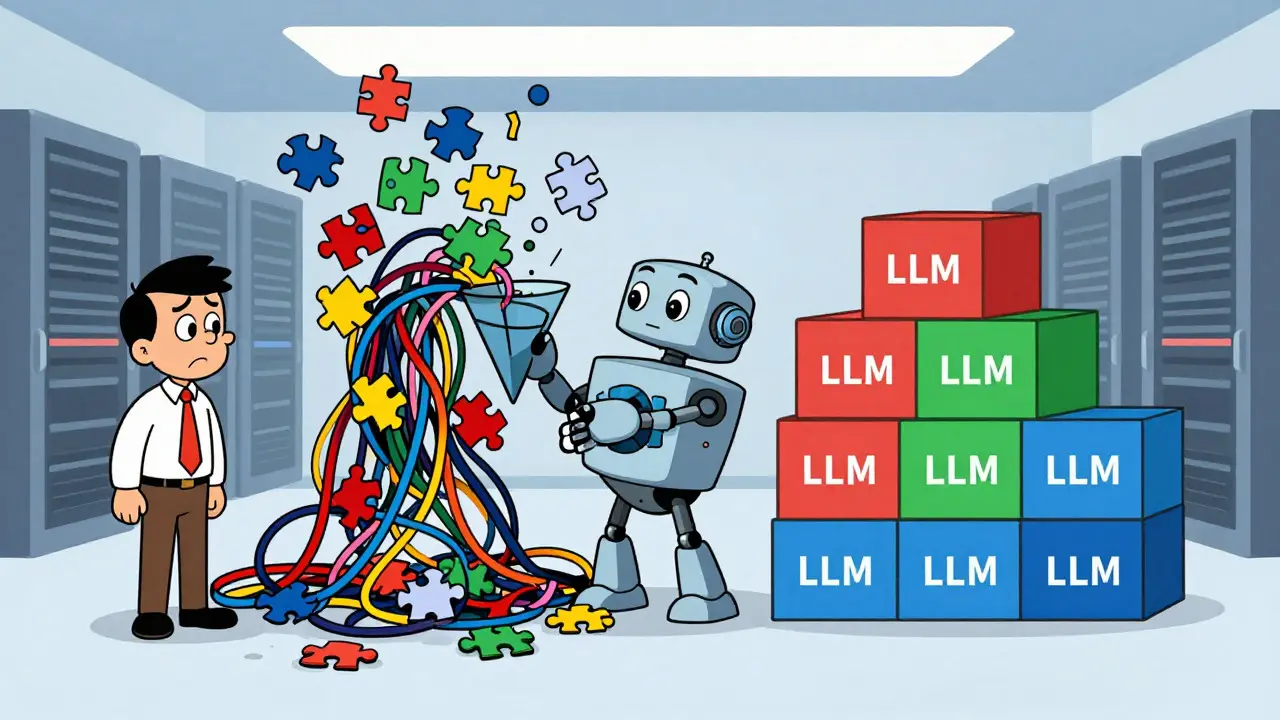
Fragmentation and lack of evaluation. If every team picks their own model without a central standard, you end up with 15 different tools, inconsistent security practices, and no way to compare performance. The solution is a central "Center of Excellence" that sets standards and shares best practices across teams.
How do I handle data privacy with API models?
Use anonymization and data masking before sending data to APIs. Avoid sending PII (Personally Identifiable Information) unless you have a Business Associate Agreement (BAA) or equivalent contract ensuring the vendor won't train on your data. For highly sensitive data, stick to on-premise open-source models.
What tools help with LLM portfolio management?
Look for observability platforms like Maxim AI or LangSmith for tracking performance. Use orchestration tools like Vellum or LangChain's Model Router to dynamically route requests to the best model based on cost and complexity. These tools automate much of the decision-making process.