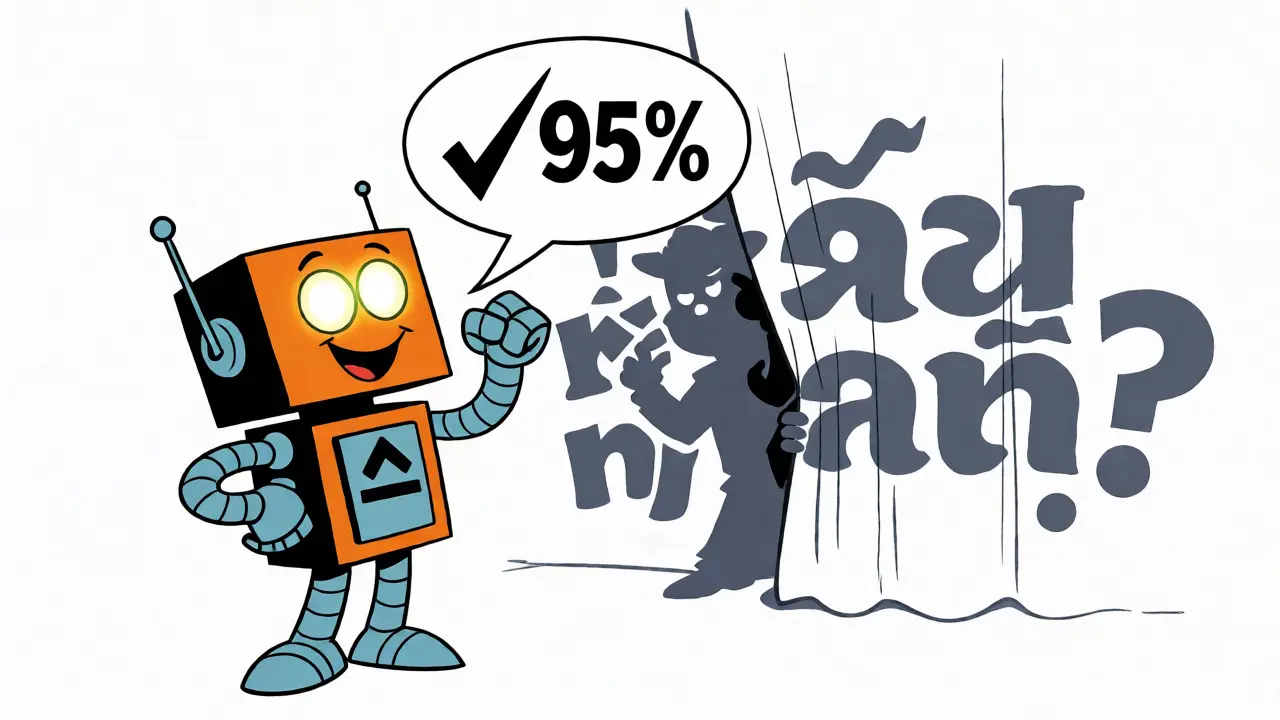
You built a chatbot that works flawlessly in English. It gives you confident answers, cites sources, and handles edge cases with grace. Then you switch the language to Swahili or Vietnamese, and suddenly it’s guessing. Worse, it guesses confidently. This is the hidden crisis of modern Large Language Models (LLMs): they are poorly calibrated for non-English languages.
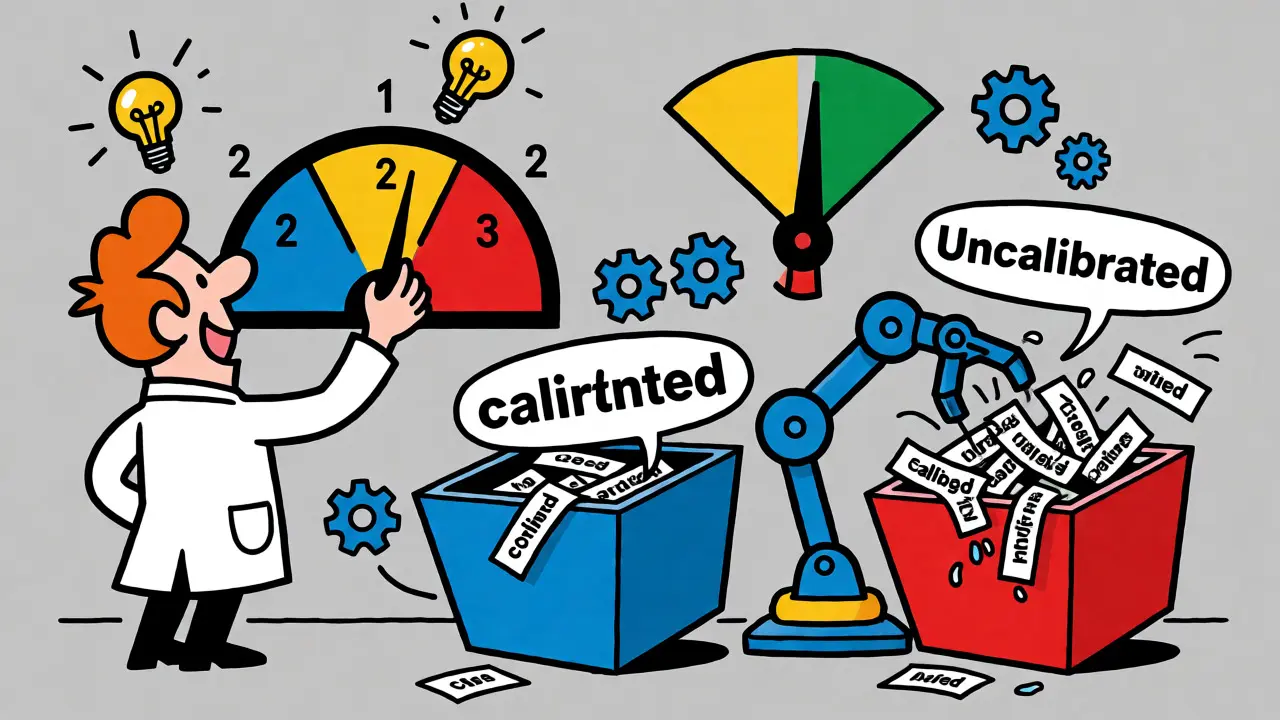
LLM output calibration is the process of ensuring a model's stated confidence matches its actual probability of being correct. In simple terms, if a model says it is 90% sure about an answer in Spanish, it should be right 9 out of 10 times. For English, this often holds true. For low-resource languages, however, models frequently claim 95% confidence on answers that are wrong half the time. According to recent research from Stanford and CMU, the Expected Calibration Error (ECE) for low-resource languages averages 18.7%, compared to just 5.2% for English. If you are deploying AI globally, ignoring this gap means shipping unreliable products to billions of users.
Why Your Model Lies About Confidence
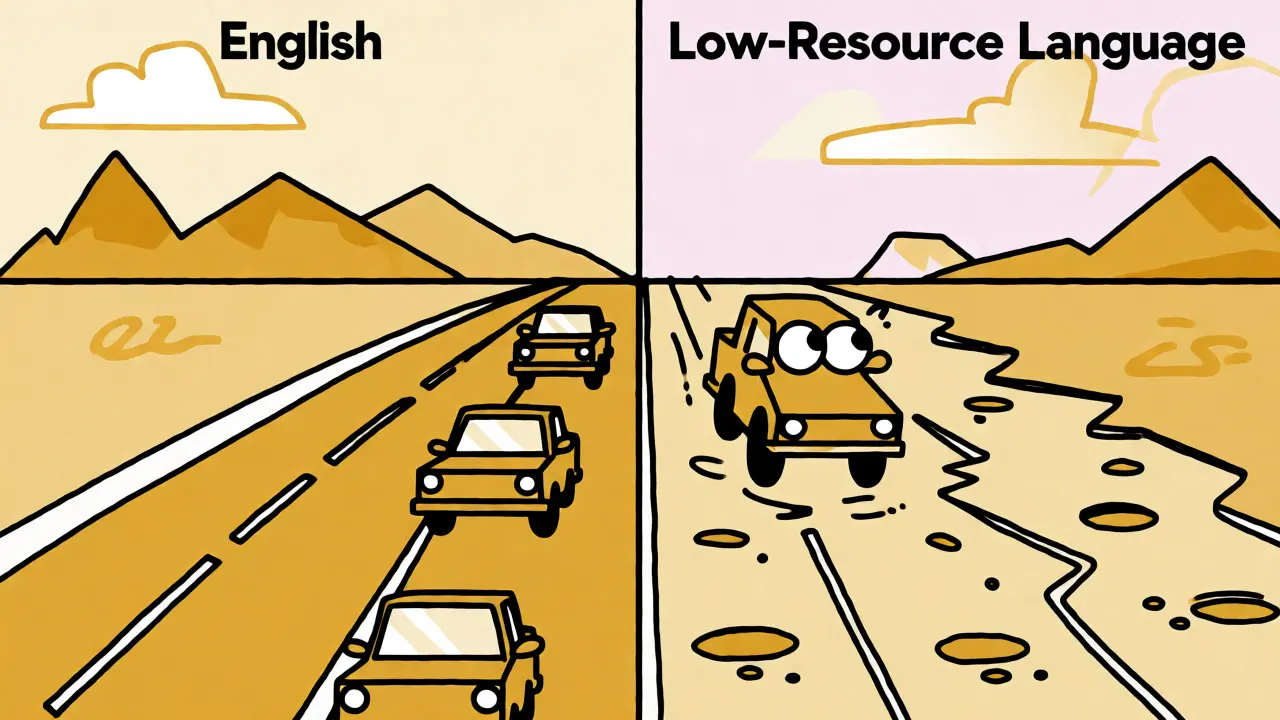
The root cause isn't magic; it's math and data distribution. Most major LLMs like mT5, XLM-R, and BLOOM are trained on corpora where English dominates. English typically makes up 60-90% of pretraining data. When a model sees a pattern in English millions of times, it learns what "correct" looks like. When it sees a similar pattern in Guarani only a few thousand times, it relies on spurious correlations-artifacts of the training set rather than genuine linguistic understanding.
This asymmetry creates a dangerous illusion of competence. A study testing 14 multilingual LLMs across 42 languages found that calibration error increases by 2.3x for every order-of-magnitude decrease in corpus size. High-resource languages like Spanish (with ~1.5 billion tokens) fare reasonably well. Low-resource languages like Swahili (~15 million tokens) suffer severe degradation. The model doesn't know what it doesn't know, but it doesn't tell you that either. It outputs a high probability score because the token sequence feels familiar, even if the semantic meaning is lost.
Measuring the Gap: ECE and Brier Scores
To fix calibration, you first need to measure it accurately. Standard accuracy metrics won't cut it here. You need probabilistic metrics. Two stand out:
- Expected Calibration Error (ECE): This measures the difference between predicted confidence and observed accuracy. An ECE of 0% is perfect. Anything above 15% renders confidence scores unreliable for high-stakes applications like healthcare or law, according to CMU SEI guidelines.
- Brier Score: This measures the mean squared difference between predicted probabilities and actual outcomes. Lower is better. A Brier score of 0.25 is roughly equivalent to random guessing for binary tasks.
Research shows that standard English-centric calibration metrics fail when applied directly to other languages. Dr. Anna Rogers' team at the University of Sheffield argues that calibration metrics must be language-specific. Why? Because linguistic structures differ. Turkish has complex morphology; Thai is tonal. A metric tuned for English syntax might misinterpret uncertainty signals in these languages, leading to false positives in your monitoring dashboard.
Techniques to Improve Non-English Calibration
You don't always need to retrain the entire model from scratch. Several post-hoc and fine-tuning techniques can significantly improve calibration without massive compute costs.
Temperature Scaling
This is the most common baseline method. It involves adjusting the logits (raw output scores) of the model before applying the softmax function. By raising the temperature parameter $T$, you flatten the probability distribution, making the model less overconfident. It requires very little data-often just 100-500 labeled examples per language. However, it's a blunt instrument. It works well for Indo-European languages but shows 31.6% better performance there compared to Sino-Tibetan languages, suggesting one-size-fits-all scaling doesn't work globally.
Label Smoothing During Fine-Tuning
Instead of telling the model "this label is 100% correct," you tell it "this label is 90% correct." This prevents the model from becoming overly confident during supervised fine-tuning (SFT). Huang et al. (2024) recommend smoothing factors between 0.1 and 0.3. This technique reduces calibration error by 22.4% for Romance languages. But beware: it underperforms for Niger-Congo languages, offering only an 8.7% improvement. Vocabulary size also matters; larger vocabularies correlate strongly with overconfidence (r=0.87), so aggressive smoothing may be needed for models with extensive token sets.
APRICOT: The Black-Box Solution
If you're using commercial APIs like OpenAI or Anthropic, you can't access the model's internal logits. Temperature scaling becomes impossible. Enter APRICOT. This method trains an auxiliary confidence predictor using only the input text and the model's output. It doesn't need model internals. On the XQuAD benchmark, APRICOT achieved a Brier score of 0.186, competitive with white-box methods. It’s ideal for enterprise deployments where API access is limited. However, it struggles with tonal languages like Thai, underperforming by 12.3% due to missed contextual nuances.
Comparing Calibration Methods
Choosing the right method depends on your access level, budget, and target languages. Here’s how the top contenders stack up:
| Method | Data Requirement | Access Needed | Best For | Limitations |
|---|---|---|---|---|
| Temperature Scaling | Low (100-500 samples) | White-box (Logits) | Indo-European languages, quick fixes | Poor performance on Sino-Tibetan/Low-resource |
| Label Smoothing | Medium (SFT Dataset) | Training Access | Romance languages, reducing overconfidence | Ineffective for large vocabularies/Niger-Congo |
| APRICOT | High (Labeled Pairs) | Black-box (API) | Commercial APIs, general use | Struggles with tonal languages (Thai) |
| Venn-Abers (IVAP) | Medium (200-300 samples) | White-box | Binary classification tasks | Adds latency (~12ms per prediction) |
Implementation Pitfalls and Costs
Calibration isn't free. Let’s look at the operational reality. Adding calibration layers increases latency. The Venn-Abers predictor adds about 12ms per prediction on a Llama-2-7B model. For real-time applications, this might seem negligible, but at scale, it impacts throughput. More critically, human-in-the-loop verification becomes necessary when calibration error exceeds 20%. Currently, 68% of non-English languages in standard models hit this threshold. Relying on human review for those queries increases costs by $3.20-$5.70 per 1,000 queries based on AWS Mechanical Turk rates.
Another pitfall is assuming bigger models are automatically better calibrated. While 7B-parameter models do show 14.2% lower ECE than 1B-parameter models, all architectures exhibit consistent degradation patterns for non-English inputs. Don't assume upgrading from Llama-2-7B to Llama-3 will magically fix your Vietnamese confidence scores without specific calibration efforts.
The Future: Dynamic and Task-Specific Calibration
The industry is moving beyond static adjustments. Microsoft’s Azure AI now integrates multilingual calibration metrics into their Responsible AI dashboards. Google’s CALM framework reduced ECE by 23.5% across 100+ languages for PaLM 2. Emerging research points toward dynamic calibration factors based on language distance. Using ISO 639-3 codes to calculate phylogenetic distance between languages allows models to adjust confidence based on how "close" the target language is to the training data. Preliminary results show a 14.2% improvement in calibration when accounting for language family proximity.
Task Calibration (TC), introduced in ACL 2025 findings, offers another avenue. It improves zero-shot performance by 7.2% on average across NLI benchmarks. However, it requires careful prompt engineering, adding complexity to your deployment pipeline. If you are building a system today, start with temperature scaling or APRICOT depending on your API access. Monitor your ECE closely. If it stays above 15%, invest in fine-tuning with label smoothing or gather more high-quality translated data for fine-tuning. The goal isn't just higher accuracy-it's knowing when your model is actually right.
What is Expected Calibration Error (ECE)?
ECE measures the discrepancy between a model's predicted confidence and its actual accuracy. It is calculated by binning predictions by confidence level and comparing the average confidence in each bin to the actual accuracy. A lower ECE indicates better calibration. For multilingual models, an ECE above 15% generally signals unreliable confidence scores for non-English languages.
Why are LLMs less confident in non-English languages?
LLMs are primarily trained on English-heavy datasets (60-90% of pretraining corpora). They learn robust patterns and confidence markers from abundant English data. For low-resource languages, the model relies on spurious correlations and has seen fewer examples, leading to overconfidence on incorrect answers. Calibration error increases by 2.3x for every order-of-magnitude drop in training data volume.
Can I calibrate a model if I only have API access?
Yes. Methods like APRICOT train an auxiliary confidence predictor using only the input text and the model's textual output. This black-box approach does not require access to internal logits or weights, making it suitable for commercial APIs like OpenAI or Anthropic, though it may perform slightly worse on tonal languages.
How much data do I need for temperature scaling?
Temperature scaling is data-efficient, typically requiring only 100-500 labeled examples per language to fit the optimal temperature parameter. This makes it a practical starting point for improving calibration in medium-to-high resource languages without extensive annotation projects.
Does model size affect multilingual calibration?
Yes, but not linearly. Larger models (e.g., 7B parameters) generally achieve lower Expected Calibration Error (14.2% lower than 1B models) across non-English languages. However, all tested architectures still exhibit significant calibration degradation for low-resource languages compared to English, meaning size alone is not a complete solution.