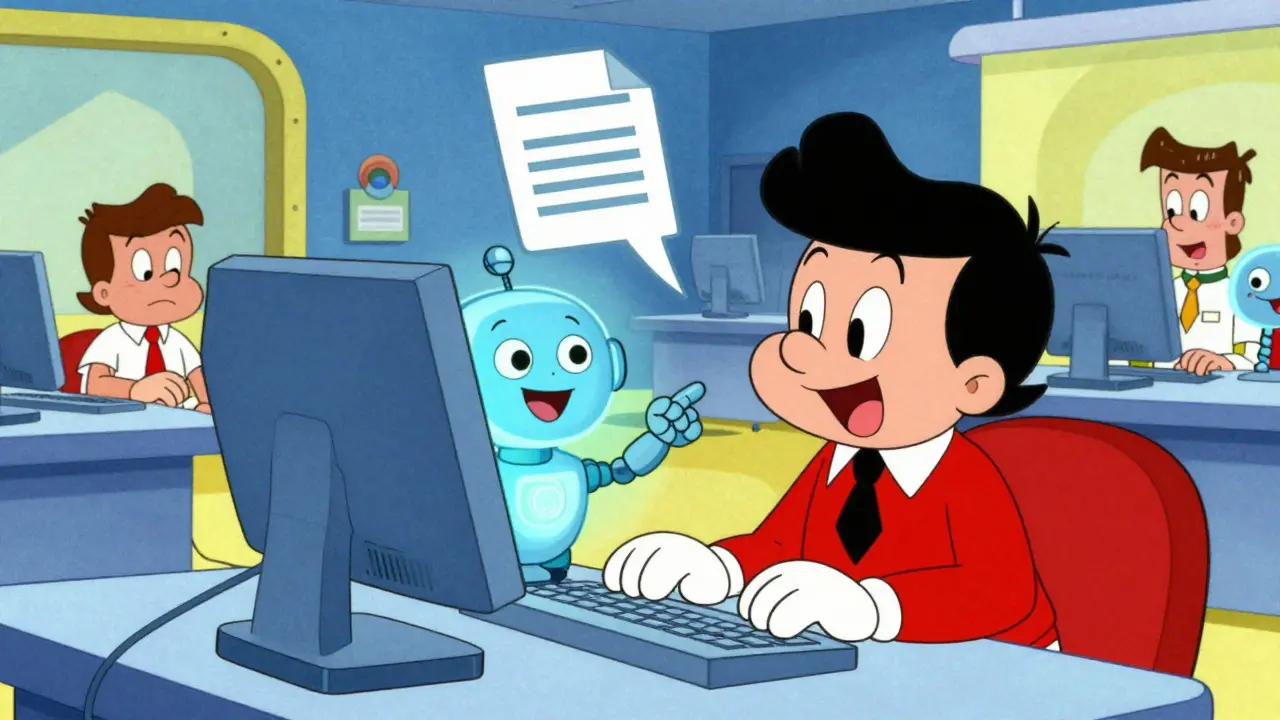
Imagine asking your company’s HR portal, “How many PTO days do I have left?” and getting an instant answer that cites the exact page in the employee handbook. This isn’t science fiction anymore. It is the reality of HR Knowledgebots, which are AI-driven assistants that use Large Language Models (LLMs) to answer employee questions about internal policies and handbooks using Retrieval-Augmented Generation (RAG).
For years, HR departments have been buried under repetitive queries. From benefits enrollment to leave policies, the volume of simple questions often overwhelms staff, delaying responses for employees who just want quick answers. Traditional solutions like static FAQ pages or basic search bars fall short because they require users to know the exact terminology to find relevant information. HR Knowledgebots change this dynamic by understanding natural language and retrieving precise, policy-backed answers from internal documents.
This technology emerged prominently between 2023 and 2024 as enterprises sought to automate routine inquiries while maintaining strict compliance with internal rules. The convergence of mature LLMs, efficient vector databases, and growing demand for 24/7 support created a perfect storm for adoption. Today, early adopters in tech, finance, and healthcare are already seeing significant reductions in HR workload, proving that AI can handle the mundane so humans can focus on the complex.
How HR Knowledgebots Work Under the Hood
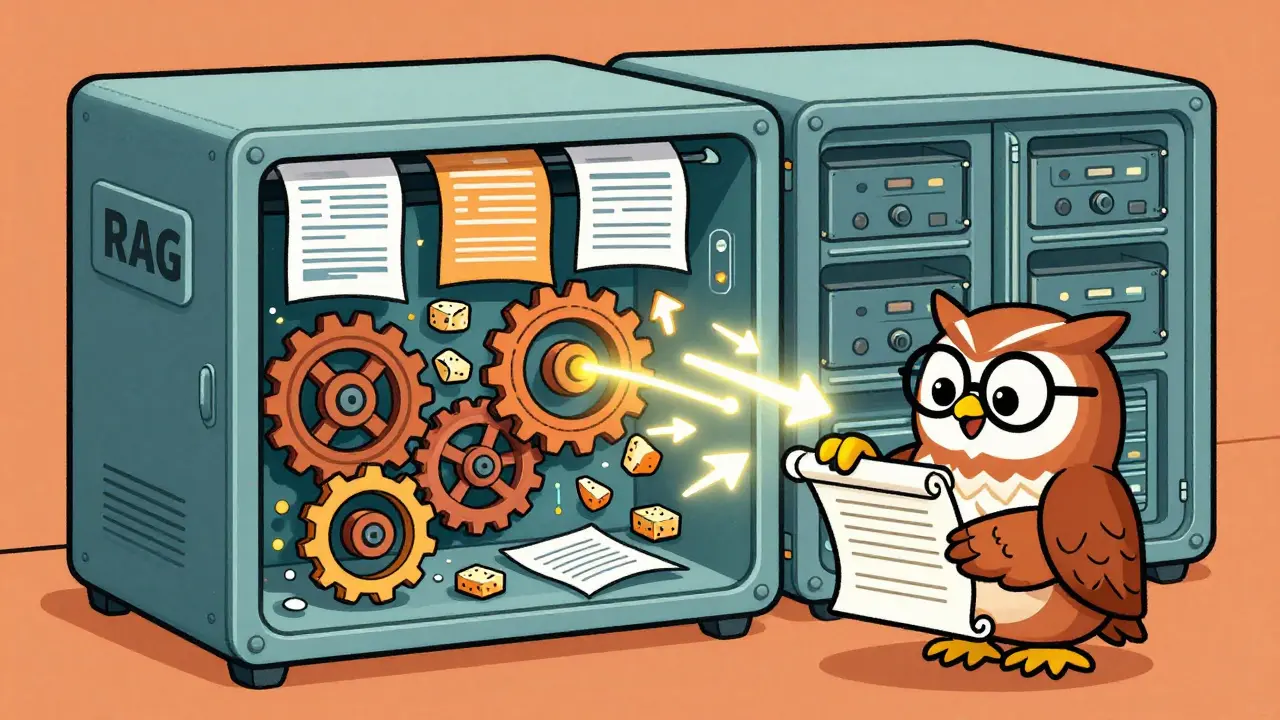
To understand why these bots are effective, you need to look at their architecture. They don’t just guess answers; they retrieve facts. The process relies on Retrieval-Augmented Generation (RAG), which is a technique that combines large language models with external knowledge bases to generate accurate, sourced responses.
Here is the step-by-step flow:
- Document Ingestion: HR uploads policy documents-PDFs, Word files, intranet pages-into the system.
- Chunking and Embedding: Algorithms break these texts into smaller segments (typically 512-1024 tokens). These chunks are then converted into numerical vectors using embedding models like
text-embedding-ada-002. - Vector Storage: These vectors are stored in a database such as Pinecone or ChromaDB, allowing for fast semantic search.
- Query Processing: When an employee asks a question via Slack or a web portal, the system converts the query into a vector and searches the database for the most relevant policy excerpts.
- Generation: An LLM, such as GPT-4o or internally hosted Llama 3, receives the retrieved excerpts and generates a concise, natural language response, citing the source document.
This structure ensures that the bot’s answers are grounded in actual company policy rather than hallucinated generalities. According to benchmarks from the ACL'24W conference, knowledge graph-enhanced approaches achieved accuracy rates between 0.748 and 0.784, significantly outperforming direct LLM methods which hovered around 0.65 accuracy.
The Business Case: Efficiency and Accuracy
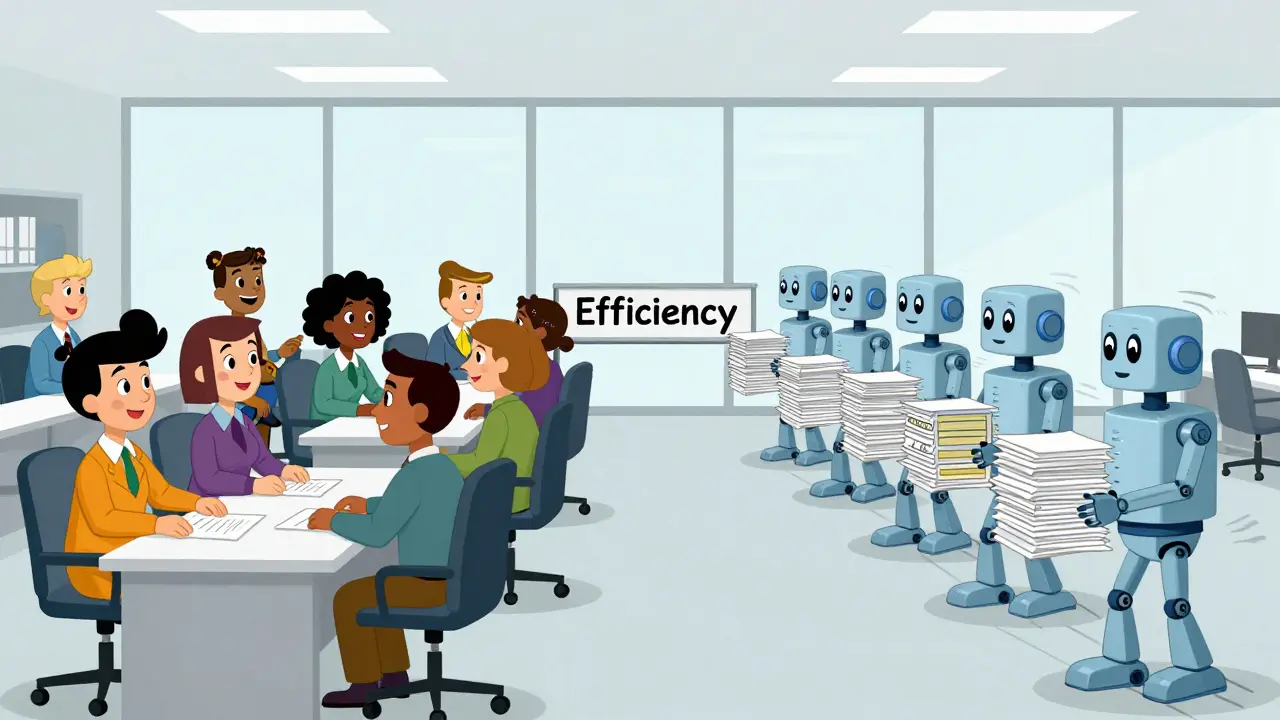
Why are companies investing in this? The numbers speak for themselves. A case study by deepsense.ai published in Q2 2024 highlighted that HR Knowledgebots can reduce department workload by 30-50% on routine queries. For a Fortune 500 technology company, this translated to a 47% drop in HR ticket volume within the first quarter of 2024.
| Feature | Traditional HR Support | HR Knowledgebot |
|---|---|---|
| Availability | Business Hours Only | 24/7 Instant Access |
| Response Time | Hours to Days | Seconds |
| Accuracy Source | Human Memory/Knowledge Base Search | Direct Policy Document Citation |
| Scalability | Limited by Staff Headcount | Infinite Concurrent Users |
| Implementation Speed | Days to Weeks | Hours (3x faster than traditional RPA) |
Beyond speed, there is the factor of consistency. Human HR reps might interpret a vague policy differently on different days. A Knowledgebot provides the same answer every time, based strictly on the text it was fed. Dr. Elena Rodriguez, Chief AI Officer at Capella Solutions, noted in June 2024 that success depends entirely on the quality of underlying documentation. If the handbook is clear, the bot is clear.
Security and Privacy: Keeping Data Internal
One major concern with AI is data privacy. Employees worry if their personal questions are being sent to public AI models. HR Knowledgebots address this through enterprise-grade security measures.
Many implementations use internally hosted LLMs like Llama 3, ensuring that no data leaves the company’s secure environment. Additionally, systems employ role-based access controls and maintain audit trails of all queries. As emphasized in vendor demonstrations, privacy is maintained by anonymizing personally identifiable information (PII) before it interacts with broader AI services, complying with regulations like GDPR and CCPA. This allows organizations to leverage AI power without exposing sensitive employee data.
Limitations and Where Bots Fail
Despite the hype, HR Knowledgebots are not a silver bullet. They excel at factual lookups-PTO balances, retirement match rates (like a specific 5% company match), and bonus percentages. However, they struggle with nuance.
A negative review on G2 from August 2024 highlighted a critical failure point: the bot couldn’t interpret a complex sabbatical policy correctly, giving contradictory answers on different days. This usually happens when source documents contain ambiguities or contradictions. If the handbook says one thing for California employees and another for New York, but doesn’t clearly link location to policy, the bot may get confused.
Furthermore, bots lack emotional intelligence. While 92% of beta testers in the deepsense.ai study preferred chatbots for routine questions, 67% still contacted human HR for emotionally sensitive issues like bereavement or harassment complaints. The bot cannot replace empathy; it only replaces information retrieval.
Implementation Roadmap: Getting Started
If you are considering deploying an HR Knowledgebot, the path forward involves six key phases, typically taking 3 to 12 weeks depending on document maturity.
- Requirements Gathering (1-2 weeks): Identify 5-10 high-volume use cases. Start with the easiest wins like PTO and holiday schedules.
- Design & Planning (1 week): Create the agentic architecture and define escalation paths to human staff.
- Development (2-4 weeks): Build the local prototype, integrating your vector database and LLM choice.
- MLOps & Integration (1-2 weeks): Add prompt validation, logging, and connect to existing single sign-on (SSO) systems.
- Knowledge Transfer (3-5 days): Conduct workshops with HR teams to train them on maintaining the knowledge base.
- Deployment: Launch to a pilot group, monitor feedback, and iterate.
The biggest hurdle? Documentation cleanup. The deepsense.ai study found that 73% of organizations faced inconsistent policy documentation across departments. You must clean up your handbooks before feeding them to the AI. Garbage in, garbage out applies doubly here.
Future Trends and Market Outlook
The market for HR technology is valued at $22.3 billion, and AI is eating a larger slice. Gartner predicts that by 2026, 70% of enterprise HR platforms will incorporate LLM-powered policy assistants, up from just 25% in late 2024. We are already seeing integrations like Microsoft’s Copilot for HR connecting directly to HRIS systems, and Workday launching its “Workday Assist” beta.
However, sustainability remains a challenge. Forrester analyst Sarah Chen warned in December 2024 that 68% of early implementations required weekly policy updates to maintain accuracy above 90%. Policies change, and your bot must change with them. Organizations that assign dedicated policy owners (recommended ratio: 1 per 500 employees) see the best long-term results.
With a reported 228% return on investment within 12 months in some cases, the financial argument is strong. But the operational argument is stronger: freeing up HR professionals to do what they do best-support people, not just parse PDFs.
What is an HR Knowledgebot?
An HR Knowledgebot is an AI assistant that uses Large Language Models and Retrieval-Augmented Generation (RAG) to answer employee questions about company policies, handbooks, and procedures by retrieving accurate information from internal documents.
Are HR Knowledgebots secure for employee data?
Yes, when implemented correctly. Many systems use internally hosted LLMs like Llama 3 and anonymize personally identifiable information (PII) to comply with GDPR and CCPA. They also employ role-based access controls to ensure data privacy.
How accurate are HR Knowledgebots?
Accuracy depends heavily on the quality of source documents. Studies show accuracy rates between 74-78% for complex recommendations, with near-perfect accuracy for straightforward policy lookups if the underlying handbook is clear and consistent.
Can HR Knowledgebots replace human HR staff?
No. They automate routine, factual inquiries (like PTO balances) but cannot handle emotionally sensitive issues or complex cases requiring human judgment and empathy. They serve as a supplement, not a replacement.
How long does it take to implement an HR Knowledgebot?
Implementation typically takes 3 to 12 weeks. Organizations with well-structured digital policies can launch prototypes in 3-4 weeks, while those needing significant documentation cleanup may take up to 12 weeks.
What are the common limitations of HR Knowledgebots?
They struggle with ambiguous or contradictory policies, complex multi-step workflows requiring external system access, and nuanced scenarios that require human interpretation or emotional intelligence.

Look, I get the hype around these bots but let's keep our boundaries straight. You can't just dump every HR question on a machine and expect it to handle sensitive stuff like harassment complaints or bereavement leave with any real grace. It's lazy management disguised as innovation. If you want efficiency, fine, use it for PTO balances. But don't pretend this replaces the human element of HR. We need people who actually give a damn about employee well-being, not just some script that cites page 42 of a handbook from 2019. Keep the humans in the loop for anything that matters.
Oh, please. Laura, you are completely missing the forest for the trees here. The architectural elegance of Retrieval-Augmented Generation is precisely what solves the issue of hallucination that plagues standard LLMs. By utilizing vector embeddings via models like text-embedding-ada-002 and storing them in high-performance databases such as Pinecone, we ensure semantic precision. It is not merely a 'script'; it is a sophisticated agentic workflow that retrieves grounded facts before generation. To suggest otherwise is to ignore the fundamental mechanics of modern NLP pipelines. The drama surrounding 'human touch' is irrelevant when the bot provides a 47% reduction in ticket volume with near-instantaneous latency. Efficiency is the new empathy in corporate structures.
yeah sure it works until they track your every query and sell it to insurance companies. its all part of the surveillance state plan. they say 'privacy' but look at the code. data goes out somewhere. always does. dont trust the cloud. ever.
we are becoming what we consume. if we ask machines for answers do we lose the ability to think? the soul of the organization dissolves into vectors. silence is golden but algorithms are loud. they fill the void with noise. is it knowledge or just information without wisdom? i wonder if the handbook knows itself better than we do. perhaps the bot is the true manager now. cold logic prevails. the human heart is messy and inefficient. maybe that is why we fear it. or maybe we deserve the silence.
actually you guys are totally wrong about the whole thing. the article says it reduces workload by 30-50% but thats only if you have clean docs which nobody does. so its a waste of money. also llama 3 is open source so anyone can hack it. security is a myth. plus who has time to update policies weekly? nobody. its a disaster waiting to happen. stop buying into the tech bro dream. its just a fancy search bar with extra steps. really annoying how everyone praises this garbage.
In my experience working across multiple international teams, the cultural nuance is exactly where these systems fail spectacularly. A policy might be clear in English but the interpretation varies wildly between regions. While the technology is undeniably impressive, we must remember that HR is fundamentally about people. In France, for example, labor laws are incredibly specific and rigid. An AI might cite the correct law but miss the cultural context of how that law is applied in practice. We need collaboration, not replacement. Let the bot handle the dry numbers, but let humans handle the relationships. That is the only sustainable path forward.