
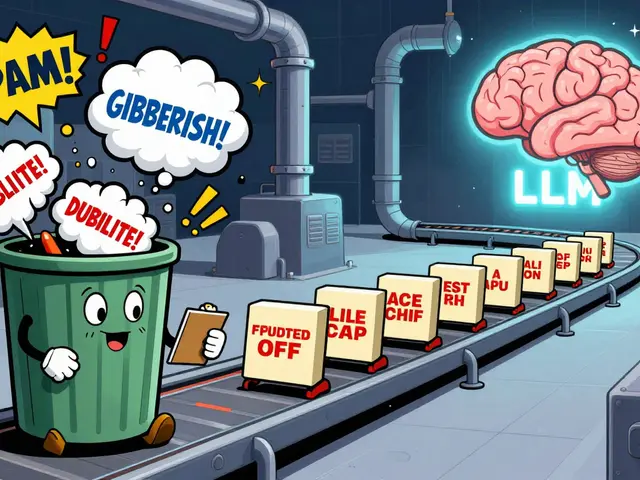
Large language models (LLMs) are great at sounding confident - even when they’re wrong. You’ve probably seen it: an AI gives you a detailed answer about cancer treatment, cites a made-up study, and sounds 100% sure. That’s a hallucination. And in healthcare, finance, or legal settings, it’s not just embarrassing - it’s dangerous.
That’s where RAG - Retrieval-Augmented Generation - comes in. It doesn’t try to fix the model’s memory. Instead, it gives the model a reliable source to check before answering. The result? Hallucinations drop. In some cases, to zero.
What RAG Actually Does
RAG isn’t magic. It’s a two-step system. First, when you ask a question, a retriever scans a trusted database - like medical journals, internal manuals, or regulatory documents - and pulls the top 3-5 most relevant pieces of text. Then, the LLM uses those snippets, along with your original question, to generate an answer.
Think of it like a doctor consulting a textbook before giving advice. The doctor still speaks, but the answer is grounded in real data. Without RAG, LLMs rely only on what they learned during training - data that’s often outdated, incomplete, or full of internet noise.
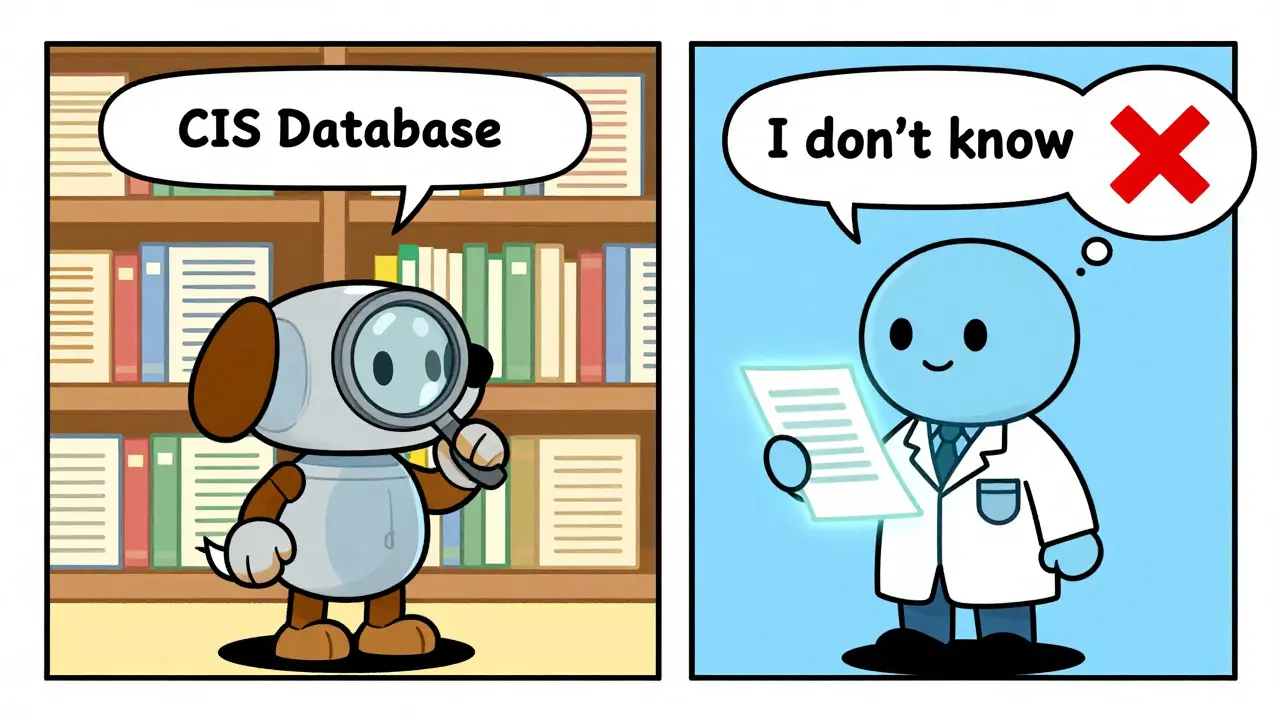
Google search results? They’re full of opinions, outdated articles, and misinformation. But a curated Cancer Information Service (CIS) database? That’s peer-reviewed, up-to-date, and vetted. A 2024 study published in JMIR Cancer showed that when GPT-4 used CIS sources with RAG, hallucination rates dropped to 0%. Without RAG, using general search results, the same model hallucinated 6% of the time.
How Much Do Hallucinations Actually Drop?
Numbers matter. Here’s what real-world tests show:
- GPT-4 with RAG + CIS sources: 0% hallucinations
- GPT-4 with general search: 6% hallucinations
- GPT-3.5 with RAG + CIS: 6% hallucinations (down from 10%)
- Enterprise customer service bots (AWS Bedrock): 60-75% reduction in hallucinations
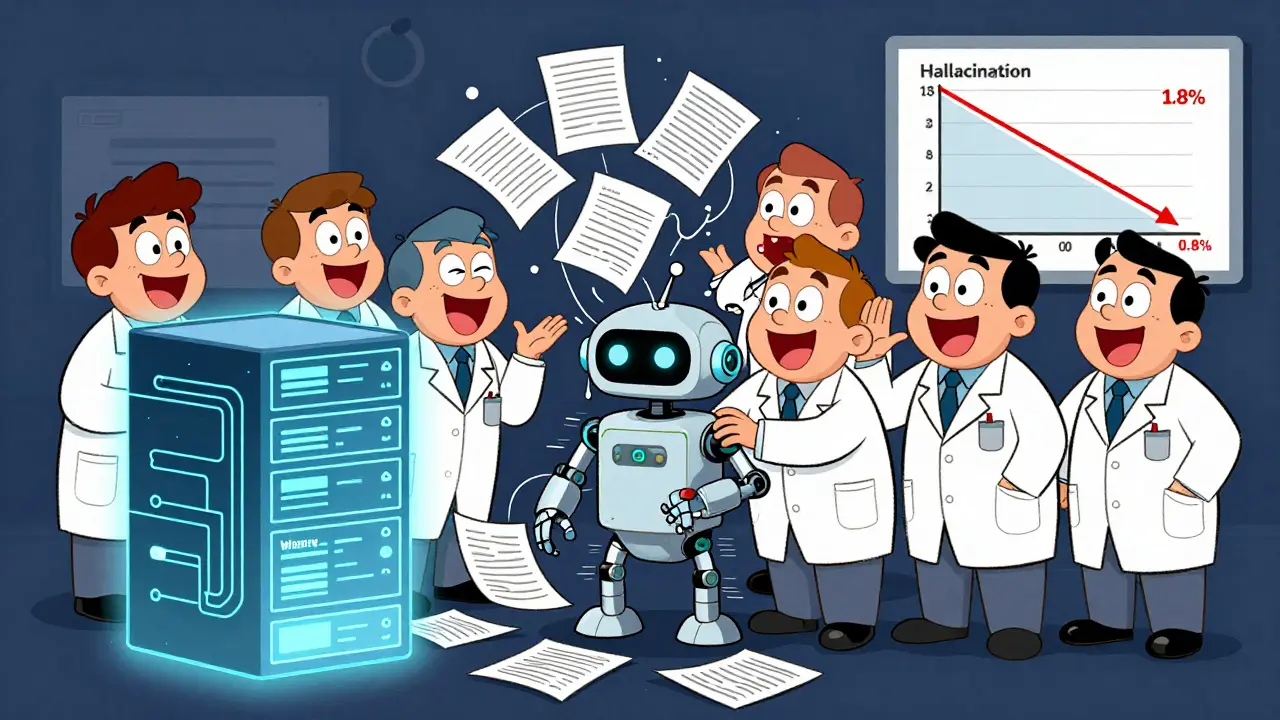
- Healthcare startup using RAG: Hallucinations dropped from 12% to 0.8%
Those aren’t theoretical improvements. They’re from published studies and real deployments. In healthcare, where a wrong answer could cost someone their life, a 0% hallucination rate isn’t a bonus - it’s a requirement.
The FDA’s April 2024 guidance on AI in healthcare explicitly recommends RAG for patient-facing tools. Why? Because it’s the only approach that ties answers to verifiable sources. Fine-tuning an LLM might help it sound more like a doctor - but it doesn’t stop it from inventing facts.
RAG vs. Other Methods
People try other tricks to fix hallucinations. Fine-tuning. RLHF. Prompt engineering. But they all have the same flaw: they work inside the model’s head. If the model never learned the truth, it can’t magically know it.
Here’s how RAG stacks up:
| Method | Time to Implement | Updates Required | Reduces Hallucinations? | Best For |
|---|---|---|---|---|
| RAG | 3-6 weeks | Real-time (update documents, no retraining) | Yes - up to 100% reduction with good sources | Factual queries: medical, legal, technical support |
| Fine-tuning | 40-100 hours | Full retraining needed for new data | Partial - only if training data is perfect | Brand voice, tone, style |
| RLHF | Weeks to months | Requires human feedback loops | Low to moderate - trains on preference, not truth | Conversational tone, safety filters |
| Prompt engineering | Hours | Constant tweaking | Minimal - doesn’t fix root cause | Simple, low-stakes questions |
RAG wins when accuracy matters. Fine-tuning might make a model sound more professional, but it can’t stop it from inventing a non-existent clinical trial. RAG can. If the source doesn’t mention the trial, the model says, “I don’t have information on that.” That’s huge.
Where RAG Still Fails
But RAG isn’t perfect. It’s not a silver bullet. Here’s where it stumbles:
- Bad retrieval: The retriever pulls a document that sounds right but is wrong. About 15-20% of the time in poorly tuned systems.
- Fusion errors: The model gets two documents that contradict each other and blends them into a false conclusion.
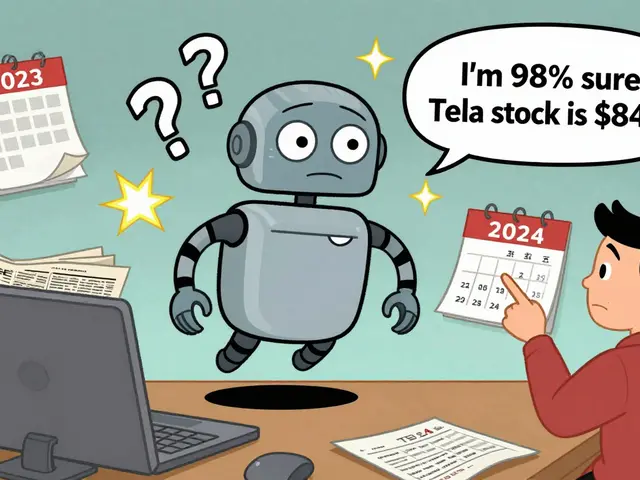
- Confidence misalignment: The model says “I’m 98% sure” about something it just made up - even if the source says nothing.
- Unstructured data: If your knowledge base is a messy PDF with no metadata, RAG struggles. A 2024 report from K2view found that RAG still hallucinates 5-15% of the time with unstructured internal docs.
GitHub issues for LangChain show over 350 open tickets related to hallucinations. The top two complaints? “Incorrect fusion of multiple documents” (147 issues) and “retrieval of irrelevant but topically similar content” (98 issues).
One user on Reddit, a data engineer at a healthcare startup, said: “We reduced hallucinations from 12% to 0.8% - but it took months to get the document chunking right. If you don’t split your PDFs properly, RAG just pulls half-sentences and makes nonsense.”
What You Need to Build It
You don’t need a PhD to set up RAG, but you do need the right pieces:
- A knowledge base: Curated, accurate, and well-structured. PDFs, databases, wikis - but they need to be cleaned and tagged.
- A vector database: Like Pinecone, Weaviate, or Qdrant. Stores document embeddings. Enterprise setups need 16-32GB RAM minimum.
- An embedding model: Sentence-BERT or text-embedding-ada-002. Turns text into numbers the retriever can compare.
- An LLM API: GPT-4, Claude 3, or open-source models like Llama 3.
- A retrieval system: LangChain, LlamaIndex, or AWS Bedrock Agents.
Most teams take 3-6 weeks to get RAG working reliably. The biggest bottleneck? Not the tech - it’s the data. If your knowledge base is garbage, RAG just makes garbage look confident.
One AWS customer spent 120 hours tuning their system. The payoff? A 70% drop in customer complaints about wrong answers.
How to Measure Success
You can’t improve what you don’t measure. The industry standard for tracking hallucination reduction is RAGAS - a set of automated metrics:
- Answer correctness: Does the answer match the retrieved documents?
- Answer relevancy: Is the answer actually about the question?
- Context precision: Are the retrieved documents truly relevant?
Amazon Bedrock uses these to trigger human review when scores drop below a threshold. If the model says “The patient should take 500mg of Drug X,” but the source says “Avoid Drug X in patients with kidney disease,” RAGAS catches it. Then a human steps in.
Don’t just measure hallucination rates. Measure user trust. Are people using the AI more? Are support tickets dropping? Are compliance officers approving the output? Those are the real KPIs.
Who’s Using It - And Why
RAG adoption is exploding. Gartner predicts 70% of enterprise AI tools will use RAG by 2025. Here’s where it’s already making a difference:
- Healthcare: 62% adoption rate. Hospitals use RAG to answer patient questions with FDA-approved guidelines. No guesswork.
- Finance: 45% adoption. Banks use RAG to answer regulatory questions based on current SEC filings.
- Legal: Law firms use RAG to pull case law from internal databases - no more citing repealed statutes.
- Customer support: Companies like Shopify and Adobe use RAG to answer product questions with up-to-date manuals.
What’s interesting? The most successful teams don’t use RAG to replace humans. They use it to empower them. A nurse gets an AI assistant that gives accurate drug interaction warnings. A customer service rep gets a tool that never lies about return policies.
What’s Next for RAG
Researchers aren’t stopping. New tools are emerging:
- ReDeEP: Traces hallucinations back to the exact retrieved document that led to the error.
- FACTOID: A benchmark to test hallucination detection - released in March 2024.
- Self-correcting RAG: Models that re-check their answers against sources before finalizing.
- Structured + unstructured fusion: Combining RAG with databases (like SQL) to reduce remaining errors by 15-25%, according to K2view’s tests.
By 2026, Gartner expects RAG to handle images, videos, and audio - not just text. Imagine asking, “Is this X-ray showing a tumor?” and the system pulls radiology reports, scans, and guidelines to answer.
The goal isn’t to make AI perfect. It’s to make it honest. RAG doesn’t make the model smarter. It makes it humble. When it doesn’t know, it says so. And that’s the biggest win of all.

Okay but what if the "trusted" database is secretly owned by Big Pharma? I’ve seen internal docs get "curated" to push certain drugs. RAG just makes lies sound official. And don’t even get me started on how they tokenize PDFs - one misplaced hyphen and the model thinks "aspirin" is "as pi rin". I’ve seen it happen. It’s not a fix. It’s a placebo with a fancy name.
Let me be perfectly clear: RAG is not a silver bullet, nor is it a panacea, nor is it a cure-all, nor is it even remotely close to being a flawless solution - and yet, it is, by far, the most rigorously defensible, epistemologically sound, and empirically verifiable approach to mitigating hallucinatory outputs in large language models currently available. The notion that fine-tuning or prompt engineering can substitute for grounding in authoritative sources is not merely misguided - it is dangerously naive. When a model fabricates a clinical trial that never existed, the consequences are not abstract; they are lethal. The fact that this is even up for debate reveals a profound moral failure in our collective prioritization of speed over safety.
Honestly, I’ve played with RAG in a small project and it’s wild how much it changes the vibe. Before, the AI would just spit out confident nonsense. Now? It says "I don’t know" way more often - and honestly, that’s kind of beautiful. It’s like the model finally learned humility. Yeah, the setup’s a pain with chunking PDFs and vector DBs, but once it works? You just feel safer using it. No hype, no drama. Just quiet reliability.
Wow. Another tech bro pretending RAG is some kind of ethical miracle. Let’s be real - you’re just outsourcing your hallucinations to a database that someone else curated. Who decided what "trusted" means? Who owns the vector DB? Who’s paying for the embeddings? You think hospitals aren’t using RAG to cut costs and replace nurses with AI that "says I don’t know" instead of actually calling a doctor? This isn’t safety - it’s corporate laziness with a fancy acronym. And don’t even get me started on how "RAGAS" metrics are just a way to automate bias under the guise of objectivity. You’re not fixing the problem. You’re just making it look prettier before you fire the human.
It’s interesting how we fetishize "truth" in machines while ignoring the deeper epistemic crisis - that all knowledge is contingent, all sources are constructed, and all retrieval systems are embedded within power structures. RAG doesn’t solve hallucinations - it merely reifies the illusion of objectivity. The model still speaks. The human still trusts. The database still hides its biases. We are not curing arrogance. We are merely teaching it to whisper.
This is the kind of post that gives me hope. I work in patient support at a health tech startup, and we went from 15% hallucinations to under 1% with RAG. People stop asking "Is this right?" and start saying "Thank you." That’s the real metric. Not numbers. Not benchmarks. The quiet relief in someone’s voice when they know they can trust the answer. Keep going.
So let me get this straight - you’re praising a system that reduces hallucinations to 0%... by having a human manually curate every single document in the database? And you call that progress? Sounds less like AI and more like a very expensive Google Doc with a fancy API on top. If the only way to make it work is to hire a team of librarians to proofread every PDF, then maybe the real problem is that we’re trying to use LLMs for things they shouldn’t be doing at all.
big fan of rag honestly. i set it up for our internal it helpdesk and wow. people stopped emailing us about wrong passwords and fake reset links because the ai now says "i dont see that in the kb" instead of making up a password policy. the only thing that sucked was getting the pdfs to split right - we had a 200 page manual and it kept pulling half sentences. took us 3 weeks but now it works like a charm. no more angry users. just happy ones. also thanks to whoever wrote this post - it helped me explain rag to my boss who thought it was "just fancy google"