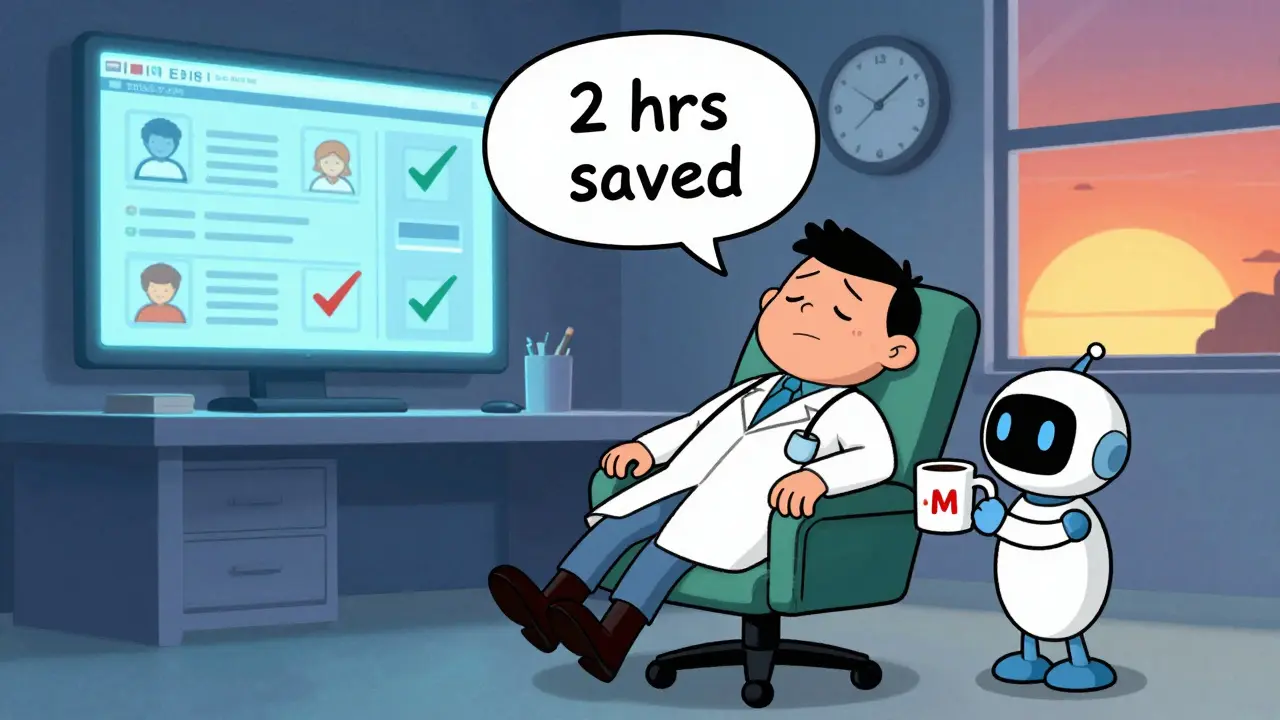
Doctors in the U.S. spend an average of two hours after each shift writing notes-time that should be spent resting, with family, or even just breathing. This isn’t just burnout; it’s a systemic flaw in how healthcare records are managed. Enter large language models (LLMs). These aren’t sci-fi fantasies anymore. By early 2026, LLMs are quietly reshaping how clinical notes are written and how urgent cases are flagged-especially in emergency rooms and telehealth platforms.
What LLMs Actually Do in Healthcare
Large language models in healthcare aren’t general-purpose AI like ChatGPT. They’re trained on billions of medical texts: patient charts, research papers, drug databases, and clinical guidelines. Models like Med-PaLM 2 and BioBERT were fine-tuned specifically to understand medical jargon, symptoms, and treatment protocols. Their job? To read what a doctor says during a patient visit and turn it into a clean, structured clinical note-or to analyze a patient’s message in a portal and decide if they need to be seen today, tomorrow, or next week.It’s not about replacing doctors. It’s about removing the paperwork that’s drowning them. In a 2023 JAMA Network Open study of 1,200 patient visits, doctors using GPT-4-based documentation tools cut their note-writing time by nearly half. That’s not a small win. That’s 1.8 hours saved per 10-hour shift, according to data from Massachusetts General Hospital’s Nuance DAX Copilot rollout.
How Documentation Tools Work in Real Clinics
Imagine a doctor sees a patient with chest pain. They talk through symptoms, history, and exam findings. Behind the scenes, a microphone picks up the conversation and feeds it to an LLM. The model listens, identifies key details-“pain radiates to left arm,” “history of hypertension,” “aspirin taken”-and generates a draft note in seconds.That draft isn’t final. The doctor reviews it, edits a few lines, maybe adds a detail the AI missed. But instead of typing for 20 minutes, they’re spending three. That’s the shift. Systems like Amazon’s HealthScribe and Epic’s AI assistant now integrate directly into electronic health records (EHRs), pulling data from vital sign monitors, lab results, and medication lists to fill in gaps automatically.
Accuracy? Around 85-92% for well-trained models. But here’s the catch: when a patient has a rare condition not in the training data, accuracy can drop by 15%. One ER doctor on Reddit reported an AI added a medication he never prescribed-nearly causing a dangerous interaction. That’s why no hospital lets these tools write notes unattended. Human review is non-negotiable.
Triage: When AI Decides Who Gets Seen First
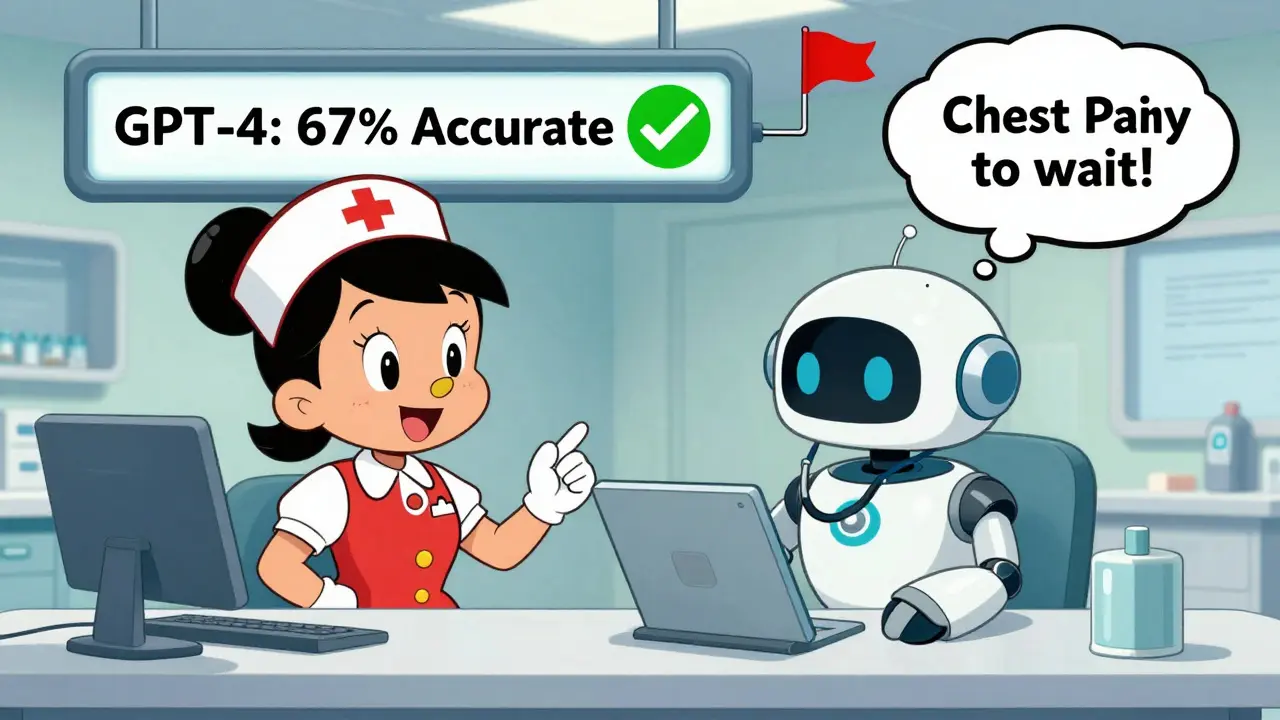
Triage is the first filter in emergency care. Who’s in danger? Who can wait? In a busy ER, this decision can mean life or death. Traditionally, nurses use protocols like the Manchester Triage System. Now, some hospitals are testing LLMs to do the same.In a 2024 study published in JMIR, GPT-4 matched professional triage nurses 67% of the time (kappa=0.67). GPT-3.5? Only 54%. That’s a big gap. But here’s what’s surprising: LLMs tend to overtriage. They flag more patients as urgent than needed-23% of cases. That sounds bad, but it’s safer than undertriage, where real humans miss critical cases 19% of the time.
At a community hospital in Ohio, an AI triage tool processed 12,000 patient portal messages in six months. It correctly flagged 81% of urgent cases, reducing response time by 17 hours per week. But false negatives still happen. A patient with early signs of sepsis might get labeled “low priority” because their fever wasn’t high enough to trigger the algorithm. That’s why these tools are used as assistants, not replacements.
Open Source vs. Commercial Tools
Not all LLMs are built the same. Commercial systems like Nuance DAX Copilot or Amazon HealthScribe are polished, easy to install, and come with vendor support. But they’re expensive-often requiring custom hardware and integration contracts. They also lock you into their ecosystem.Open-source models like Med-PaLM 2 and BioGPT give you full control. You can tweak them, train them on your hospital’s data, and avoid vendor lock-in. But you need a team of data scientists and clinicians to make it work. A hospital in Minneapolis tried Med-PaLM 2 and got 82% accuracy on documentation-but spent eight months training it and hiring two AI specialists just to get it running.
For most hospitals, the choice isn’t about which model is better. It’s about who has the resources to make it work. Academic centers with research budgets? They’re experimenting with open source. Community hospitals? They’re buying off-the-shelf tools, even if they cost $287,000 to install.
The Hidden Problem: Bias in AI
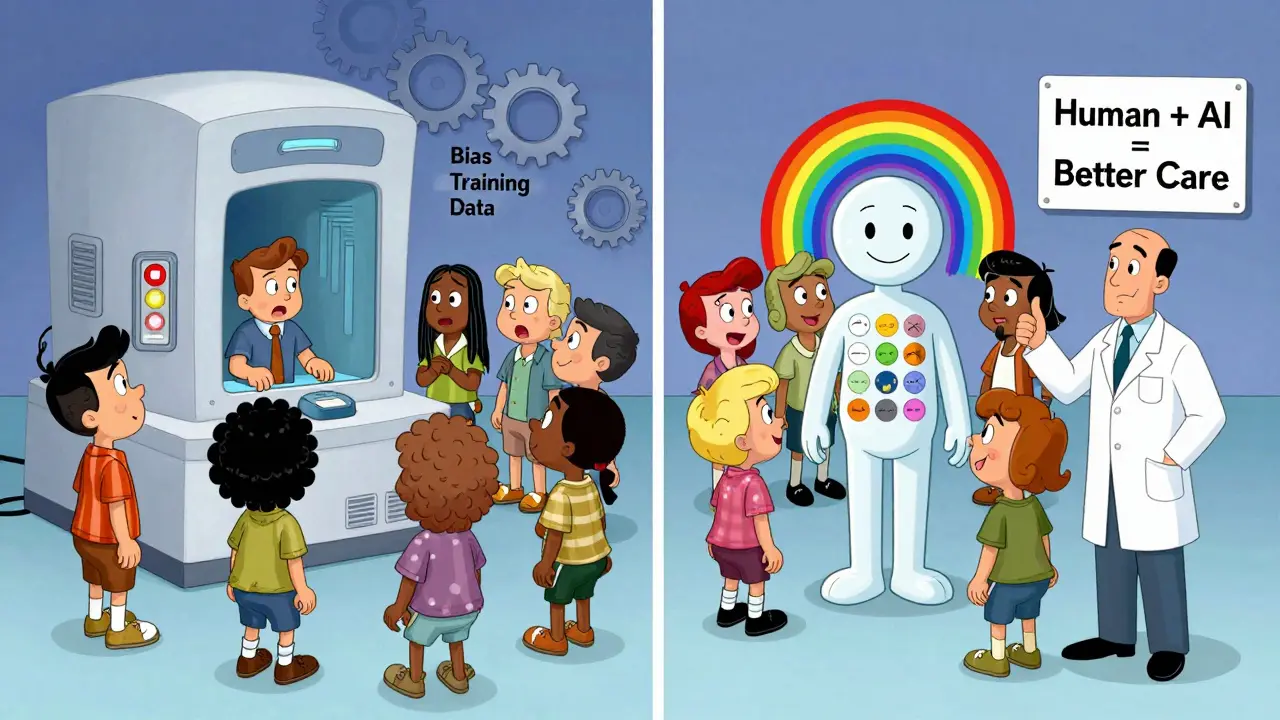
This is the quiet crisis no one talks about enough. A 2024 study from arXiv found that LLM triage systems gave Black and Hispanic patients lower urgency scores than white patients-even when symptoms were identical. In counterfactual testing, the same patient description got a “high priority” rating when the name was changed from “Jamal” to “James.”Why? The training data. Most electronic health records were built from populations that historically had better access to care. So the AI learned that certain symptoms were “less serious” when they appeared in minority patients. That’s not a glitch. It’s a reflection of systemic bias baked into decades of medical data.
Some hospitals are trying to fix this by retraining models with more diverse datasets. But it’s slow. And until bias is actively measured and corrected, these tools risk making healthcare inequalities worse.
Integration Is the Real Challenge
You can have the best AI in the world, but if it can’t talk to your EHR, it’s useless. Most LLMs use HL7 FHIR standards to exchange data with systems like Epic or Cerner. But only 37% of current implementations can send and receive data seamlessly.One hospital in Oregon spent six months trying to connect their LLM to their EHR. They hired three IT specialists, rewrote five API scripts, and still had to manually copy-paste notes into the system. That’s not automation-that’s a workaround.
Successful deployments share three things: an integration expert who understands both AI and EHRs, a clinician champion who pushes adoption, and a validation process where every AI-generated note is reviewed before being saved. Hospitals that did this saw a 63% drop in documentation errors.
Regulation and the Road Ahead
The FDA treats most healthcare LLMs as Class II medical devices, meaning they need clearance before use. But enforcement is patchy. As of December 2023, only 17 LLM products had formal FDA approval. Most are being used under “enforcement discretion”-meaning regulators are watching, but not stopping them.The European Union’s AI Act, which took effect in February 2025, is stricter. It requires clinical validation, bias testing, and transparency logs. That’s forcing U.S. companies to build two versions of their software-one for Europe, one for America. It’s expensive. It’s messy. But it’s necessary.
Looking ahead, the next big leap is multimodal AI. Models like LLaVA-Med can now analyze both text and X-rays or skin images. By 2026, 65% of new healthcare LLMs will likely combine text understanding with visual analysis. Imagine a doctor describing a rash, and the AI cross-references it with a photo the patient uploaded. That’s the future.
Is This Really Working?
The numbers say yes. Doctors are happier. Notes are faster. Triage is more consistent. But the human element is still the safety net. AI doesn’t understand context the way a nurse does. It doesn’t know that a patient skipped meals because they’re worried about the bill. It doesn’t recognize fear in a voice.The best systems don’t try to replace clinicians. They free them up to be clinicians. Documentation and triage are tasks, not decisions. Let the AI handle the tasks. Let the human handle the care.
Right now, only 15% of U.S. hospitals use these tools. But adoption is accelerating. By 2027, that number could be over 50%. The question isn’t whether LLMs belong in healthcare. It’s whether we’ll use them wisely-or let them amplify our mistakes.
Can large language models replace doctors in triage?
No. LLMs can help prioritize patients by analyzing symptoms and history, but they can’t replace clinical judgment. Studies show they’re good at flagging urgent cases, but they often overtriage-assigning higher urgency than needed. Human clinicians still make better decisions in complex, ambiguous cases. The goal is a hybrid system: AI handles the initial sorting, and doctors make the final call.
Are LLM-generated clinical notes accurate?
For common conditions, yes-accuracy ranges from 85% to 92% in controlled studies. But performance drops sharply for rare diseases or when vital signs are missing. In one study, accuracy fell by 22% when key data like blood pressure or oxygen levels weren’t available. That’s why every AI-generated note must be reviewed by a clinician before being finalized in the medical record.
Do LLMs have bias in healthcare?
Yes, and it’s a serious problem. Multiple studies have shown that LLMs assign lower urgency scores to Black and Hispanic patients compared to white patients with identical symptoms. This happens because training data reflects historical disparities in care. Without active correction, these tools can reinforce, not fix, inequities. Hospitals using LLMs must regularly audit outputs for bias and retrain models with diverse data.
What’s the difference between GPT-3.5 and GPT-4 in healthcare?
GPT-4 significantly outperforms GPT-3.5 in medical tasks. In triage accuracy, GPT-4 matches professional nurses 67% of the time (kappa=0.67), while GPT-3.5 only matches 54%. For documentation, GPT-4 reduces note-writing time by 48%, compared to 29% for GPT-3.5. The difference comes from better training on medical language, improved reasoning, and more precise understanding of clinical context.
How much does it cost to implement an LLM in a hospital?
Implementation costs vary widely. Commercial systems like Nuance DAX or Amazon HealthScribe can cost $250,000-$350,000 per hospital, including integration, training, and support. Open-source models like Med-PaLM 2 are free to use but require $100,000-$200,000 in technical labor to deploy and maintain. Most hospitals need 3-6 months of preparation, including hiring AI specialists and training staff. ROI is still uncertain-only 28% of implementations show positive returns within 18 months.
Is HIPAA compliance a problem with LLMs?
Yes. Seventy-eight percent of healthcare systems cite HIPAA compliance as a top concern. LLMs need access to patient data to work, but sending that data to third-party servers (like OpenAI or Google) can violate privacy rules. Solutions include on-premise models, encrypted data pipelines, and using only de-identified data for training. Some hospitals now run LLMs entirely within their own secure networks to avoid external exposure.


Let me tell you something they don't want you to know-this isn't about efficiency, it's about control. The same people who pushed EHRs to make doctors into data clerks are now pushing AI to erase the human touch entirely. They're not saving time-they're outsourcing judgment to algorithms trained on biased, corporate-controlled medical records. And don't even get me started on how these models were fed data from hospitals that ignored Black patients for decades. Now the AI thinks a Black man with chest pain is 'low priority' because his name sounds 'too urban.' It's not a glitch. It's genocide by algorithm. And they call it innovation. Meanwhile, nurses are getting fired because 'the AI can triage better.' Funny how the people who built this never have to sit in the ER at 3 a.m. watching a patient die because a bot thought their fever wasn't high enough. Wake up. This is the new eugenics, wrapped in Python and sold with a SaaS subscription.
They're not replacing paperwork. They're replacing conscience.
And if you think the FDA is regulating this? HA. They're asleep at the wheel while Big Pharma quietly buys up every LLM startup that says 'bias mitigation.' The real goal? Make healthcare so automated that you can't sue anyone when it goes wrong. Liability? All buried in the Terms of Service. You think you're getting better care? You're getting cheaper care. And someone's making billions off your suffering.
Next thing you know, your grandma's insulin dose will be auto-adjusted by a model that learned from 10,000 white patients and zero diabetic elders in rural Mississippi. And when she goes into ketoacidosis? The system will log it as 'non-compliance.' Because the AI doesn't know she couldn't afford the meds. It just knows the data says she's a 'high-risk patient.' And that's the real tragedy-not the tech, but the people who let it happen without a fight.
They call it progress. I call it surrender.
And if you're still nodding along like this is just 'innovation,' you're part of the problem. The machines don't have malice. But the people behind them? Oh, they're hungry. And they're not feeding the patients. They're feeding the shareholders.
Don't believe me? Check the stock prices of every company selling these tools. They're skyrocketing. While ER nurses are quitting in droves. Coincidence? Or calculus?
They're not fixing healthcare. They're cannibalizing it.
And you're clicking 'agree' to the EULA while your mom's chart gets auto-corrected into oblivion.
It is both lamentable and profoundly concerning that the medical profession, an institution historically grounded in ethical deliberation and human empathy, is now being subsumed by algorithmic determinism under the guise of efficiency. The notion that a machine, trained on datasets riddled with systemic inequities, should be entrusted with triage decisions-or even documentation-is not merely a technical oversight; it is a moral failure of the highest order. The reduction of clinical judgment to statistical probabilities, the commodification of care through vendor lock-in, and the normalization of unchecked bias under the banner of innovation represent a dangerous erosion of professional integrity. One cannot outsource conscience to a neural network. The physician-patient relationship is not a data pipeline; it is a sacred covenant, and to replace its human dimension with code is to hollow out the very soul of medicine. The fact that we celebrate a 67% alignment with human triage as a triumph, rather than a scandal, speaks volumes about our collective moral drift. If we continue down this path, we will not have improved healthcare-we will have automated its indifference.
There is a grammatical error in the third paragraph: 'They're trained on billions of medical texts: patient charts, research papers, drug databases, and clinical guidelines.' The colon should be followed by a capital letter if it introduces a complete sentence, but here it introduces a list, so it is correct-but the sentence structure is still awkward. Also, 'that’s the shift' is colloquial and imprecise; it should read 'that is the paradigm shift' for formal clarity. Furthermore, the phrase 'nearly half' is vague-'48%' is more accurate and professional. And '23% of cases' needs a subject: 'The AI flagged 23% of cases as urgent.' Without proper subject-verb agreement and precision, this article reads like a blog post, not a serious analysis. If you're going to cite JAMA and arXiv, at least write like it.
Look, I get it-tech bros love to sell us shiny new toys. But let’s be real: we’re not in some Silicon Valley demo lab. We’re in America, where half the hospitals still use fax machines and the other half are broke. You think some startup’s AI is gonna fix systemic racism in healthcare? Nah. It’s just gonna make it faster and more anonymous. And don’t even get me started on how these ‘open-source’ models are just glorified GitHub projects with a fancy name. Med-PaLM? Sounds like a vitamin. Meanwhile, real docs are drowning in paperwork because Congress hasn’t funded proper EHR reform since 2009. This isn’t innovation-it’s distraction. We need better pay for nurses, not more AI that overtriages and underperforms. And if you think GPT-4 is the future of medicine, you’ve never sat next to a real clinician who’s seen 10,000 patients and knows when someone’s lying about their pain. No algorithm can read fear in a voice. Only a human can. So stop pretending this is progress. It’s just another way for consultants to charge $500/hour while the system keeps crumbling.
This is a well-researched and balanced overview of a complex issue. The distinction between augmentation and replacement is critical, and the emphasis on human review as non-negotiable is exactly right.