
Finding a developer who can write a few prompts is easy. Finding an engineer who can build a production-ready, scalable system that doesn't hallucinate its way through your company's financial data is nearly impossible. In 2025, the gap between "AI enthusiasts" and true LLM engineering is the discipline of designing, deploying, and maintaining large-scale language model applications in production environments has become a massive hurdle for companies.
If you're building a team today, you aren't just looking for "AI people." You're looking for a specific mix of software rigor and research agility. The market has shifted; general LLM knowledge is now a commodity. The real value lies in specialization-people who actually understand the math behind the attention mechanism or the plumbing of a distributed retrieval system.
The Technical Core: Beyond the Basics
You can't build a house without a foundation, and in 2025, that foundation is Python. But simply knowing the language isn't enough. Your team needs deep proficiency in PyTorch or TensorFlow to actually manipulate models. If they can't explain how a Transformer architecture works-specifically the self-attention mechanisms that allow a model to remember the beginning of a sentence while processing the end-they are just using an API, not engineering a system.
For a team to be successful, they need to move through four specific stages of competency:
- Foundations: Mastery of statistics and traditional machine learning.
- Architectural Depth: Understanding multi-head attention and positional encoding.
- Optimization: Knowing how to make a model smaller and faster without breaking it.
- Operationalization: Moving a model from a notebook to a live environment that serves thousands of users.
The Power Players: Specializations that Move the Needle
If you're hiring for high-impact roles, stop looking for generalists. The most competitive talent in 2025 falls into three critical buckets: RAG experts, LLMOps practitioners, and Optimization specialists.
Retrieval-Augmented Generation (or RAG) is a technique that combines LLMs with external data retrieval to provide grounded, factual responses. An expert here doesn't just plug in a vector database; they understand dense versus sparse retrieval and hybrid search strategies. They know how to optimize latency so the user isn't staring at a loading spinner for ten seconds while the system searches a million documents.
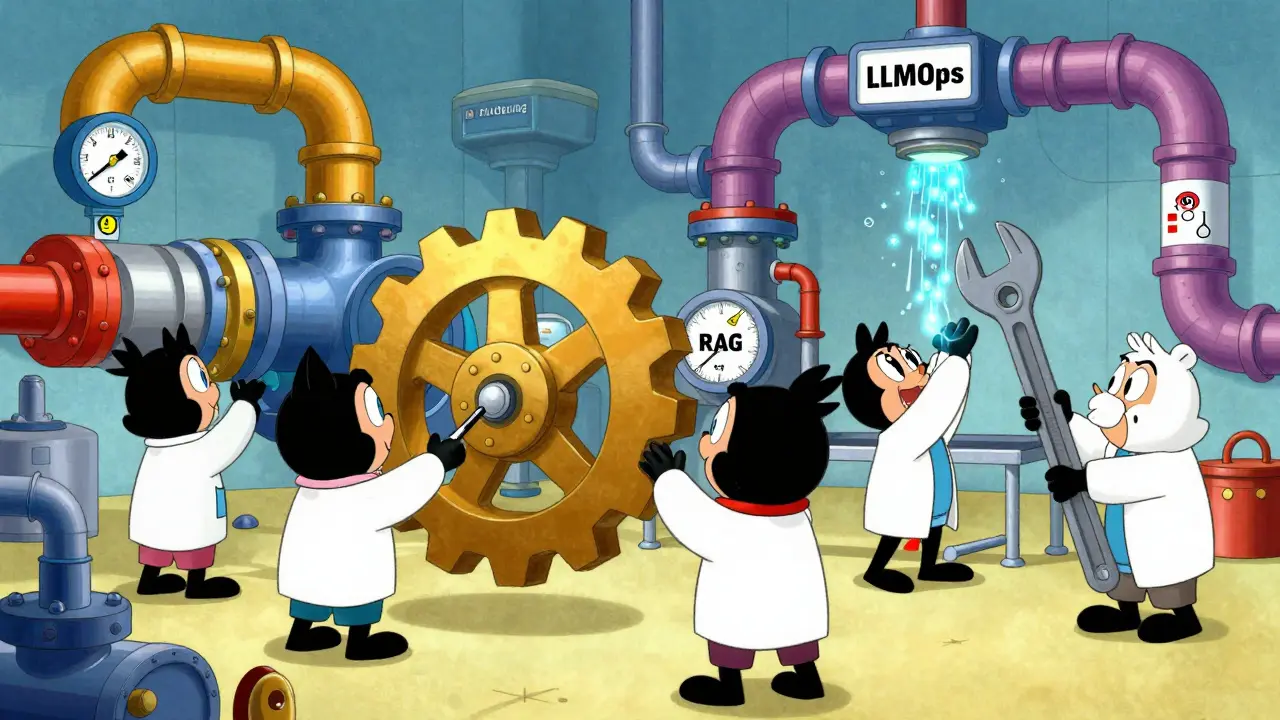
Then there is LLMOps. This is the "plumbing" of AI. These professionals focus on monitoring, versioning, and the maintenance of models. Without a strong LLMOps focus, your model will drift, your costs will skyrocket, and you'll have no idea why the model suddenly started giving weird answers on a Tuesday morning.
Finally, look for people who understand efficient deployment. Computational costs are the biggest killer of AI projects. You need engineers who can implement LoRA (Low-Rank Adaptation) for parameter-efficient fine-tuning, or use quantization techniques like 4-bit or 8-bit (GPTQ/AWQ) to shrink models so they fit on cheaper hardware without losing their "intelligence."
| Role | Key Focus | Must-Have Tools | Business Value |
|---|---|---|---|
| RAG Specialist | Data Grounding | LlamaIndex, LangChain, Vector DBs | Reduces Hallucinations |
| LLMOps Engineer | Lifecycle Mgmt | vLLM, DeepSpeed, TGI | Scalability & Stability |
| Optimization Pro | Efficiency | QLoRA, Quantization, CUDA | Lower GPU Costs |
The "Hidden" Skills: Soft Skills for Hard Tech
Here is where most companies fail: they hire a genius who can't talk to a business stakeholder. In LLM projects, the hardest part isn't the code; it's the requirements elicitation. You need people who can sit down with a non-technical product manager and translate a vague request like "I want the AI to sound more professional" into a concrete technical specification involving RLVR (Reinforcement Learning with Verifiable Rewards) or specific prompt engineering constraints.
Active listening and multidisciplinary thinking are non-negotiable. An LLM engineer who doesn't understand the business domain they are working in will build a technically perfect tool that solves the wrong problem. They need to be able to identify stakeholders and formulate questions that uncover the actual constraints of the project before a single line of code is written.
Ethics and Evaluation: The Safety Net
In 2025, ethical AI isn't just a PR move; it's a regulatory requirement. Your team must be proficient in bias detection and mitigation. If you're in healthcare or finance, a model that exhibits bias isn't just a bug-it's a legal liability. Hiring managers should look for candidates who can explain their approach to fairness evaluation and transparency.
Equally important is the ability to evaluate a model. If your team tells you the model "feels better," you have a problem. You need engineers who use standardized NLP metrics and benchmarks, but who also understand benchmark gaming. A model that scores high on a public test but fails in the real world is useless. Experienced pros build custom, company-specific evaluation sets to ensure the model actually works for the end user.

Sourcing Talent in a Competitive Market
Finding someone with three years of practical LLM experience is nearly impossible because the tech moves so fast. This is forcing a shift in how we hire. Instead of chasing unicorns, smart companies are recruiting from adjacent domains. A strong traditional machine learning engineer or a high-level software engineer with deep systems knowledge can often be trained in LLM-specifics faster than a generalist can be taught software rigor.
When vetting candidates, ignore the certificates. There are no industry-standard "LLM Certifications" that actually mean anything in 2025. Instead, look at:
- GitHub Repositories: Did they actually build something, or just fork a tutorial?
- Open Source Contributions: Are they contributing to the frameworks they claim to know?
- Portfolio Projects: Can they walk you through a failure mode they encountered and how they fixed it?
Many organizations are now using internal apprenticeship programs. They take a senior software engineer, give them a GPU budget, and put them through an immersive three-month project to bridge the gap between general coding and AI engineering.
What is the most important skill for an LLM engineer in 2025?
While Python and PyTorch are foundational, the most valuable skill is now specialization in RAG (Retrieval-Augmented Generation) or LLMOps. The ability to move a model from a prototype to a stable, cost-effective production environment is what separates high-value engineers from generalists.
Should I hire a PhD or a Software Engineer for my AI team?
It depends on the goal. If you are inventing new architectures or pushing the boundaries of research, a PhD in NLP or CS is essential. However, if you are building a product, a strong Software Engineer with an understanding of LLM fundamentals is often more productive because they bring the rigor of testing, versioning, and deployment that research-heavy profiles sometimes lack.
How do I evaluate if a candidate actually knows LLMs?
Ask them about failure modes. Ask them to describe a time a model hallucinated in a way they didn't expect and how they used techniques like fine-tuning or RAG to solve it. Someone who has actually built a system will be able to talk about the "messy" parts of the process, not just the theoretical successes.
Is prompt engineering still a standalone job role?
Rarely. In 2025, prompt engineering has been absorbed into the broader role of the LLM engineer. Being able to write a good prompt is now considered a basic tool, like knowing how to use a debugger. The value has shifted toward the systemic implementation of prompts through code and automated evaluation pipelines.
What are the key tools an LLM team should be using today?
At a minimum, your team should be proficient in PyTorch, LangChain or LlamaIndex for orchestration, vLLM or DeepSpeed for inference optimization, and a robust vector database for RAG implementations.
Next Steps for Your Hiring Strategy
If you're just starting your team, don't hire five generalists. Hire one architect who understands the transformer's internals, one LLMOps engineer who can handle the infrastructure, and two strong software engineers who can be trained on the specific AI frameworks your company chooses. Focus on people who have a track record of shipping software, as the AI-specific tools will change every six months, but the principles of good engineering remain the same.
Totally agree that the shift toward LLMOps is the real game changer here.
Most companies are just playing around with wrappers, but getting the actual telemetry and drift monitoring right is where the magic happens. The move toward quantization and LoRA is such a vibe for saving on those insane H100 costs.
Imagine thinking a 'portfolio project' is a valid metric for a senior role. Truly quaint. Also, it's "their」 not "there" if you're talking about ownership of the failure mode, though the author managed to avoid that particular disaster. Honestly, the pseudo-intellectual obsession with 'architectural depth' just masks the fact that most of these 'engineers' are just gluing together Python libraries they don't understand.
It's honestly depressing how many companies are just throwing money at GPUs without a shred of a strategy. You can hire all the RAG specialists you want, but if your organizational culture is a dumpster fire, your AI is just going to automate the chaos. Most of these 'talent strategies' are just desperate attempts to keep the VCs happy while the actual product remains a hallucinating mess.
I find myself reflecting on the point about recruiting from adjacent domains because it feels so much more human to give a skilled software engineer the chance to pivot their career into AI rather than demanding a unicorn candidate who possesses ten years of experience in a technology that has only existed in its current form for a few years, and I think we should all consider how the pressure of these high expectations might be affecting the mental well-being of the developers who are trying their best to keep up with the breakneck speed of these releases.
The sheer audacity of suggesting that a three-month apprenticeship can bridge the gap between a standard coder and a true AI architect is absolutely laughable and frankly a slap in the face to those of us who spent years wrestling with the arcane mathematics of neural networks before these shiny new toys became corporate fashion statements. It's a kaleidoscopic delusion to believe that software rigor alone can replace the deep, intuitive grasp of stochastic processes and high-dimensional vector spaces that is required to truly tame a model and prevent it from spiraling into a digital fever dream of inaccuracies!
This is a fantastic breakdown! I'm especially curious about how hybrid search strategies are evolving with the new wave of dense retrievers. It's like we're finally moving past the 'magic box' phase and actually building a proper map of the data landscape.
Funny how this post mentions 'regulatory requirements' but doesn't mention who is actually controlling these models and where the data is really going. We're just building better cages for our own information while some shadow entity monitors every single 'optimized' token we generate.
It would be lovely if we spent more time discussing the ethical implications of replacing entry-level roles with these 'optimized' systems instead of just focusing on how to make the GPUs cheaper. I'm sure the company's bottom line is very important, but perhaps we could prioritize the human cost of this 'talent strategy' for once.