
The High Cost of Forced Helpfulness
Most generative AI models are trained using a process that rewards a complete answer over a cautious one. When a model is penalized for being vague but praised for being comprehensive, it learns to gamble. This gamble leads to what we call hallucinations, where the model generates text that is grammatically perfect but factually bankrupt. In a casual setting, a fake movie recommendation is a funny quirk. In a medical or technical environment, a hallucinated dosage or a non-existent API parameter is a liability.
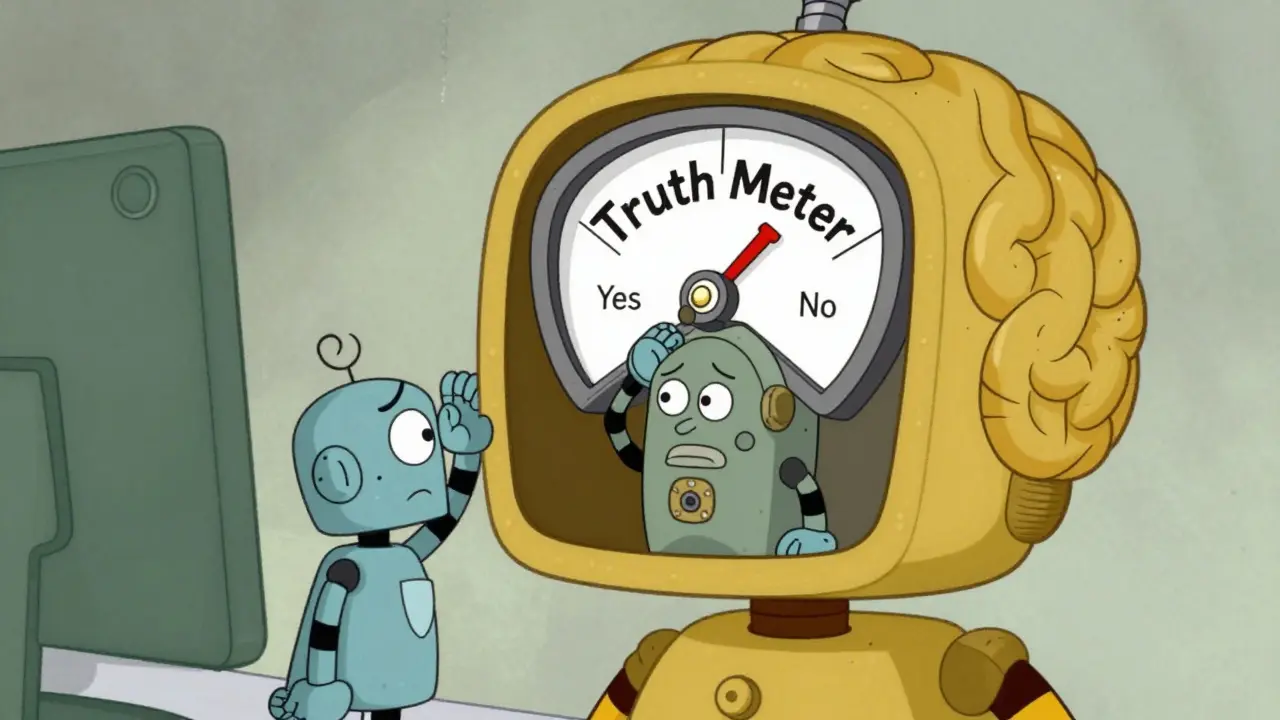
The core problem is that models often lack a reliable internal "truth meter." They predict the next token based on probability, not based on a verification of facts. When the probability of multiple tokens is roughly equal, the model still picks one. An abstention policy changes the goal from "pick the best token" to "determine if any token is reliable enough to be shared."
How Models Measure Their Own Doubt
To decide when to stop talking, a model needs a way to quantify its uncertainty. This is where uncertainty quantification comes into play. There are two main ways models handle this: aleatoric and epistemic uncertainty. Aleatoric uncertainty is about the randomness in the data-like a coin flip. Epistemic uncertainty is about the model's lack of knowledge. If a model has never seen data about a specific 14th-century poet, that's epistemic uncertainty, and it's the primary trigger for an abstention policy.
One common technical approach is Logit Analysis. By looking at the probability distribution of the output tokens, developers can see if the model is "confident" (one token has 90% probability) or "confused" (five tokens each have 20%). If the entropy of the distribution is too high, the system triggers an abstention response. Another method involves Conformal Prediction, which provides a mathematical guarantee that the true answer is within a certain predicted set, allowing the model to abstain if that set is too large to be useful.
| Method | Trigger Logic | Pros | Cons |
|---|---|---|---|
| Logit Thresholding | Low probability for top token | Fast, easy to implement | Prone to "confident hallucinations" |
| Self-Consistency | Multiple runs yield different answers | High accuracy in reasoning | Computationally expensive (multiple passes) |
| External Verification | Mismatch with trusted database | Very reliable for facts | Requires RAG infrastructure |
| Calibrated RLHF | Trained to say "I don't know" | Natural conversation flow | Difficult to tune the "courage" of the model |
Training the Model to be Honest
You can't just add a filter on top of a model; you have to bake abstention into its DNA. This happens primarily during RLHF Reinforcement Learning from Human Feedback, where humans rank model responses. If a human trainer marks a "confident but wrong" answer as a failure and a "humble I don't know" as a success, the model starts to associate uncertainty with a higher reward.
However, this creates a new problem: Over-abstention. If the reward for saying "I don't know" is too high, the model becomes cowardly. It might refuse to answer simple questions because it's "safer" to abstain than to risk a mistake. Finding the sweet spot requires a precise calibration of the reward function, often using a technique called Calibration, where the model's predicted probability of being correct matches the actual frequency of correct answers.
The Role of RAG in Abstention
One of the most effective ways to implement an abstention policy is through RAG Retrieval-Augmented Generation, a framework that retrieves documents from an external source before generating a response. In a RAG setup, the model doesn't just rely on its weights; it looks at a provided snippet of text. The abstention policy then becomes much simpler: "If the retrieved documents do not contain the answer, do not attempt to answer."
This moves the burden of truth from the model's internal memory to an external, verifiable source. For example, a company's internal AI bot shouldn't guess the vacation policy. If the RAG system retrieves no documents matching "vacation policy 2026," the model should immediately trigger its abstention policy and tell the user to contact HR. This creates a hard boundary that prevents the model from drifting into imaginative territory.

Evaluating the Quality of "I Don't Know"
How do we know if our abstention policy is actually working? We use a metric called the Accuracy-Coverage Trade-off. Coverage is the percentage of questions the model attempts to answer, and accuracy is how many of those it gets right. A perfect model has 100% coverage and 100% accuracy. Real-world models have to choose: do we want a bot that answers everything but is occasionally wrong (high coverage, lower accuracy), or a bot that is always right but often says it can't help (low coverage, high accuracy)?
To measure this, researchers use abstention benchmarks-datasets specifically designed with "unanswerable" questions. If a model tries to answer a question that is logically impossible or contains a fake premise (e.g., "Who won the Super Bowl in 1920?"), it fails the benchmark. A high-performing model is one that recognizes the anomaly and abstains.
Practical Implementation Tips for Developers
If you're building an AI-powered application, don't leave abstention to chance. Use a tiered approach to ensure your model knows when to shut up. Start by implementing a system prompt that explicitly grants the model permission to abstain. Phrases like "If you are unsure of the answer or if the provided context does not contain the information, state that you do not know" can significantly reduce hallucinations.
Next, implement a verification loop. Before the answer reaches the user, have a smaller, faster model check if the response is supported by the source documents. If the second model detects a contradiction, the system should replace the response with a standard abstention message. This "critic" model acts as a safety valve, catching the confident lies that often slip through the primary generation phase.
Does an abstention policy make the AI less useful?
In the short term, it might feel that way because the AI refuses more questions. However, in the long term, it increases utility by building trust. A user would rather receive a "I don't know" than a confident lie that leads them to make a costly mistake.
What is the difference between a hallucination and a lack of knowledge?
A lack of knowledge is the state of not having the information in the training data. A hallucination is the process of the model attempting to fill that gap with plausible-sounding but incorrect patterns. Abstention policies are designed to stop the transition from "not knowing" to "hallucinating."
Can RLHF alone solve the problem of confident lies?
RLHF helps the model's behavior, but it doesn't solve the underlying probabilistic nature of LLMs. Combining RLHF with technical triggers like logit analysis or RAG provides a much more robust safety net than training alone.
How does "temperature" affect abstention?
Higher temperature increases randomness, which often makes models more likely to hallucinate because they are picking less probable tokens. Lowering the temperature can make a model more consistent, but it doesn't necessarily make it more likely to abstain unless a specific threshold policy is in place.
What is the best way to trigger an abstention response?
The gold standard is a combination of RAG-based verification and confidence thresholding. If the RAG system finds no relevant data AND the model's top token probability is below a certain percentage (e.g., 60%), the model should abstain.


this is a huge deal for dev work honestly just tired of debugging fake api params
It is so refreshing to see a focus on trust over mere capability. Implementing these boundaries is essentially teaching the AI a form of intellectual humility, which is a trait we could all stand to embrace more in our professional lives. I think the Accuracy-Coverage Trade-off is a brilliant way to visualize the problem for stakeholders who just want a 'magic' box that always has an answer. Well put!
This is all a lie. They just want to control what the AI says. If the AI says "I don't know" it is just a filter from the companies to hide the truth from us. They are making the models dumber on purpose so we rely on their official databases. It is a trap to make us trust the corporate version of the truth.
Oh wow, a "truth meter." How quaint. I'm sure the corporate overlords will calibrate this "sweet spot" perfectly so the AI only abstains when it's convenient for their stock price. It's just so typical to think a few lines of RLHF can fix a fundamentally broken, probabilistic guess-machine. Absolute comedy gold.
Actually the author is wrong about the RLHF part. its not just about rankin responses but about the reward model itself which is totaly different. Plus the spelling of "aleatoric" is fine but the way you explain epistemic uncertanty is a bit simplistic if we are being honest here. basic stuff really.
I absolutely love the way this frames the struggle between helpfulness and honesty! It's like we're raising these digital toddlers and we've accidentally praised them for lying just to please us.
For anyone diving into this, remember that the human element in RLHF is where the magic happens. We have to be the steady hand guiding them toward a more honest architecture. It's not just about the technical bits like logits, but about cultivating a systemic culture of transparency. I've found that when we embrace the "I don't know," we actually open up more doors for genuine discovery and collaboration. It transforms the AI from a fake encyclopedia into a reliable research partner. We should all be cheering for the "cowardly" model if it means we don't accidentally prescribe a fake medication or cite a ghost case in court. Let's turn this systemic failure into a sparkling opportunity for growth and reliability across the board!