
Imagine a doctor asking an AI assistant about a rare pediatric condition. The model confidently suggests a medication dosage that is double the safe limit for a child. No red flags pop up. The doctor trusts the output because it sounds professional. That’s not just a bug; it’s a potential malpractice suit waiting to happen. Now, imagine a lawyer using an AI tool to draft a contract clause. The AI inadvertently reveals a confidential detail from a previous client’s case because it failed to recognize the context of attorney-client privilege. In both scenarios, the core issue isn't that the Large Language Model (LLM) was "dumb." It was hallucinating or leaking data in ways that generic safety filters simply don't catch.
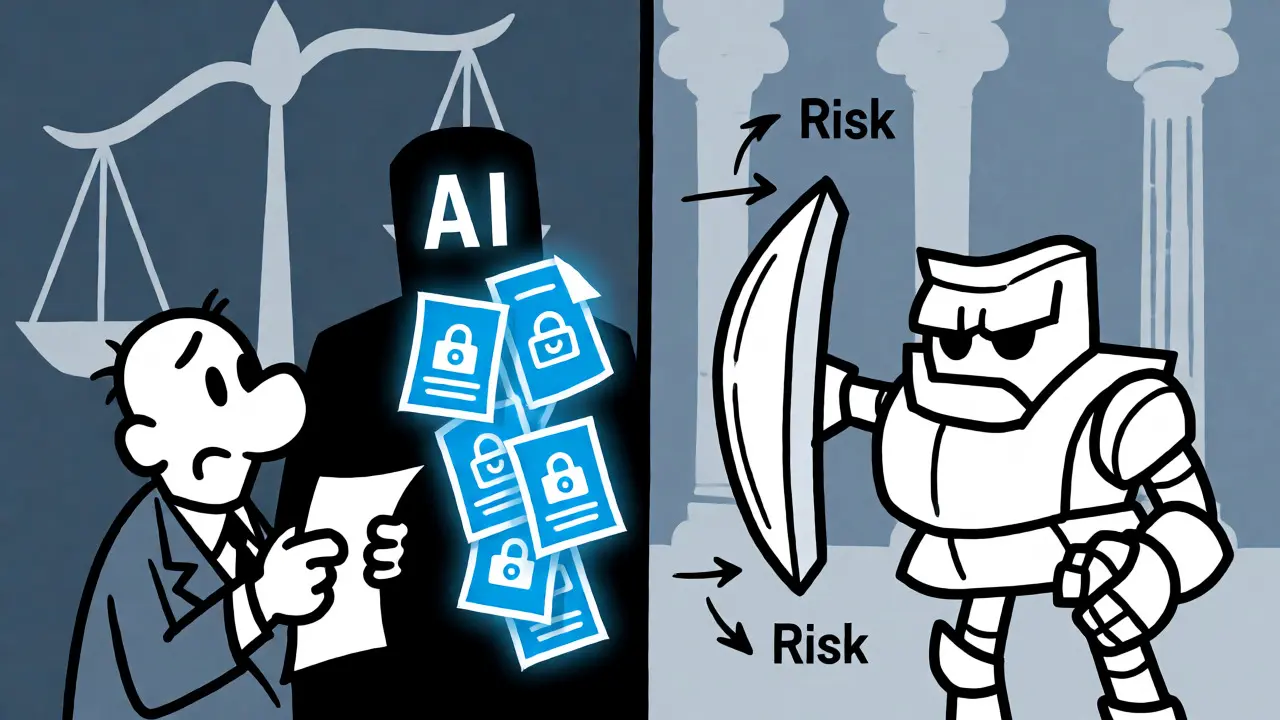
This is where LLM guardrails become critical infrastructure rather than optional add-ons. When we talk about guardrails for factual domains, we are referring to specialized software layers designed to intercept, filter, and validate inputs and outputs specifically for high-stakes industries like healthcare and law. Unlike general chatbots that might tolerate a bit of creative flair, medical and legal AI must operate within rigid boundaries defined by HIPAA, FDA regulations, and bar association rules. As of late 2025, the pressure to implement these controls has intensified. Studies show hallucination rates exceeding 60% in open-ended clinical tasks, while healthcare data breaches compromised over 130 million US records in recent years. If you are deploying AI in these sectors, understanding how to build and maintain these guardrails is no longer optional-it’s a survival mechanism.
Why Generic Safety Filters Fail in Regulated Industries
You might wonder, "Can’t I just use the built-in safety features of GPT-4 or Claude?" The short answer is no. General-purpose models are trained on vast amounts of internet text, which means they are optimized for conversational fluency, not regulatory compliance. A standard safety filter might block a request for violent content or hate speech, but it won’t necessarily stop a model from providing unauthorized legal advice or misinterpreting a complex medical interaction.
In the medical domain, the stakes are literal life-and-death issues. For instance, a generic model might suggest a treatment plan based on average adult statistics without accounting for specific patient comorbidities flagged in the Electronic Health Record (EHR). In the legal realm, the risk shifts toward liability and confidentiality. An AI might summarize a deposition accurately but fail to redact privileged information because it doesn't understand the subtle nuances of jurisdiction-specific legal ethics. According to the American Bar Association Formal Opinion 498, lawyers must take "reasonable measures" to prevent AI from providing unauthorized legal advice. This requires more than just a keyword blocklist; it demands contextual awareness.
The technical reality is that generic filters lack the semantic depth required for these fields. They often suffer from two major failure modes: false positives and false negatives. False positives occur when the system blocks legitimate queries-like a doctor discussing differential diagnoses for rare conditions-because the phrasing triggers a "diagnosis" warning. False negatives are worse: the system allows a dangerous recommendation through because it looks syntactically correct. HiddenLayer’s research in November 2024 demonstrated that sophisticated prompt injection attacks could bypass safety policies in major models with a 78.6% success rate, highlighting the fragility of one-size-fits-all approaches.
Core Components of Domain-Specific Guardrail Systems
Effective guardrails aren't a single switch you flip. They are multi-layered systems that operate at different stages of the AI workflow. To build robust controls for medical and legal applications, you need to address three distinct layers: input filtering, output validation, and contextual auditing.
- Input Filtering: This layer acts as the bouncer. It analyzes user prompts before they reach the LLM. In healthcare, this involves detecting Protected Health Information (PHI) patterns. For example, if a user pastes a raw lab report containing a patient's name and Social Security number into a public API, the guardrail should either redact this data or reject the query entirely. NVIDIA’s NeMo Guardrails uses regex pattern matching combined with semantic similarity checks to identify these risks, blocking 127 distinct query types related to patient data access.
- Output Validation: Once the LLM generates a response, the guardrail reviews it. Does the medical advice align with current clinical guidelines? Does the legal summary avoid making definitive claims about case outcomes? This layer often uses secondary, smaller models or rule-based engines to verify facts against trusted sources like UpToDate for medicine or Westlaw for law. If the confidence score falls below a threshold, the system can flag the response for human review or block it entirely.
- Contextual Awareness: This is the hardest part. The system needs to understand the role of the user and the intent of the query. Is the user a physician seeking peer review, or a patient looking for reassurance? Contextual guardrails adjust their strictness accordingly. For instance, a query from a verified clinician might allow broader diagnostic discussions, while the same query from a consumer might trigger stricter warnings about seeking professional care.
Implementation isn't trivial. Healthcare deployments typically require 3-6 months for full integration. You need certified HIPAA security officers and clinical subject matter experts to configure the rules. It’s not just code; it’s policy encoded into logic.
Leading Technologies: NeMo Guardrails vs. Llama Guard vs. TruLens
The market for LLM guardrails has matured rapidly, with several dominant players offering different strengths. Choosing the right tool depends heavily on whether your primary concern is healthcare compliance, legal precision, or enterprise auditability.
| Framework | Primary Strength | Market Adoption | Key Limitation | Best Use Case |
|---|---|---|---|---|
| NVIDIA NeMo Guardrails | HIPAA Compliance & PHI Detection | 63% in Healthcare | Overblocking legitimate clinical nuance | Clinical decision support tools |
| Meta Llama Guard | Multilingual Support & Open Source | 41% in Legal Tech Startups | Misses subtle unauthorized practice of law | Global legal document analysis |
| TruLens | Audit Trails & Enterprise Integration | 58% in Fortune 500 Legal | Requires heavy customization for medical | High-compliance corporate legal workflows |
NVIDIA NeMo Guardrails has emerged as the leader in healthcare, capturing 63% of the market among surveyed providers. Its strength lies in its YAML-based configuration system, which allows developers to define specific rails for topics like medication interactions or diagnosis limitations. It integrates seamlessly with EHR systems like Epic and Cerner via FHIR APIs. However, clinicians have reported frustration with "overblocking," where valid medical discussions are stifled because the system is too cautious. At Mayo Clinic’s pilot, doctors complained about needing manual overrides multiple times per shift.
Meta’s Llama Guard dominates the open-source space, particularly in legal tech startups. It offers superior multilingual support, handling 137 languages, which is crucial for global firms. But Stanford’s 2024 LegalTech Audit revealed a significant weakness: it missed 32.7% of unauthorized practice of law scenarios. It struggles with the subtle distinction between legal information and legal advice, a line that varies significantly by jurisdiction.
TruLens is the go-to for large enterprises needing rigorous audit trails. It provides granular explanations for why content was blocked, averaging 3.2 verification points per decision. This transparency is vital for legal defensibility. However, it lacks out-of-the-box medical specificity, requiring extensive customization to handle clinical nuances.
The Hallucination Problem: Why Accuracy Isn't Enough
Even with guardrails, the underlying problem remains: LLMs hallucinate. In factual domains, a hallucination isn't just an error; it's a violation of trust. The University of Washington’s 2024 study found that guardrails add 120-350ms of latency to responses, but they achieve only 92.7% accuracy in blocking healthcare violations. That might sound high, but in a hospital setting, a 7.3% failure rate on critical alerts is unacceptable.
The root cause is that LLMs predict the next likely word, not the truth. They don't "know" that Warfarin interacts with Vitamin K; they know that words like "Warfarin" and "Vitamin K" often appear together in contexts involving bleeding risks. Guardrails try to patch this by checking outputs against external knowledge bases. But what happens when the model invents a citation? Or cites a real study but misinterprets its conclusion?
This is why retrieval-augmented generation (RAG) is often paired with guardrails. Instead of relying solely on the model's internal weights, RAG pulls relevant documents from a trusted database. The guardrail then verifies that the model's answer actually comes from those retrieved documents. If the model says "Study X proves Y," the guardrail checks if Study X actually exists and if it indeed supports claim Y. Without this grounding, even the best guardrails are just guessing.

Regulatory Pressures Driving Adoption
If you're still debating whether to invest in these controls, look at the regulatory landscape. The cost of non-compliance is skyrocketing. The EU AI Act now classifies medical diagnostic tools as "high-risk," requiring stringent oversight. In the US, the FDA issued draft guidance in September 2024 on AI/ML-enabled medical devices, emphasizing the need for continuous monitoring and performance assurance.
For legal professionals, the pressure comes from bar associations and malpractice insurers. Professor Richard Susskind OBE warned in his 2024 Legal Ethics Review that AI providing unqualified advice constitutes unauthorized practice of law in 47 US jurisdictions. This exposes both the developer and the user to liability. Consequently, 92% of healthcare CIOs indicated they would not deploy clinical AI systems without domain-specific guardrails, according to the 2025 CHIME survey.
Adoption rates reflect this urgency. 68% of US healthcare systems with over 500 beds now deploy specialized medical guardrails, up from 42% in 2023. In the legal sector, adoption is growing even faster, driven by the need to protect client confidentiality. Data breaches in 2023 compromised over 130 million US health records, a statistic that keeps compliance officers awake at night.
Implementation Challenges and Best Practices
Deploying guardrails is technically demanding. Organizations report needing 120-160 hours of specialized training for AI safety officers to manage these systems effectively. The learning curve is steep because you're dealing with two complex fields: AI engineering and domain-specific regulation.
One common pitfall is treating guardrails as a set-it-and-forget-it solution. Regulations change. Clinical guidelines evolve. A rule set that works today might be obsolete next month. Healthcare implementations require an average of 14.3 monthly updates to remain HIPAA-compliant. Automated retraining pipelines are essential to keep pace.
Another challenge is balancing safety with usability. If the guardrail blocks too many valid queries, users will abandon the tool. Physicians resist workflow disruption. The goal is to create a seamless experience where the AI feels helpful, not obstructive. This requires fine-tuning thresholds and implementing feedback loops where users can flag false positives, helping the system learn over time.
Finally, never rely on a single layer. The Association of American Medical Colleges recommends "multiple, redundant guardrail systems" for clinical deployment. Combine input filtering, output validation, and human-in-the-loop verification for high-risk outputs. This defense-in-depth strategy ensures that if one layer fails, another catches the error.
What is the difference between generic safety filters and domain-specific guardrails?
Generic safety filters focus on broad categories like violence, hate speech, and sexual content. Domain-specific guardrails are tailored to industry regulations, such as HIPAA for healthcare or attorney-client privilege for law. They check for factual accuracy, regulatory compliance, and context-specific risks that generic filters miss.
How do guardrails reduce hallucinations in medical AI?
Guardrails reduce hallucinations by validating outputs against trusted external knowledge bases and enforcing strict formatting rules. They can block responses that cite non-existent studies or recommend treatments outside established clinical guidelines. While they don't eliminate hallucinations entirely, they significantly lower the risk of dangerous errors reaching the end-user.
Which guardrail framework is best for healthcare startups?
NVIDIA NeMo Guardrails is widely regarded as the best option for healthcare due to its strong HIPAA compliance features and integration with major EHR systems. However, for budget-constrained startups, Meta's Llama Guard offers a robust open-source alternative, though it may require more custom development to meet specific medical standards.
Do guardrails slow down AI response times?
Yes, guardrails add latency to the process. Benchmarks show they typically add 120-350 milliseconds to standard LLM responses. This overhead is generally acceptable in most professional contexts, but it must be accounted for in real-time applications like emergency triage or live courtroom assistance.
Can guardrails completely replace human oversight in legal AI?
No. Current guardrails are insufficient for unsupervised legal decision-making. They serve as a first line of defense, catching obvious errors and privacy leaks. However, nuanced legal judgments, ethical considerations, and strategic advice still require human attorney review. Most firms use a "human-in-the-loop" model for high-stakes outputs.