
You built a Retrieval-Augmented Generation (RAG) system. It looks great in the demo. But when you deploy it to production, users start complaining that the AI is making things up. This isn't just an annoyance; in fields like legal or healthcare, it's a liability. The core problem? Your Large Language Model (LLM) might be answering questions using its internal training data instead of the specific documents you fed it. This is where Grounded QA Evaluation becomes critical. It’s the process of checking if your model's answers are actually supported by the source text, not just plausible-sounding fabrications.
Why Faithfulness Matters More Than Fluency
For years, we measured LLM performance on how smooth the sentences were. That changed around 2022-2023 as RAG systems became standard. We realized that a perfectly grammatical answer is useless if it’s factually wrong relative to the provided context. Researchers from Stanford and deepset AI pioneered methods to quantify "faithfulness," which is essentially the opposite of hallucination. According to deepset AI’s technical reports, about 73% of enterprise RAG implementations fail to prevent hallucinations in production, even with advanced models. If you’re building a chatbot for insurance claims or medical advice, you can’t afford that error rate. You need to know, with mathematical certainty, whether the model pulled facts from your PDF or dreamed them up.
The Core Metrics: How Do We Measure Grounding?
There isn't one single way to score grounding. Different frameworks approach the problem differently, but they all try to solve the same puzzle: matching generated statements to source evidence. Here are the three most prominent methods you’ll encounter in 2026.
| Metric/Framework | Methodology | Best Use Case | Key Limitation |
|---|---|---|---|
| Groundedness Score (deepset AI) | Breaks answers into atomic statements and checks semantic alignment against retrieved docs. | Enterprise RAG, technical documentation. | Can penalize valid elaborations in creative tasks. |
| RAGAS Framework | Multi-metric approach including faithfulness, answer relevance, and context precision. | General purpose, open-source integration. | High computational cost; prompt sensitivity issues. |
| ContextNLI | Uses Natural Language Inference (DeBERTa-v3-large) to detect contradictions between answer and context. | High-stakes domains like legal or medical QA. | Struggles with multi-hop reasoning scenarios. |
The Groundedness Score, implemented in platforms like Haystack, works by splitting the model's response into individual claims. It then calculates how well each claim is supported by the retrieved chunks, giving you a score between 0 and 100%. It’s precise, down to 0.01% increments, which makes it great for debugging specific sentences. On the other hand, RAGAS is broader. It doesn’t just check faithfulness; it also measures "context precision" (did we retrieve the right stuff?) and "answer relevance" (did we actually answer the user?). As of late 2025, RAGAS had been downloaded over 14,000 times from PyPI, showing its dominance in the open-source community.
The Judge Problem: Who Evaluates the Evaluator?
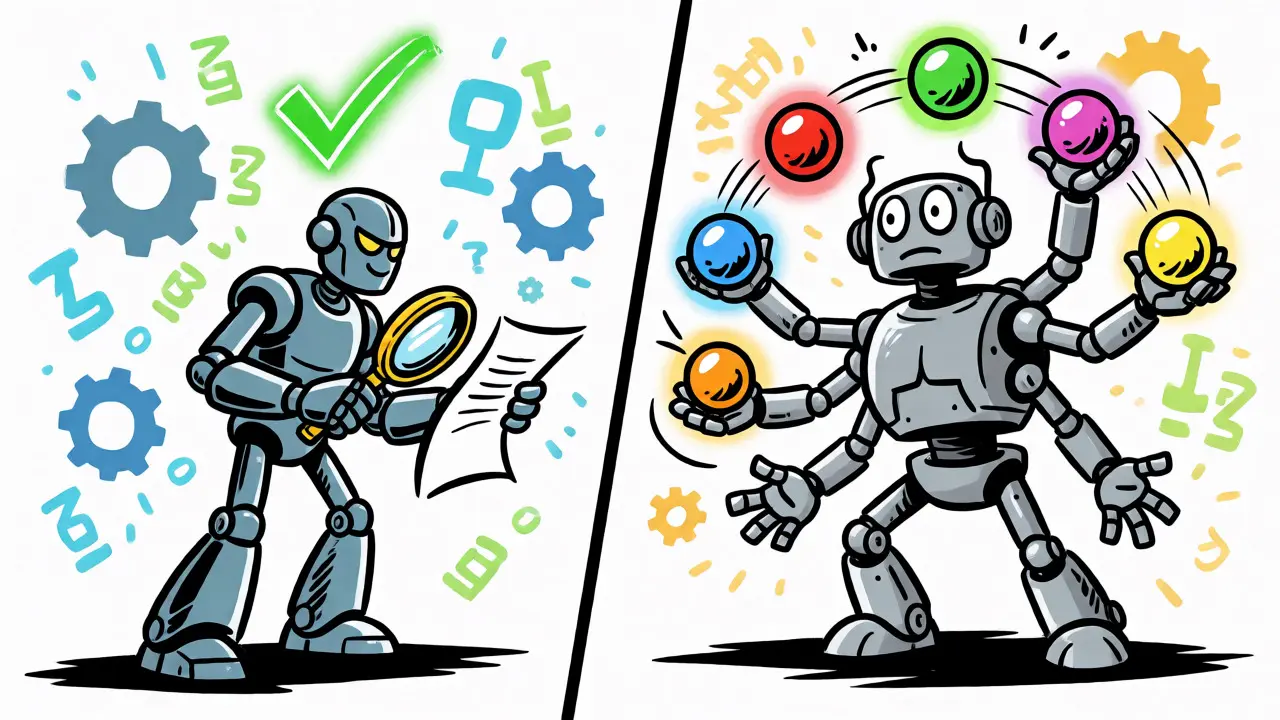
Here’s the tricky part. Most modern evaluation methods use another LLM to judge the first LLM. This is called "LLM-as-judge." For example, GPT-4 might read your RAG output and decide if it’s grounded. Studies from LMSYS show that GPT-4-based judges agree with human experts about 89% of the time. That sounds good until you realize there’s a "judge model dependency." Sebastian Raschka noted in October 2025 that evaluation scores can vary by up to 37% depending on which model acts as the judge. GPT-4-turbo tends to give systematically higher scores than open-source alternatives like Llama-3-70B. If you switch judges, your metrics change, even if your model didn’t improve. This lack of reproducibility is a major headache for teams trying to track progress over time.
To mitigate this, some teams use specialized smaller models fine-tuned for judging, known as "Phudge" models. These achieve about 78% of GPT-4’s accuracy but at one-tenth the cost. For startups watching their cloud bills-where groundedness evaluations can add $3,200 to $8,700 monthly-this trade-off is often worth it. However, for Fortune 500 companies in regulated industries, the extra cost for GPT-4 consistency is usually justified.
Implementation Pitfalls and Real-World Fixes
Implementing these tools isn't just about installing a library. Enterprise users report significant challenges. A senior AI engineer at a pharmaceutical company shared that while implementing deepset’s Groundedness Score reduced hallucinations in drug interaction queries from 38% to 9%, it required two full-time engineers for integration. Why so much effort? Calibration. Setting the threshold for what counts as "grounded" is hard. If you set it too high, you get false positives-flagging correct answers as errors. One survey found that 67% of enterprises initially set thresholds too high, wasting QA team time reviewing non-issues.
Another common issue is "prompt sensitivity." Small changes to the evaluation prompt can cause score fluctuations of 15-25%. If your evaluation pipeline breaks because someone tweaked a comma in the judge’s prompt, your CI/CD pipeline will be unstable. To fix this, lock down your evaluation prompts and version-control them strictly. Also, be aware of language limitations. A Multilingual AI Consortium survey found inconsistent results in 43% of international implementations, meaning your English-focused evaluator might fail miserably on Spanish or Japanese documents.

Regulatory Pressure and Market Growth
This isn't just a tech trend; it's becoming law. The EU AI Act, effective February 2026, requires "systematic verification of factual grounding" for high-risk AI systems. Similarly, the SEC mandates hallucination detection protocols for financial advisory AI. This regulatory push is driving adoption. Gartner projects that by 2027, 85% of enterprise LLM deployments will include groundedness metrics, up from just 32% in 2025. Healthcare leads this charge with a 94% implementation rate, followed closely by legal services.
If you’re starting out, don’t try to evaluate everything at once. The LMSYS team recommends beginning with a small set of 100 high-value queries. Expand iteratively based on failure modes you see in production. This approach cuts initial implementation time by 40% compared to setting up comprehensive benchmarks immediately. Remember, the goal isn't perfection; it's reducing risk to an acceptable level.
Frequently Asked Questions
What is the difference between faithfulness and correctness in LLM evaluation?
Faithfulness measures whether the model's answer is supported by the provided source documents. Correctness measures whether the answer is factually true in the real world. A model can be faithful (it correctly summarized a biased news article) but incorrect (the article itself was wrong). Grounded QA focuses on faithfulness.
Which framework is best for beginners: RAGAS or deepset?
RAGAS is generally better for beginners due to its strong open-source community, extensive documentation, and ease of installation via pip. Deepset’s Groundedness Score is more powerful for enterprise-scale applications but requires more complex integration and infrastructure setup.
How much does LLM-as-judge evaluation cost?
Costs vary widely. Using GPT-4 as a judge can add $3,000-$8,000 monthly for mid-sized startups running frequent evaluations. Open-source models like DeBERTa or fine-tuned smaller LLMs significantly reduce this cost but may require more GPU resources for local hosting.
Can groundedness evaluation handle multi-hop reasoning?
Current methods struggle here. Yoav Goldberg’s research indicates that current groundedness metrics underestimate hallucinations in multi-hop reasoning scenarios by 29-43%. If your queries require synthesizing info from multiple distant documents, you may need custom logic or human-in-the-loop review.
Is there a standard benchmark for grounded QA?
No single universal standard exists yet. ClapNQ and HotpotQA are popular datasets, but fragmentation remains. NIST is expected to release updated guidelines in June 2026 to help standardize these measurements across the industry.



they think they solved it but its just a loop of llms grading llms and the data is probably rigged anyway dont trust the numbers