
You ask an AI a question about your company’s latest product specs. It answers confidently. The problem? It made half of it up. This is the hallucination problem that keeps enterprise leaders awake at night. Large Language Models (LLMs) are brilliant at mimicking human language but terrible at knowing facts they weren't explicitly trained on or that have changed since their training cutoff. That’s where grounded generation comes in. It’s not just a buzzword; it’s the mechanism that forces an LLM to look up information before speaking, anchoring its responses in verifiable truth rather than statistical probability.
If you’re building AI applications today, you can’t rely on the model’s internal memory alone. You need external sources. Specifically, you need Structured Knowledge Bases-databases organized by entities and relationships, not just chunks of text-to feed the model accurate data. This approach transforms a probabilistic text generator into a reliable knowledge assistant. Let’s break down how this works, why it matters, and how you can implement it without getting bogged down in complexity.
Why Standard LLMs Fail on Facts
Think of a standard LLM as a incredibly well-read student who took a final exam five years ago and hasn’t read a newspaper since. They know grammar perfectly. They know historical events. But if you ask them about yesterday’s stock price or your specific company policy from last month, they guess. And because they are designed to be helpful, they present those guesses with absolute confidence.
This happens because LLMs predict the next word based on patterns learned during training. They don’t "know" facts in the way a database does; they recognize which words tend to follow other words. When real-world data changes, or when you ask about niche domain-specific info, the pattern matching fails. The result is a plausible-sounding lie. In high-stakes environments like healthcare or finance, a plausible lie is worse than no answer at all.
Grounding solves this by separating two tasks: retrieval and generation. Instead of asking the model to remember, you ask it to read. You provide the relevant context directly in the prompt. If the context says "Product X costs $50," the model doesn’t have to guess the price; it just has to extract it. This shift from parametric memory (weights inside the model) to non-parametric memory (external data) is the core of grounded generation.
The Role of Structured Knowledge Bases
Most people hear "knowledge base" and think of a messy folder of PDFs or a wiki page. While those work, Structured Knowledge Bases offer a massive advantage: precision. A structured base organizes data around entities (like "Customer," "Invoice," or "Medication") and their attributes (like "Balance," "Due Date," or "Dosage").
When you ground an LLM with unstructured text, you risk retrieving irrelevant paragraphs that confuse the model. With a structured base, you retrieve exact facts. For example, instead of pulling a whole contract to find a termination clause, you query the "Contract Entity" for the attribute "Termination Clause." This reduces noise significantly. According to industry benchmarks, using structured data for grounding can reduce hallucinations by 30-50% compared to ungrounded models, and often outperforms simple document retrieval systems by ensuring the retrieved snippet is exactly what was asked for.
Consider Wikidata or internal enterprise graphs. These systems define relationships explicitly. "Company A" [owns] "Subsidiary B." An LLM querying this structure gets a definitive link, not a vague textual mention that might be ambiguous. This clarity is crucial for logical reasoning tasks.
Retrieval-Augmented Generation (RAG): The Leading Method
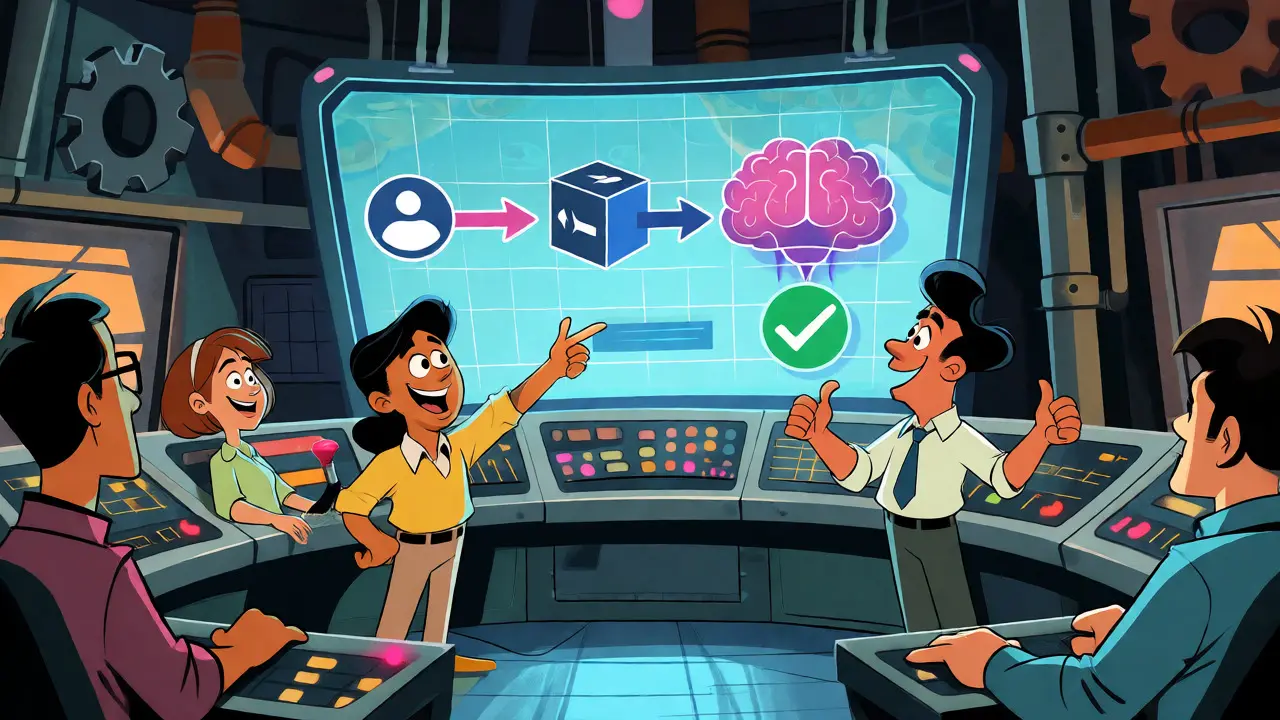
The most common way to achieve grounded generation is through Retrieval-Augmented Generation (RAG). It sounds complex, but the workflow is straightforward:
- User Query: A user asks a question.
- Semantic Search: The system converts the question into a vector and searches a Vector Database (like Pinecone or Weaviate) for similar documents or entities.
- Context Injection: The top-retrieved snippets are inserted into the LLM’s prompt alongside the original question.
- Generation: The LLM generates an answer using only the provided context.
RAG isn’t magic. It requires careful tuning. If your retrieval step pulls irrelevant info, the LLM will try to force an answer from that noise. This is where structured knowledge bases shine. By indexing entities and their attributes separately from raw text, you can use hybrid search-combining keyword matching for exact terms with semantic search for conceptual queries. Studies show this hybrid approach improves retrieval precision by roughly 18-25%, leading to much cleaner inputs for the LLM.

Implementation Challenges and Costs
Don’t let the simplicity of the concept fool you. Implementing grounded generation with structured data has overhead. You aren’t just plugging in an API. You need to build pipelines that keep your knowledge base current. If your inventory updates every hour, your index must update every hour. Stale data leads to stale answers.
Here’s a realistic look at what you face:
| Feature | Ungrounded LLM | Grounded with Structured KB |
|---|---|---|
| Hallucination Rate | High (Plausible errors) | Low (Verifiable facts) |
| Up-to-date Info | No (Training cutoff) | Yes (Real-time retrieval) |
| Implementation Cost | Low (API calls only) | Medium-High ($15k-$50k setup) |
| Maintenance Effort | Minimal | Continuous (Data pipeline upkeep) |
| Best Use Case | Creative writing, brainstorming | Support, Finance, Healthcare |
The initial setup involves preparing your data. You need to decide how to chunk your information. For structured bases, this means defining your schema. What are your entities? What are their properties? This upfront modeling takes time but pays off in accuracy. Once running, the main cost shifts to maintenance. You need automated jobs to refresh embeddings whenever source data changes. For fast-moving industries, this might mean refreshing content every 24-72 hours.
Another hurdle is the "context window." Even with perfect retrieval, you can only fit so much text into the prompt. If you retrieve ten documents, the LLM might get confused by conflicting info. Structured data helps here too. Because you retrieve specific attributes rather than whole documents, you pack more relevant facts into fewer tokens. This efficiency allows the model to reason over more precise data points within its limited attention span.
Enterprise Impact and Real-World Results
Companies aren’t adopting this tech just for fun. They’re doing it because it saves money and reduces risk. In financial services, one case study reported a 40% reduction in incorrect regulatory references after implementing entity-based grounding. Why? Because the model stopped guessing which SEC rule applied and started quoting the exact section retrieved from the structured legal database.
In customer support, the impact is equally tangible. Users trust answers more when they can see the source. A healthcare provider noted a 25% drop in medical information errors after switching to a grounded system. Patients received answers backed by current clinical guidelines, not the model’s outdated training data. On review platforms, users rate grounded solutions nearly 1.5 stars higher for accuracy than ungrounded ones, citing "reduced fact-checking time" as the biggest win.
Gartner predicts that by 2025, 80% of enterprise LLM implementations will include some form of grounding. This isn’t speculation; it’s already happening. Financial services lead adoption at 78%, followed closely by healthcare. The drive is partly regulatory. The EU AI Act, for instance, mandates technical solutions to minimize risks of incorrect information in high-risk applications. Grounding is the most direct way to comply.
Getting Started: A Practical Checklist
If you want to move beyond basic chatbots, start small. You don’t need a million-document corpus on day one. Pick a narrow domain with clear questions and answers. Maybe it’s HR policies or product troubleshooting.
- Audit Your Data: Is it structured? Can you identify key entities? If not, start cleaning it up.
- Choose a Vector Store: Tools like Pinecone, Weaviate, or open-source options like FAISS are standard.
- Build a Retrieval Pipeline: Test different chunk sizes. Smaller chunks often yield better precision for factual queries.
- Prompt Engineering: Explicitly instruct the model: "Answer ONLY using the provided context. If the answer is not in the context, say 'I don't know.'"
- Evaluate: Don’t just eyeball results. Use metrics like faithfulness (does the answer match the source?) and relevance (does it answer the question?).
Expect a learning curve. Developers familiar with APIs usually grasp the concepts in 2-4 weeks. The trickiest part isn’t the code; it’s the data strategy. Garbage in, garbage out applies doubly here. If your knowledge base is inconsistent, your grounded LLM will be inconsistent too.
Future Trends: Beyond Simple Retrieval
We are moving past basic RAG. The next frontier is "self-grounding" and multi-modal integration. Imagine an LLM that doesn’t just retrieve text but also checks images or sensor data to verify a claim. Or consider "Entity-Guided RAG," a recent research direction that improves precision by 35% by explicitly modeling entity relationships during retrieval.
Automation is also key. Manual curation of knowledge bases is unsustainable at scale. New tools are emerging that automatically detect when source documents change and update the vector indexes accordingly. Microsoft’s recent announcements highlight automated knowledge base updating, reducing manual effort by 60%. The goal is a system that stays fresh without human intervention.
Ultimately, grounded generation turns LLMs from creative writers into reliable analysts. It bridges the gap between linguistic fluency and factual accuracy. As structured knowledge bases become easier to integrate and maintain, the barrier to entry drops. The companies that master this now will have AI assistants that employees actually trust, while competitors will still be fighting hallucinations.
What is the difference between fine-tuning and grounded generation?
Fine-tuning adjusts the model's internal weights to learn new styles or domains, but it doesn't add new facts efficiently and is expensive to update. Grounded generation retrieves external facts at runtime. It allows for real-time updates without retraining the model, making it superior for dynamic, fact-heavy tasks.
Do I need a structured knowledge base for RAG?
No, RAG can work with unstructured text like PDFs or HTML. However, structured knowledge bases (entity-attribute-value pairs) significantly improve precision and reduce noise. For complex reasoning and high-accuracy requirements, structured data is highly recommended.
How much does it cost to implement grounded generation?
Basic RAG systems typically range from $15,000 to $50,000 for initial development, depending on data complexity and infrastructure choices. Ongoing costs involve vector database hosting and maintenance pipelines. Costs vary widely based on scale and vendor selection.
Can grounded generation eliminate all hallucinations?
It drastically reduces them, often by 30-50% or more, but it doesn't eliminate them entirely. Hallucinations can still occur if the retrieved context is incomplete, contradictory, or if the model fails to follow instructions to stick to the provided text. Rigorous evaluation is still necessary.
Which vector databases are best for structured knowledge?
Popular choices include Pinecone, Weaviate, and Milvus. Weaviate is particularly strong for structured data due to its built-in support for cross-references and modular vectorization. Open-source options like FAISS are good for prototyping but require more management for production scaling.



Great article, but honestly this is just fancy term for "look up the answer before you speak." We've been doing retrieval systems for decades. The only reason this feels new is because LLMs are bad at lying less confidently than humans. Stop overcomplicating it with "structured knowledge bases" when a simple SQL query would do half the job without the vector database overhead.
You think they're selling us on RAG to make money? Wake up. They want our data flowing into their black boxes. Structured knowledge bases mean every query we log gets indexed and sold. It's not about accuracy, it's about surveillance capitalism. 🕵️♂️ Once your company defines its entities, Big Tech owns the map of your business logic. Don't let them trick you into thinking this is neutral tech. It's a trap. 🚫💰
The tragedy here isn't technical; it's existential. We are building gods that can read but cannot remember. Grounding is merely a crutch for a mind that has no soul, no continuity of self. By anchoring LLMs in static databases, we strip away the creative chaos that makes intelligence human. We are creating perfect librarians who will never write poetry again. Is that progress? Or is it the end of imagination? 🎭📉
Finally someone says it. USA leads this adoption because we have the infrastructure. Europe is bogged down in red tape like the EU AI Act mentioned here. 🇺🇸🦅 While they regulate, we implement. Financial services at 78% adoption proves American efficiency. Don't let the naysayers tell you otherwise. We build, they complain. 😎👊
I appreciate the focus on healthcare impacts. Seeing that 25% drop in errors gives me hope for patient safety. It’s comforting to know technology can support care rather than replace it. ❤️
To add to the implementation challenges: ensure your schema evolution strategy is robust. As your domain changes, your entity relationships must update dynamically. I recommend using versioned embeddings to handle this transition smoothly. 🛠️✨ Also, don't underestimate the cost of cleaning unstructured data before structuring it. That phase often takes 60-70% of the project timeline. Plan accordingly! 📝✅