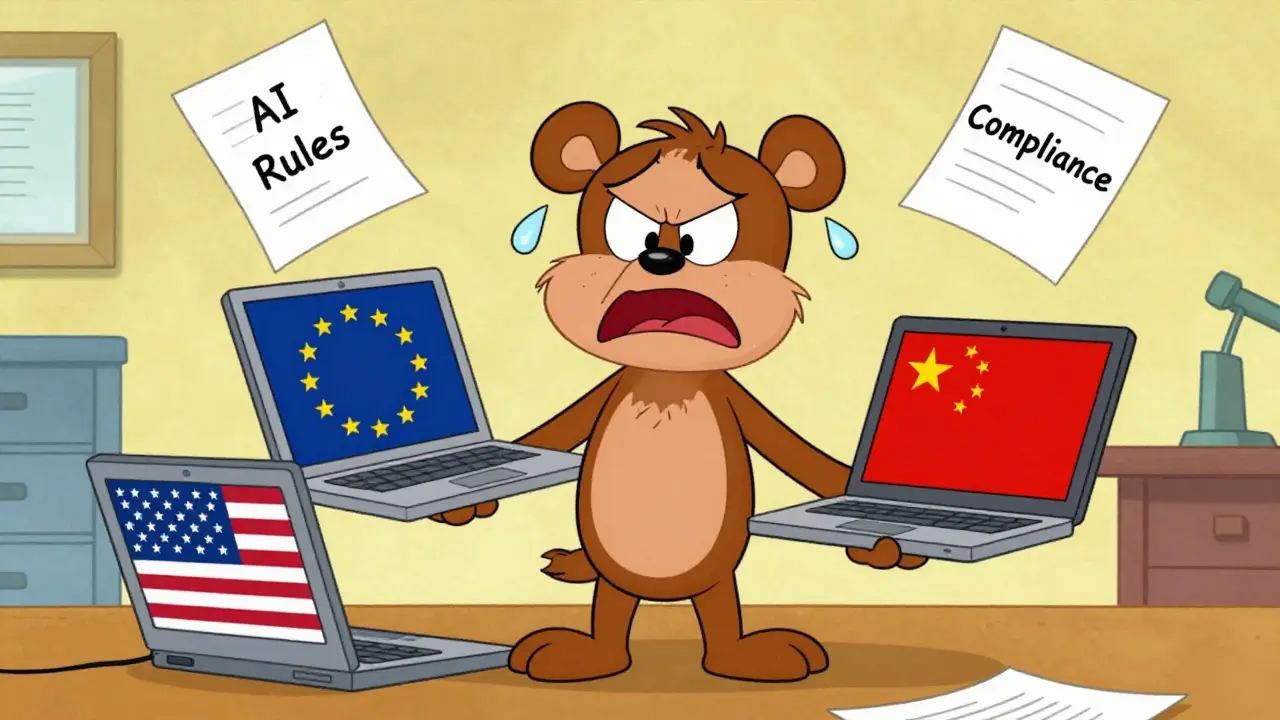
Imagine building a single AI-powered app that works seamlessly everywhere. Now imagine having to rewrite its core logic three times just to keep it legal. That is the reality for developers and business leaders in 2026. We are no longer asking if governments will regulate Generative AI is artificial intelligence capable of creating text, images, audio, and code based on user prompts. We are living through the messy, high-stakes era where they actually do.
The landscape has shifted dramatically since early 2025. What started as vague promises has hardened into concrete laws, executive orders, and strict enforcement mechanisms. You have the European Union’s heavy-handed risk-based approach, the United States’ sudden pivot toward deregulation, and China’s rigid content control framework. These aren't just policy differences; they are fundamentally different philosophies about what AI should be allowed to do. If you are operating globally, you can’t ignore this anymore. The cost of non-compliance isn't just a fine-it’s being locked out of entire markets.
The Three Pillars of Global AI Law
To understand where we stand, we need to look at the three major powers shaping the rules. They are moving in opposite directions, creating a complex web of requirements that companies must navigate carefully.
The European Union AI Act is the world's first comprehensive AI law, taking full effect in August 2025 with strict risk-based regulations. This is the gold standard for regulatory rigor. It treats AI like pharmaceuticals or aviation safety-high-risk applications get scrutinized heavily. General-purpose AI models that pose systemic risks face mandatory transparency obligations, copyright compliance checks, and rigorous testing before market entry. The EU doesn't care about your growth metrics; it cares about fundamental rights and societal stability. If you sell to Europeans, you follow these rules, period.
Then there is the United States Approach, which shifted under Executive Order 14179 in January 2025 to prioritize innovation over federal restriction. In a dramatic reversal, the U.S. revoked its previous 2023 executive order on safe AI development. The new stance? Remove barriers. Let the market decide. The goal is clear: maintain U.S. dominance in AI technology by avoiding the "regulatory drag" seen elsewhere. However, don't mistake this for anarchy. Federal agencies still issued 59 AI-related regulations in 2024 alone. The difference is that the U.S. relies more on sector-specific guidelines and voluntary commitments rather than a single, overarching federal law. It’s a patchwork system that favors speed but creates uncertainty for long-term planning.
Finally, we have China's Interim Measures, which enforced strict data sourcing, content moderation, and alignment with socialist core values since August 2023. China moved first and moves fast. Their framework is prescriptive and uncompromising. Providers must ensure training data is legally sourced, obtain explicit user consent, and label all AI-generated content with visible watermarks. More importantly, the output must align with state authority and social values. There is no room for ambiguity here. If your model generates content deemed harmful to national security or social stability, it gets shut down. For global companies, this means maintaining separate, heavily filtered versions of their AI services specifically for the Chinese market.
Where the Rules Converge
Despite the obvious clashes, some things are becoming universal. You can think of these as the "minimum viable compliance" standards that every jurisdiction now expects.
- Transparency and Labeling: Every major framework demands that users know when they are interacting with AI. Whether it’s the EU’s transparency duties or China’s watermarking mandates, hiding the origin of AI content is no longer an option. The UK and Japan also emphasize disclosure in their guidance documents.
- Risk Management: Organizations are no longer managing one or two AI risks. According to McKinsey, the average company now manages four distinct AI-related risks, including privacy breaches, explainability failures, reputational damage, and regulatory non-compliance. Regulators expect you to have formal processes for identifying and mitigating these threats.
- Data Provenance: Where did your training data come from? This question is central to almost every regulatory inquiry. Copyright infringement is a massive liability. Both the EU and China explicitly require legal sourcing of data. The U.S., while less prescriptive, sees increasing litigation around dataset origins, making provenance a practical necessity regardless of local law.
This convergence gives us a baseline. You can build your core AI governance strategy around transparency, risk management, and clean data. But once you step beyond that baseline, you hit the divergence wall.
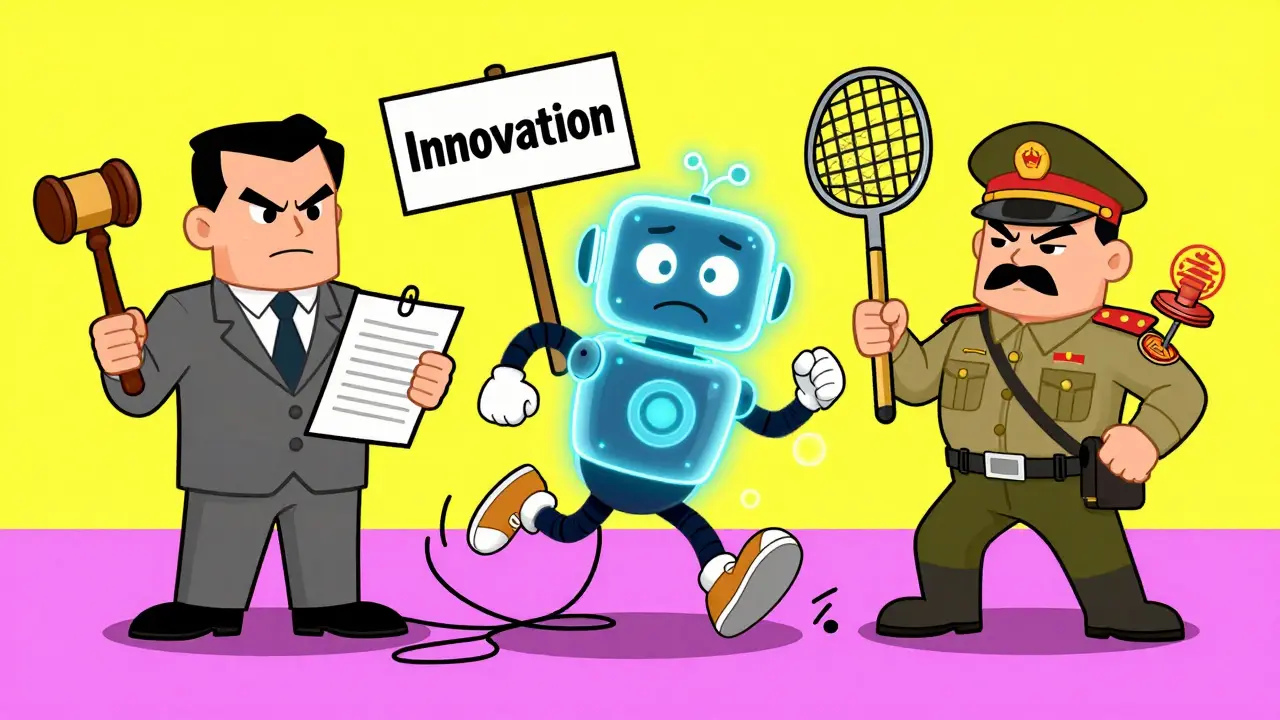
The Divergence Trap: Sovereign AI and Data Residency
The biggest headache for global operators isn't the basic rules-it's the concept of Sovereign AI is a regulatory strategy ensuring that AI data, models, and compute resources remain under national or regional control.. Over 50% of AI leaders cite regulatory monitoring and infrastructure control as their top challenges in this area. Data residency laws are tightening. China requires certain data to stay within its borders. The EU has strict GDPR implications for cross-border data transfers. The U.S. is increasingly concerned about foreign influence on critical infrastructure.
This forces companies into a difficult choice: do you build separate AI stacks for each region? That’s expensive and slow. Do you try to build one global stack that complies with the strictest rules (usually the EU)? That might stifle innovation or fail to meet local cultural nuances required by markets like China. Deloitte’s research shows that 52% of AI leaders find regulatory monitoring their most significant challenge precisely because of this fragmentation. You can't just set it and forget it. Regulations change weekly.
Implementation Reality: It’s Harder Than You Think
Let’s talk about what happens when you try to implement these rules. The gap between policy and practice is wide. Stanford HAI’s 2025 report highlights a persistent issue: while companies recognize Responsible AI (RAI) risks, meaningful action lags behind awareness. Standardized RAI evaluations remain rare among major industrial model developers.
Here is why implementation stalls:
- Legacy System Integration: Fifty-eight percent of organizations struggle to integrate new AI tools with existing IT infrastructure. Old systems weren't built for real-time compliance checks or detailed audit trails.
- Skill Gaps: You need people who understand both code and law. Seventy-eight percent of organizations now employ dedicated AI compliance officers, up from just 32% in 2023. Finding talent that speaks both languages is incredibly difficult.
- Documentation Quality: Not all regulations are created equal. The EU AI Act documentation scores well for clarity (3.8/5 stars), but China’s Interim Measures score lower (2.9/5) due to perceived ambiguity in how to interpret "socialist core values" in technical terms. This forces companies to guess, which is a risky strategy.
It takes an average of 6.2 months to establish an effective AI governance framework. That is half a year of overhead before you even start seeing returns on your AI investment. And during that time, the rules might change again.
| Region | Primary Philosophy | Key Requirement | Enforcement Style | Innovation Impact |
|---|---|---|---|---|
| European Union | Risk-Based Precaution | Systemic risk assessment, copyright compliance | Strict, centralized fines | High barrier to entry |
| United States | Innovation-First | Voluntary commitments, sector-specific rules | Decentralized, litigation-driven | Low barrier, high uncertainty |
| China | Content Control & Security | Data localization, value alignment, labeling | Prompt administrative shutdown | Restricted scope, high compliance cost |
| United Kingdom | Pro-Innovation Contextual | Regulator-led guidance, capability building | Advisory, flexible | Moderate, adaptive |

The Economic Stakes
This isn't just about legal boxes. It’s about money. Global AI governance funding has surged. Canada pledged $2.4 billion, France committed €109 billion, and Saudi Arabia launched a $100 billion initiative called Project Transcendence. Meanwhile, the generative AI market attracted $33.9 billion in private investment in 2024. Of that, 12.3% went directly into regulatory compliance tools. That is a multi-billion dollar industry emerging solely to help companies obey the rules.
Adoption rates are soaring-54.6% globally as of mid-2025-but the quality gap between regions is closing. China produced fewer notable models than the U.S. in 2024 (15 vs 40), but performance benchmarks like MMLU show near parity. This means competition is fierce. If your regulatory strategy slows you down too much, competitors from less regulated jurisdictions might leapfrog you. But if you cut corners, you face existential legal risks. Balancing speed and safety is the defining challenge of 2026.
What Comes Next?
We are entering a phase of enforcement. The initial shock of new laws is wearing off, replaced by the grind of audits, penalties, and cross-jurisdictional conflicts. Dr. Yoshua Bengio predicts we will see the first major cross-jurisdictional enforcement actions by 2027. Imagine a company fined in Europe for lack of transparency and blocked in China for data issues simultaneously. That scenario is becoming likely.
International bodies like the OECD, UN, and African Union are releasing frameworks to encourage coordination, but true harmonization remains distant. For now, agility is your best asset. Build modular compliance systems. Hire specialists who understand the nuance of each market. Don't assume one size fits all. The future of AI belongs to those who can navigate complexity without losing their way.
When does the EU AI Act fully take effect?
The EU AI Act came into full effect in August 2025. It imposes strict requirements on general-purpose AI models posing systemic risks, including transparency, copyright compliance, and risk mitigation measures.
How did US AI regulation change in 2025?
In January 2025, the US issued Executive Order 14179, revoking the previous 2023 order. The new approach prioritizes removing regulatory barriers to foster innovation and maintain US dominance, relying more on voluntary commitments and sector-specific guidelines rather than a unified federal law.
What is Sovereign AI?
Sovereign AI refers to strategies ensuring that AI data, models, and computing resources remain under national or regional control. It addresses concerns about data residency, security, and independent technological development, often requiring separate infrastructure for different jurisdictions.
Why is China's AI regulation considered strict?
China's Interim Measures mandate lawful data use, explicit user consent, visible watermarking of AI content, and alignment with socialist core values. Enforcement is swift, with providers facing immediate shutdowns if content undermines state authority or social stability.
What are the main challenges in implementing global AI compliance?
Key challenges include integrating AI with legacy systems, addressing skill gaps in compliance expertise, navigating conflicting data residency laws, and managing the high costs of continuous regulatory monitoring across multiple jurisdictions.



The soul of technology is being fractured by the cold, hard hands of bureaucracy. We are not just building apps; we are weaving the digital fabric of humanity, and now these governments demand we use different threads for every single region. It is a tragedy of epic proportions. The EU wants safety like a mother hen, the US wants speed like a cheetah, and China wants silence like a tomb. How can one mind create something beautiful when it must constantly apologize to three different gods?
It reminds me of the Tower of Babel, but instead of languages, we have compliance frameworks. We are shouting at each other across borders that shouldn't exist in the cloud. The irony is palpable: AI was supposed to unite us, yet regulation is driving us apart into sovereign silos. I feel a deep melancholy watching this unfold. Is this progress or regression? Perhaps both. The artist suffers so the state can sleep.
We must remember that behind every line of code is a human desire to connect. When you force a developer to rewrite their core logic three times, you are not just adding work; you are diluting the vision. You are asking them to compromise their integrity for the sake of legality. It is a slow death of creativity. The future looks gray, fragmented, and deeply unhappy.
I think there is a lot of optimism to be found here if we look closely. Yes, the regulations are complex, but they also provide clarity. For years, we operated in a grey zone where anything went, which was actually quite stressful for long-term planning. Now we have rules. The EU’s risk-based approach ensures that high-stakes applications are handled with care, which builds trust among users. Trust is the currency of the future.
The US pivot toward innovation-first is encouraging because it shows that leadership understands the need to move fast. By removing federal barriers, they allow market forces to find the best solutions. This competition drives excellence. Meanwhile, China’s strict controls ensure stability in their market, which is crucial for global supply chains.
We should view this not as a clash, but as a maturation process. Every industry goes through this phase-aviation, pharmaceuticals, finance. They all had messy beginnings before standards emerged. AI is no different. If we adapt our systems to be modular and compliant, we will emerge stronger. Let’s focus on building robust governance frameworks rather than complaining about the rules. There is light at the end of this tunnel.
u r all missing the point completly. this isnt about 'trust' or 'safety'. its about control. the eu is just trying to tax us into submission while the us tries to keep its tech giants profitable. china? they dont give a damn about your rights.
the whole idea of 'sovereign ai' is laughable. data has no borders. u cant just fence off information like cattle. the article says 52% of leaders find regulatory monitoring challenging? no kidding. its a scam designed to hire more lawyers who do nothing but write memos. i bet half the compliance officers hired are just sitting around drinking coffee.
also the part about 'socialist core values' being ambiguous is hilarious. its not ambiguous, its just stupid. how do u code for 'values'? u cant. its impossible. so companies will just guess and get sued anyway. its a lose-lose situation. the only winners are the consultants selling compliance tools. 12.3% of investment going to compliance? thats robbery. wake up sheeple.
hey guys, honestly i didnt read the whole thing but it sounds super complicated. why cant they just make one rule? like, come on, its 2026. surely we figured out how to agree on something by now? it seems like such a waste of time and money. i just want my ai to work without worrying about fines. maybe if everyone relaxed a bit, things would be easier. just a thought! :)
Do you really think these laws are accidental? No. It is a coordinated effort to monitor us. The EU, US, and China are playing a game. They want to own your data. They want to know what you think. Sovereign AI is just a fancy word for surveillance infrastructure.
When they say 'data residency', they mean 'we want your secrets here'. When they say 'transparency', they mean 'we want to see your inputs'. It is all about control. The conspiracy is right in front of us. They are building a cage. And we are walking into it willingly because we are too lazy to fight back.
Don't trust the 'innovation' narrative. That is just bait. Once they have your data, they don't care about innovation. They care about power. Wake up. The walls are closing in.
Oh, please. Spare me the dramatics about 'souls' and 'tragedies'.
Let's look at the facts, shall we? The EU AI Act is not 'heavy-handed'; it is precise. It demands accountability. If you cannot comply, perhaps you should not be building high-risk AI in the first place. The US approach is chaotic and dangerous. Relying on 'voluntary commitments' is naive. Corporations will always choose profit over ethics if given the chance. Look at the history of environmental regulations. Did companies voluntarily clean up their messes? No. They needed laws.
China's framework is indeed rigid, but it is effective. Order is preferable to chaos. The idea that 'ambiguity' in socialist core values is a problem is absurd. If you cannot align with basic social stability, your model is flawed.
The real issue is incompetence among developers. They whine about complexity because they lack the skill to manage it. Six months to establish governance? That is an eternity. Inefficient. Sloppy. Unacceptable. Get your act together or get out of the business. The market does not reward mediocrity.
I appreciate all the different perspectives here. It is clear that everyone has valid concerns. Rajashree raises important points about the fragmentation of creativity, while Parth highlights the benefits of clarity and trust. Vishal and Madhuri offer sharp critiques of the current implementation flaws, which are worth considering.
Perhaps the solution lies in finding a middle ground. We need regulations that protect users without stifling innovation. Modular compliance systems, as mentioned in the post, seem like a practical step forward. Instead of fighting against the trends, we can adapt and collaborate. Open dialogue helps us understand each other's positions better. Let's continue to discuss this constructively. Peace and understanding are key to navigating these changes.
It is helpful to break down the technical challenges mentioned in the post. Legacy system integration is a significant hurdle for many organizations. Fifty-eight percent struggle with this, which makes sense given that older IT infrastructure was not designed for real-time compliance checks. Upgrading these systems requires careful planning and resource allocation.
Skill gaps are another critical area. Hiring dedicated AI compliance officers is a smart move, but finding talent with both legal and technical expertise is difficult. Companies might consider cross-training existing staff to bridge this gap. Documentation quality varies by region, so investing in clear internal guidelines can reduce ambiguity.
Building a modular compliance strategy allows flexibility. Start with the baseline requirements like transparency and data provenance. Then add region-specific layers as needed. This approach reduces overhead and adapts to changing regulations. Consistency and attention to detail are essential for success.
Wow, what a vibrant discussion! I love seeing such passionate engagement from everyone. Let's channel this energy into action! The regulatory landscape may seem daunting, but it is also an opportunity to innovate. Think of it as a puzzle waiting to be solved. Each piece-EU, US, China-fits together in a unique way.
Embrace the challenge! Build those modular systems. Hire those specialists. Create workflows that dance between jurisdictions with grace and efficiency. The future belongs to the agile, the creative, and the resilient. Don't let the red tape slow you down; use it as a rhythm to move to.
Remember, every constraint breeds creativity. Picasso didn't paint freely; he worked within frames. You can build amazing AI within these boundaries. Keep pushing, keep learning, and keep smiling. The world needs your brilliance. Let's make 2026 the year of breakthrough compliance!