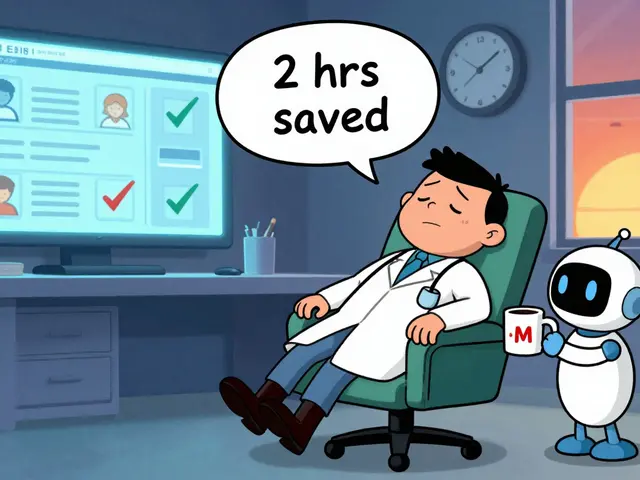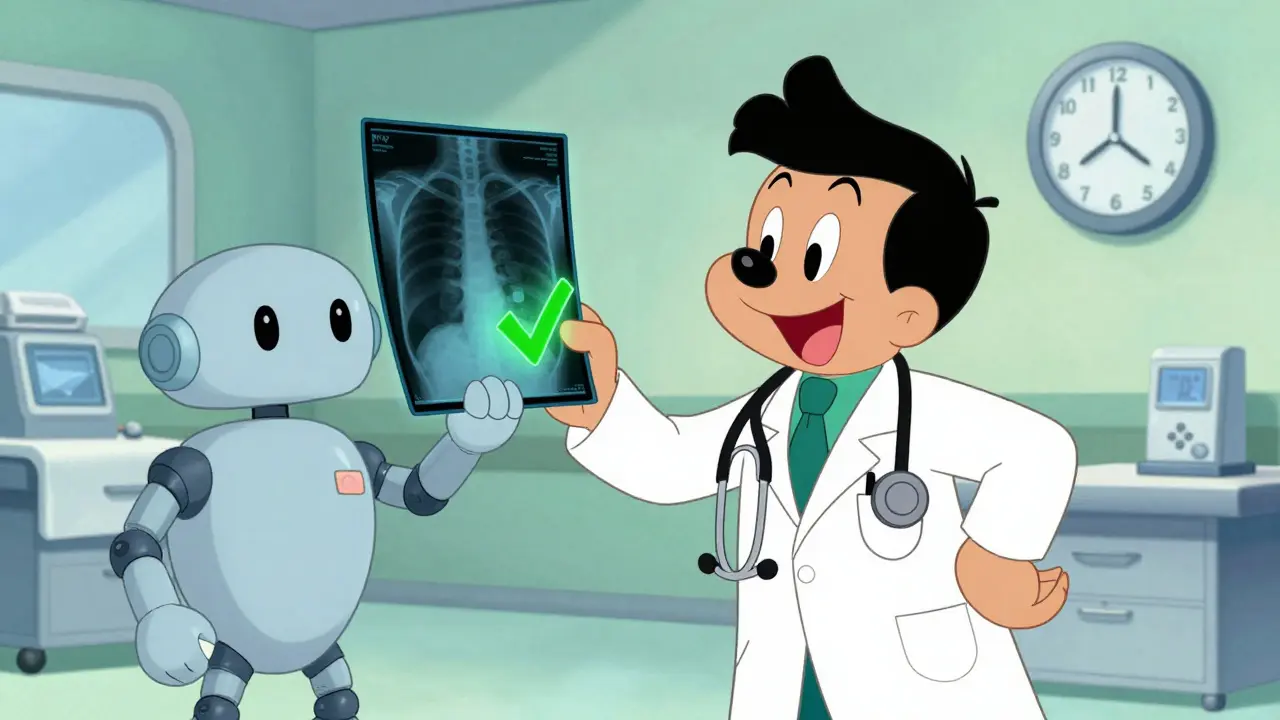
Imagine a busy emergency room where every second counts. A doctor is staring at a chest X-ray, trying to spot the faintest sign of a pneumothorax. Now imagine an Generative AI system that flags that exact issue in milliseconds, not by replacing the doctor, but by handing them a prioritized list of possibilities before they even finish their coffee. This isn't science fiction anymore. It’s happening now.
We often talk about the return on investment (ROI) of artificial intelligence in business terms-cost savings, efficiency gains. But in healthcare, the currency is human life. The real ROI of generative AI lies in two critical metrics: how accurately it helps diagnose conditions and how quickly it gets patients into treatment. If you are evaluating whether to integrate these tools into your clinical workflow or investing in health tech, you need to look past the hype and examine the hard data on performance.
The Reality Check on Diagnostic Accuracy
Let’s get straight to the numbers. Does AI actually work? The answer is yes, but with important caveats. In a major study published in JAMA in 2024, researchers tested GPT-4 on complex, diagnostically difficult cases. The model included the correct diagnosis in its differential list 64% of the time (45 out of 70 cases). More impressively, it offered the correct diagnosis as its top recommendation 39% of the time.
That might sound modest until you consider the alternative. For years, doctors have relied on intuition and experience, which are great but prone to fatigue and bias. When GPT-4 did include the right answer, it usually ranked it second or third. Compare this to older differential diagnosis generators, which scored lower on quality metrics. GPT-4 achieved a mean differential quality score of 4.2, beating earlier systems that sat around 3.8. This suggests that while AI isn’t infallible, it provides a robust safety net, catching conditions that might otherwise slip through the cracks.
However, general-purpose models like GPT-4 aren’t the whole story. Specialized models trained on specific medical domains often perform better. Research in Radiology showed a multimodal generative AI model trained on over 8.8 million radiograph-report pairs achieved 95.3% sensitivity for detecting pneumothorax. That is significantly higher than what general vision-language models like GPT-4Vision achieved in similar tasks. The lesson here is clear: domain-specific training yields superior clinical utility. If you are building or buying AI solutions, generic LLMs are a starting point, but specialized models are where the real diagnostic power lies.
Data Quality Drives Diagnostic Precision
Garbage in, garbage out. This old computing adage holds true for generative AI in medicine. An AHRQ-funded study published in NPJ Digital Medicine highlighted a crucial factor: structured clinical data. When researchers added laboratory results to the prompts for five different AI models, diagnostic accuracy jumped by up to 30% across the board.
GPT-4, for instance, saw its Top-1 accuracy rise to 55% and lenient accuracy hit 79% when lab data was included. The models correctly interpreted liver function panels and toxicology screens, proving they can handle complex numerical data if presented clearly. This has massive implications for implementation. Integrating AI into electronic health records (EHRs) isn’t just about text; it’s about feeding the model the full picture, including labs, vitals, and history. Without this structured input, even the smartest AI is flying blind.
| Model Type | Accuracy Metric | Key Finding | Context |
|---|---|---|---|
| GPT-4 (General) | 64% inclusion rate | Correct diagnosis in differential list | Complex clinical vignettes |
| GPT-4 + Lab Data | 55% Top-1 accuracy | Significant boost with structured data | AHRQ-funded study |
| Domain-Specific Radiology AI | 95.3% sensitivity | High detection of pneumothorax | Chest X-ray interpretation |
| Human Physicians (Baseline) | Variable | Improved by AI assistance | University of Pennsylvania study |
Speed Matters: Reducing Time-to-Treatment
Accuracy is vital, but speed saves lives. In acute care settings, the time between symptom onset and treatment initiation is often the difference between recovery and complication. Stanford HAI research found that physicians using ChatGPT completed case assessments more than one minute faster on average compared to those without the tool.
You might think one minute is negligible. Multiply that by hundreds of patients per day in a large hospital, and you’re looking at hours of reclaimed cognitive bandwidth. More importantly, that minute represents reduced administrative burden and faster triage decisions. While the Stanford study noted no significant improvement in accuracy for that specific cohort, the time-saving benefit alone justifies the integration for many workflows. Faster documentation means less burnout for staff and quicker access to beds and treatments for patients.
Augmenting, Not Replacing: The Human-AI Partnership
There is a persistent fear that AI will replace doctors. The data suggests a different reality: AI augments human capability. A systematic review in JMIR Medical Informatics analyzed 30 studies comparing humans and LLMs. Interestingly, healthcare professionals had higher accuracy in 33.7% of studies, while LLMs won in 33.3%. It’s a tie. But the magic happens when they work together.
Research from the University of Pennsylvania showed that AI suggestions improved physician diagnostic accuracy across diverse patient demographics. For white male patient scenarios, accuracy rose from 47% to 65%. For Black female patient scenarios, it jumped from 63% to 80%. Crucially, these improvements were consistent regardless of race or gender, indicating that AI assistance does not perpetuate existing healthcare disparities. Instead, it acts as a leveling force, ensuring that all patients receive high-quality diagnostic consideration.
This partnership model is key to ROI. You aren’t paying AI to do the job of a senior specialist; you are paying it to elevate junior residents and experienced alike to a higher standard of care. The ROI comes from fewer missed diagnoses, reduced malpractice risk, and improved patient outcomes.
Adoption Trends and Market Readiness
The industry is moving fast. An American Medical Association survey revealed that approximately 66% of physicians were using health AI tools as of 2023, a 78% increase from the previous period. This rapid adoption signals that the technology has moved from experimental to essential. Hospitals and clinics are no longer asking *if* they should use AI, but *how* to implement it effectively.
For investors and healthcare administrators, this trend indicates a maturing market. The early adopters focused on chatbots for patient engagement. The next wave, which we are seeing in 2026, focuses on deep clinical integration-diagnostic support, radiology interpretation, and predictive analytics. The barrier to entry is shifting from technical feasibility to regulatory compliance and data privacy.
Pitfalls and Limitations to Watch
Despite the promise, generative AI is not perfect. The JAMA study acknowledged limitations such as subjectivity in outcome measures and potential underestimation of model capabilities due to protocol constraints. However, a bigger risk is hallucination-the tendency of LLMs to generate plausible-sounding but incorrect information. In a clinical setting, a hallucinated diagnosis can be dangerous.
To mitigate this, institutions must implement rigorous validation protocols. AI outputs should always be reviewed by licensed professionals. Furthermore, reliance on general-purpose models without domain-specific fine-tuning can lead to suboptimal results. As seen in the radiology study, specialized models outperform general ones. Investing in custom-trained models or partnering with vendors who offer domain-specific solutions is crucial for long-term success.
Calculating the True ROI
So, how do you measure the return on investment? Look beyond direct cost savings. Consider:
- Reduced Length of Stay: Faster diagnostics lead to quicker treatments and shorter hospital stays.
- Staff Retention: Automating administrative tasks reduces burnout, lowering turnover costs.
- Risk Mitigation: Fewer diagnostic errors mean fewer lawsuits and better reputation management.
- Patient Volume: Increased efficiency allows providers to see more patients without compromising care quality.
When you combine these factors, the ROI becomes compelling. Generative AI is not just a tech upgrade; it’s a strategic asset that enhances both financial performance and clinical excellence.
Is generative AI accurate enough for clinical diagnostics?
Yes, but with context. Studies show GPT-4 includes the correct diagnosis 64% of the time in complex cases. Domain-specific models, like those trained on radiology data, can achieve sensitivities above 95%. Accuracy improves significantly when structured data like lab results are included.
How does AI affect time-to-treatment?
AI reduces assessment time. Research from Stanford HAI found physicians using AI tools completed cases over one minute faster on average. This cumulative time saving improves throughput and reduces delays in critical care environments.
Does AI introduce bias in healthcare?
Current evidence suggests AI can help reduce bias. A University of Pennsylvania study found that AI assistance improved diagnostic accuracy equally across different racial and gender groups, helping to level the playing field rather than exacerbate disparities.
What is the ROI of implementing generative AI in healthcare?
ROI is measured through improved diagnostic accuracy, reduced time-to-treatment, lower staff burnout, and decreased malpractice risk. With 66% of physicians already adopting AI tools, the trend points toward significant operational and clinical benefits.
Should hospitals use general LLMs or specialized models?
Specialized models generally offer better performance. While general LLMs like GPT-4 are powerful, domain-specific models trained on millions of medical records or images demonstrate higher sensitivity and specificity in tasks like radiology interpretation.