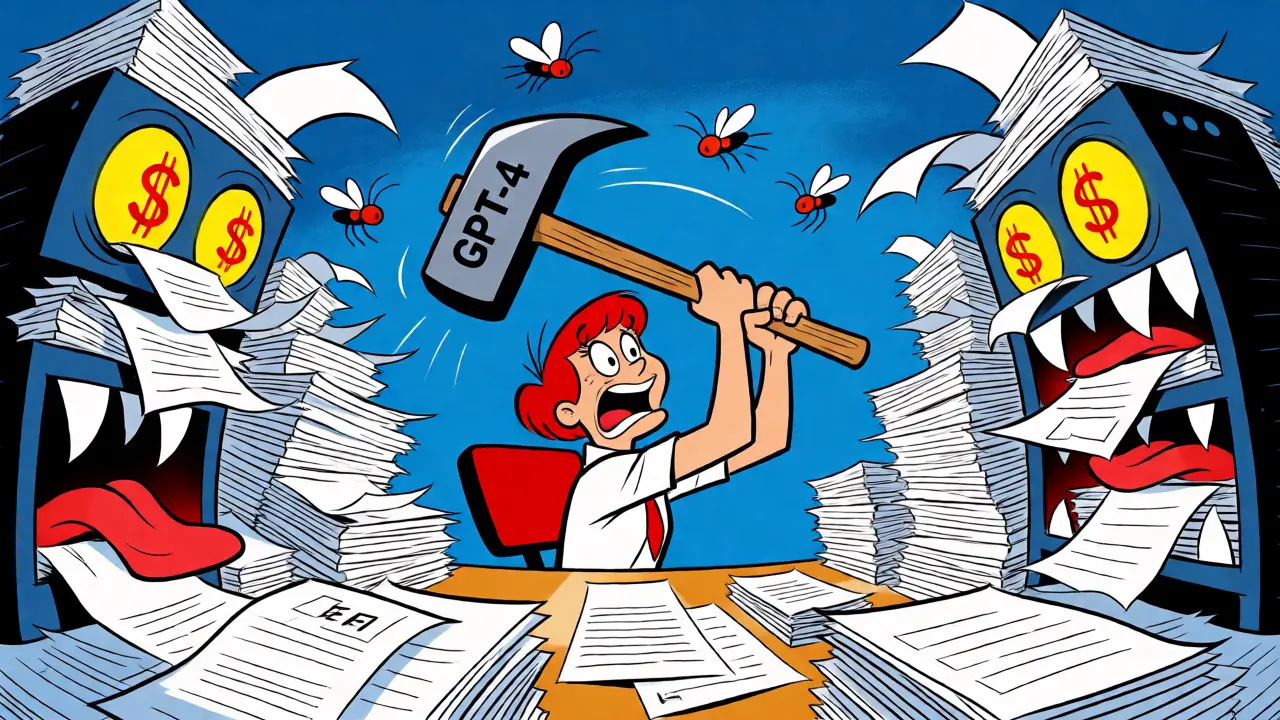
You built a killer AI feature. Users love it. Then the invoice arrives. It’s not just expensive; it’s unsustainable. Maybe you’re burning $250,000 a month on OpenAI or Anthropic APIs, and your margins are shrinking faster than your context window.
Here is the hard truth: most teams default to the biggest, smartest model for every single request. They treat GPT-4 like a hammer for every nail. But not every query needs a sledgehammer. Some need a screwdriver. Some need tweezers. If you can architect your system to match the tool to the task, you can slash bills by 30-80% while keeping quality at 95-98%. No magic tricks. Just solid engineering decisions.
Right-Sizing Your Model Selection
The first mistake? Assuming the latest flagship model is always the best choice. It isn’t. It’s often overkill. Start by benchmarking smaller models against your specific dataset. Use metrics that matter to your users, like F1-score for classification or BLEU for translation, not just generic benchmarks.
Consider this: GPT-3.5-turbo handles about 78% of standard customer service queries perfectly well. Why pay 3x more for GPT-4 if the output is indistinguishable to the user? FutureAGI’s 2025 analysis showed that right-sizing alone cuts token costs by 25-40%. Don’t guess. Test. Run A/B tests where half your traffic goes to a cheaper model and measure user satisfaction. If they don’t notice the difference, neither should your CFO.
Intelligent Model Routing
If right-sizing helps, routing saves the day. Instead of one model doing all the work, build a tiered system. Think of it as a triage nurse in an emergency room. A lightweight classifier-maybe a tiny 125M parameter model-looks at the incoming request and decides who gets seen by whom.
- Tier 1 (Cheap): Simple greetings, FAQs, confirmations. Route these to Claude Haiku or GPT-3.5. Cost: ~$0.00015 per 1K tokens.
- Tier 2 (Mid): Standard interactions. Send these to GPT-4o-mini. Cost: ~$0.00075 per 1K tokens.
- Tier 3 (Premium): Complex reasoning, code generation, nuanced analysis. These go to GPT-4 or Claude Opus. Cost: ~$0.03+ per 1K tokens.
Maxim AI’s production benchmarks show this approach yields 37-46% cost reductions. Dr. Sarah Chen from Stanford HAI called model routing "the single highest-impact architectural decision," noting it maintains 97.3% of GPT-4’s performance on 80% of queries. The catch? You need to build that classifier. It takes 2-3 weeks of engineering effort, but the ROI is massive.
Prompt Engineering: The Low-Hanging Fruit
Before you rewrite your infrastructure, look at your prompts. Are you sending entire PDFs when you only need three paragraphs? Are you asking for a novel-length response when you want two sentences?
DeepChecks documented a 40% token reduction just by removing redundant context and using low-verbosity chain-of-thought prompting. Alexander Thamm measured 20-40% savings simply by adding constraints like “limit answer to two sentences.” This is the fastest win. You don’t need new servers. You don’t need new models. You just need to be concise. And remember: verbose prompts cost money. Every word counts.
| Strategy | Typical Cost Savings | Implementation Effort | Quality Risk |
|---|---|---|---|
| Prompt Optimization | 20-40% | Low (1-2 weeks) | Low |
| Model Routing | 37-46% | Medium (2-3 weeks) | Low (if tuned correctly) |
| Semantic Caching | 15-30% (up to 60% for repetitive) | Medium (Redis setup) | None (exact matches) |
| Quantization | High (memory/inference speed) | High (infrastructure change) | Medium (2-5% accuracy drop) |

Caching: Stop Paying for Repeats
Why compute the same answer twice? If 30% of your queries are similar, you’re wasting money. Implement a multi-layer caching strategy. Start with exact-match caching for identical queries. Then move to semantic caching using tools like Redis.
Semantic caching stores embeddings rather than raw text. So if User A asks “How do I reset my password?” and User B asks “Password reset instructions,” both hit the cache. Redis’ 2026 LLMOps Guide highlights this as a core pillar of modern AI operations. One Shopify engineer reported cutting their monthly bill from $82,000 to $31,000 just by implementing Redis semantic caching. No user complaints. Just pure savings.
Quantization: Trading Precision for Speed
If you’re running open-source models like Llama-2 or Mistral, consider quantization. This reduces model weights from 32-bit floating point to 8-bit or even 4-bit integers. The result? Memory footprint drops by 75-90%, and inference speeds up by 2-4x because integer math is faster.
But be careful. Quantization isn’t free. DeepChecks’ benchmarks show a potential 2-5% accuracy drop on specialized tasks. A healthcare startup learned this the hard way after aggressively quantizing Llama-2 to 3-bit, causing a 12% accuracy drop in medical diagnosis that cost them $250k in remediation. Use quantization for edge deployments or general chatbots, not for precision-critical applications like legal contract review.
Infrastructure Hygiene
Finally, look at your cloud bills. Are you running idle GPUs? Use auto-scaling with Kubernetes or Ray to spin down resources when traffic dips. Choose regions wisely; US-East is often 20% cheaper than Europe-West due to data center economics. For predictable workloads, buy reserved instances for 30-50% savings.
And don’t forget batch processing. If you’re generating weekly reports or analyzing logs, don’t process them in real-time. Batch them. One Reddit user cut costs by 52% by batching 5,000 weekly reports instead of processing them live. Same output, half the price.
The Layered Approach Wins
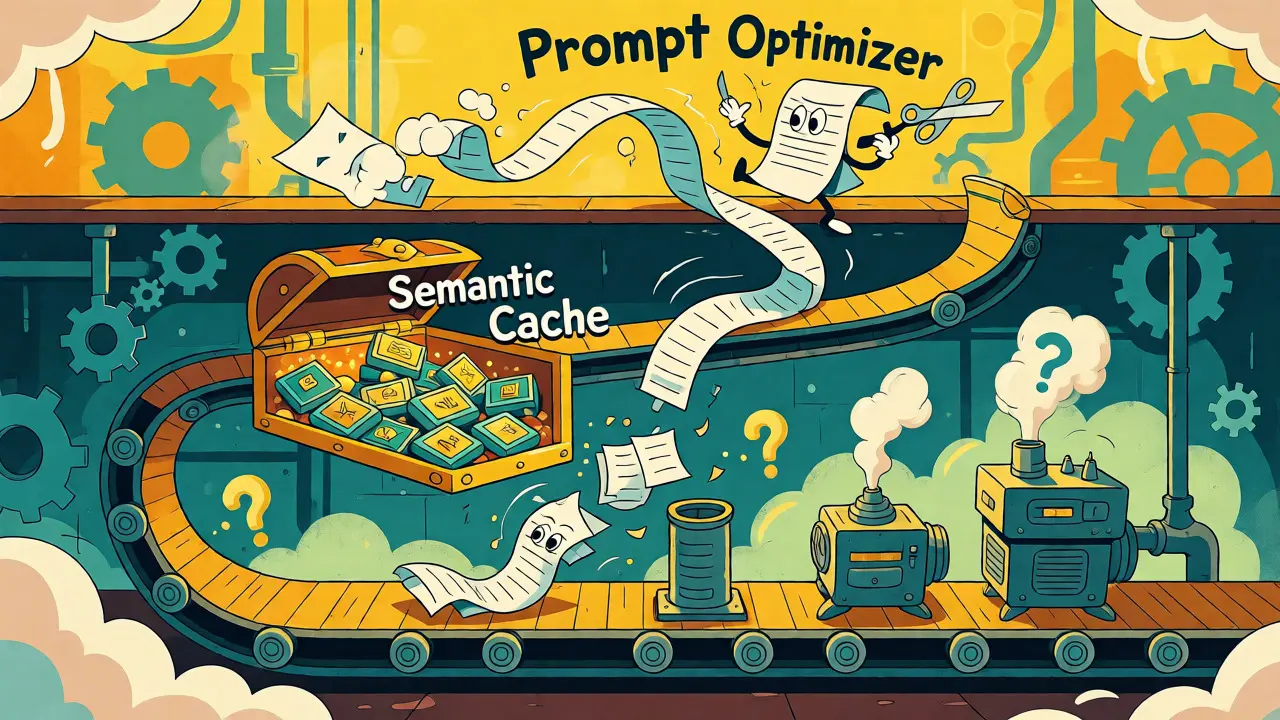
Don’t pick one trick. Combine them. The optimal architecture looks like this:
- Semantic Cache: Check if we’ve seen this before.
- Prompt Optimizer: Trim the input.
- Model Router: Decide which model to use.
- Inference Engine: Generate the response.
- Response Cache: Store the output.
This layered defense reduces load incrementally. Maxim AI found this approach outperforms single-technique implementations by 18-22%. Start with prompt optimization today. Build routing next week. Add caching next month. Watch your bills drop without your users noticing a thing.
Does model routing affect latency?
It can add a small overhead for the classification step, usually under 100ms. However, since you're often routing to faster, smaller models, the total end-to-end latency often improves. The net effect is typically neutral or positive for perceived speed.
Is quantization safe for all LLMs?
No. While 4-bit quantization works well for general chat, it can degrade performance on tasks requiring high precision, such as mathematical reasoning or medical diagnosis. Always benchmark your specific use case before deploying quantized models in production.
How much does semantic caching save?
Savings depend on query repetition. For applications with 30%+ duplicate or semantically similar queries, you can see 40-60% cost reductions. For unique creative tasks, savings may be minimal, so monitor your hit rate before investing heavily.
What is the biggest risk in LLM cost optimization?
Over-optimization leading to quality degradation. Aggressive context truncation or poor routing logic can cause hallucinations or irrelevant answers. Always maintain a feedback loop tracking cost-per-query against user satisfaction scores.
Do I need MLOps expertise to start?
Not initially. Prompt optimization requires only good writing skills. Model routing and caching require moderate engineering effort. Full infrastructure changes like quantization and auto-scaling benefit from MLOps experience, but many managed services now offer these features out of the box.