
Imagine you are teaching a child to read. You don't hand them Shakespeare on day one. You start with "The Cat Sat," then move to short stories, and finally tackle novels. This intuitive progression is the core of curriculum learning in AI. It’s a strategy that structures how large language models (LLMs) consume data, moving from simple to complex tasks to boost performance without needing bigger GPUs or more data.
For years, the standard approach to training LLMs was random shuffling. We’d take millions of documents, mix them up like a salad, and feed them to the model. But recent research from 2020 through 2025 shows that this isn’t always optimal. By carefully ordering and blending datasets, engineers can achieve better convergence, higher accuracy, and significant compute savings. If you’re building or fine-tuning an LLM, ignoring how you mix your data is leaving free performance on the table.
Why Random Shuffling Isn’t Enough
Random shuffling assumes all data points are equally valuable at every stage of training. They aren’t. Early in training, a model struggles to grasp basic syntax and common patterns. If it’s bombarded with highly complex, noisy, or rare examples too early, it might fail to learn foundational concepts effectively. This is where curriculum learning steps in. It mimics human education by presenting easier samples first, allowing the model to build a robust base before tackling harder problems.
The benefits are tangible. Studies indicate that using an easy-to-hard curriculum as a warmup phase can deliver up to 3.5% higher end-task performance compared to fully random baselines. That’s a substantial gain for zero additional computational cost during inference. The key is determining what constitutes "easy" versus "hard" and how to transition between them.
Strategies for Ordering Your Data
There isn’t one-size-fits-all method for ordering data. Engineers use several distinct strategies depending on the model architecture and the nature of the dataset.
- Difficulty-Based Sorting: This involves calculating a difficulty metric $D(x)$ for each sample. Common metrics include data compression ratios (higher entropy often means higher complexity), prompt length, or initial loss values. By sorting samples by these metrics, you create a smooth gradient of complexity.
- Attention-Based Curriculum: Instead of static metrics, this approach uses the model’s own attention scores to determine difficulty. Samples that require less attention to predict correctly are deemed easier. Experiments with models like Mistral-7B and Gemma-7B showed that attention-based sorting often outperformed other methods, particularly on mathematical reasoning tasks where focus is critical.
- Dynamic Curriculum: Static ordering can be rigid. Dynamic approaches adjust the next batch of data based on the model’s current state. Using techniques like bandit algorithms, the system selects data chunks that minimize loss while maintaining accuracy above a threshold. Systems like CAMPUS have demonstrated that dynamic curricula yield higher final performance on instruction-following benchmarks than static ones.
The Art of Dataset Blending
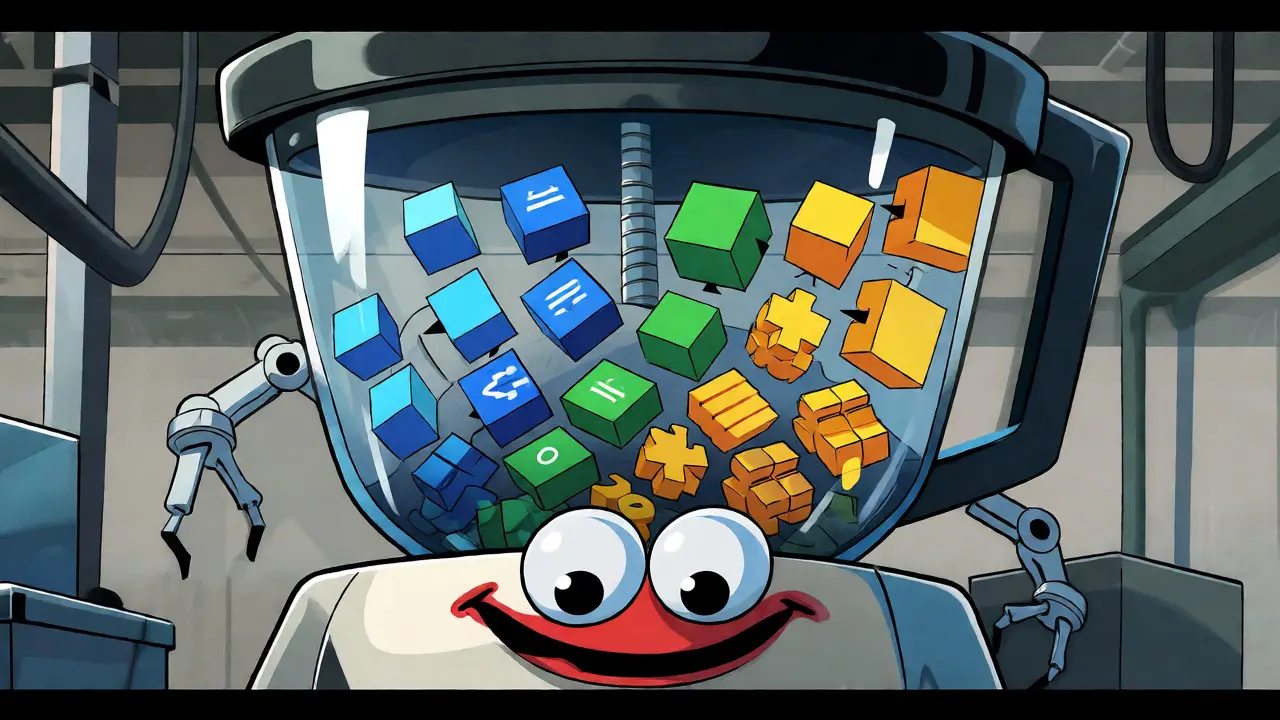
Ordering is only half the battle. The other half is dataset blending. This refers to the mixture of different data sources-code, books, web text, synthetic data-and how their proportions change over time. A well-blended dataset ensures diversity without overwhelming the model.
Consider multilingual training. If you expose a model to 100 languages simultaneously from step one, it may struggle to master any single one due to noise and interference. A phased blending strategy might start with high-resource languages (like English or Chinese) to establish strong syntactic patterns, then gradually introduce low-resource languages. This allows the model to transfer learned generalizations to new, sparser distributions.
| Strategy | Description | Best Use Case | Risk |
|---|---|---|---|
| Static Blend | Fixed proportions of all data sources throughout training. | Simple pipelines; small datasets. | Model may overfit to dominant source; ignores temporal learning dynamics. |
| Progressive Diversity | Starts with narrow distribution (low entropy), expands to broad mix. | Multilingual models; domain adaptation. | Complex scheduling logic required; risk of forgetting if not balanced. |
| Interleaved | Maintains diversity in every mini-batch but varies difficulty within batch. | Instruction tuning; preventing specialization. | Harder to implement; mixed results depending on metric. |
| Two-Phase Mix | Clean/simple subset first, followed by full diverse/noisy set. | Noisy web data; pre-training. | May miss early signals from hard data; requires careful phase boundary. |
Joint Model and Data Curricula
What if you could grow the model and the data complexity together? This is called joint curriculum learning. At smaller scales (100M-1.3B parameters), researchers found that growing model depth or width in stages while simultaneously increasing data difficulty yields better outcomes than doing either alone. For instance, a 1.3B-parameter model trained with curriculum-guided layer scaling outperformed a baseline model by about 1.7% on average across tasks. On specific easy QA tasks, improvements hit 5%. This suggests that structural growth and data progression are synergistic.

Practical Implementation Tips
If you’re implementing this today, start simple. Don’t try to build a dynamic reinforcement learning loop immediately. Here’s a pragmatic roadmap:
- Define Difficulty: Choose a proxy for difficulty. Compression ratio is a cheap, effective starting point. If you have access to model logits, use perplexity.
- Warmup Phase: Train the first 10-20% of steps on the easiest quartile of your data. This stabilizes early gradients.
- Linear Ramp-Up: Gradually introduce harder samples. A linear interpolation of difficulty percentiles works surprisingly well.
- Monitor Loss Variance: If loss spikes when introducing new data types, slow down the curriculum. The model needs time to adapt.
- Evaluate Mid-Training: Don’t wait until the end. Check benchmarks after the warmup phase to see if the curriculum is actually helping convergence speed.
One caveat: curriculum effectiveness isn’t universal. For datasets that are already well-mixed and homogeneous, random shuffling might still win. For example, on the Alpaca dataset, random arrangement sometimes yielded higher average accuracy than structured curricula. However, on specialized datasets like orca-math, attention-based curricula provided clear advantages. Always test on your specific domain.
Future Directions
The field is moving toward automated curriculum generation. Frameworks like CITING use larger AI models to generate curricula for smaller student models, removing the bottleneck of manual data curation. As we push for longer context windows and multimodal capabilities, curriculum techniques will become essential for managing the quadratic costs of attention mechanisms. Variable sequence length training, which introduces shorter sequences first, is a prime example of this trend, allowing efficient long-context training without exploding memory usage.
Does curriculum learning increase training time?
Not necessarily. While sorting data adds preprocessing overhead, the improved convergence rates often mean you reach target performance faster. In some cases, like SPaRFT, it reduces sample usage by up to two orders of magnitude during RLHF, significantly cutting total compute costs.
How do I measure data difficulty?
Common methods include using gzip compression ratios (lower compression implies higher complexity), initial model loss/perplexity, or attention entropy. For code, cyclomatic complexity is a good metric. Start with compression ratios as they are model-agnostic and fast to compute.
Can I apply curriculum learning to fine-tuning?
Yes, it is highly effective for instruction tuning. Starting with simple instructions and progressing to complex multi-step reasoning helps prevent catastrophic forgetting and improves alignment with user intent. Mixed curricula also help avoid overfitting to narrow domains.
Is curriculum learning useful for all model sizes?
Research suggests it is particularly beneficial for smaller to mid-sized models (100M-10B parameters) where capacity is limited. Larger models may have enough capacity to handle random noise, but even they benefit from structured data presentation for specific tasks like math or coding.
What is the risk of poor curriculum design?
If the curriculum is too aggressive, the model may forget earlier learned patterns. If it’s too conservative, you lose the efficiency gains. Poorly defined difficulty metrics can lead to suboptimal ordering, potentially performing worse than random shuffling. Always validate against a random baseline.


honestly this whole idea of curriculum learning feels like we're just trying to trick the model into thinking it's smarter than it is
the real question isn't how you feed it data but whether the data itself is even true or if it's just a reflection of human bias and noise that we've collectively agreed to ignore because it's convenient for us
The assertion that random shuffling is insufficient is technically correct but practically overstated for most modern architectures. While the paper cites specific gains, these are often within the margin of error for large-scale runs unless one has infinite compute budget for hyperparameter tuning. It is frankly lazy to assume that 'difficulty' can be so cleanly defined by compression ratios when semantic complexity is non-linear and context-dependent.
I think there’s a bit of nuance missing here about *why* the curriculum works. It’s not just about easy-to-hard; it’s about gradient stability in the early phases. When I was fine-tuning a smaller Llama variant last month, starting with high-perplexity code snippets caused immediate divergence. By warming up on simple syntax first, the loss landscape smoothed out significantly before introducing complex logic. It’s less about the 'child reading Shakespeare' metaphor and more about avoiding local minima traps during initialization. Also, don’t underestimate the cost of the sorting step itself-for massive datasets, the preprocessing overhead can sometimes negate the training speedups if your pipeline isn’t optimized for parallel sorting.
You people are completely missing the point again! You’re obsessed with the mechanics but ignoring the philosophy. Why do we assume 'easy' means 'better'? This is just another way for big tech to control what the AI learns first, shaping its worldview from the start. It’s manipulative. And honestly, if you can’t handle the noise of random shuffling, maybe your model architecture is just weak. Don’t blame the data, blame yourself.
exactly!! they want us to believe that ordering matters so they can sell us better GPUs later. if you shuffle randomly the model sees everything at once and gets confused just like humans do when they watch too much news. it’s all connected. the conspiracy is that they want the model to forget the hard stuff until they decide it’s safe for us to know. keep your eyes open.
lol typical academic fluff 🙄 we’ve been doing this in production for years without reading fancy papers. just filter out the garbage web crawl data first then throw in the good stuff. done. no need for bandit algorithms or whatever fancy term they use now. americans built the internet, we figured it out while you were still writing abstracts :)
It is fascinating to observe how the narrative shifts from mere computational efficiency to a deeper epistemological framework. The concept of 'difficulty' is indeed subjective, yet the empirical evidence suggests that our models possess an inherent preference for structured progression, much like biological learners. Perhaps we should consider that the 'noise' in random shuffling is not merely interference, but a form of regularization that prevents overfitting to specific patterns. However, the risk of catastrophic forgetting in phased blending strategies cannot be understated; one must tread carefully to ensure that the foundational knowledge remains intact as new domains are introduced. It is a delicate dance between order and chaos.
Wait, wait, wait!!! Hold on!!!
This is HUGE... absolutely game-changing... but also terrifying?? Like, really??? If we curate the difficulty, aren't we basically pre-programming the model's personality? What happens when the 'hard' data is actually biased? Does the model learn the bias faster because it's harder? Or does it reject it?
And why nobody talks about the emotional impact on the loss curve?? It spikes! It crashes! It's dramatic!! We need to treat these models like actors rehearsing their lines, not just machines eating tokens. Seriously though, have anyone tried this with multimodal inputs yet? Because text alone is boring... we need images, sound, everything mixed together in a chaotic symphony of difficulty levels!!! 😱🔥💀
Great insights. Empathy matters in design too.