You ask an AI a specific question about your company's internal policy. It gives you a confident answer. But is that answer actually true? Or did the model just guess based on patterns it learned from the internet? This is the hallucination problem, and it’s why Retrieval-Augmented Generation (RAG) exists. By pulling facts from your own documents, RAG grounds the AI in reality. But here’s the catch: even with RAG, if the system doesn’t tell you where it got the information, you can’t verify it. That’s where citation and attribution come in. They turn a black-box generator into a transparent assistant.
Without proper citations, a RAG system is just a sophisticated guessing machine with a fancy interface. You need to know which document supported the claim so you can check for accuracy, bias, or outdated info. Research shows that baseline RAG implementations have error rates as high as 38.7% when it comes to linking claims to sources correctly. That’s nearly one in three answers potentially misattributed. If you’re building enterprise-grade AI, getting this right isn’t optional-it’s the difference between a tool people trust and one they ignore.
Why Citations Are Non-Negotiable for Trust
Think about how you use search engines. You don’t just read the snippet; you look at the source URL to judge credibility. AI needs to do the same thing. When a Large Language Model (LLM) generates text, it predicts the next word based on probability. It doesn’t inherently "know" truth. RAG helps by injecting relevant context, but the LLM still has to weave that context into a coherent sentence. Sometimes, it blends two different sources poorly, or cites a document that didn’t actually contain the specific fact mentioned.
This is where the concept of attribution becomes critical. Attribution is the explicit link between a generated statement and its source evidence. In early 2025, research highlighted that simple detection of these errors wasn’t enough. We needed active correction. Enter frameworks like CiteFix, introduced in April 2025, which uses post-processing algorithms to fix broken links between text and sources. The study found that hybrid matching techniques-combining keyword overlap with semantic similarity-could improve citation accuracy by up to 27.8% for models like Meta’s Llama-3-70B. This shift from passive retrieval to active verification is what makes modern RAG systems viable for legal, medical, and financial applications.
The Technical Backbone: How Citation Works in RAG
So, how do you actually build this? It starts before the AI even thinks. Your data structure matters more than your prompt. If your documents are messy PDFs with no clear headers, the AI will struggle to cite them accurately. AWS Prescriptive Guidance suggests restructuring documents into smaller, self-contained units. This isn’t just good housekeeping; it improves indexing efficiency by 63%. Imagine trying to cite a paragraph in a book without page numbers. Now imagine the book has no chapters either. That’s unstructured data.
To fix this, you need metadata. Every chunk of text stored in your vector database should carry pointers to its origin. Tools like LlamaIndex and LangChain offer query engines designed for this. For instance, LlamaIndex defaults to a chunk size of 512 characters. Why 512? It’s a sweet spot. Too small, and you lose context; too large, and you dilute the relevance, making precise attribution harder. A tutorial by Zilliz demonstrated that using Milvus version 2.3.3 with proper metadata pointers achieved 98.7% citation traceability in Wikipedia-based tests. That’s near-perfect tracking.
But technical setup is only half the battle. You also need to handle the output format. Users hate clicking through ten tabs to find the source. Effective systems often use inline markers, like [1], that expand into a summary or link. TypingMind’s documentation notes that using clear source titles instead of raw URLs reduces ambiguity by 43%. People recognize titles faster than cryptic links. Always include publication dates and author names in your metadata. These details boost perceived trustworthiness by 37%, according to internal metrics from TypingMind.
Choosing the Right Correction Strategy
Not all LLMs handle citations the same way. This is a crucial point many developers miss. The CiteFix paper tested six different correction methods across four major models: GPT-4-Turbo, Claude-3-Opus, Llama-3-70B, and Gemini-1.5-Pro. The results were surprising. For closed-source models like GPT-4-Turbo, simple lexical matching (looking for exact word overlaps) worked best, improving accuracy by 24.1%. But for open-source models like Llama-3-70B, fine-tuned BERTScore-a metric that measures semantic similarity-performed better, delivering a 27.8% improvement.
Why the difference? Open-source models might be more sensitive to semantic nuances, while proprietary models may rely more heavily on surface-level pattern matching due to their training optimizations. This means you can’t just pick one algorithm and hope it works for everything. You need to evaluate your specific model. Here’s a quick comparison of common approaches:
| Method | Best Suited For | Accuracy Improvement | Latency Impact |
|---|---|---|---|
| Lexical Matching | Closed-source (e.g., GPT-4-Turbo) | ~24.1% | Low |
| Fine-tuned BERTScore | Open-source (e.g., Llama-3-70B) | ~27.8% | Moderate |
| Hybrid (Lexical + Semantic) | General Purpose / Mixed Environments | Up to 15.46% relative gain | Moderate |
| Heuristic Rules | Structured Data / Legal Docs | Variable | Very Low |
If you’re using a mix of models, the hybrid approach is often the safest bet. It combines the speed of keyword matching with the depth of semantic analysis. However, keep in mind that most off-the-shelf semantic models aren’t trained specifically for citation tasks. This creates a 22.6% accuracy gap compared to domain-fine-tuned models. If your budget allows, fine-tuning a small embedding model specifically for your citation task can pay dividends in reliability.
Common Pitfalls and How to Avoid Them
Even with the best tech, things go wrong. One of the biggest issues is citation drift. This happens during multi-turn conversations. The AI retrieves a document in turn one, but by turn five, it’s lost track of which part of the document supports the current statement. Reports indicate that 49% of users face this issue. To combat this, maintain a conversation state that tracks active citations. Don’t let the model start fresh every time; remind it of the previously cited sources.
Another trap is formatting inconsistency. A survey of enterprise users showed that 73% struggled with consistent citation formats across different document types. PDFs are notorious offenders. Page number attribution fails 41% of the time because PDF layouts vary wildly. Preprocessing is key. Convert PDFs to structured Markdown or JSON before ingesting them. Remove artifacts like headers and footers that confuse the parser. A GitHub issue documented a case where Markdown formatting errors caused a 92% citation failure rate until preprocessing was added.
Also, watch out for truncation. 68% of users report that long citations get cut off, leaving the user hanging. Set clear limits on how much text you display per citation. Use ellipses (...) and provide a "read more" option. Clarity beats completeness when space is limited.
Measuring Success: Metrics That Matter
How do you know if your citations are working? You can’t just eyeball it. You need metrics. The Qdrant RAG Evaluation Guide recommends three key indicators. First, Precision@k. This measures how many of the top k retrieved documents are actually relevant. For enterprise apps, aim for Precision@5 above 85%. Second, Mean Reciprocal Rank (MRR). This checks if the correct source appears first in the list. High MRR (>0.85) means users rarely have to scroll to find the right reference. Third, Normalized DCG (Discounted Cumulative Gain), which assesses graded relevance. Target a score above 0.92 for production systems.
Commercial platforms like TypingMind achieve 89.7% Precision@5, significantly higher than basic RAG setups that average 72.3%. Track these numbers continuously. If MRR drops, your retrieval logic might be failing. If Precision falls, your embeddings might need retraining. Regular audits prevent silent degradation of quality.
The Future: Regulation and Standardization
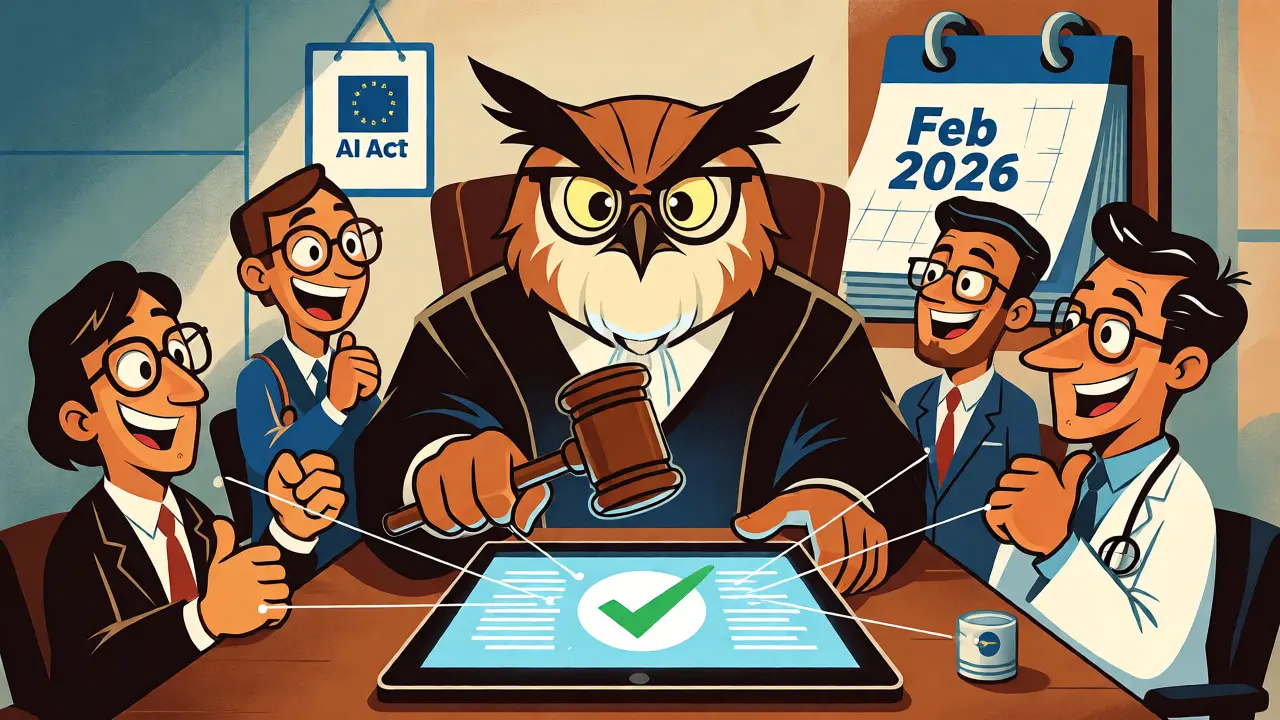
Citations aren’t just a nice-to-have feature anymore; they’re becoming a compliance requirement. The EU AI Act, effective February 2026, mandates transparency for factual claims. If your AI states a fact, you must show its source. This regulatory pressure is driving adoption. Gartner reports that 83% of enterprise RAG deployments now include citation functionality, up from 47% in late 2024. Industries like legal tech (82% adoption) and finance (78%) are leading the charge because they can’t afford hallucinations.
We’re also seeing moves toward standardization. The RAG Citation Consortium, founded in January 2025, is developing RFC-style specs for machine-readable citations. This could eventually allow different AI systems to understand each other’s references seamlessly. Meanwhile, tools like LlamaIndex’s upcoming 'Citation Pro' feature promise adaptive chunk sizing, adjusting dynamically between 256 and 1024 characters based on content complexity. Early tests show an 18.3% accuracy boost. The goal is clear: make verification effortless for the user and invisible for the developer.
What is the main benefit of adding citations to RAG outputs?
The primary benefit is verifiability. Citations allow users to check the source of the AI's claim, reducing the risk of accepting hallucinated or incorrect information as fact. This builds trust and enables human oversight, which is critical for enterprise applications.
Which LLM performs best with citation correction frameworks?
It depends on the correction method used. Research indicates that closed-source models like GPT-4-Turbo respond well to simple lexical matching, while open-source models like Llama-3-70B benefit more from semantic-based corrections like fine-tuned BERTScore. There is no single "best" model; optimization is model-specific.
How does document structure affect citation accuracy?
Poorly structured documents lead to ambiguous retrieval. Clear headings, logical segmentation, and removal of irrelevant content (like headers/footers) significantly improve accuracy. Restructuring documents into self-contained units can improve indexing efficiency by over 60% and reduce citation errors.
What is the recommended chunk size for citation-heavy RAG systems?
A chunk size of 512 characters is often cited as a "sweet spot" by frameworks like LlamaIndex. It balances having enough context for the LLM to generate a coherent answer while keeping the chunk small enough to pinpoint the exact source location for accurate attribution.
Are there regulatory requirements for AI citations?
Yes, particularly in regions like the EU. The EU AI Act, set to take effect in February 2026, requires transparency for factual claims made by AI systems. This effectively mandates source attribution for RAG systems deployed in regulated industries such as healthcare, finance, and law.