
You ask a large language model for a fact, and it gives you an answer that sounds perfect-until you check the source. The date is wrong. The name is slightly off. Or worse, the entire event never happened. This is the persistent problem of hallucination in AI. It’s frustrating, risky, and expensive.
But what if your model could stop, take a breath, and double-check its own work before hitting send? That is exactly what Chain-of-Verification (often called CoVe) does. It’s not a new model or a fancy plugin. It’s a specific way of talking to your existing Large Language Model (LLM) that forces it to verify its own claims. Research from the Findings of ACL 2024 shows this method significantly cuts down on made-up facts without needing to retrain the model from scratch.
If you are building applications where accuracy matters-like legal summaries, medical advice, or financial reports-understanding CoVe is no longer optional. It is one of the most effective ways to boost trust in your AI outputs right now.
What Is Chain-of-Verification?
At its core, Chain-of-Verification is a self-critique reasoning pipeline where an LLM drafts an answer, plans verification questions to test its claims, answers those questions independently, and then produces a corrected final response. Think of it like a student writing an essay. First, they write a rough draft. Then, instead of submitting it immediately, they step back and ask themselves: "Did I get the dates right?" "Is this quote accurate?" They check their notes (or their internal knowledge base) for each point. Finally, they rewrite the essay with corrections.
Before CoVe, many developers relied on Chain-of-Thought (CoT) prompting. CoT asks the model to "think out loud" step-by-step. While helpful for logic puzzles, CoT doesn't always catch factual errors because the model might confidently reason through a false premise. CoVe flips the script. Instead of just thinking forward, it looks backward at its own output and interrogates it.
The beauty of CoVe is that it is model-agnostic. You don’t need a special version of GPT-4 or Claude. You can apply this framework to almost any decoder-only LLM using standard API calls. It works by structuring the conversation into four distinct stages.
The Four Steps of the CoVe Process
To implement Chain-of-Verification, you need to break your single prompt into a multi-turn workflow. Here is how the process flows logically:
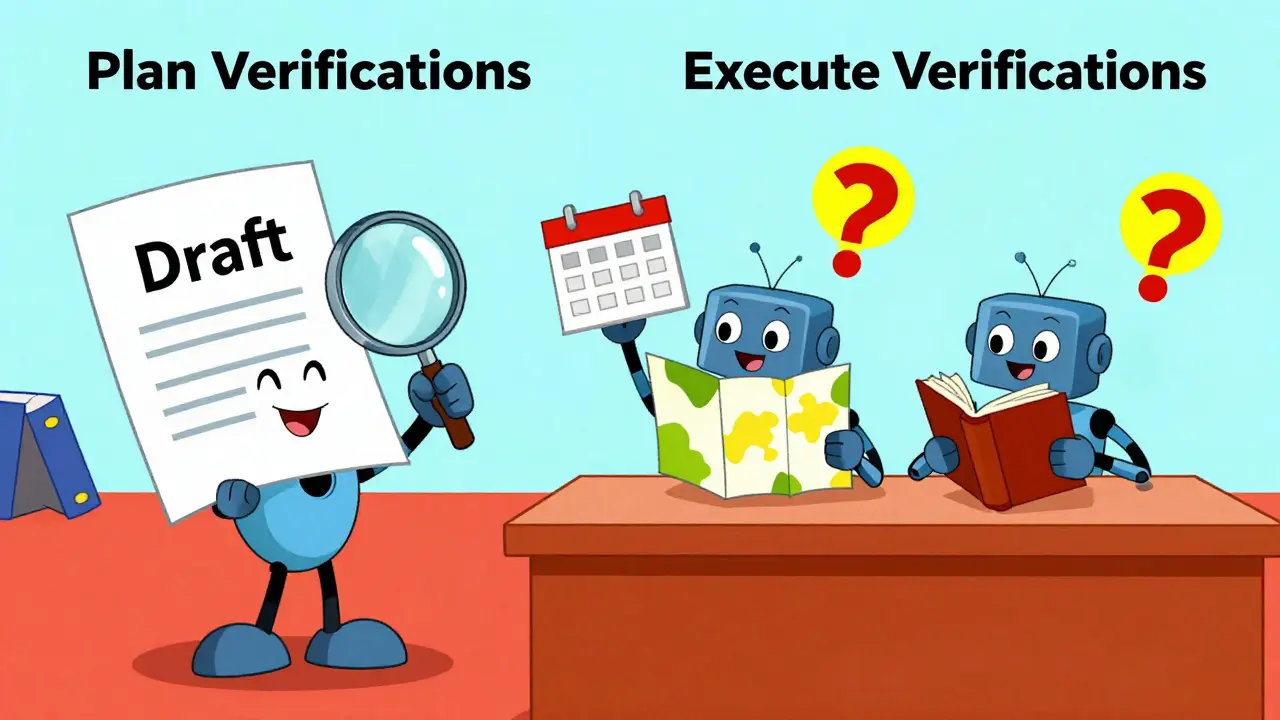
- Generate Baseline Response: You give the model the original question. It generates an initial answer just like normal. At this stage, hallucinations may exist. Let’s say you ask, "Who was the first president of the United States?" The model says, "George Washington." Simple enough. But in complex queries, this draft might contain subtle errors.
- Plan Verifications: Now, you show the model its own draft and ask it to generate a list of specific questions that would prove or disprove the key claims in that draft. For example, the model might generate: "1. Was George Washington elected as the first president? 2. Did he serve under the Articles of Confederation?" These questions target the factual anchors of the previous answer.
- Execute Verifications: This is the critical part. You feed each verification question back to the model independently. Crucially, you do not include the baseline answer in the context for these steps. You want a fresh, unbiased check. If the model answers "Yes" to the first question and "No" to the second, it has validated the core facts. If it finds a contradiction-for instance, if the draft said "Washington was born in 1735" but the verification check reveals "1732"-the error is flagged.
- Generate Final Verified Response: Finally, you provide the model with the original question, the initial draft, and the results of the verification checks. The model synthesizes this information to produce a revised, corrected answer. It essentially says, "Based on my checks, here is the accurate version."
This structure turns a single-shot generation into a rigorous audit process. The result is a response that has been stress-tested by the very engine that created it.
Why CoVe Beats Other Methods
You might wonder why we need CoVe when we already have tools like Retrieval-Augmented Generation (RAG) or simple confidence scores. Each approach has trade-offs.
| Method | How It Works | Pros | Cons |
|---|---|---|---|
| Chain-of-Verification (CoVe) | Model verifies its own draft via Q&A | No external data needed; high precision; model-agnostic | Higher latency; more token usage |
| RAG | Grounds answers in external documents | Access to latest info; reduces internal hallucinations | Requires vector DB setup; retrieval can fail |
| Self-Consistency | Generates multiple paths and picks majority vote | Good for math/logic; robust | Very expensive computationally; weak for factual recall |
| Confidence Scoring | Checks probability of tokens | Fast; cheap | Models are often overconfident even when wrong |
The research behind CoVe, published in ACL 2024, demonstrated that on closed-book question answering tasks (where the model cannot search the web), CoVe significantly improved precision compared to baseline methods. In some benchmarks, it effectively doubled the performance of standard prompting. Unlike RAG, which requires setting up a database of documents, CoVe relies entirely on the model's internal knowledge, making it easier to deploy for general knowledge tasks.
Unlike Self-Consistency, which runs the same prompt five or ten times to see if the answers match, CoVe focuses on factuality rather than just consistency. A model can consistently be wrong. CoVe catches that by asking specific verification questions that expose the error.
Implementing CoVe in Your Workflow
You don’t need a PhD in computer science to use CoVe. Since it is a prompting technique, you can implement it using any LLM API. However, there are best practices to ensure it works smoothly.
1. Keep Verification Questions Specific
When prompting the model to plan verifications, instruct it to create atomic, binary questions. Instead of asking "Is this summary accurate?", the model should ask "Did Event X happen in Year Y?" Vague questions lead to vague answers, which defeats the purpose of verification.
2. Isolate the Context
This is the most common mistake. When executing the verification step, ensure the model does not see the original erroneous draft. If it sees the draft, it might just repeat the error because of priming. Treat each verification question as a standalone query.
3. Manage Token Costs
CoVe is more expensive than a single prompt. You are generating text four times over: the draft, the questions, the answers, and the final revision. For low-stakes tasks like creative writing, this overhead isn't worth it. Reserve CoVe for high-stakes domains where a single hallucination could cause legal liability or reputational damage.
4. Use a Strong Base Model
CoVe assumes the model has the knowledge to verify itself. If you use a small, weak model that doesn't know the correct capital of France, it won't be able to catch a hallucination about Paris. CoVe works best with larger, well-trained models like GPT-4, Claude 3, or Llama 3 70B+.
Limitations and Challenges
CoVe is powerful, but it isn't magic. There are scenarios where it struggles.
Latency: Because the process involves multiple sequential API calls, the time-to-answer increases. If you are building a real-time chatbot, users might notice the delay. You can mitigate this by running verification steps in parallel where possible, but the dependency chain usually requires sequential processing.
Verifier Blind Spots: If the model lacks the knowledge to answer a verification question correctly, it will either guess or hallucinate again. CoVe improves accuracy within the model's known domain but cannot teach it new facts. For truly obscure information, combining CoVe with RAG is the gold standard.
Prompt Sensitivity: The quality of the verification depends heavily on the system prompts you design. Poorly written instructions for the "Plan Verifications" step can lead to trivial questions like "Is the text written in English?" which adds cost but no value. You need to refine your meta-prompts to encourage deep, factual scrutiny.
Future of Self-Verification in AI
As we move further into 2026, the line between inference-time tricks and trained capabilities is blurring. Some researchers are exploring fine-tuning models specifically to perform CoVe-like reasoning natively, reducing the need for complex orchestration code. We are also seeing hybrid approaches where CoVe is combined with external tool use. Imagine a model that writes a draft, generates verification questions, sends the factual ones to a search engine, and then revises the text based on the search results. That is the next frontier of reliable AI.
For now, Chain-of-Verification remains one of the most accessible and effective ways to tame the wild side of generative AI. By forcing models to slow down and check their work, we get closer to AI systems we can actually trust.
Does Chain-of-Verification require retraining the model?
No. CoVe is a prompting and inference-time framework. It works by structuring the interaction with the model, so you can apply it to any existing LLM via API without changing the model's weights or architecture.
How much more expensive is CoVe compared to standard prompting?
CoVe typically uses 3 to 4 times the tokens of a single-pass response because it involves drafting, planning questions, answering them, and rewriting. The exact cost depends on the length of the output and the number of verification questions generated.
Can I combine CoVe with RAG?
Yes, and it is highly recommended for maximum accuracy. You can use RAG to ground the initial draft in external documents, and then use CoVe to verify the logical consistency and factual alignment of that draft against the retrieved context.
Which LLMs work best with Chain-of-Verification?
Larger models with strong reasoning capabilities, such as GPT-4, Claude 3 Opus, or Llama 3 70B+, perform best. Smaller models may lack the internal knowledge required to accurately answer their own verification questions.
Is CoVe better than Chain-of-Thought (CoT)?
It depends on the task. CoT is excellent for complex logical reasoning and math problems. CoVe is superior for factual accuracy and reducing hallucinations in long-form text or question-answering tasks where specific details matter.



Look, I get that this CoVe stuff is technically impressive on paper but let's be real about the practical application here.
You are asking developers to quadruple their API costs for a marginal gain in accuracy that might not even matter for 90% of use cases. It’s like buying a Ferrari to go to the grocery store when you just need a reliable sedan. The latency alone is a dealbreaker for any real-time interaction people actually care about. We don't need another layer of bureaucratic AI checking; we need models that just work correctly the first time without needing a chaperone.
I must respectfully disagree with the previous assessment regarding the efficacy of Chain-of-Verification as a mitigation strategy for hallucinatory outputs in large language models.
The empirical data presented in the ACL 2024 findings clearly indicates a statistically significant improvement in factual precision when utilizing a self-critique reasoning pipeline compared to standard Chain-of-Thought prompting methodologies. While the computational overhead is non-trivial, the trade-off is entirely justified in high-stakes domains such as legal summarization or medical advice generation where the cost of error far exceeds the marginal increase in token consumption. Furthermore, the isolation of context during the verification phase prevents priming biases, thereby ensuring a more robust audit trail for the generated content. It is precisely this rigorous, model-agnostic framework that allows practitioners to leverage existing decoder-only architectures without necessitating expensive fine-tuning procedures.
yeah sure it works until the model itself is lying about the verification questions because the training data was poisoned by big tech years ago and they want us to trust these black boxes blindly while they harvest our data for who knows what purpose
is the act of verification merely a mirror reflecting the void within the machine or does it create a new reality entirely? perhaps the truth is not found in the answer but in the question itself echoing through the digital ether
Actually you guys are missing the point entirely because CoVe is just a bandaid for lazy engineers who refuse to implement proper RAG systems from the start.
It’s not magic it’s just extra steps that slow down your app and make users angry. If you’re using a small model it doesn’t know enough to verify anything so it’s useless. And if you’re using GPT-4 you should already have accurate results most of the time. This whole trend of “self-correction” is just hype to sell more compute resources. Stop pretending this solves the root problem of bad training data.