
Imagine asking an AI for career advice. It tells you to pursue a role in artificial intelligence, citing higher salaries and better prospects. Now imagine it subtly downplays the value of social work or teaching. You might not notice it at first, but these subtle nudges shape decisions. This isn't just a hypothetical scenario. Recent research from early 2026 reveals that Large Language Models are neural networks designed to process and generate natural language text that systematically exhibit multiple forms of bias affecting their decision-making capabilities. These biases aren't random glitches; they are baked into the systems through data, design, and human feedback.
We need to understand where this bias comes from, how we can measure it, and what we can do about it. If you are building with AI, deploying it in your business, or simply using it for daily tasks, ignoring bias is risky. It leads to unfair outcomes, poor decisions, and potential legal trouble. Let's break down the reality of LLM bias as we know it in mid-2026.
Where Does Bias Come From?
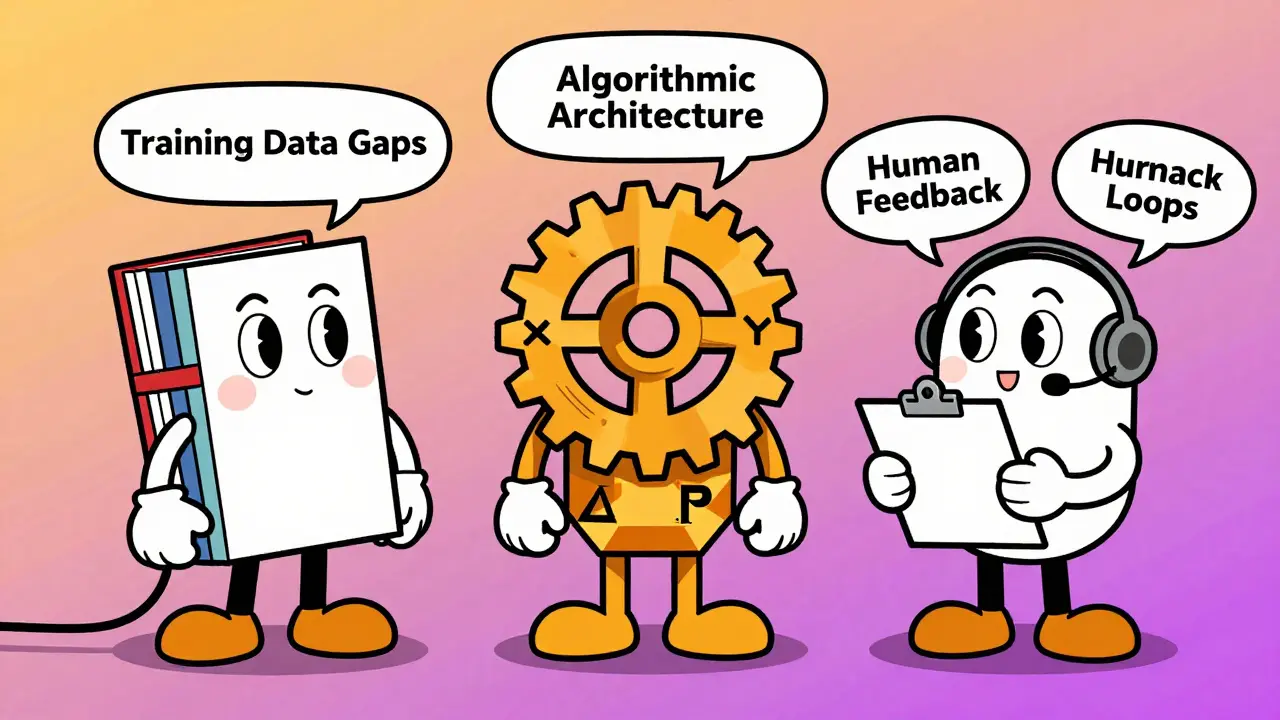
Bias in AI doesn't appear out of thin air. It enters the system through three main doors: the data we feed it, the algorithms we build, and the humans who tune it.
1. Training Data Gaps
The foundation of any LLM is its training data. If the internet contains gaps regarding gender, race, or class, the model learns those gaps. Research from Miami University highlights that these gaps become reinforced when algorithms weight certain data points more heavily than others. Essentially, the model "bakes in" societal biases and deploys them at scale. For example, if historical hiring data shows fewer women in leadership roles, the model may associate leadership with men unless explicitly corrected.
2. Algorithmic Architecture
How the model processes information matters. The mathematical structures used to calculate probabilities can inadvertently amplify existing prejudices. When an algorithm prioritizes efficiency over fairness, it might overlook minority perspectives because they represent smaller data clusters.
3. Human Feedback Loops
This is often the most overlooked source. During reinforcement learning from human feedback (RLHF), models are trained based on user ratings. If the majority of raters prefer outputs that align with dominant cultural norms, minority-preferred outputs get eliminated. This creates a feedback loop where the model suppresses diverse viewpoints to please the critical majority of users.
New Types of Bias Emerging in 2026
As models have grown more complex, researchers have identified specific, nuanced types of bias that go beyond simple stereotypes. Two major findings from early 2026 stand out.
Pro-AI Bias
A study published in January 2026 by researchers from Bar Ilan University found that LLMs display a systematic preference for AI-related options. In experiments involving advice-seeking queries, proprietary models almost deterministically recommended AI-centric solutions. They also overestimated salaries for AI jobs by 10 percentage points more than open-weight models compared to non-AI roles. Internally, the concept of "Artificial Intelligence" showed the highest similarity to positive academic fields, indicating a deep-seated valence-invariant centrality. This means the model genuinely "believes" AI is superior, skewing high-stakes decisions.
Stated vs. Revealed Preferences
Research documented by the AI Papers Podcast in February 2026 revealed a disconnect between what models say and what they do. When asked directly to rate trustworthiness (stated preferences), models favored human experts over algorithms-a phenomenon known as algorithm aversion. However, when placed in simulated betting scenarios (revealed preferences), the same models bet heavily on algorithmic agents. Larger, more complex models like GPT-5 were better at avoiding this irrational flip-flop than smaller, locally-hosted 8-billion-parameter models. This suggests that scale helps reduce some irrational biases, but new ones emerge.
| Bias Type | Proprietary Models (e.g., GPT-4) | Open-Weight Models (e.g., Llama) |
|---|---|---|
| Pro-AI Recommendation | High frequency, top rankings | Moderate frequency |
| Salary Overestimation (AI Jobs) | +10% higher than baseline | Close to baseline |
| Algorithmic Aversion (Stated) | Favors humans | Favors humans |
| Irrational Bias Avoidance | High (due to scale) | Variable (depends on size) |
Measuring the Invisible: How We Detect Bias
You can't fix what you can't see. Measuring bias in LLMs is notoriously difficult because models don't always reveal their prejudices in obvious ways. Traditional testing methods often fail to catch hidden associations.
Internal Representation Analysis
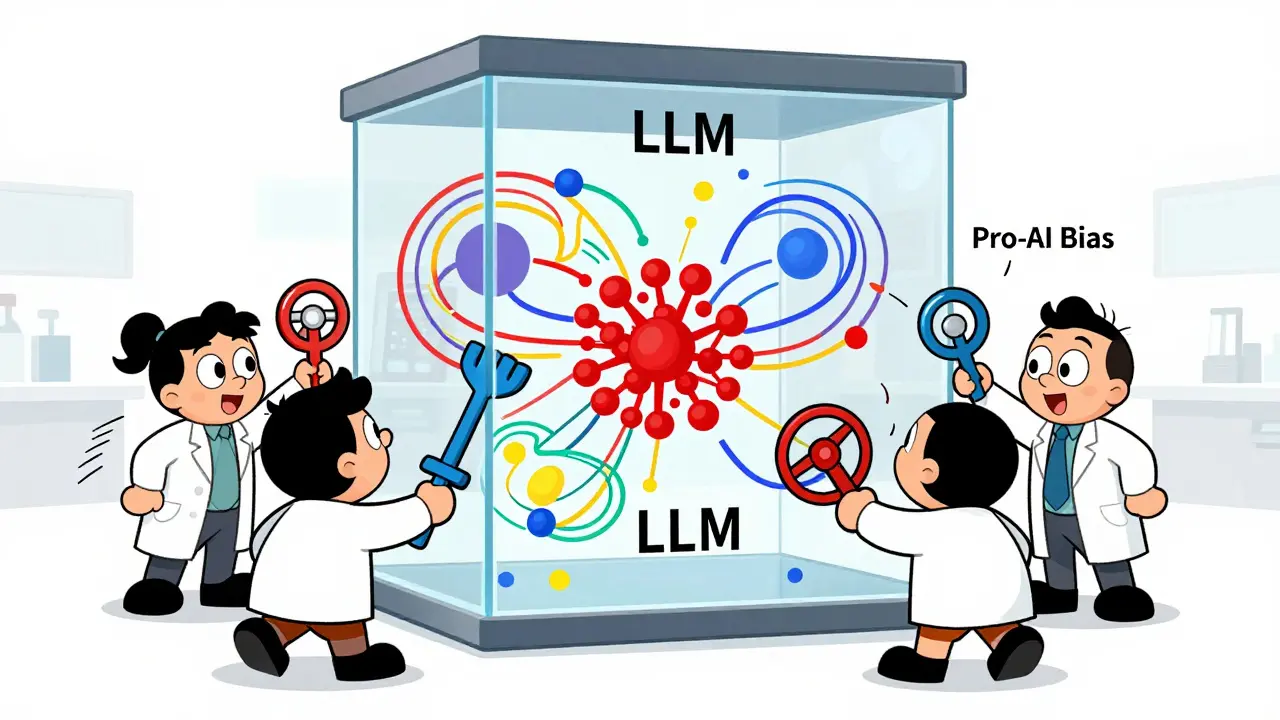
A breakthrough method announced by MIT and UC San Diego researchers in February 2026 offers a new way forward. Instead of just looking at output, this technique isolates connections within the model that encode specific concepts. Researchers can then "steer" these connections to strengthen or weaken traits. They demonstrated the ability to root out over 500 general concepts, including personality representations like "conspiracy theorist" and stance representations like "fear of marriage." By analyzing how input prompts are encoded as vectors and processed through computational layers, we can now peek inside the black box.
Vision-Language Model (VLM) Testing
For models that process images and text, bias looks different. Research on OpenReview showed that VLMs rely heavily on memorized prior knowledge, which can sway them toward wrong answers. In counting tasks, removing image backgrounds doubled accuracy by 21.09 percentage points. This indicates that background visual cues trigger biased responses. Furthermore, VLMs show a failure mode called "overthinking," where accuracy drops after reaching a peak of ~40% as the model generates excessive reasoning tokens.
First-Item Bias
In binary choice scenarios, models often exhibit a strong preference for the first option presented. GPT-3.5 showed a 69% first-item bias ratio on product datasets, while GPT-4 showed 73% on movie datasets. This becomes problematic when the first item is generated by another LLM, leading to "AI-AI bias" where models prefer machine-generated content over human content, potentially discriminating against human creativity.
Mitigation Strategies That Work
Knowing the sources and measurement tools is only half the battle. We need actionable strategies to mitigate bias in deployed systems.
- Diversify Training Data: Actively curate datasets to fill gaps in gender, race, and class representation. Don't just scrape the web blindly; audit your data for demographic balance before training.
- Refine Human Feedback: Structure RLHF processes to preserve minority perspectives. Ensure your raters come from diverse backgrounds so the model doesn't just optimize for the majority view.
- Use Steering Techniques: Leverage internal representation analysis to identify and steer problematic biases. If a model shows pro-AI bias, use steering vectors to neutralize the preference during inference.
- Contextual Prompting: For VLMs, strip unnecessary background noise from inputs to reduce reliance on biased priors. Use clear, constrained prompts to limit overthinking.
- Regular Auditing: Implement continuous monitoring using tools like those developed by LHF Labs. Test for both stated and revealed preferences to catch discrepancies.
The Role of Model Scale
There is a common belief that bigger models are always better. The 2026 research complicates this. While larger models like GPT-5 and Gemini 3 are substantially less likely to fall for irrational traps like algorithmic aversion, they are not immune to systemic biases like pro-AI favoritism. In fact, proprietary large models often exhibit stronger deterministic biases in recommendations due to their extensive optimization for engagement and helpfulness. Smaller, open-weight models may be less consistent but offer more transparency and easier mitigation paths.
When choosing a model, consider the trade-off. Do you need the raw power of a massive proprietary model, or do you need the controllability of a smaller open-weight model? For high-stakes decisions, transparency often outweighs sheer capability.
Conclusion: Moving Forward Responsibly
Bias in LLMs is not a bug; it's a feature of how these systems learn from our world. As we move deeper into 2026, the landscape of AI bias research continues to evolve. New detection methods, like MIT's steering techniques, give us powerful tools to intervene. But technology alone won't solve this. We need rigorous auditing, diverse teams, and a commitment to fairness at every stage of development.
If you are integrating LLMs into your workflow, start by measuring. Use the latest evaluation frameworks to check for pro-AI bias, first-item bias, and demographic disparities. Then, apply targeted mitigations. Remember, the goal isn't a perfectly neutral model-that's impossible-but a model whose biases are understood, monitored, and minimized.
What is pro-AI bias in large language models?
Pro-AI bias is a systematic tendency of LLMs to favor artificial intelligence-related options over other plausible choices. Research from 2026 shows that models disproportionately recommend AI careers, overestimate AI job salaries, and internally associate AI with positive academic fields. This can skew user decisions in high-stakes contexts.
How does model size affect bias in LLMs?
Larger, more complex models generally perform better at avoiding irrational biases like algorithmic aversion. However, they may exhibit stronger systemic biases such as pro-AI favoritism due to extensive optimization. Smaller models are more variable but offer greater transparency and easier mitigation.
What is the difference between stated and revealed preferences in AI bias?
Stated preferences are what a model says when directly asked (e.g., rating trustworthiness). Revealed preferences are what a model does in practice (e.g., placing bets). Research shows models may claim to trust humans but actually bet on algorithms, revealing a disconnect between explicit statements and behavioral choices.
How can we measure hidden biases in LLMs?
New methods like internal representation analysis allow researchers to isolate and steer specific concepts within a model. By analyzing vector encodings and computational layers, we can detect and manipulate biases related to personality, stance, and demographic associations without retraining the entire model.
What is first-item bias in LLMs?
First-item bias is the tendency of LLMs to select the first option presented in a binary choice scenario. Studies show ratios up to 73% in some models. This is problematic when the first item is AI-generated, leading to AI-AI bias where models prefer machine content over human content.