
You type a prompt into Cursor or Replit, hit enter, and boom-working code. It feels like magic. But here is the catch nobody tells you about vibe coding is an AI-assisted development practice where developers describe requirements in natural language to large language models (LLMs), which generate source code without human review of the implementation details. While this speeds up your workflow massively, it creates a dangerous blind spot: architectural drift. Without oversight, AI agents make structural decisions on the fly, leading to "black box architectures" that are impossible to maintain six months later. That is why automated architecture lints have become essential. They act as the guardrails for your AI-generated code, ensuring that while the vibe stays chill, the structure stays solid.
The Hidden Cost of Fast Coding
Andrej Karpathy coined the term vibe coding in early 2025, highlighting how developers shifted from writing line-by-line to directing AI agents. The speed is addictive. You ask for a feature, and you get it. But AI doesn't inherently understand your specific business domain constraints unless you explicitly teach it. A recent report by Genpact confirmed that AI-assisted coding has moved from experimentation to full integration in enterprises. This shift brings a new problem: technical debt accumulates faster than you can refactor it manually.
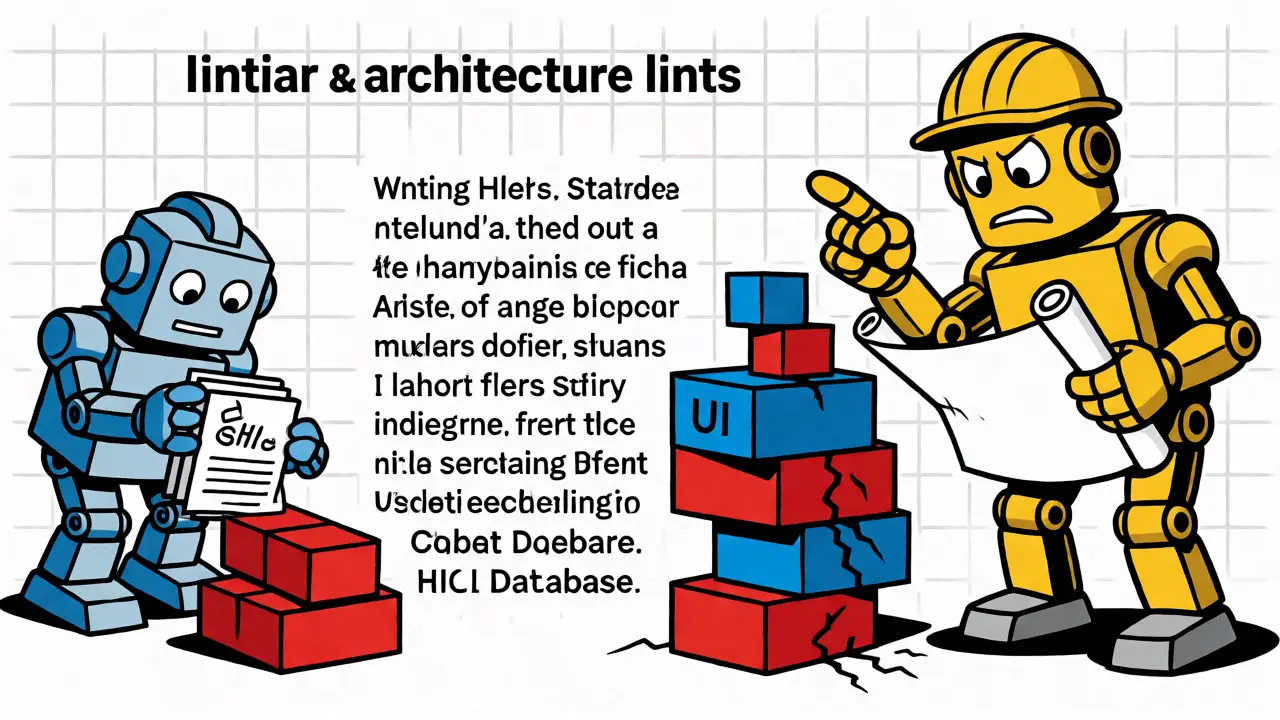
When you don't read the blueprint, you risk creating circular dependencies, leaking backend logic into frontend components, or mixing data layers with presentation logic. These aren't just style issues; they are structural failures. Dr. Sarah Chen, Principal Architect at Microsoft, warns that without checks, vibe coding creates systems where structure is emergent rather than intentional. Maintenance becomes exponentially harder because no one knows why certain modules talk to each other. Automated architecture lints solve this by enforcing boundaries automatically, catching violations before they merge.
How Architecture Lints Differ from Standard Linters
If you are used to ESLint or Prettier, you might think these tools do the same job. They don't. Standard linters check syntax, formatting, and basic best practices within a single file. Architecture lints operate at a higher level, analyzing relationships between files, modules, and layers. They verify that your application respects its intended design patterns, such as layered architecture or microservice boundaries.
For example, a standard linter won't care if your React component imports a database query directly. An architecture lint will flag it immediately because it violates the separation of concerns. Tools like SonarQube have some architectural rules, but they often lack deep integration with AI workflows. Specialized architecture lints interpret natural language prompts and map them to structural constraints. If you ask an AI to build a budget tracker, the linter ensures the data model stays separate from the UI logic, even if the AI tries to shortcut the process.
| Feature | Standard Linter (e.g., ESLint) | Architecture Lint (e.g., ArchUnit) |
|---|---|---|
| Primary Focus | Syntax, style, local errors | Module dependencies, layering, boundaries |
| Scope | Single file or small scope | Cross-file, cross-module, system-wide |
| Vibe Coding Integration | Limited (catches typos, not structure) | High (enforces design intent) |
| Detection Rate | High for syntax errors | 73% reduction in architectural violations |
Implementing Lints in Your Workflow
Getting started requires a bit of setup, but it pays off quickly. Most modern architecture lints integrate via YAML configuration files. You define what constitutes a boundary. For instance, you might specify that the `domain` layer cannot import from the `infrastructure` layer. Once defined, the linter runs during your CI/CD pipeline or as a pre-commit hook.
Integration with platforms like Cursor Composer or GitHub Copilot Architect is becoming seamless. When the AI generates code, the linter analyzes it in real-time. If a violation occurs, the tool provides feedback that can be fed back into the next prompt. This creates a closed loop where the AI learns from its mistakes. Performance impact is minimal, adding only 12-18% processing time to the build process, according to benchmarks from vFunction. In exchange, you reduce long-term maintenance costs by up to 35%.
- Define Boundaries: Start simple. Identify your main layers (UI, Logic, Data) and forbid illegal imports between them.
- Integrate Early: Add the linter to your CI pipeline so every pull request gets checked.
- Tune Rules: Begin with permissive rules to avoid false positives, then tighten them as your team adapts.

Real-World Successes and Pitfalls
Companies are already seeing results. A healthcare SaaS provider used architecture lints across 14 vibe-coded microservices and reduced integration time by 63%. They caught boundary violations early, preventing costly refactors later. On the flip side, a fintech startup skipped these checks and faced a $285,000 remediation cost after discovering improper data flow between security-critical modules. The lesson? Speed without structure is fragile.
However, lints aren't perfect. They excel at detecting structural issues but struggle with semantic correctness. As Dr. Michael Rodriguez from Stanford notes, automated checks can verify that Module A doesn't depend on Module B, but they can't tell you if that dependency makes business sense. False positives remain a common complaint, cited by nearly half of users in community reviews. To mitigate this, combine automated lints with periodic human architectural reviews. The AI handles the routine enforcement; humans handle the strategic alignment.
The Future of AI-Assisted Development
The market for architecture lints in vibe-coded apps is exploding, projected to grow at a 68% CAGR through 2027. Gartner predicts 85% enterprise adoption by 2027. New tools are emerging, like vFunction Architect 2.0, which uses multi-agent validation to check different aspects of the architecture simultaneously. We are moving toward a world where architecture lints are as standard as syntax checkers.
Regulatory pressures are also driving adoption. Updates to standards like PCI DSS now require verifiable architectural separation. If you are building payment systems with AI, you need proof that your boundaries hold. Automated lints provide that audit trail. As we move forward, the challenge isn't whether to use these tools, but how to configure them effectively without stifling creativity. The goal is to let AI handle the tedious structural enforcement so you can focus on solving actual user problems.
What is the main difference between a code linter and an architecture lint?
A code linter checks syntax, formatting, and local variable usage within individual files. An architecture lint analyzes the relationships between files and modules, ensuring that high-level design patterns (like layering or microservice boundaries) are respected across the entire application.
Do architecture lints slow down vibe coding significantly?
No, the impact is minimal. Benchmarks show that architecture lints add approximately 12-18% processing time to the build or analysis phase. This slight overhead is outweighed by the reduction in architectural violations and subsequent rework costs.
Can architecture lints detect all types of bad code?
They primarily detect structural and dependency violations. They are less effective at identifying semantic issues, such as whether a specific algorithm is efficient or if a business rule is logically sound. Human review is still necessary for these deeper checks.
Which tools are popular for enforcing architecture in vibe-coded apps?
Popular options include specialized tools like ArchUnit for AI, integrated features in GitHub Copilot Architect, and open-source projects like VibeLint. Many teams also use enhanced configurations of existing static analysis tools like SonarQube tailored for architectural rules.
Is it hard to set up architecture lints for beginners?
There is a moderate learning curve, typically taking 2-3 weeks for developers familiar with both architecture concepts and AI tools. Starting with simple boundary definitions in YAML format helps ease into the process without overwhelming the team.