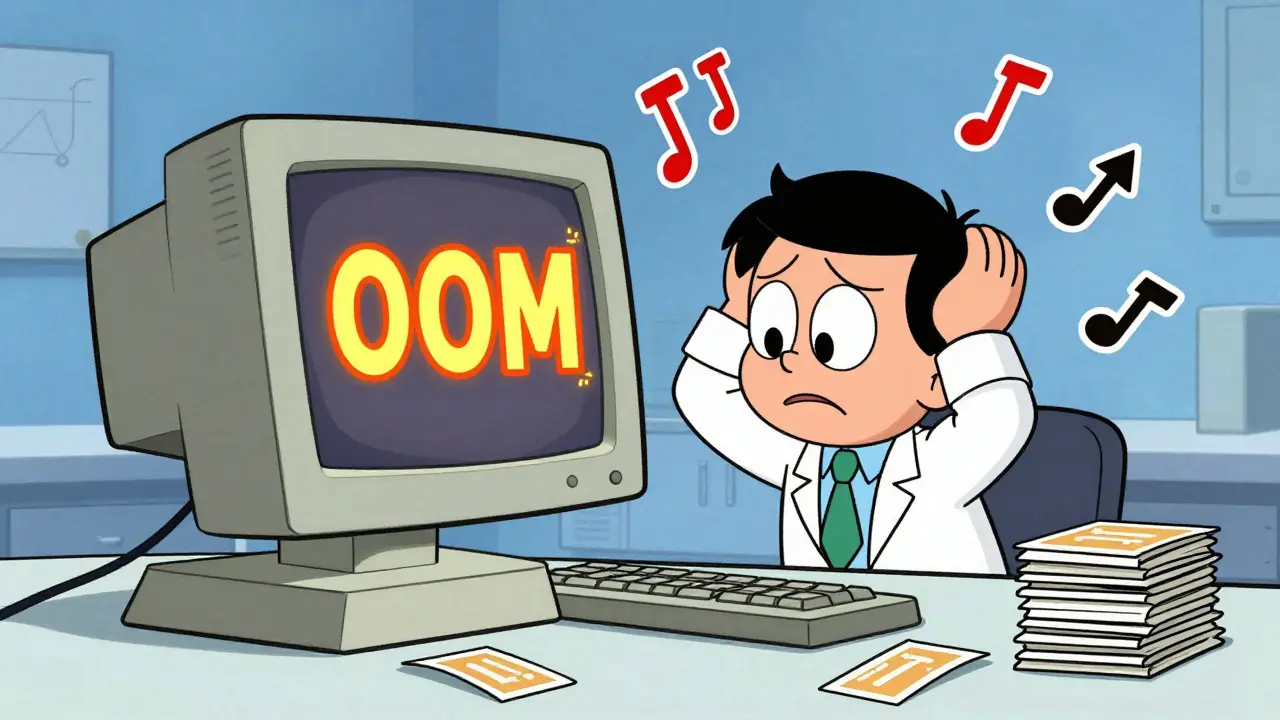
Picking an optimizer for a Large Language Model (LLM) usually feels like a gamble between memory crashes and poor convergence. If you've ever hit an Out-Of-Memory (OOM) error halfway through a training run, you know that the way a model updates its weights is just as important as the architecture itself. While AdamW is the industry standard, newer alternatives like Lion and Adafactor are challenging that dominance by trading a bit of precision for massive memory savings.
The Heavy Hitter: Understanding AdamW
AdamW is a modification of the Adam optimizer that decouples weight decay from the gradient update. In the original Adam, weight decay was lumped in with the gradient, which messed up the regularization for deep networks. By separating them, AdamW ensures the model generalizes better to new data rather than just memorizing the training set.
The cost of this reliability is memory. AdamW tracks two moving averages for every single parameter: the first moment (mean) and the second moment (uncentered variance). This creates a 3x memory overhead compared to the model's weights alone. If you're training a 7B parameter model, that's a lot of extra VRAM just for the optimizer's bookkeeping. Despite this, it remains the safe bet, appearing in nearly 80% of academic research papers because it simply works without needing a PhD in hyperparameter tuning.
The Memory Miser: How Adafactor Works
When Google started training massive transformers, the 3x overhead of AdamW became a dealbreaker. This led to the creation of Adafactor, an optimizer designed to reduce memory by approximating the second-moment matrix. Instead of storing a full value for every parameter, Adafactor uses a technique called factored second-moment estimation. Essentially, it treats the matrix as an outer product of two smaller vectors.
This trick cuts the memory overhead down to roughly 1.5x the model size. However, there's a catch. Some practitioners have reported that Adafactor's learning rate schedule is incredibly sensitive. You might find yourself failing three training runs in a row before you hit the right settings. It's also slightly slower to converge; for smaller models like GPT2-small, research shows it can be 8-12% slower than AdamW.
The New Contender: Enter the Lion Optimizer
Introduced in 2023 through a process called symbolic discovery, Lion (Evolving Linearly Optimized Optimizer) takes a different approach. While AdamW and Adafactor care about the magnitude of the gradient, Lion only cares about the sign. It uses a sign-based update rule that only requires the first moment estimate.
This architectural shift reduces memory overhead to 2x the model size. But the real win is speed. Some benchmarks show Lion achieving target perplexity scores 18-22% faster than AdamW. In production, this is huge. For example, switching to Lion on 7B parameter models has allowed engineers to increase batch sizes by over 2x without buying more hardware. In one documented case, this shift saved nearly $18,500 in AWS compute costs for a 3B parameter model.
| Attribute | AdamW | Adafactor | Lion |
|---|---|---|---|
| Memory Overhead | 3x Parameters | ~1.5x Parameters | 2x Parameters |
| Update Rule | 1st & 2nd Moment | Factored 2nd Moment | Sign-based (1st Moment) |
| Convergence Speed | Standard (Baseline) | Slower (8-12% lag) | Faster (18-22% gain) |
| Stability | Very High | Low (LR Sensitive) | Moderate (Needs Tuning) |
| Best For | Research & Accuracy | Extreme Memory Constraints | Production Efficiency |

Which One Should You Actually Use?
Choosing the right LLM optimizer depends on whether you are optimizing for a research paper, a tight budget, or a production deployment. If you have plenty of H100s and your goal is the absolute highest downstream accuracy on benchmarks like MMLU or SuperGLUE, stick with AdamW. It consistently edges out Lion and others in final accuracy by 2-4%.
If you're battling OOM errors or trying to squeeze a larger model into a smaller GPU cluster, Lion is the strongest choice. It offers a sweet spot between the extreme memory savings of Adafactor and the stability of AdamW. Just be prepared for a bit more time spent on hyperparameter sweeps; it's not quite as "plug-and-play" as AdamW.
For those pushing the absolute limits of memory, Adafactor remains a viable tool, especially for massive models where even a 2x overhead is too much. However, keep a close eye on your learning rate-it's the most common point of failure when using this optimizer.
Beyond the Big Three: Specialized Variants
The landscape is fragmenting. We're seeing the rise of AdamS, which has demonstrated a 35.8% improvement in throughput over AdamW by reducing batch processing time. Then there's Sophia, a second-order optimizer that can achieve lower validation loss than AdamW, though it requires more compute per step.
Another emerging player is Adan, which some in the MoE (Mixture of Experts) community claim outperforms AdamW across all data volumes. While these specialized tools are exciting, they often lack the massive community support of AdamW. If you run into a bug with AdamW, there are over a thousand Stack Overflow threads to help you; with Lion or Adan, you're mostly relying on a few research papers and GitHub issues.
Practical Implementation Tips
- LayerNorm Sensitivity: Regardless of the optimizer, ensure you apply adaptivity to both the last layer and LayerNorm parameters. This is critical for maintaining stability relative to your learning rate.
- The Batch Size Leverage: If you switch to Lion, don't just enjoy the memory savings-increase your batch size. The memory freed up by the optimizer should be used to stabilize gradients and speed up training.
- Warmup is Non-Negotiable: Especially with Adafactor and Lion, a gradual learning rate warmup is essential to prevent the model from diverging in the first few hundred steps.
Is Lion always faster than AdamW?
In terms of GPU hours and reaching target perplexity, yes, Lion is often 18-22% faster. However, in terms of "wall-clock time" to a final, polished model, it can be slower if you spend a week tuning hyperparameters that AdamW would have handled automatically.
Does Adafactor perform worse than AdamW?
For smaller models (like GPT2-small), Adafactor has been shown to be strictly inferior, with higher loss metrics. For giant models, the gap closes because the memory efficiency allows for larger batches or more parameters, which can offset the slightly worse convergence properties.
Why does AdamW use so much memory?
AdamW stores two additional values for every model parameter: the mean of the gradients (1st moment) and the variance of the gradients (2nd moment). This effectively triples the memory needed for the weights themselves.
What is the "sign-based" update in Lion?
Unlike AdamW, which scales updates based on the precise magnitude of the gradient, Lion only looks at whether the gradient is positive or negative. This simplification removes the need to track second-moment statistics, which is where the memory savings come from.
Should I use Sophia for my LLM?
Only if you are prioritizing the absolute lowest validation loss and have the extra compute to spare. Sophia is a second-order optimizer that can be more efficient in some GPT architectures, but it's more computationally demanding per step than AdamW or Lion.
Next Steps for Your Pipeline
If you are currently using AdamW and hitting memory limits, try this sequence: First, implement gradient checkpointing to save VRAM. If that's not enough, switch to Lion and perform a small hyperparameter sweep on your learning rate. If you are still OOM, move to Adafactor, but be extremely cautious with your learning rate schedule. For those looking to optimize throughput further, keep an eye on the implementation of AdamS as it begins to integrate into more major frameworks.


This breakdown is absolutely stellar! I've been wrestling with these memory bottlenecks for weeks and the clarity here is just refreshing. Definitely going to try swapping to Lion and cranking up that batch size to see if I can squeeze out some more efficiency. Total game changer!
Oh wow, a basic guide to optimizers. How revolutionary.
Though it's genuinely fascinatin' that people still treat AdamW like some magical black box when it's just basic calculus with more memory bloat. Maybe if people actually understood the underlying math instead of just copying a GitHub repo, they wouldn't be so terrified of a few OOM errors. Truly an epiphany for the masses, isn't it?
I really appreciate how you laid everything out so clearly because for someone like me who often feels overwhelmed by the sheer volume of new papers coming out every week, having a centralized comparison helps me feel a bit more grounded and less anxious about making the wrong choice for my small-scale project, though I do worry if my specific dataset might be too niche for Lion to actually provide those speed gains without causing some weird instability in the early epochs that I might not notice until it's too late.
It's honestly sad that we've reached a point where we're choosing optimizers based on AWS bills rather than actual scientific rigor. We're just chasing efficiency while the soul of the architecture is being stripped away for the sake of a slightly faster convergence time. It's just a race to the bottom of a very deep, very expensive hole.
Trivial. Any serious practitioner knows that the choice of optimizer is secondary to data quality, yet here we are discussing the merits of Lion as if it's a profound breakthrough. It's embarrassing that this is considered 'valuable' information for anyone who isn't a complete novice.
The sheer audacity of claiming that a sign-based update is a 'win' without discussing the catastrophic potential for loss spikes in highly non-convex landscapes is simply breathtaking. It's a glittering lure for the inexperienced who crave speed over substance, ignoring the subtle, jagged nuances of convergence that only a seasoned eye can appreciate while they blindly accelerate into a wall of divergence!
It would be so much more helpful if we focused on how these compute costs impact the environment. I'm sure it's fine to save $18k, but the carbon footprint of these massive clusters is something we should probably be discussing with a bit more urgency than just comparing VRAM overhead.
Typical corporate narrative. They want us using 'efficient' optimizers so they can hide how much compute they're actually stealing from the grid. These 'symbolic discovery' methods are probably just a way to automate the removal of human oversight in training. Trust me, there's a reason they want you to move away from the standard, traceable paths.