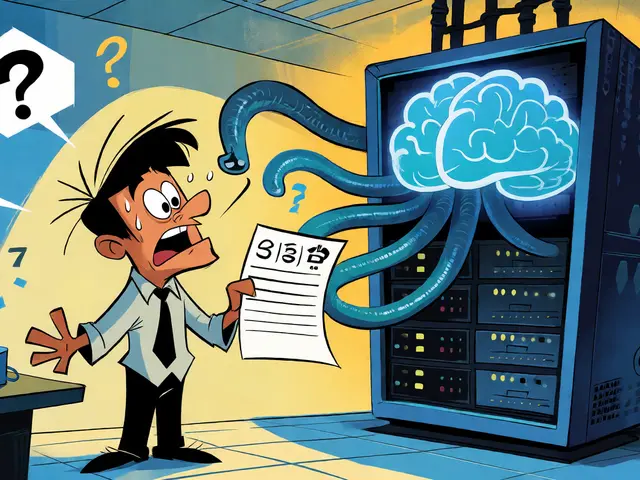
Imagine trying to read a 500-page book by only remembering the last sentence you read. That is essentially how Recurrent Neural Networks (RNNs) work. They process text one word at a time, updating a small hidden state with each step. By the time they reach page 100, the details from page 1 are often lost or severely distorted. This fundamental limitation is why Transformers replaced RNNs as the backbone of modern Large Language Models (LLMs). It wasn't just a trend; it was a necessity driven by hardware and math.
If you have ever wondered why models like GPT-4 or Llama 3 can handle entire documents while older architectures struggled with paragraphs, the answer lies in how these systems scale. Scaling isn't just about adding more parameters; it's about using compute resources efficiently. Transformers win this battle because they remove sequential bottlenecks, allowing them to train on trillions of tokens in weeks rather than years. Let’s break down exactly why this architectural shift happened and why it matters for anyone building or deploying AI today.
The Sequential Bottleneck: Why RNNs Hit a Wall
RNNs, including popular variants like LSTMs (Long Short-Term Memory networks) and GRUs, were the standard for sequence modeling for nearly two decades. Their design is intuitive: they maintain a hidden state that carries information forward. If token $t$ depends on token $t-1$, the network updates its state based on both. Simple, right?
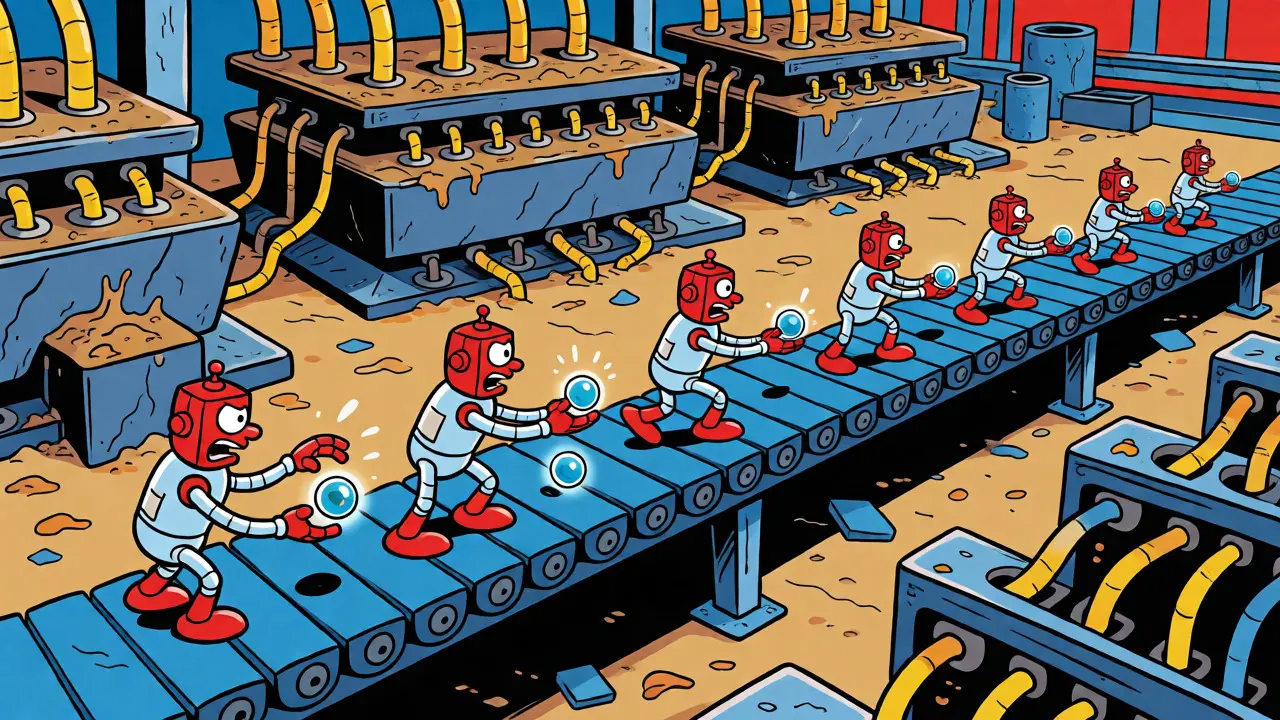
But here is the problem: this process is strictly sequential. To predict the next word, the model must finish processing the previous word. You cannot calculate step 10 until step 9 is done. This creates a massive dependency chain. In an RNN, the path length between any two tokens equals the distance between them. If you need to connect a subject at the start of a sentence to a verb at the end, the information must pass through every intermediate layer and time step.
This leads to two critical failures when you try to scale:
- Vanishing Gradients: As information travels backward during training, gradients shrink exponentially over long sequences. The model forgets early context because the signal gets too weak to update weights effectively.
- Hardware Underutilization: Modern GPUs and TPUs thrive on parallelism. They want to do thousands of calculations at once. RNNs force these powerful chips to wait for one calculation to finish before starting the next. You might have 10,000 cores available, but an RNN uses them inefficiently because it processes tokens one by one.
For small datasets and short sentences, this was manageable. But when researchers tried to feed billions of words into these models, training times exploded linearly with sequence length. There was no way to speed it up without fundamentally changing the architecture.
The Transformer Advantage: Parallelism and Attention
Enter the Transformer. Introduced in the 2017 paper "Attention Is All You Need," this architecture ditched recurrence entirely. Instead of passing information sequentially, transformers use self-attention mechanisms to look at all tokens in a sequence simultaneously.
Think of attention like a spotlight. When the model processes the word "bank" in a sentence, it doesn't just look at the previous word. It looks at every other word in the sentence-"river," "money," "loan," "account"-and decides which ones are relevant. It calculates a weighted sum of these relationships. Crucially, it does this for all words at the same time.
| Feature | RNN / LSTM | Transformer |
|---|---|---|
| Processing Mode | Sequential (token by token) | Parallel (all tokens at once) |
| Dependency Path Length | O(N) - proportional to sequence length | O(1) - constant per layer |
| Training Speed | Slow on large data due to serial dependencies | Fast; exploits GPU/TPU parallelism |
| Memory Complexity | Linear O(N) | Quadratic O(N²) for attention matrix |
| Long-Range Dependencies | Weak; suffers from vanishing gradients | Strong; direct connections between any tokens |
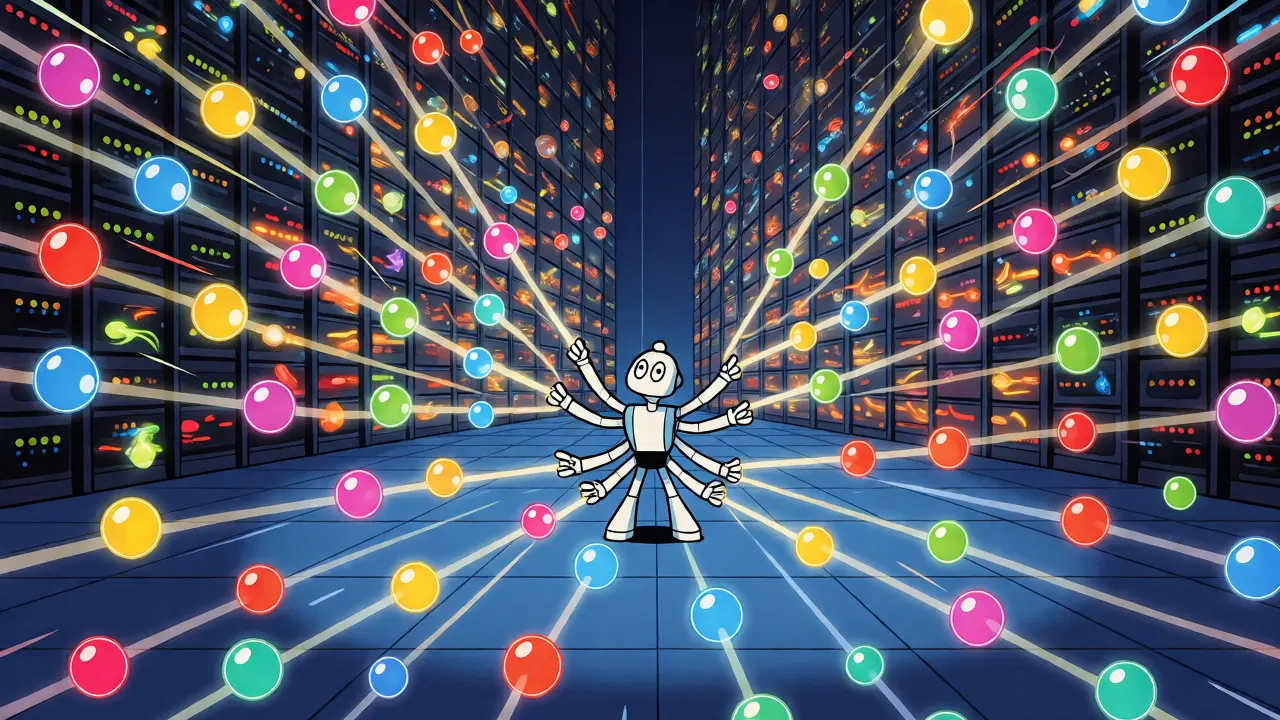
This parallelism is the key to scaling. Because there are no time-dependent operations within a single layer, you can feed a batch of 512 sequences, each 1,024 tokens long, directly into the GPU. The chip computes the attention scores for all 524,288 tokens in parallel. This allows transformers to chew through terabytes of text much faster than RNNs could ever dream of.
Scaling Laws: Predictable Performance Gains
One of the most compelling reasons engineers choose transformers is their adherence to Neural Scaling Laws. These laws describe how model performance improves as you increase three variables: parameter count ($N$), dataset size ($D$), and compute budget ($C$).
Research consistently shows that transformer loss decreases according to a smooth power law. If you double your parameters and double your data, you get a predictable drop in error rate. This predictability is invaluable for business decisions. If you know that spending $1 million on compute will yield a specific quality improvement, you can plan accordingly.
RNNs do not scale this cleanly. As you add more parameters to an LSTM, you hit diminishing returns quickly. The fixed-size hidden state becomes a bottleneck. No matter how many layers you stack, the model struggles to store vast amounts of latent knowledge. Transformers, with their multi-head attention and feed-forward networks, distribute knowledge across millions of parameters in a way that scales gracefully. A model with 70 billion parameters behaves very similarly to one with 7 billion, just better. This consistency allowed companies to confidently invest in trillion-parameter models.
Handling Long-Range Dependencies
Language is full of long-range dependencies. Consider this sentence: "The trophy didn't fit into the brown suitcase because it was too large." Who or what is "it"? The trophy or the suitcase? An RNN has to propagate the concept of "trophy" through dozens of intermediate states to resolve this ambiguity. Over long contexts, this signal degrades.
A transformer connects "it" directly to "trophy" and "suitcase" in a single layer. The distance doesn't matter. Whether the reference is 5 words away or 500 words away, the computational cost to establish the link is identical. This makes transformers exceptionally good at tasks requiring global context, such as summarizing books, understanding codebases, or translating complex documents.
While memory usage grows quadratically with sequence length ($O(N^2)$), modern optimizations like sparse attention and efficient kernels mitigate this. For most practical applications, the benefit of perfect long-range recall outweighs the memory cost, especially given the rapid decrease in hardware costs.
Practical Implications for Developers
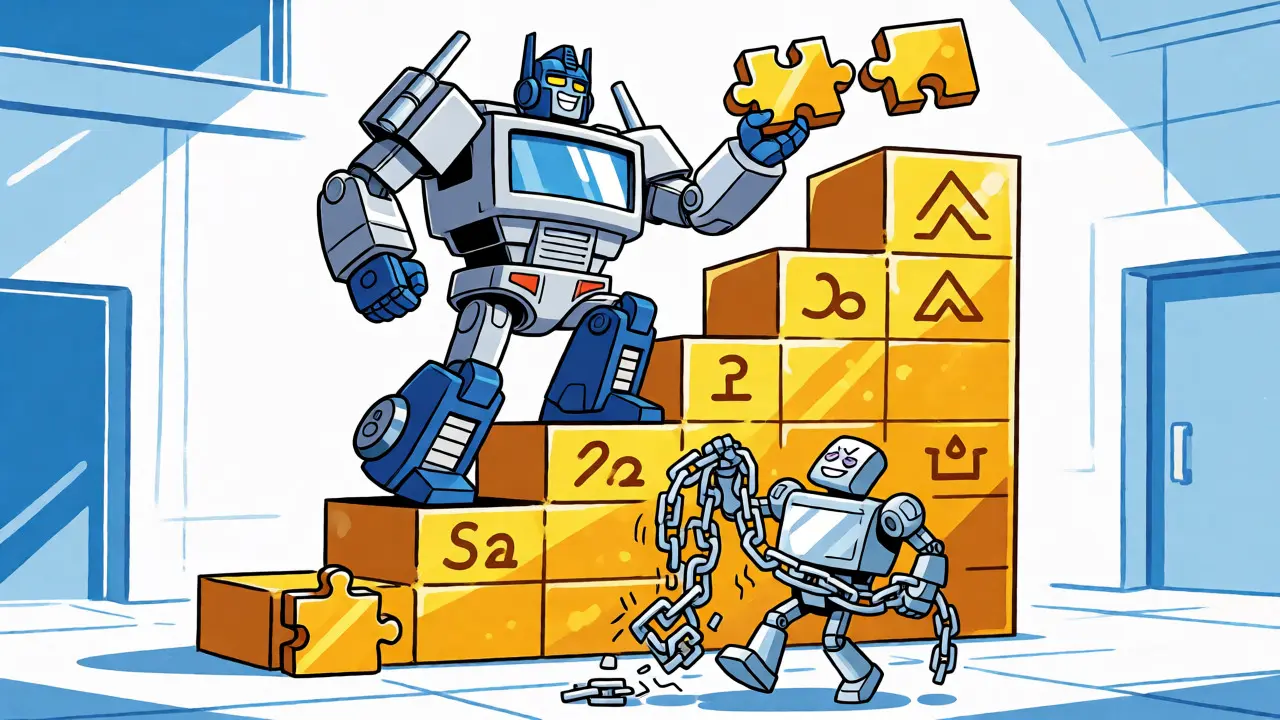
If you are building an LLM application today, choosing a transformer-based model is rarely a question of "if" but "which." However, understanding the trade-offs helps you optimize.
- Data Hunger: Transformers shine when you have massive datasets. If you are working with a tiny dataset of 1,000 examples, a simpler model might suffice. But if you have millions of examples, transformers will outperform RNNs significantly.
- Context Window Management: Since attention is quadratic, extending context windows increases memory usage sharply. Techniques like RoPE (Rotary Positional Embeddings) and sliding window attention help manage this, but you still need to be mindful of inference costs for very long inputs.
- Ecosystem Support: Virtually all major frameworks (PyTorch, TensorFlow, JAX) and libraries (Hugging Face Transformers) are optimized for transformer architectures. You get access to pre-trained checkpoints, quantization tools, and serving infrastructure that simply don't exist for high-performance RNNs.
Are RNNs dead? Not entirely. State-space models (SSMs) like Mamba are emerging as hybrids that offer linear scaling complexity with some recurrent benefits. But for general-purpose language understanding where accuracy and scalability are paramount, transformers remain the undisputed kings.
Frequently Asked Questions
Why did transformers replace RNNs so quickly?
Transformers replaced RNNs primarily because they allow for parallel processing during training. RNNs must process sequences step-by-step, which limits how fast you can train on large datasets. Transformers process all tokens simultaneously, making much better use of modern GPU hardware. This efficiency enabled the creation of models with billions of parameters trained on trillions of tokens, something RNNs couldn't achieve practically.
Do transformers have disadvantages compared to RNNs?
Yes. The main disadvantage is computational complexity. Self-attention requires calculating relationships between every pair of tokens, leading to quadratic memory and compute growth ($O(N^2)$) with sequence length. RNNs have linear complexity ($O(N)$). This means transformers become expensive for extremely long sequences unless specialized techniques like sparse attention or retrieval-augmented generation are used.
What are neural scaling laws?
Neural scaling laws are empirical observations that show a predictable relationship between model performance and resources. Specifically, they demonstrate that as you increase model size, data volume, and compute power, the loss (error) decreases following a power-law curve. Transformers follow these laws very consistently, allowing developers to predict how much performance gain they will get from additional investment.
Can RNNs still be useful for language tasks?
Yes, in specific niches. RNNs and newer state-space models can be more efficient for tasks with strict latency requirements, limited memory (like edge devices), or shorter sequences where the overhead of attention matrices isn't justified. However, for state-of-the-art performance on large-scale language modeling, transformers are currently superior.
How does self-attention help with long-term dependencies?
Self-attention allows any token in a sequence to directly interact with any other token, regardless of their position. In an RNN, information from the beginning of a long sentence must pass through many intermediate steps to reach the end, often getting diluted. In a transformer, the connection is direct, preserving the integrity of the information over long distances.