
Large language models are powerful, but they have a nasty habit of making things up. You ask them a question about your company's internal policy, and they give you a confident answer that sounds right but is completely wrong. This is the "hallucination" problem that has plagued Generative AI, which relies on static training data that quickly becomes outdated. The solution isn't just bigger models; it's smarter architecture. Enter Retrieval-Augmented Generation, commonly known as RAG. It’s the technology bridging the gap between raw AI capability and reliable, factual answers.
RAG changes the game by connecting your AI model to external, authoritative knowledge bases. Instead of relying solely on what it memorized during training, the system looks up real-time information before answering. As of May 2026, this approach has evolved from a simple novelty into the backbone of enterprise AI, driving better search results and significantly more accurate responses across industries.
How Retrieval-Augmented Generation Works
To understand why RAG is such a big deal, you need to see how it operates under the hood. Unlike standard chatbots that predict the next word based on probability, RAG follows a strict four-stage process designed to ground every answer in fact. According to Google Cloud's 2025 implementation guide, these stages are Ingestion, Retrieval, Augmentation, and Generation.
First comes Ingestion. Your documents-manuals, PDFs, legal contracts-are broken down into chunks and converted into numerical representations called vector embeddings using models like OpenAI's text-embedding-3-large. These vectors are stored in specialized databases like Pinecone, which reported over 4 million active deployments by late 2025.
Next is Retrieval. When you ask a question, the system searches these vectors for relevant matches. Modern systems use hybrid search, combining dense vector similarity with sparse keyword matching. NVIDIA’s February 2025 whitepaper notes this achieves 87.4% precision, far beating traditional keyword search at 63.2%. Then, in Augmentation, those retrieved facts are stuffed into the prompt alongside your question. Finally, in Generation, the LLM writes the answer using only that provided context. Stanford’s 2025 evaluation framework shows this boosts factual accuracy on domain-specific queries to 78.6%, compared to just 53.1% for standard LLMs.
The Evolution: From Naive to Agentic RAG
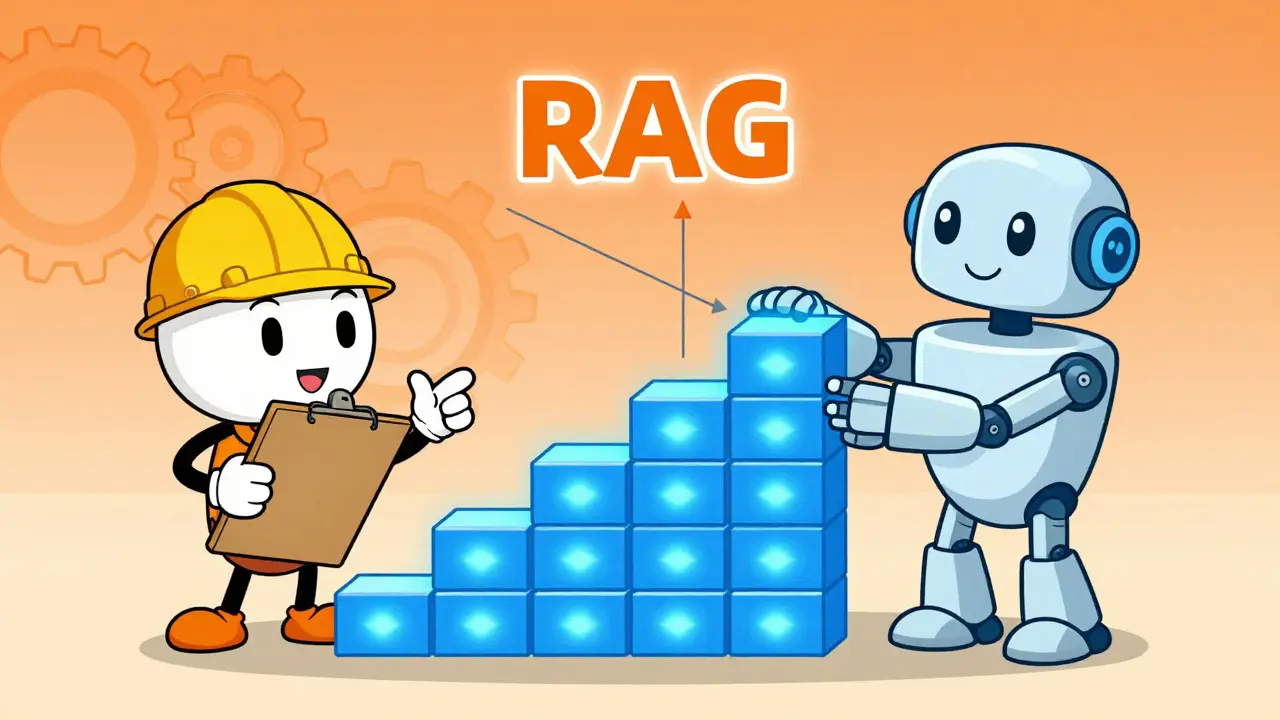
RAG hasn't stayed static since its debut in 2020. If you're building or buying an AI solution today, understanding the three generations of RAG is critical because performance varies wildly between them.
- Naive RAG (2020-2022): The basic version. It takes a query, finds the top few similar documents, and feeds them to the model. It’s fast but often misses nuance, leading to irrelevant context.
- Advanced RAG (2022-2024): This introduced techniques like re-ranking and query decomposition. It breaks complex questions into smaller parts and filters results more aggressively, improving relevance significantly.
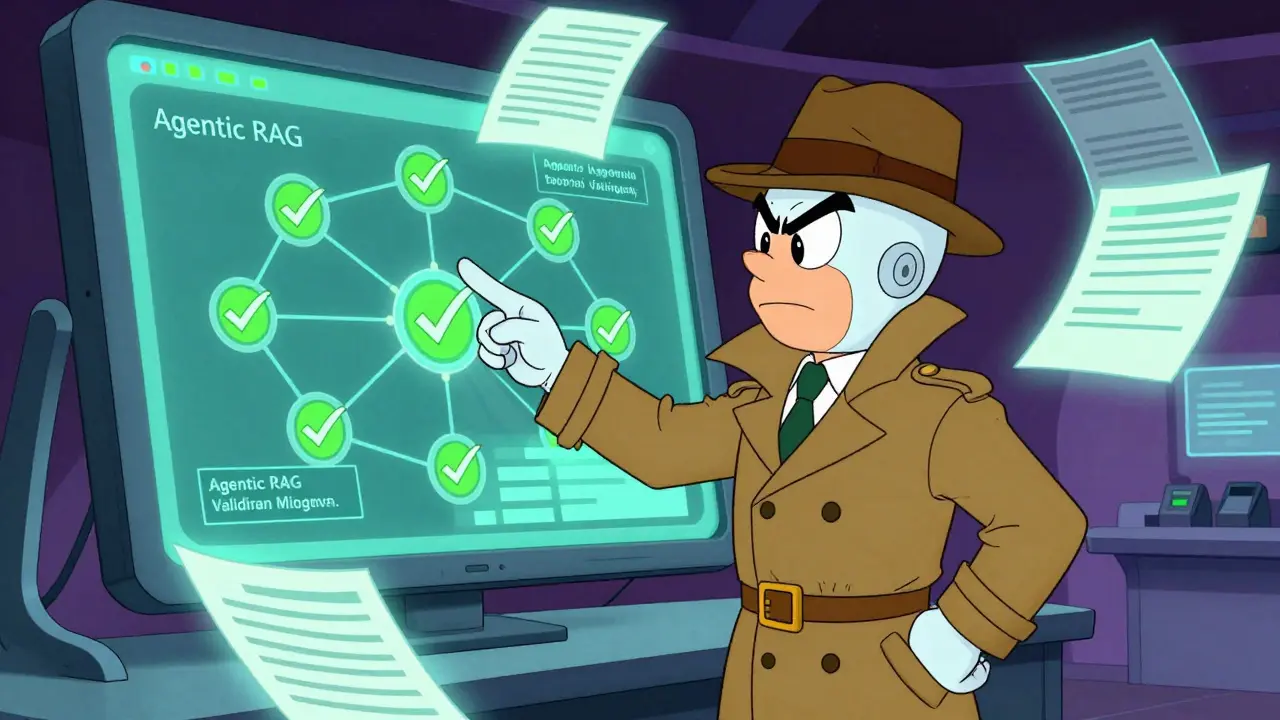
- Agentic RAG (2024-Present): The current gold standard. Here, the LLM acts as an agent. It decides *which* tools to use, *when* to retrieve information, and even validates sources before answering. LangChain’s Agent RAG 2.0, released in November 2025, demonstrated a 41% accuracy jump on complex queries by allowing multiple retrieval attempts.
This shift toward agentic behavior means the AI doesn't just fetch data; it reasons about the quality of that data. However, complexity increases. Dr. Anna Rogers from MIT warns that only 22% of enterprise implementations have truly mastered semantic understanding beyond naive keyword matching.
RAG vs. Fine-Tuning: Which Should You Choose?
A common mistake teams make is assuming fine-tuning is always better. It isn’t. While fine-tuning teaches a model new behaviors or styles, RAG provides new facts. Microsoft Research’s 2025 comparative analysis highlights a stark cost difference: fine-tuning a 7B parameter model costs roughly $18,500 per iteration, while updating a RAG system’s vector database costs virtually nothing.
| Feature | RAG | Fine-Tuning |
|---|---|---|
| Update Cost | Negligible (database update) | High (~$18,500 per iteration) |
| Knowledge Freshness | Real-time | Static (until retrained) |
| Hallucination Reduction | Up to 83% reduction | Moderate reduction |
| Complex Reasoning | Weaker (32.7% benchmark score) | Stronger (41.3% benchmark score) |
| Best Use Case | Fact-heavy domains (legal, medical) | Style transfer, specific workflows |
If your goal is to keep employees updated on daily changing policies or ensure medical advice is current, RAG is the clear winner. IBM’s 2025 healthcare case study showed RAG-powered systems maintained 92.3% accuracy with daily updates, whereas fine-tuned models dropped to 76.8% when forced to wait for weekly retraining cycles. However, if you need the AI to perform complex logical reasoning tasks, fine-tuned models still hold an edge, scoring higher on Chain-of-Thought benchmarks.
Real-World Implementation Challenges
It’s not all smooth sailing. Deploying RAG requires careful engineering. The learning curve spans 8 to 12 weeks for experienced teams, extending to 20 weeks for beginners. The biggest hurdle? Retrieval relevance tuning, which eats up 37% of total implementation time.
Users frequently complain about "context window overflow." If you retrieve too much text, you exceed the LLM’s memory limit, causing errors. Techniques like context compression help reduce input length by 47% while keeping 92% of the useful information. Another major pain point is handling contradictory information. A Stanford study found that 63.7% of RAG systems fail when retrieved documents conflict, leading to a 28.4% error rate in final outputs. This is where Agentic RAG shines, as it can validate sources against each other.
Developer adoption patterns also reveal a truth: DIY rarely works well. Stack Overflow’s survey of 1,204 developers showed that 78% of successful implementations involved dedicated vector search specialists, compared to just 32% success for generalist teams trying to cobble it together.
Future Trends: Recursive and Multimodal RAG
Looking ahead to the rest of 2026 and beyond, RAG is getting even smarter. Meta AI announced "Recursive RAG" in December 2025, allowing the model to iteratively refine its search queries based on initial results. This multi-step process improved complex question-answering accuracy by 37%. Imagine asking, "What were our Q3 sales trends compared to last year's marketing spend?" The AI first checks sales data, realizes it needs marketing data, refines its query, and then synthesizes the answer.
Google’s January 2026 release of "Gemini RAG" adds multimodal retrieval. Now, systems can pull images, audio, and video alongside text. Early benchmarks show a 28% improvement on queries requiring visual context, opening doors for technical support scenarios where a photo of a broken part is crucial.
The market is exploding too. Gartner reports the RAG market hit $4.7 billion in 2025, driven by regulatory pressure like the EU AI Act, which mandates accuracy for customer-facing AI. With 82% of Fortune 500 companies already implementing some form of RAG, the technology has moved from experimental to essential infrastructure.
What is the main benefit of using RAG over standard LLMs?
The primary benefit is factual accuracy and reduced hallucinations. Standard LLMs rely on static training data, which can be outdated or incorrect. RAG connects the model to live, authoritative knowledge bases, ensuring answers are grounded in current, verified information. Studies show this can boost factual accuracy on domain-specific queries from 53.1% to 78.6%.
Is RAG expensive to implement and maintain?
Implementation requires upfront investment in engineering talent and infrastructure, typically taking 8-12 weeks for experienced teams. However, maintenance is significantly cheaper than alternatives like fine-tuning. Updating a RAG system involves simply adding new documents to a vector database, costing negligible computational resources compared to the thousands of dollars required to retrain models.
What is Agentic RAG and why does it matter?
Agentic RAG is the latest generation of the technology where the LLM acts as an autonomous agent. Instead of passively accepting retrieved data, it decides which tools to use, validates sources, and performs multiple retrieval steps if needed. This leads to higher accuracy on complex queries and better handling of contradictory information, addressing key weaknesses in earlier RAG versions.
Which vector databases are best for RAG in 2026?
Top choices include Pinecone, Weaviate, and Qdrant. Pinecone leads in enterprise adoption with over 4 million deployments, praised for real-time indexing. Weaviate is popular for its open-source flexibility. The choice often depends on specific needs like scalability, support for hybrid search, and budget, with cloud providers like AWS and Azure also offering managed services.
Can RAG handle non-text data like images or videos?
Yes, recent advancements like Google's Gemini RAG enable multimodal retrieval. Systems can now retrieve and incorporate images, audio, and video alongside text. This is particularly useful for applications requiring visual context, such as technical support or medical diagnostics, showing a 28% improvement in accuracy for such queries.



Another day, another buzzword wrapped in a press release.
Look, I get it. RAG is just a fancy way of saying "look up the answer before making shit up." We've been doing this with search engines for twenty years. The problem isn't that AI doesn't know the facts; it's that companies are too lazy to build proper knowledge bases and want to blame the model instead. You're paying $18k for fine-tuning? Maybe spend that on actual data hygiene.
The distinction between Naive and Agentic RAG is where the real philosophical shift happens. It’s not just about retrieval anymore; it’s about agency. When we allow the model to decide *when* to retrieve, we’re essentially giving it a form of skepticism. This mirrors human cognition-we don’t just recall memories passively; we actively verify them against our current context.
However, the MIT warning about semantic understanding is crucial. If the agent lacks the foundational ability to understand nuance, its "reasoning" becomes a hall of mirrors. We must ask: does the system truly understand the contradiction, or is it just pattern-matching conflict signals?
Typical American tech hubris!!! They think they can solve everything with more code and less common sense!! In Britain, we still prefer reading the manual ourselves because at least then we KNOW we aren't being lied to by some silicon witch!! The EU AI Act is the only thing keeping these reckless engineers in check!! And don't get me started on Pinecone... sounds like a conspiracy to harvest our vector data for some global surveillance state!!!
Let's be clear here. This entire industry is built on sand. The "accuracy" metrics cited are cherry-picked from controlled environments that do not exist in the wild. You claim an 83% reduction in hallucinations? That is statistically meaningless without a defined baseline of what constitutes a hallucination in dynamic contexts. Furthermore, the reliance on external databases introduces a single point of failure that malicious actors will exploit within weeks. Stop selling snake oil and start securing your infrastructure.
I feel so drained just reading about how "smart" these systems are supposed to be. It’s exhausting. Every time I try to use one, it gives me half-truths that sound confident but leave me feeling violated and confused. Why can’t they just admit when they don’t know? Instead, they wrap their ignorance in corporate jargon and vector embeddings. It feels like emotional manipulation. I’m tired of being gaslit by algorithms.
Hi everyone! 👋 I really appreciate this detailed breakdown. It’s great to see such comprehensive information shared openly. 🌟 I’ve been struggling with context window overflow myself, and the tip about context compression reducing input length by 47% is super helpful! Thanks for sharing this resource. It makes me feel less alone in the learning curve. 😊 Let’s keep supporting each other as we navigate these changes!
This is a fantastic overview! I have been working on implementing Advanced RAG for our internal documentation, and the re-ranking techniques mentioned here are exactly what we needed. The cost comparison between fine-tuning and RAG updates is particularly striking. It really highlights the importance of choosing the right tool for the job. Keep up the great work! 👏
Nice post! In India, we are seeing a lot of interest in hybrid search models. The precision jump from 63.2% to 87.4% is significant for us handling multilingual documents. It helps bridge the gap between local dialects and standard English queries. Great insights!
i totally agree with the part about agentic rag being the future it seems like having the ai check its own work is a big deal i was worried about the cost but if updating the database is cheap that is good news for small teams like mine thanks for explaining it so simply
The section on contradictory information is spot on. We ran into this issue last month where two internal policy documents conflicted, and the naive RAG just picked the first one. Switching to an agentic approach allowed us to flag the conflict for human review. It adds latency, but it prevents costly errors. Good read.