Ever asked a large language model to write a report, analyze data, and draft an email all at once, only to get a messy, half-baked response? You are not alone. Single-prompt approaches often fail when tasks get complicated because the AI tries to do everything at once, leading to logical gaps or outright hallucinations. That is where prompt chaining comes in. It is a technique that breaks complex requests into a sequence of smaller, connected steps. The output of one step becomes the input for the next, guiding the AI through a clear path to a reliable result.
Think of it like giving directions to a friend. Instead of saying, "Go to the store, buy milk, check the price, and tell me if it's cheaper than last week," you break it down: first, go to the store. Then, find the milk. Next, note the price. Finally, compare it. This structured approach drastically reduces errors. According to a 2024 IBM study, using this method reduced factual errors by 67.3% compared to single-prompt attempts on complex analytical tasks.
How Prompt Chaining Works
At its core, prompt chaining relies on sequential logic. You design a series of prompts where each one builds on the previous outcome. This isn't just about asking multiple questions; it's about creating a workflow. The architecture uses natural language processing to maintain context between these steps. However, keeping that context alive requires care. AWS demonstrated in late 2024 that maintaining a context window of at least 4,096 tokens is crucial for coherence in multi-step reasoning.
There are several structural patterns you can use:
- Instructional Chaining: Providing explicit, step-by-step directions for the AI to follow.
- Iterative Refinement: Using successive cycles to improve the output, such as drafting, then critiquing, then revising.
- Contextual Layering: Adding background information incrementally so the AI doesn't get overwhelmed.
- Conditional Branching: Using if-then logic to determine which prompt comes next based on the previous answer.
For example, if you are building a customer support bot, the first prompt might identify the user's issue. If the issue is technical, the chain branches to a troubleshooting guide. If it's billing, it branches to account verification. This keeps the AI focused and relevant.
Why Use Prompt Chaining Over Single Prompts?
The main benefit is reliability. Large Language Models (LLMs) are probabilistic engines. They predict the next word based on patterns. When you ask for too much, the probability distribution spreads thin, increasing the chance of nonsense. By narrowing the scope of each step, you keep the AI within its comfort zone.
| Strategy | Accuracy on Complex Tasks | Error Rate Reduction | Processing Time Impact |
|---|---|---|---|
| Single Prompt | 52.3% | Baseline | Fastest |
| Prompt Chaining | 84.6% | 67.3% | +38% slower |
| Chain-of-Thought | High | Moderate | +15% slower |
As shown above, while prompt chaining takes longer-about 38% more time due to sequential operations-it delivers significantly higher accuracy. Forrester reported in Q3 2024 that prompt chaining achieved 4.3 times higher accuracy on complex reasoning tasks involving multiple data sources. However, this comes with a trade-off: it requires 2.1 times more development time to engineer the prompts correctly.
Common Pitfalls and How to Avoid Them
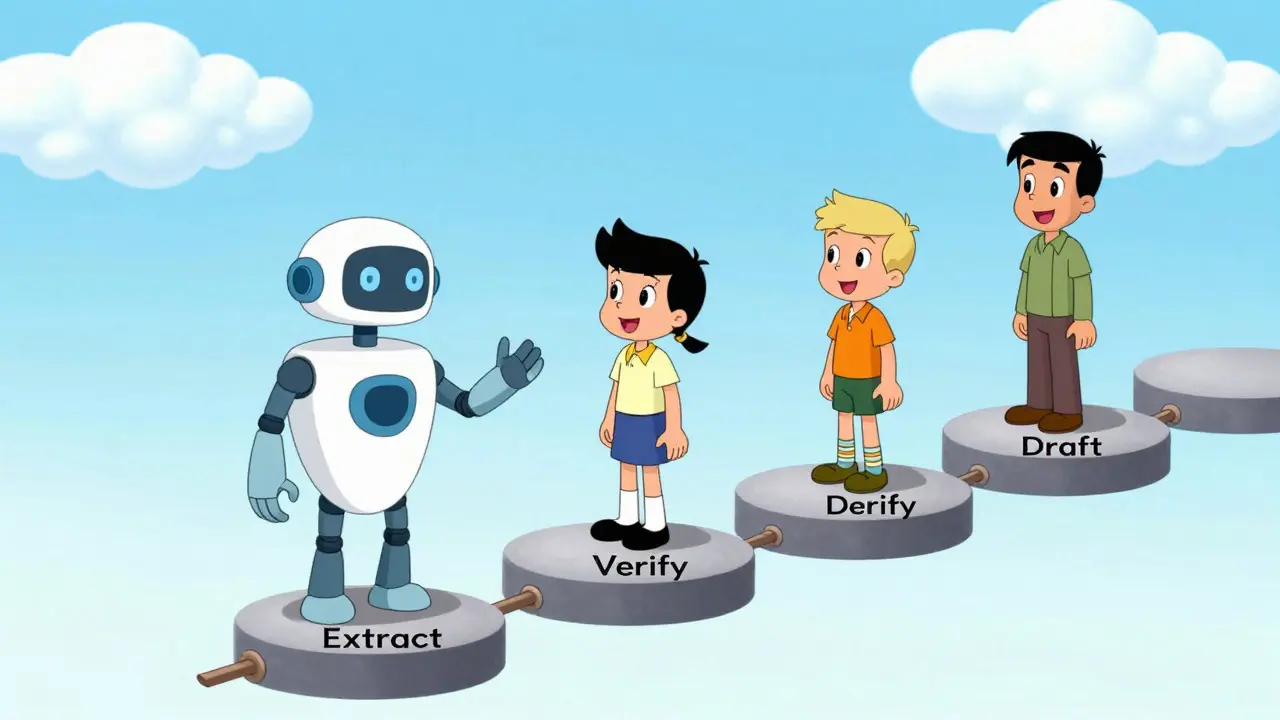
Prompt chaining is powerful, but it is fragile. If one link in the chain breaks, the whole process fails. This is known as error propagation. A study from MIT's AI Lab found that error rates increase by 23.5% when chain logic is flawed. Imagine calculating a tax deduction incorrectly in step one; every subsequent financial projection will be wrong.
To mitigate this, you need validation steps. Don't just pass data blindly from one prompt to the next. Insert checks. For instance, after the AI extracts data, have a second prompt verify the format or range of values before proceeding. Google's research noted that context drift becomes a serious issue when chains exceed 7-8 steps. Keep your chains short and sweet. If you find yourself needing ten steps, consider breaking the task into two separate workflows.
Another common mistake is ignoring the learning curve. Promptitude.io surveyed over 1,200 practitioners and found that users need about 28.7 hours of training to become proficient in designing effective chains, compared to just 14.2 hours for basic prompting. Start simple. Begin with 3-5 step chains for straightforward workflows before attempting complex conditional branching.

Real-World Applications
This technique is already transforming industries. In content generation, Jotform reported a 73% improvement in article quality metrics when using chained prompts to structure drafts. In customer support, Telnyx saw a 58% reduction in ticket escalation rates because the AI could handle nuanced queries step-by-step rather than guessing. Even in legal document analysis, users reported a 71% reduction in errors by using a 7-step chaining process to review contracts clause by clause.
However, it is not a silver bullet. Highly time-sensitive applications suffer because of the added processing time. If you need an instant response for a live chat, a long chain might frustrate users. In those cases, simpler models or cached responses might be better. Also, novice engineers struggle with debugging. Tracing errors through multiple prompt steps is difficult, with 29% of negative reviews citing this as a major pain point.
The Future of Prompt Chaining
We are moving toward automation. Gartner predicts that by 2026, 65% of enterprise prompt chains will incorporate AI-assisted design. Tools like Google's upcoming 'Auto-Chain' for Gemini 2.0 aim to use reinforcement learning to optimize prompt sequences automatically. Microsoft is also integrating chaining capabilities into Copilot Studio. The goal is adaptive chaining, where the AI dynamically modifies the sequence based on intermediate results, potentially reducing errors by another 22-37%.
For now, however, human oversight remains critical. The EU AI Act recommends multi-step validation processes for high-risk applications. As you implement these systems, remember that prompt chaining is not just a technical trick; it is a governance tool. It provides transparency and control over how AI reaches conclusions, making it indispensable for enterprise reliability.
What is the difference between prompt chaining and chain-of-thought prompting?
Chain-of-thought asks the AI to explain its reasoning within a single prompt to improve accuracy. Prompt chaining involves multiple distinct API calls or prompts where the output of one feeds into the next. Prompt chaining offers more structured control and reduces logical inconsistencies by 31.8% compared to chain-of-thought, but it is more complex to build.
How many steps should a prompt chain have?
Ideally, keep chains under 7-8 steps. Research from Google indicates that context drift increases significantly beyond this point, leading to loss of coherence. Start with 3-5 steps for simple workflows and add complexity only when necessary.
Does prompt chaining work with all Large Language Models?
Yes, it is compatible with major models like OpenAI's GPT-4, Anthropic's Claude 3, and Meta's Llama 3. However, performance varies based on the model's context window size and reasoning capabilities. Ensure your model supports sufficient token limits to hold the context across steps.
What is error propagation in prompt chaining?
Error propagation occurs when a mistake in an early step of the chain affects all subsequent steps. Since later prompts rely on earlier outputs, an initial hallucination or calculation error compounds. Mitigate this by adding validation steps between prompts to catch errors early.
Is prompt chaining suitable for real-time applications?
It depends. Prompt chaining increases processing time by approximately 38%. For applications requiring instant responses, this delay may be unacceptable. For batch processing, detailed analysis, or non-urgent customer support, the trade-off for higher accuracy is usually worth it.