
You ship the feature. The tests pass. The demo looks slick. But six months later, when you need to swap out a database or add a new payment provider, your codebase turns into a tangled knot of spaghetti logic. This is the hidden tax of vibe coding-the practice of letting AI agents generate code with minimal explicit architectural guidance. While it accelerates initial development, it often collapses critical structural boundaries, leaving you with applications that work in isolation but fail at scale.
The core problem isn't that AI writes bad syntax; it's that AI lacks a global view of system design unless you force it. Without strict rules, AI agents default to convenience over structure, merging business logic, data access, and presentation into single files. To build maintainable systems with AI assistance, you must treat the AI as a junior developer who needs precise architectural constraints, not an autonomous architect.
The Silent Collapse of Architectural Boundaries
When you ask an AI to "build a user profile page," it optimizes for speed and functionality, not long-term maintainability. In a traditional setup, a senior engineer would instinctively separate the UI components from the API calls and the database queries. An AI agent, however, often dumps all this logic into one route handler because it sees the immediate task, not the systemic implication.
This leads to what experts call "architectural rot." It doesn't crash your app today, but it makes changing it tomorrow nearly impossible. The code compiles, so linters are happy. Tests pass, so CI/CD pipelines are green. But under the hood, the separation of concerns has evaporated. Your business rules are now hard-coded inside React components or Express.js routes. If you want to reuse those rules in a mobile app or a background job, you can't. You have to copy-paste them, creating multiple sources of truth that inevitably drift apart.
This phenomenon is particularly dangerous in existing codebases. AI agents excel at local optimization-they can fix a bug in function X without breaking function Y. But they struggle to understand how function X interacts with the broader system architecture. A change that seems harmless locally might violate a domain boundary, coupling two services that should remain independent. Over time, these small violations accumulate, turning a clean modular monolith into a distributed monolith where every change requires touching five different places.
Why AI Agents Ignore Layering by Default
To fix the problem, you first need to understand why it happens. Large Language Models (LLMs) predict the next token based on probability and context windows. They don't inherently value "clean architecture" unless you explicitly tell them to. In fact, many training datasets contain plenty of tutorial-style code where everything lives in one file for simplicity. When prompted vaguely, the AI mimics this pattern.
Consider a typical prompt: "Create an endpoint to fetch user orders." Without further instruction, the AI might write a controller that directly queries the database using raw SQL, formats the JSON response, and handles error logging-all in ten lines. It’s efficient for a prototype, but terrible for production. The AI didn't know you wanted a service layer to handle business logic or a repository pattern to abstract data access. It made an architectural decision for you, and it was likely the wrong one for your specific scale requirements.
Microsoft engineers like Mark Russinovich have highlighted that developers must guide AI with complexity theory and design principles. The AI doesn't see the forest; it only sees the branch it's typing on. Real architecture lives in the agreements between teams, the diagrams, and the contracts-not just in the autocomplete suggestions. If you don't provide the map, the AI will draw its own path, usually the shortest one, which often bypasses necessary checkpoints.
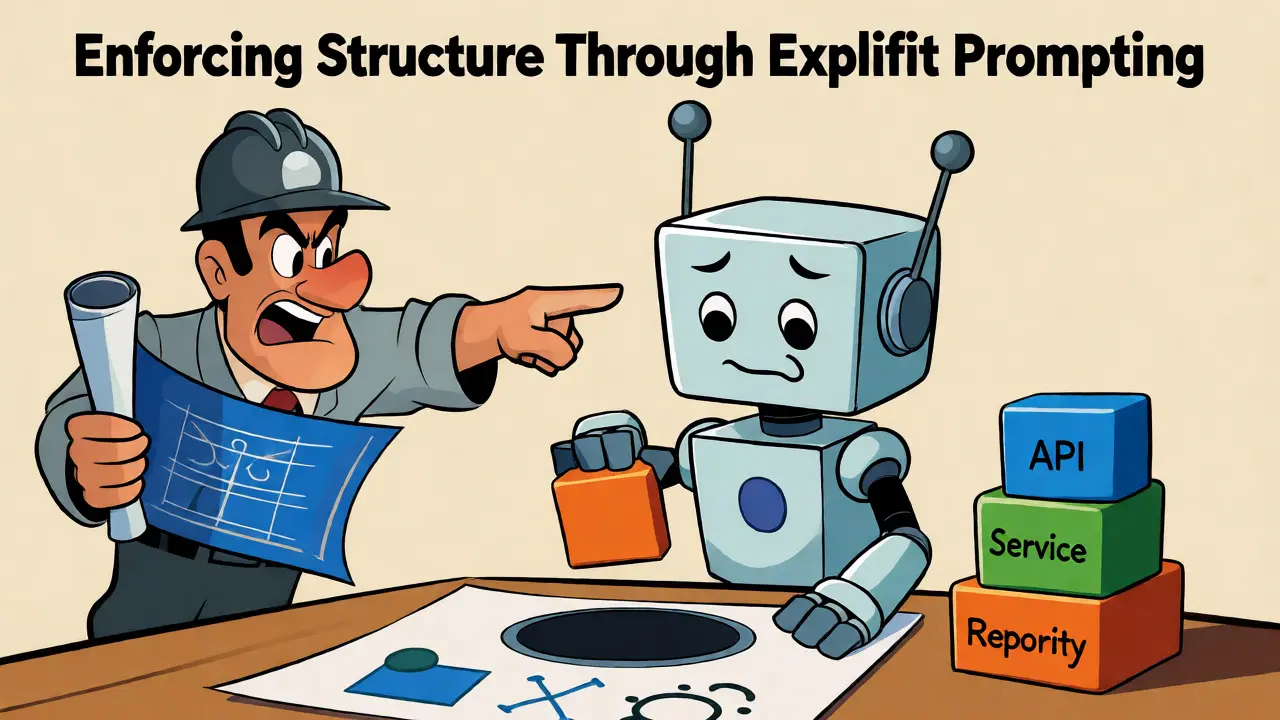
Enforcing Structure Through Explicit Prompting
The solution starts with how you talk to the AI. You cannot rely on implicit conventions. You must be explicit about layers and responsibilities. Instead of asking for a feature, ask for a component within a specific layer.
Here is a practical comparison of vague vs. structured prompting:
| Aspect | Vague Prompt (Vibe Coding) | Structured Prompt (Architectural Enforcement) |
|---|---|---|
| Prompt Example | "Add a function to calculate shipping costs." | "Create a pure function in the `domain/shipping` module that calculates costs based on weight and zone. Do not include database calls or HTTP handling." |
| Expected Output | A mixed function potentially containing DB queries and UI formatting. | A isolated, testable unit focused solely on business logic. |
| Integration Effort | High. Requires refactoring to fit into existing layers. | Low. Drops directly into the designated service layer. |
| Testability | Difficult. Requires mocking external dependencies. | Easy. Pure input/output testing. |
By defining the boundaries in the prompt, you prevent the agent from collapsing layers. Tell it exactly where the code belongs. For example, specify that the AI should generate a DTO (Data Transfer Object) for the API contract, a Service interface for the business logic, and a Repository implementation for data access. This forces the AI to respect the separation of concerns even if it doesn't fully understand the "why" behind it.
The Developer as the System Architect
In the era of vibe coding, your role shifts from writing every line of code to designing the constraints within which the AI operates. Think of yourself as the architect signing off on blueprints, while the AI is the construction crew laying bricks. If you don't check the blueprint, the crew might lay bricks in a way that supports the wall but blocks the plumbing.
This requires a design-first approach. Before you hit "generate," sketch out the flow. Ask yourself: Where does this logic belong? Does this feature reinforce existing boundaries or break them? Would another developer understand why this code is here? If you can't answer these questions, you aren't ready to delegate to AI.
Documentation becomes critical, but not just JSDoc comments. You need architectural decision records (ADRs). When the AI generates a complex piece of logic, review it and document *why* it was placed in that specific layer. Was it chosen for performance? For security? For reusability? These notes serve as guardrails for future AI interactions. When you ask the AI to modify the code later, feed it these ADRs. Now, the AI understands the intent, not just the syntax.

Greenfield vs. Brownfield Challenges
The difficulty of enforcing layered architecture varies depending on whether you're starting from scratch or working with legacy code. In greenfield projects, you have the advantage of setting the rules from day one. You can scaffold the project structure manually-creating folders for `api`, `services`, `repositories`, and `models`-and then instruct the AI to place generated code strictly within these directories. This physical separation reinforces logical separation.
Brownfield scenarios are trickier. Existing codebases often have inconsistent patterns. Some modules follow MVC, others use hooks, and some are just giant scripts. AI agents struggle here because they try to match the local style rather than enforce a global standard. If you ask an AI to add a feature to a messy module, it will likely create more mess. To combat this, isolate new features into new, clean modules whenever possible. Avoid injecting new AI-generated logic into already tangled files. Create new boundaries instead of patching old ones.
Another risk in brownfield apps is dependency confusion. AI might import a utility function from a random corner of the codebase because it found it via search, not because it respects the architectural hierarchy. Always review imports. Ensure that high-level modules depend on abstractions, not concrete implementations, and that lower-level modules do not reach up into higher levels.
Practical Checklist for Vibe-Coded Architecture
How do you know if your vibe-coded app is holding together or falling apart? Use this sanity checklist during code reviews. If you spot these red flags, intervene immediately before the debt compounds.
- The God Component Test: Is there a single file or component doing more than three distinct jobs (e.g., fetching data, calculating totals, rendering HTML)? If yes, split it.
- The Circular Dependency Check: Can module A import module B, which imports module C, which imports module A? AI often creates these loops by trying to share logic too broadly. Break the cycle by introducing interfaces or moving shared logic to a common library.
- The Business Logic Leak: Are there `if/else` statements checking specific user roles or pricing tiers inside your API controllers? Business rules belong in the service layer, not the transport layer.
- The Database Coupling: Does your frontend component know about SQL table names? If your UI breaks when you rename a column, your layers are fused.
- The Missing Contract: Do you have clear type definitions or interfaces separating layers? If the AI changes a return object in the backend, does the frontend break silently? Strong typing acts as a firewall against architectural drift.
Remember, the goal isn't to ban AI from making decisions. It's to ensure those decisions align with your long-term vision. By treating the AI as a tool that needs strict scoping, you get the speed of automation without sacrificing the stability of good engineering.
What is vibe coding?
Vibe coding is a development paradigm where AI agents generate code and make architectural decisions with minimal explicit guidance from human developers. It prioritizes rapid iteration and functional output over strict adherence to established software design principles, often resulting in code that works initially but lacks structural integrity.
Why does AI-generated code often lack separation of concerns?
AI models optimize for completing the immediate task described in the prompt. Without explicit instructions to maintain architectural layers, they tend to collapse business logic, data access, and presentation into single units for simplicity and efficiency, ignoring long-term maintainability.
How can I enforce layered architecture when using AI tools?
Be explicit in your prompts. Define the expected layers (e.g., Controller, Service, Repository) and specify which layer each piece of code belongs to. Provide examples of the desired structure and forbid mixing concerns, such as including database queries in UI components.
Is vibe coding suitable for enterprise applications?
It can be, but only with strict governance. Enterprise apps require rigorous separation of concerns for scalability and team collaboration. Unmanaged vibe coding introduces technical debt that makes future modifications risky and expensive, so human architectural oversight is mandatory.
What is the biggest risk of ignoring architecture in AI-assisted coding?
The biggest risk is "invisible damage." The application continues to function correctly, masking systemic dysfunction. This leads to brittle systems where minor changes cause widespread regressions, eventually halting development velocity due to the complexity of untangling coupled code.