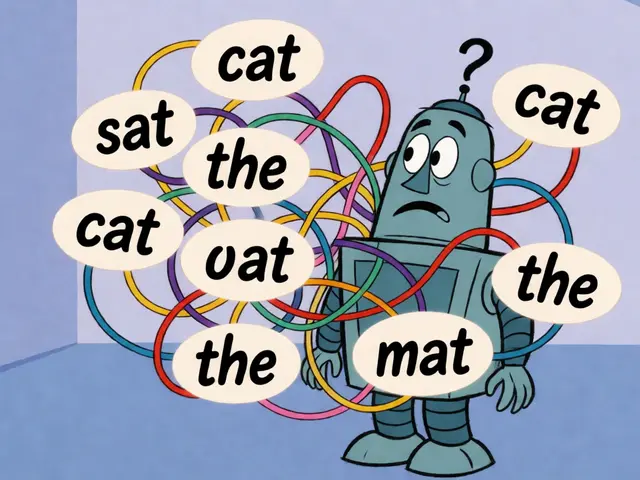
Imagine asking your company’s internal system, "What is our current policy on GDPR compliance for European customer data?" and getting a direct, synthesized answer with citations in three seconds. Now imagine that same question taking an employee two hours to answer by manually searching through twelve different PDF policies, Confluence pages, and email threads. This gap between static information storage and dynamic knowledge retrieval is exactly what Large Language Models (LLMs) are solving for enterprise knowledge management.
We are no longer just storing documents; we are conversing with them. Since the release of powerful foundation models like GPT-4 around 2023, organizations have moved beyond simple keyword search. They are building systems that understand context, retrieve relevant fragments from proprietary data, and generate human-like responses. But this isn't magic-it's engineering. And if you get the architecture wrong, you don't just get slow answers; you get confident lies.
The Core Architecture: Retrieval-Augmented Generation (RAG)
To build a reliable enterprise Q&A system, you cannot simply feed all your internal documents into an LLM prompt. The context windows are too small, and the cost is prohibitive. Instead, the industry standard is Retrieval-Augmented Generation (RAG), which combines the retrieval power of vector search with the generative capabilities of LLMs.
Here is how the pipeline works in practice:
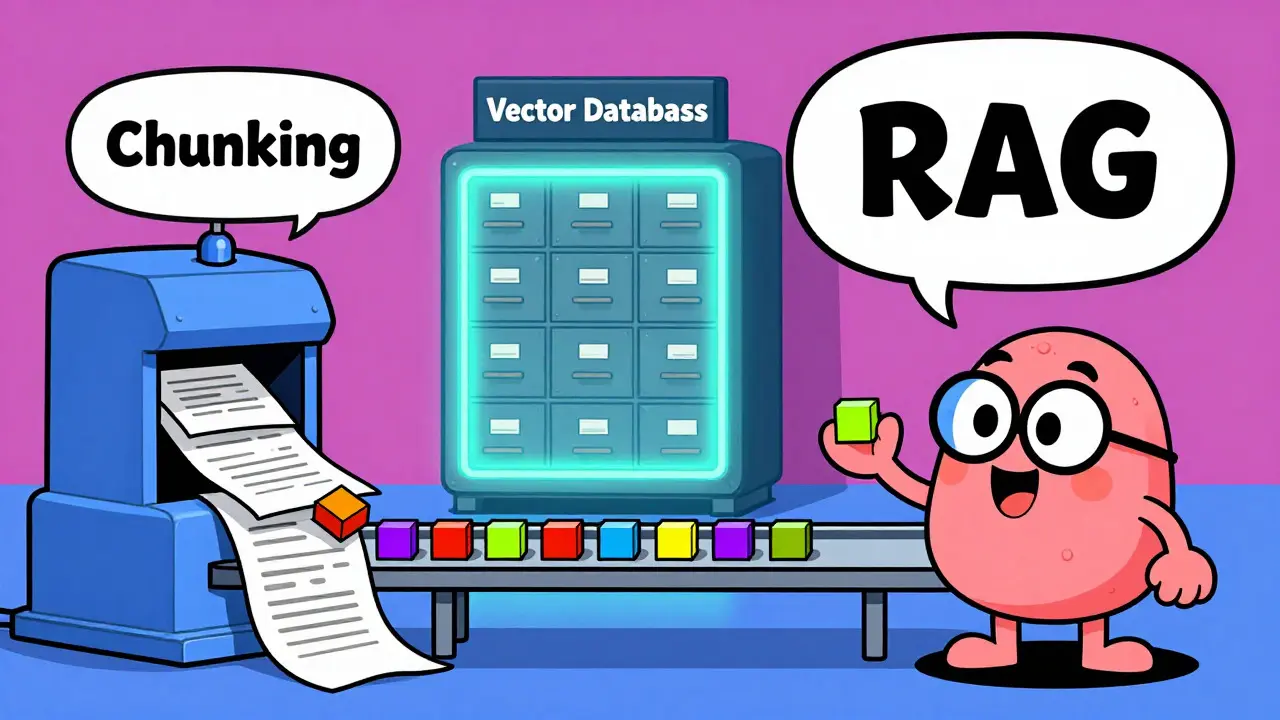
- Ingestion: Your raw documents-PDFs, DOCX files, internal wikis-are broken down into smaller chunks. Each chunk is converted into a numerical representation called an embedding using models like BERT or specialized embedding APIs.
- Storage: These embeddings are stored in a Vector Database such as Pinecone or Weaviate. This database allows for semantic similarity search, meaning it finds concepts rather than exact word matches.
- Retrieval: When a user asks a question, their query is also embedded. The system searches the vector database for the most similar document chunks.
- Generation: The retrieved chunks are fed into the LLM alongside the original question. The model synthesizes a response based *only* on that provided context.
This separation of retrieval and generation is critical. It keeps the LLM grounded in your actual data, significantly reducing the risk of hallucination. According to benchmarks from Lumenalta, properly implemented RAG systems achieve 85-92% accuracy in retrieving correct information, with response latencies between 1.2 and 3.5 seconds.
Why Traditional Search Fails at Scale
You might wonder why we can't just use advanced filters in SharePoint or Confluence. The problem is fragmentation. Modern IT environments are siloed across cloud computing platforms, cybersecurity logs, and data engineering repositories. A traditional search engine looks for keyword matches. If a document says "data privacy regulations" and you search for "GDPR," you might miss it entirely unless the acronym is explicitly defined nearby.
LLM-powered systems understand semantic relationships. They know that "GDPR" and "European data protection laws" refer to the same concept. Workativ’s 2024 case studies highlight that this contextual understanding leads to a 63% faster resolution time for employee queries and a 41% reduction in repetitive tickets sent to IT help desks. The shift is from finding documents to finding answers.
| Feature | Traditional Search (SharePoint/Confluence) | LLM-Powered RAG Systems |
|---|---|---|
| Search Method | Keyword matching | Semantic similarity & context understanding |
| Output Format | List of document links | Synthesized direct answer with citations |
| Cross-Document Synthesis | Poor (requires manual reading) | Strong (combines info from multiple sources) |
| Accuracy Risk | Low (shows source directly) | Moderate (risk of hallucination without validation) |
| Implementation Complexity | Low | High (requires vector DBs, GPU inference) |
The Hallucination Problem and How to Fix It
The biggest fear in enterprise AI adoption is the "confident lie." An LLM might invent a policy that doesn't exist because it sounds plausible. eGain’s analysis identified this as a dangerous blind spot, noting that unverified implementations can produce incorrect answers in 18-25% of complex queries.
To mitigate this, you need a hybrid approach. Seth Earley, CEO of Enterprise Knowledge, argues that LLMs are not ready to replace human-curated systems entirely. Instead, successful deployments combine LLM capabilities with structured Knowledge Graphs. These graphs provide a rigid structure of facts that the LLM must adhere to, acting as a guardrail against fabrication.
Additionally, implement these technical safeguards:
- Source Citation: Every generated answer must include clickable links to the specific document chunks used. This allows users to verify the information instantly.
- Human-in-the-Loop Validation: For critical domains like legal or healthcare, flag low-confidence responses for human review before they reach the end-user.
- Recency Scoring: Weight newer documents higher in the retrieval phase to avoid outdated advice. About 48% of modern systems use automated recency scoring to handle knowledge decay.
Infrastructure Costs and Performance Requirements
Building this system is not free. The computational load is significant. You need GPU acceleration for real-time inference. NVIDIA A100 GPUs remain the industry standard for production deployments requiring sub-second response times. Without proper hardware, your "instant" answers will take minutes, destroying user trust.
The financial impact is substantial. A 2024 Stanford study calculated that maintaining enterprise-scale LLM knowledge systems costs between $18,500 and $42,000 monthly per 10,000 employees in inference computing alone. This excludes development time, vector database licensing, and maintenance. However, when weighed against the productivity gains-such as the 35-50% reduction in employee onboarding time reported by companies like Salesforce and Adobe-the ROI often justifies the expense for large organizations.
Security and Access Control
Security is non-negotiable. In a traditional search, permissions are handled at the file level. In a RAG system, where text is chunked and embedded, you must ensure that a junior marketing associate doesn't retrieve salary data belonging to the executive team.
Ninety-four percent of successful deployments report strict access controls as essential. This requires implementing metadata tagging during the ingestion phase. Each document chunk must carry user permission tags. When a query is made, the vector search filters results not just by relevance, but by the querying user's security clearance. Failure to configure this correctly has led to sensitive information leaks in early pilot programs, as discussed in various machine learning communities.
Implementation Roadmap for Enterprises
If you are planning to deploy this technology, expect a timeline of 8 to 12 weeks for a medium-sized enterprise. Here is a realistic breakdown:
- Weeks 1-3: Data Preparation. Clean your documents. Remove duplicates, redact PII if necessary, and define metadata schemas. Poor data quality here guarantees poor answers later.
- Weeks 4-6: Pipeline Development. Build the ingestion pipeline to convert PDFs and DOCX files into embeddings. Set up your vector database (Pinecone, Weaviate, or Milvus).
- Weeks 7-9: Integration & Prompt Engineering. Connect the LLM API. Fine-tune prompts to enforce tone and citation formats. Dr. Andrew Ng notes that fine-tuning on domain-specific data can improve accuracy by 31-47%, but careful prompt engineering is often sufficient for general corporate knowledge.
- Weeks 10-12: Testing & Security Audit. Run benchmark tests for accuracy and latency. Audit access controls rigorously.
Don't try to boil the ocean. Start with a specific department, like HR or IT Support, where questions are frequent and the consequences of minor errors are lower. Expand once you have proven the reliability of the system.
Future Trends: From Search to Autonomous Agents
We are currently in the "Innovation Trigger" phase of Gartner’s Hype Cycle for this technology. By 2026, Gartner predicts that 60% of large enterprises will deploy function-specific knowledge assistants rather than centralized universal search engines. This means instead of one giant "Company Brain," you’ll have specialized copilots for Legal, Finance, and Engineering.
Looking further ahead, autonomous knowledge maintenance is emerging. Research from Zeta Alpha suggests that AI agents will soon monitor internal communications and document changes to automatically update knowledge bases, eliminating the manual curation burden. While promising, this introduces new challenges regarding accountability and audit trails, especially under regulations like the EU AI Act, which now mandates transparency in AI decision-making for many European enterprises.
What is the difference between RAG and fine-tuning an LLM?
Fine-tuning involves retraining the model's weights on your data, which is expensive and static. Once trained, the model knows that data until it is retrained again. RAG (Retrieval-Augmented Generation) keeps the model unchanged but feeds it relevant data snippets at runtime. RAG is cheaper, more flexible, and ensures the model always accesses the latest information without needing retraining.
How do I prevent my LLM from leaking confidential data?
Implement row-level security in your vector database. Tag every document chunk with user permissions during ingestion. When a user queries the system, filter the retrieved results to only include chunks they have permission to view. Additionally, consider using private, on-premise LLM instances if data sovereignty is a strict requirement.
Which vector database should I choose for enterprise use?
Popular choices include Pinecone for managed ease-of-use, Weaviate for its hybrid search capabilities, and Milvus for high-performance open-source needs. Your choice depends on your existing infrastructure, team expertise, and scalability requirements. Most offer free tiers for testing.
Is it worth the cost for small businesses?
For very small teams (<50 employees), the complexity and cost ($18k+/month for large scale) may outweigh benefits. However, mid-sized companies (1,000+ employees) see significant ROI through reduced support ticket volume and faster onboarding. Start with a niche use case to validate value before scaling.
How does the EU AI Act affect enterprise knowledge systems?
The EU AI Act requires transparency and traceability. This means your system must clearly indicate when an answer is AI-generated and provide provenance (source citations). Many European enterprises are now implementing knowledge provenance tracking to comply with these regulatory demands.