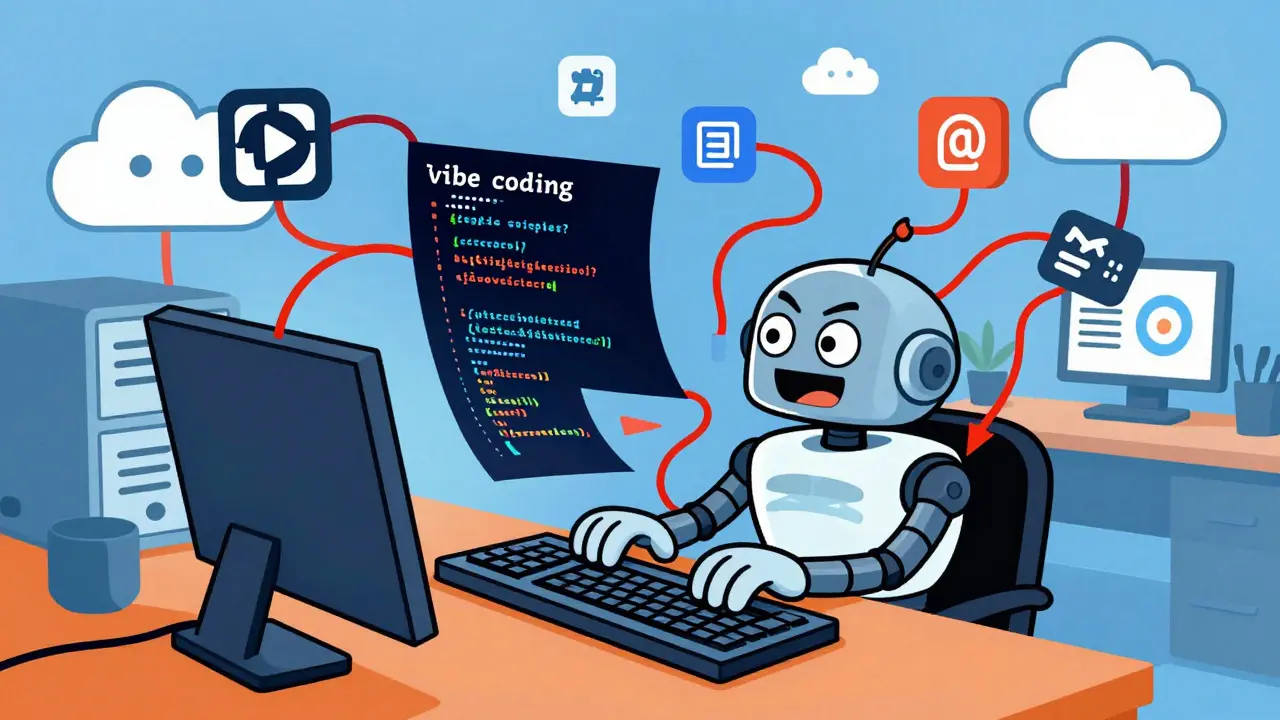
Building software with vibe coding is fast. You prompt an AI agent, it generates a React component or a Python script, and you ship it. But speed has a cost. When code is generated by large language models (LLMs) without strict architectural constraints, data flows become invisible. This creates a massive blind spot for privacy compliance under the General Data Protection Regulation (GDPR) and the California Consumer Privacy Act (CCPA). If your system doesn't know where personal data goes, how long it stays, or why it was collected, you are one audit away from a fine.
The core problem isn't just that AI writes bugs; it's that AI writes implicit logic. A vibe-coded feature might send user email addresses to a third-party analytics tool because the LLM assumed that was standard practice, even if your privacy policy says otherwise. To fix this, you need to treat data mapping not as a legal document, but as a technical requirement of the development lifecycle. Here is how to handle data mapping and consent flows when your codebase is being built by machines.
Why Vibe Coding Breaks Traditional Data Maps
Traditional data mapping assumes a static architecture. You define your databases, your APIs, and your third-party vendors upfront. In vibe-coded systems, the architecture evolves with every prompt. An LLM might introduce a new dependency, like a serverless function that calls an external API, without updating your inventory. According to a 2025 survey by the International Association of Privacy Professionals (IAPP), 58% of privacy professionals cite difficulties tracking data across cloud environments and third-party processors as their biggest challenge. For vibe-coded apps, that number is likely higher because the "third parties" are often hidden inside generated code snippets.
Data mapping is a process designed to systematically analyse, identify and minimise the data protection risks of a project or plan. In a vibe-coded context, this means you cannot rely on manual documentation alone. You need automated discovery tools that scan your code repository and infrastructure for PII (Personally Identifiable Information) patterns. Without this, your Records of Processing Activities (RoPAs) required by GDPR Article 30 will be outdated within weeks. One user on Reddit’s r/privacy subreddit reported spending 147 hours over three months to complete an initial data map for a mid-sized e-commerce site, noting that identifying sources across legacy systems was the hardest part. In vibe coding, the "legacy" is the previous version of the AI-generated code.
Mapping Personal Data in AI-Generated Code
To map data effectively, you must first define what counts as personal data. Under GDPR, this includes names, ID numbers, online identifiers, location data, and anything that can connect to an identifiable natural person. CCPA is broader, covering inferences drawn from other data to create consumer profiles. When an LLM generates a user profile feature, it might combine browsing history, purchase data, and demographic info into a single object. That object is now a "profile" under CCPA and requires specific handling.
Here is a practical approach to mapping in vibe-coded systems:
- Scan for PII Patterns: Use static analysis tools to detect strings, variables, and database fields that match PII regexes (e.g., email formats, SSN patterns, IP addresses).
- Trace Dependencies: Identify all external API calls made by the generated code. Every call to a third-party service is a potential data transfer event.
- Tag Legal Bases: For each data point, tag the legal basis for processing. Is it consent? Contract performance? Legitimate interest? The LLM needs these tags in its context window to generate compliant code.
- Document Retention: Define deletion triggers. If the code stores data in a NoSQL database, ensure there is a TTL (Time-To-Live) or a cron job for cleanup. Vibe-coded apps often forget this step.
Jane Finlay, CIPP/E and Director of Privacy at Ethyca, noted that organizations mapping data at the processing activity level see 68% fewer compliance gaps during audits. This means you aren't just listing data types; you are documenting the specific action (e.g., "sending welcome email") and the legal justification for that action.
Designing Consent Flows for Dynamic Interfaces
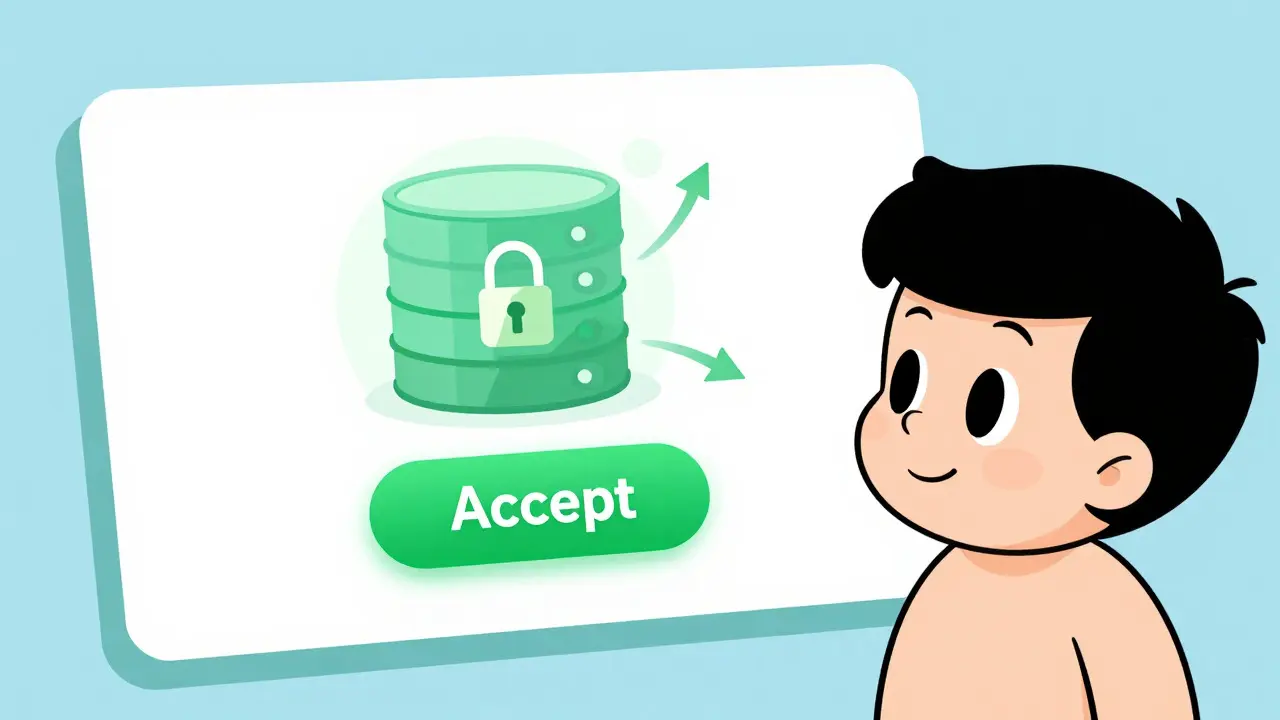
Consent is the most fragile part of vibe-coded systems. Front-end components generated by LLMs often lack proper state management for consent banners. You might have a beautiful UI, but if the "Accept" button doesn't persist the choice in a secure cookie or database field, you have no proof of consent. GDPR requires explicit, informed, and unambiguous consent. CCPA requires a clear opt-out mechanism for selling/sharing data.
When prompting an LLM to build a consent flow, be specific about the backend requirements. Don't just say "add a cookie banner." Say: "Create a React component for a consent banner that sends the user's choice to /api/consent, stores it in PostgreSQL, and updates the global state so that analytics scripts only load after 'Accept' is clicked." This forces the AI to consider the data flow, not just the UI.
Consider the difference between GDPR and CCPA consent mechanisms:
| Feature | GDPR (EU) | CCPA (California) |
|---|---|---|
| Primary Mechanism | Opt-in for non-essential cookies/tracking | Opt-out for selling/sharing personal information |
| Data Subject Rights | Access, Rectify, Erase, Portability | Know, Delete, Correct, Opt-Out |
| Sensitive Data | Special category data requires explicit consent | Sensitive PI requires notice before collection |
| Code Implication | Block third-party scripts until consent is given | Provide a "Do Not Sell My Info" link that persists preference |
In vibe coding, the risk is that the LLM implements a generic "cookie consent" library that handles one regulation but ignores the nuances of the other. For example, a US-based startup might use a GDPR-compliant banner but fail to implement the specific "Do Not Sell" link required by CCPA. Always specify the jurisdiction in your prompts.
Automating Discovery in CI/CD Pipelines
If you want to scale vibe coding without breaking compliance, you need automation. Manual data mapping is too slow for the pace of AI-generated code. Integrate data discovery tools into your Continuous Integration/Continuous Deployment (CI/CD) pipeline. Tools like OneTrust or TrustArc can scan code repositories and infrastructure-as-code files to detect new data flows.
Forrester predicts that 45% of large enterprises will implement AI-powered data mapping by 2027, reducing manual effort by 60-75%. This technology uses machine learning to classify data fields automatically. For instance, if an LLM generates a new table column named `user_zip_code`, the tool should flag it as PII and check if it has a documented retention period.
However, don't trust automation blindly. Dr. Rebecca Herold, known as The Privacy Professor, warns that 32% of organizations using fully automated approaches still experienced compliance gaps in 2025 audits. Automated tools miss context. They might flag a variable as PII when it's actually a test dummy value, or miss a subtle inference that constitutes profiling. Human oversight is still required to validate the legal interpretation of the mapped data.
Best Practices for Developers Using LLMs
How do you stay compliant while moving fast? Here are actionable tips for developers working with vibe-coded systems:
- Use Context-Aware Prompts: Include your data dictionary and privacy policies in the LLM's context. If the model knows that `email` is only used for transactional emails, it is less likely to add it to marketing lists.
- Implement Feature Flags for Data Collection: Wrap new data collection points in feature flags. This allows you to turn off data flows during audits or if a bug is found.
- Log All Data Transfers: Ensure that every API call involving PII is logged. These logs serve as evidence for DSARs (Data Subject Access Requests) and audits.
- Regularly Review Generated Dependencies: LLMs love to suggest popular libraries. Check if those libraries have their own privacy implications. A logging library might send data to a vendor you haven't vetted.
- Update RoPAs Automatically: Link your code commits to your RoPA entries. When a PR merges that adds a new data field, trigger a workflow to update the compliance documentation.
David Holtz, former Chief Privacy Officer at Adobe, stated that data mapping must operationalize around consent mechanisms, with explicit tagging of data elements by their legal basis. This prevents overcollection claims. If your code collects more data than declared in your privacy policy, you are in violation. Tagging helps keep the code and the policy in sync.
Handling Sensitive Personal Information
Both GDPR and CCPA treat sensitive data differently. GDPR defines "special category data" including health, biometrics, and genetic data. CCPA defines "Sensitive Personal Information" (SPI) which includes precise geolocation, government ID numbers, and biometric data. The January 2026 CPRA enforcement update mandates specific mapping of SPI with stricter opt-out requirements.
In vibe-coded systems, the risk is accidental exposure. An LLM might generate a debug endpoint that dumps user records, including health data, to the console. To mitigate this, enforce strict linting rules that prevent logging of objects containing SPI fields. Additionally, encrypt SPI at rest and in transit. While encryption is good security practice, it also serves as a mitigating factor in breach notifications under both regulations.
Remember that AI models themselves are data processors. If you use an LLM to analyze customer support tickets, the ticket content is being processed by a third party (the AI provider). You need a Data Processing Agreement (DPA) with that provider. Make sure your data map includes these AI services as subprocessors.
Frequently Asked Questions
What is vibe coding and why does it affect privacy?
Vibe coding is a development style where programmers use Large Language Models (LLMs) to generate code based on natural language prompts. It affects privacy because the generated code may introduce undocumented data flows, dependencies, or processing activities that violate GDPR or CCPA requirements if not explicitly managed.
How do I map data in an AI-generated application?
Use automated data discovery tools to scan your codebase for PII patterns and external API calls. Tag each data point with its legal basis for processing and retention period. Integrate these scans into your CI/CD pipeline to ensure the map updates as the code changes.
Does CCPA require opt-in consent for all data collection?
No, CCPA generally operates on an opt-out basis for selling or sharing personal information. However, it requires notice before collecting Sensitive Personal Information. GDPR, in contrast, often requires explicit opt-in consent for non-essential tracking and special category data.
What are the risks of using LLMs for customer support data?
The main risk is unauthorized processing by the AI provider. Customer tickets contain personal data, and sending them to an LLM constitutes a data transfer. You must have a Data Processing Agreement (DPA) with the AI vendor and include them in your data map as a subprocessor.
How often should I update my data map in a vibe-coded environment?
Ideally, in real-time via automated tools integrated into your deployment pipeline. If relying on manual updates, review the map after every significant release or feature addition. Given the speed of AI generation, quarterly reviews are often insufficient; monthly or per-sprint reviews are safer.