Imagine building a fraud detection dashboard in four days instead of three weeks. You don’t write a single line of Python or SQL. You just describe what you need in plain English, and the system builds it for you. This is vibe coding, a term coined by Andrej Karpathy in 2025 to describe AI-driven development where intent replaces syntax. For fintech companies, this sounds like magic until you remember that one bad line of code can trigger a regulatory fine or leak sensitive customer data.
The real challenge isn’t generating code; it’s ensuring that code survives the scrutiny of financial regulators. As we move through 2026, the conversation has shifted from "Can AI build apps?" to "Can AI build compliant apps?" The answer lies in how you handle mock data, implement compliance guardrails, and manage the risks of autonomous development.
What Is Vibe Coding in Fintech?
Vibe coding is not just autocomplete on steroids. Traditional tools like GitHub Copilot react to your keystrokes, suggesting snippets based on context. Vibe coding platforms, such as Superblocks, Replit, and Cursor, operate on an agentic model. You provide a high-level goal-"Create a KYC verification workflow"-and the AI plans, codes, tests, and deploys the solution with minimal human intervention.
In the fintech sector, this shift is critical because engineering resources are often bottlenecked by legacy systems and strict security protocols. According to industry reports from early 2025, nearly 50% of new fintech codebases contain AI-generated segments. However, there is a distinct split between experimental startups and enterprise-grade implementations. Startups use vibe coding to ship features fast. Enterprises use it to solve specific operational bottlenecks without breaking their existing compliance frameworks.
The key difference is governance. In a startup, speed might outweigh perfect documentation. In a bank, missing an audit trail is unacceptable. Enterprise vibe coding platforms address this by embedding SOC 2 and HIPAA standards directly into the generation process, ensuring that every prompt results in code that respects role-based access controls (RBAC) and data encryption requirements.
The Mock Data Problem: Why Synthetic Data Matters
You cannot test financial software with real customer data during development. That violates GDPR, CCPA, and basic privacy laws. Yet, most traditional testing environments suffer from "data drift," where dummy data doesn’t accurately reflect the complexity of real transactions. This leads to bugs that only appear in production.
Vibe coding exacerbates this risk if not handled correctly. If you ask an AI to generate a transaction simulator using generic placeholders, it will create unrealistic patterns. A European neobank reported that their initial vibe-coded onboarding tool failed compliance checks three times before they realized the mock data didn’t simulate realistic edge cases, such as cross-border currency fluctuations or unusual spending behaviors.
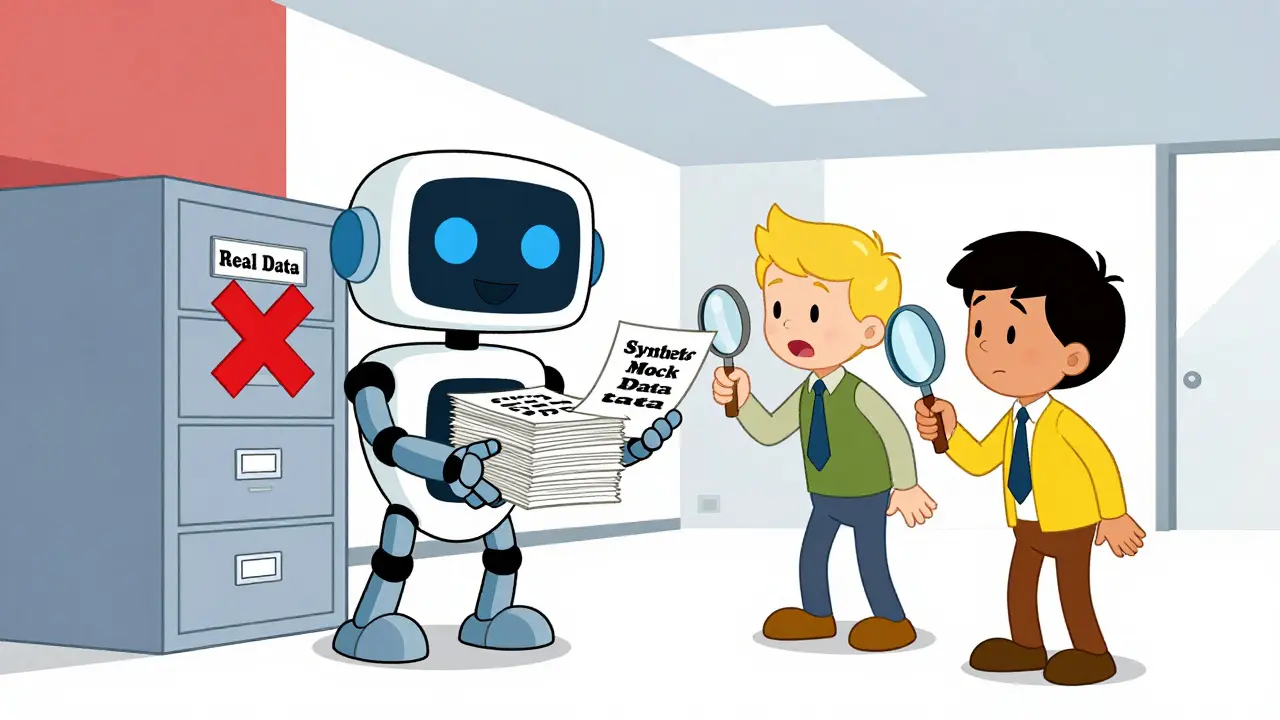
The solution is synthetic data generation. Modern enterprise platforms now integrate synthetic data engines that create statistically accurate replicas of production data without exposing any personally identifiable information (PII). When configuring your vibe coding environment, ensure your prompts explicitly request synthetic data structures that mirror your core banking system’s schema. This allows developers to test complex scenarios-like fraud detection algorithms-safely and effectively.
- Never use anonymized production data: Anonymization is often reversible. Use synthetically generated data instead.
- Define data constraints: Tell the AI the expected ranges for transaction amounts, dates, and user locations to avoid unrealistic outputs.
- Validate against real-world logic: Ensure the mock data supports negative testing (e.g., attempting to withdraw more than the balance).
Compliance Guardrails: Building Safety Into the Code
"Innovation without governance is just improvisation," said Riccardo Balsamo of Tenity in April 2025. In fintech, improvisation is expensive. Compliance guardrails are the rulesets that prevent AI from generating code that violates financial regulations. These aren’t afterthoughts; they are foundational components of enterprise vibe coding.
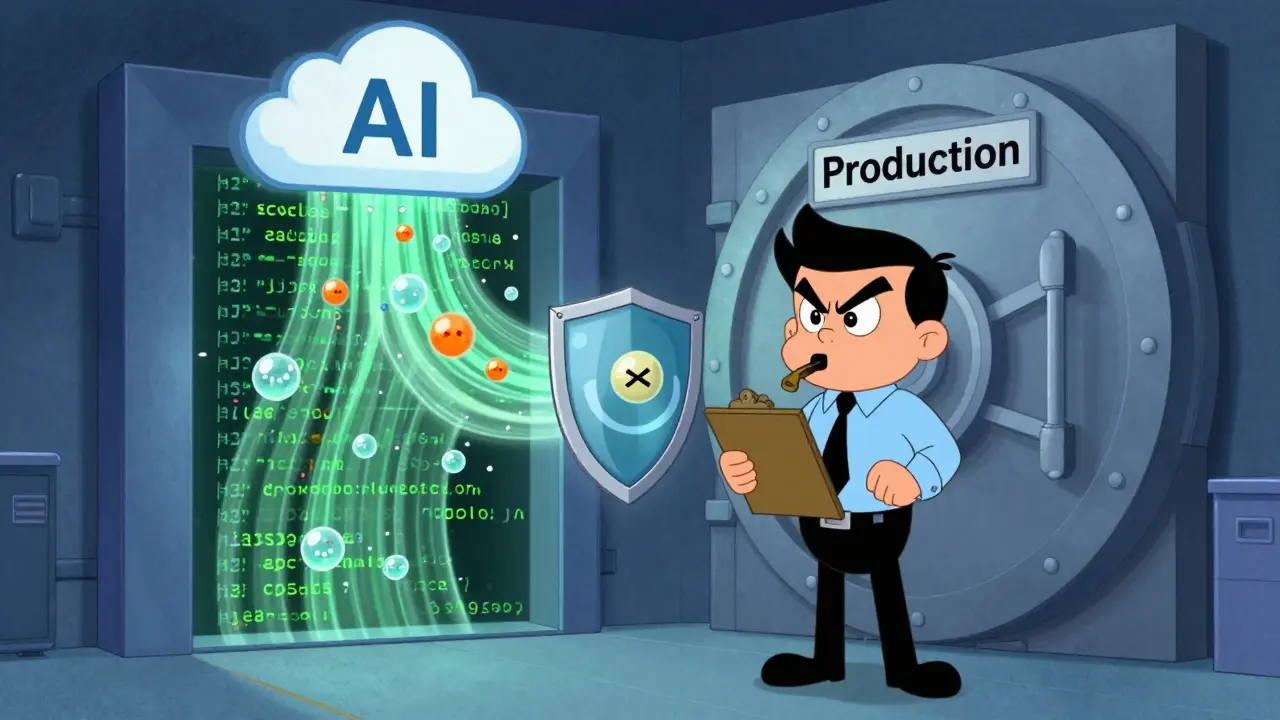
Effective guardrails include automated audit trails, which log every change made by the AI, who approved it, and when. They also enforce role-based access control (RBAC), ensuring that a junior analyst cannot accidentally deploy code that accesses sensitive executive data. Platforms like Superblocks have introduced "compliance-first AI guardrails" that automatically embed regulatory requirements for major jurisdictions, including the EU, US, and UK.
However, guardrails require configuration. They are not plug-and-play. A mid-sized payment processor found that while their vibe-coded fraud monitoring dashboard deployed 80% faster, they spent two weeks collaborating between developers and compliance officers to configure proper audit trails. This highlights a crucial insight: vibe coding shifts the burden from writing code to defining policies. Your compliance team must be involved in the prompting phase, not just the review phase.
| Feature | Traditional Development | Enterprise Vibe Coding |
|---|---|---|
| Time to Prototype | 5-7 business days | 1 business day |
| Engineering Involvement | High (100%) | Low (~20%) |
| Compliance Integration | Manual review post-development | Built-in via guardrails |
| Risk of Compliance Drift | Low (human-controlled) | Medium (requires oversight) |
| Best Use Case | Core transaction systems | Internal tools & reporting |
Real-World Risks: Where Vibe Coding Fails
Vibe coding is powerful, but it is not infallible. The biggest risk identified in 2025 is "compliance drift." This occurs when iterative updates to an AI-generated application gradually deviate from original regulatory requirements. Because the AI makes decisions autonomously, small changes in logic can accumulate, leading to a system that no longer meets SOC 2 or GDPR standards.
Another significant limitation is handling complex financial algorithms. While vibe coding excels at building interfaces and standard workflows, it struggles with millisecond-level precision required for high-frequency trading or core ledger systems. J.P. Morgan’s 2025 guide warns that quantitative development environments still outperform AI agents in these specialized areas.
User feedback from Reddit’s r/fintech community in June 2025 highlighted this tension. A senior operations manager noted that while development time dropped significantly, the learning curve for non-technical staff was steep. Formulating effective prompts that incorporate regulatory constraints requires domain expertise. If a compliance officer doesn’t understand how to specify data retention policies in natural language, the AI will guess-and guesses are dangerous in finance.
Implementation Strategy: Getting Started Safely
If you want to experiment with vibe coding in your fintech organization, start small. Do not begin with customer-facing applications. Begin with internal tools that have low regulatory risk, such as compliance reporting dashboards or internal knowledge bases.
Follow these steps to mitigate risk:
- Establish a Governance Framework: Define clear rules for what can and cannot be built using AI. Include your legal and compliance teams in this discussion.
- Configure Guardrails Early: Set up RBAC and audit logging before you write your first prompt. Make these non-negotiable defaults.
- Use Synthetic Data: Ensure your development environment uses realistic but fake data to test functionality without privacy violations.
- Maintain Human-in-the-Loop: Never fully automate deployment. Require a senior engineer or compliance officer to review and approve all AI-generated code before it goes live.
- Monitor for Drift: Implement regular audits to compare the current state of the application against its original compliance specifications.
By Q2 2025, approximately 37% of fintech startups had adopted some form of vibe coding, compared to 22% of traditional financial institutions. This gap reflects the caution banks exercise. However, as platforms mature and guardrails become more sophisticated, adoption is expected to grow rapidly.
Future Outlook: Beyond Prototyping
The future of vibe coding in fintech lies in deeper integration with regulatory technology (RegTech). By 2027, Gartner predicts that 60% of internal fintech tool development will use vibe coding, but it will remain supplementary for core transaction systems. The next evolution involves AI-powered compliance validation that cross-references generated code against regulatory databases in real-time.
This means the AI won’t just build the app; it will also certify its compliance. Imagine a system that flags a potential GDPR violation before the code is even compiled. This level of automation will reduce the burden on compliance teams and accelerate innovation further.
For now, however, the focus remains on balancing speed with safety. Vibe coding is not a replacement for skilled engineers or compliance experts. It is a multiplier. Used correctly, it allows fintech teams to move at startup speed without compromising the reliability and security that customers demand.
Is vibe coding safe for financial applications?
Vibe coding can be safe for financial applications if implemented with strict compliance guardrails, synthetic data, and human oversight. It is best suited for internal tools and non-critical workflows rather than core transaction systems.
What is compliance drift in vibe coding?
Compliance drift occurs when iterative updates to an AI-generated application gradually deviate from original regulatory requirements. Regular audits and human reviews are necessary to prevent this.
How does vibe coding differ from GitHub Copilot?
GitHub Copilot assists developers by suggesting code snippets based on context. Vibe coding platforms use agentic AI to autonomously plan, code, and deploy entire applications based on natural language prompts.
Why is mock data important in fintech development?
Mock data allows developers to test applications without using real customer data, which protects privacy and ensures compliance with regulations like GDPR and CCPA. Synthetic data provides realistic testing scenarios without the risks.
Which platforms support enterprise vibe coding?
Platforms like Superblocks, Replit, Cursor, and Lovable offer enterprise-grade vibe coding capabilities with built-in compliance features, security controls, and integration options for financial services.