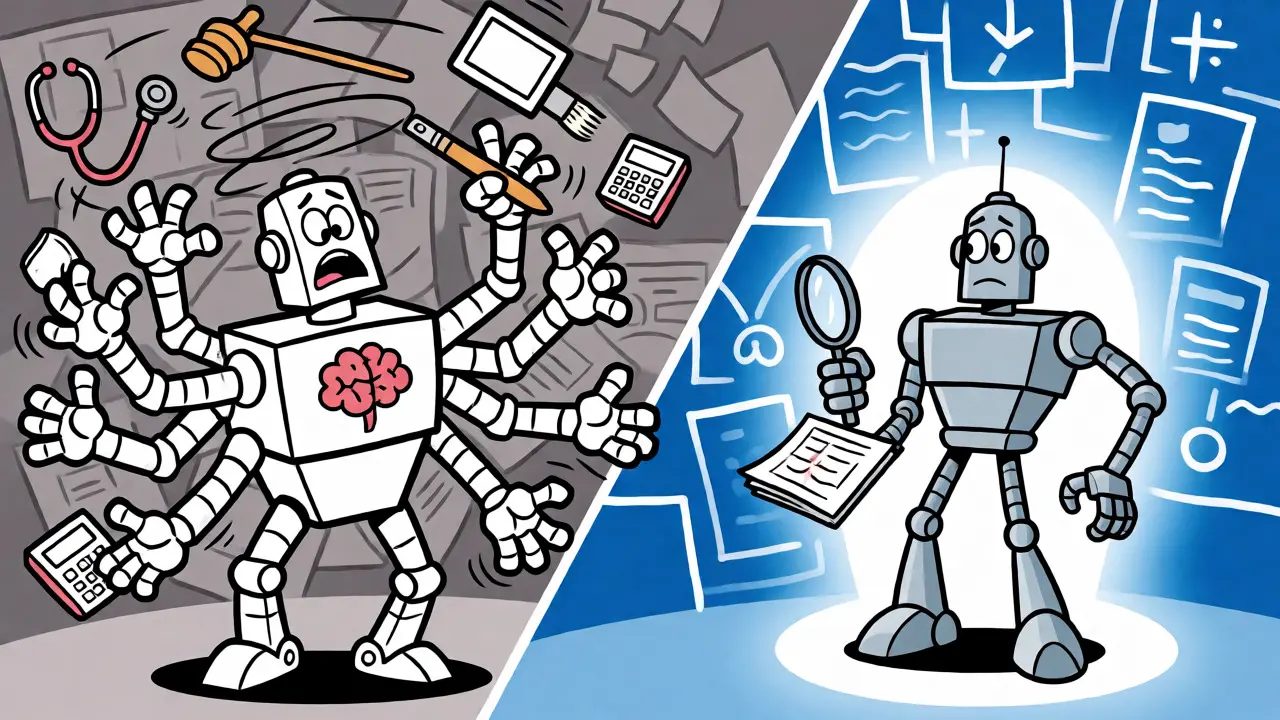
You built a chatbot using a massive general-purpose model. It writes poetry, codes in Python, and explains quantum physics. But when you ask it to review a complex financial derivative contract or diagnose a rare pathology slide, it hallucinates. It sounds confident, but it’s wrong. This is the trap of generality: broad knowledge often comes at the cost of precision.
The market has shifted. By late 2026, the era of "one model fits all" is over for serious enterprise applications. We are seeing a decisive move toward domain-specialized generative AI models. These are systems fine-tuned on narrow, high-quality datasets to achieve superior performance in specific verticals like healthcare, finance, or law. The data backs this up: specialized models consistently outperform larger, generic counterparts in their target fields, often by margins of 30-50% in accuracy.
Why does this matter? Because businesses don’t need an AI that can write a sonnet; they need one that won’t miss a compliance clause or misread an X-ray. Let’s break down why vertical excellence is winning the race against generality, and how you can leverage this shift.
The Accuracy Gap: Small Data, Big Wins
Conventional wisdom said bigger is better. If GPT-4 with hundreds of billions of parameters struggles with medical jargon, surely a smaller model can’t do better? Actually, it can. Stanford’s PubMedGPT, a model with just 2.75 billion parameters, significantly outperformed same-sized generalist models on medical question-answering tasks. How? It wasn’t trained on the entire internet. It was trained on biomedical literature.
This phenomenon highlights a critical truth: quality and relevance of training data trump sheer volume when domain expertise is required. IBM Research confirmed this in 2023, noting that smaller models trained on specific data often beat larger, general-purpose ones. In regulated industries, this gap is stark. A 2024 comparative study showed domain-specific AI achieving 89% accuracy in specialized tasks versus 62% for generic models. In healthcare, the difference jumps to 92% vs. 58%. That 34-point gap isn’t just a statistic; it’s the difference between a usable tool and a liability.
Consider IBM Watson for Oncology. Trained on 14 million medical papers and 40,000+ clinical trial results, it improved cancer treatment recommendation accuracy by 35% over general medical AI. It didn’t know everything about history or pop culture, but it knew oncology deeply. That depth is what enterprises pay for.
Hallucinations and Compliance: The Safety Net
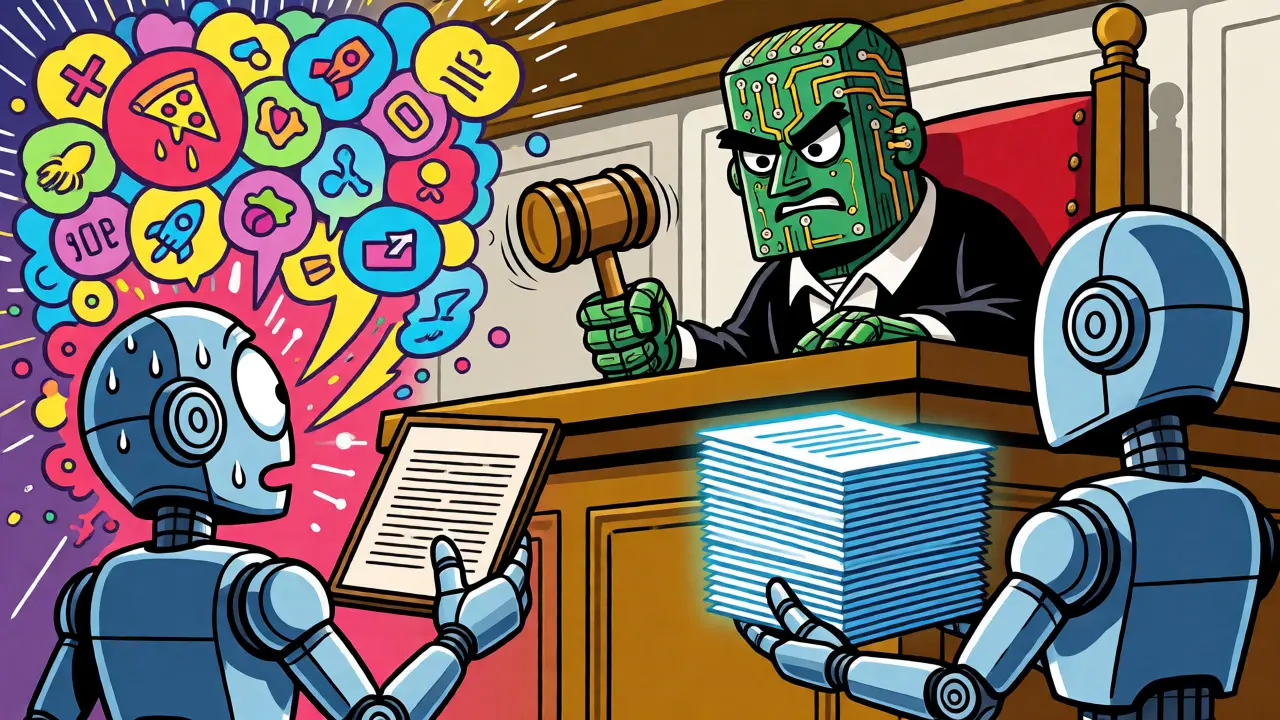
One of the biggest hurdles for AI adoption in business is hallucination-the tendency of large language models to invent facts. For creative writing, a hallucination is a plot twist. For a bank approving a loan, it’s a regulatory violation. Domain-specialized models drastically reduce this risk. Generic models exhibit hallucination rates of 15-25% in complex domains. Specialized models drop this to 5-8%.
Why? Because the model’s probability distribution is tightly constrained by its training corpus. When a legal AI is trained exclusively on case law and contracts, it doesn’t have enough "noise" from unrelated topics to drift into fiction. It sticks to the script defined by its data.
This tightness also aids compliance. Financial institutions require strict adherence to SEC and FCA regulations. A general model might paraphrase a regulation correctly but miss a nuance. A specialized model, trained on millions of regulatory documents, learns the exact phrasing and context required. IBM’s recent release, Watsonx.governance, trained on 12 million legal documents across 30 jurisdictions, achieved 94.7% accuracy in identifying regulatory changes affecting financial institutions. That level of reliability is non-negotiable for banks.
The Cost-Benefit Analysis: Is Specialization Worth It?
Specialization isn’t free. Building a domain-specific model requires curated data, which costs money. You’re looking at $50,000 to $500,000 just for data acquisition and curation. The total development cost averages $120,000 to $750,000 according to industry surveys. Compare this to calling an API for a general model, and the upfront price tag seems steep.
But look at the ROI. Dr. Fei-Fei Li from Stanford notes that domain specialization represents the most significant productivity multiplier in enterprise AI, with ROI improvements of 200-400% compared to generic implementations. McKinsey reports that companies using specialized GenAI see 2.3x faster time-to-value and 37% higher employee adoption rates.
Here is the trade-off:
| Metric | General-Purpose Model | Domain-Specialized Model |
|---|---|---|
| Accuracy in Niche Tasks | ~60% | ~90% |
| Hallucination Rate | 15-25% | 5-8% |
| Versatility (Tasks) | 100+ | 3-5 Core Tasks |
| Initial Dev Cost | Low (API usage) | $120k - $750k |
| Data Requirement | Massive Internet Scrapes | 50k-500k Curated Docs |
| Compliance Risk | High | Low |
If your use case involves high-stakes decisions-like diagnosing disease or assessing credit risk-the initial cost pays for itself quickly through reduced errors and faster workflows. A European bank reduced fraud detection false positives by 38% using a finance-specialized model. That reduction saves millions in manual review hours and lost revenue.

Implementation Pitfalls: The Data Bottleneck
Don’t let the promise of accuracy blind you to the implementation reality. The hardest part isn’t the code; it’s the data. RTS Labs’ 2024 analysis shows that insufficient domain-specific data causes 68% of failed implementations. You can’t just dump raw PDFs into a vector database and expect magic.
You need a structured pipeline:
- Data Inventory (2-4 weeks): Identify where your proprietary knowledge lives. Is it in emails? Legacy databases? Physical archives?
- Curation and Labeling (6-12 weeks): This is the expensive part. You need experts to label data. A radiologist must annotate scans; a lawyer must tag clauses. Expect to spend $50,000-$300,000 here.
- Fine-Tuning (4-8 weeks): Using transfer learning, you adapt a pre-trained foundation model to your data. Techniques like LoRA (Low-Rank Adaptation) make this more efficient than full retraining.
- Validation (2-4 weeks): Test against industry benchmarks, not just internal metrics. Does it pass the bar set by human experts?
- Integration (3-6 weeks): Connect it to your CRM or EHR system. ServiceNow reports that 78% of these implementations integrate with existing enterprise software.
A common failure mode is over-specialization leading to brittleness. Gary Marcus, NYU professor, warns that over-specialized systems are vulnerable to domain shifts. If a manufacturing company trains an AI solely on supply chain data from stable markets, it may fail catastrophically during a pandemic-like disruption. The solution? Hybrid approaches. Use specialized models for core tasks and keep a general model on standby for creative or cross-domain queries.
The Future: Fragmentation or Standardization?
We are heading toward a fragmented landscape. MIT’s AI Ethics Lab predicts over 10,000 siloed AI models by 2030. This creates maintenance headaches. Who updates the legal model when laws change? Who retrains the medical model when new diseases emerge?
However, standardization efforts are underway. Frameworks for cross-domain knowledge transfer are emerging, allowing models to share weights or adapters. Forrester predicts that by 2027, 75% of enterprise GenAI implementations will be domain-specialized, up from 42% in 2025. The winners will be those who build robust MLOps pipelines capable of continuous retraining without breaking production.
For now, the verdict is clear. If you need creativity, breadth, and speed, stick with general models. If you need precision, compliance, and trust, go vertical. The future of AI isn't just smart; it's specialized.
What is a domain-specialized generative AI model?
A domain-specialized generative AI model is a large language model (LLM) or similar architecture that has been fine-tuned or trained specifically on data from a particular industry, such as healthcare, finance, or law. Unlike general-purpose models trained on diverse internet data, these models focus on narrow fields to achieve higher accuracy, better contextual understanding, and lower hallucination rates in specific tasks.
How much more accurate are specialized models compared to general ones?
Studies show domain-specialized models achieve 30-50% higher accuracy in domain-specific tasks compared to general models. In highly regulated industries like healthcare, the gap can be even wider, with specialized models reaching 92% accuracy versus 58% for generic models. This improvement stems from training on relevant, high-quality data rather than noisy, broad internet data.
What are the main disadvantages of using vertical AI models?
The primary disadvantages include limited versatility (they typically handle only 3-5 specific tasks), higher initial development costs ($120,000-$750,000 on average), and dependency on high-quality domain-specific data. They can also become brittle if the industry changes rapidly, requiring frequent retraining to stay relevant.
Do specialized models reduce AI hallucinations?
Yes, specialized models significantly reduce hallucination rates. While general models may hallucinate in 15-25% of complex domain-specific queries, specialized models typically maintain hallucination rates below 8%. This is because their training data constrains the output space to factual information within that specific domain.
Is it worth building a custom AI model for my business?
It depends on your use case. If your tasks involve high-stakes decisions, strict compliance requirements, or complex industry jargon (like legal or medical diagnostics), custom specialized models offer superior ROI through accuracy and trust. For general brainstorming, customer service FAQs, or creative tasks, general-purpose APIs are usually more cost-effective and flexible.