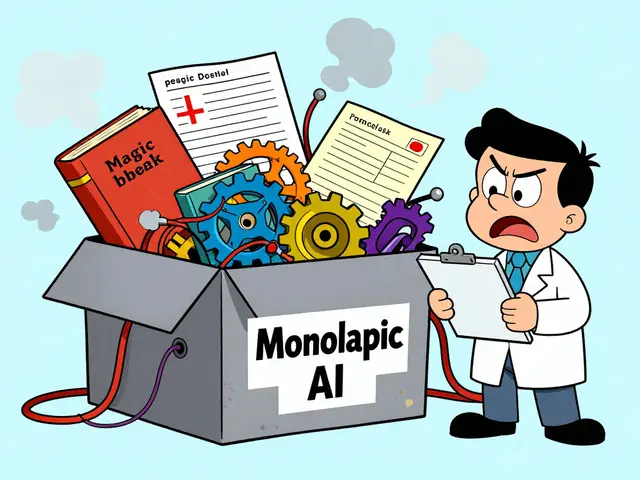
You spent six months building a sleek generative AI model. It passes every technical test. The accuracy is high, the latency is low, and the API integration works like a charm. Then you roll it out to your team, and nothing happens. People ignore it. They go back to their old spreadsheets. Your AI ROI flatlines because the humans didn't change.
This isn't a rare glitch; it's the norm. Gartner reported that 85% of AI projects fail to deliver expected business value, not because the code was bad, but because the organization didn't adapt. If you're budgeting for GenAI, you're likely looking at servers, tokens, and developer salaries. But there's a silent line item that often eats up 15-25% of your first-year budget: change management. Specifically, training your staff and redesigning your workflows to actually use the tool.
Let's break down what this really costs in 2026, why skipping it burns cash later, and how to structure your budget so your AI investment doesn't become another shelfware statistic.
The Real Cost of Getting Humans Onboard
Most companies underestimate the human element. You might think training is just a one-hour webinar on "How to Use ChatGPT." It’s not. For generative AI, training involves teaching people how to prompt, how to verify outputs, and how to integrate these tools into their daily rhythm without losing their minds.
According to data from SmartDev’s analysis of SME implementations, initial staff training and change management consume between $8,000 and $20,000 in the first year alone. This isn't just for big enterprises. Even smaller teams face significant hurdles. Why? Because generative AI changes the nature of work. It shifts roles from creation to curation. That psychological shift takes time and structured support.
If you skip this phase, you don't save money; you defer it. A manufacturing SME documented by SmartDev saw its maintenance and scaling spend jump from $45,000 in year two to $74,000 in year three. Why? Because the initial workflow redesign was rushed. Staff were using the AI incorrectly, leading to errors that required expensive remediation. The average cost of fixing these adoption failures is around $18,000 per incident for mid-sized firms. Do the math: spending $10k upfront to avoid an $18k fix is a no-brainer.
Breaking Down the Budget: Three Phases of Change
To plan accurately, you need to view change management as a lifecycle, not a single event. It happens in three distinct phases, each with its own price tag.
| Phase | Key Activities | Estimated Cost Range | Duration |
|---|---|---|---|
| Initial Implementation | Technical training, workflow mapping, user adoption programs | $8,000 - $20,000 | 3-6 Months |
| Ongoing Optimization | Quarterly refreshers, skill development, incremental adjustments | $3,000 - $8,000 per key member/year | Continuous |
| Scaling Phase | Expanding to new departments, customizing for specific units | $15,000 - $30,000 per unit | Variable |
The Initial Implementation is where most budgets bleed if you aren't careful. This covers the heavy lifting: identifying which processes can be automated, mapping the new workflows, and getting buy-in from skeptical employees. If you have legacy system power users who resist change-and 68% of implementations face this resistance-you need dedicated resources to manage them. This isn't just about sending emails; it's about coaching.
The Ongoing Optimization phase is often overlooked. Generative AI models update frequently. Your team needs to stay current. Cutting this budget leads to skill decay. Organizations that maintain ongoing training see 73% user adoption rates, compared to just 42% for those who treat training as a one-off event.
Finally, Scaling is expensive. When you move from a pilot group to the whole company, you can't just copy-paste the training. Each department has unique workflows. Customizing the rollout for marketing versus finance requires significant effort. Expect to pay $15,000-$30,000 for every new business unit you bring online.
Why Process Redesign Is Non-Negotiable
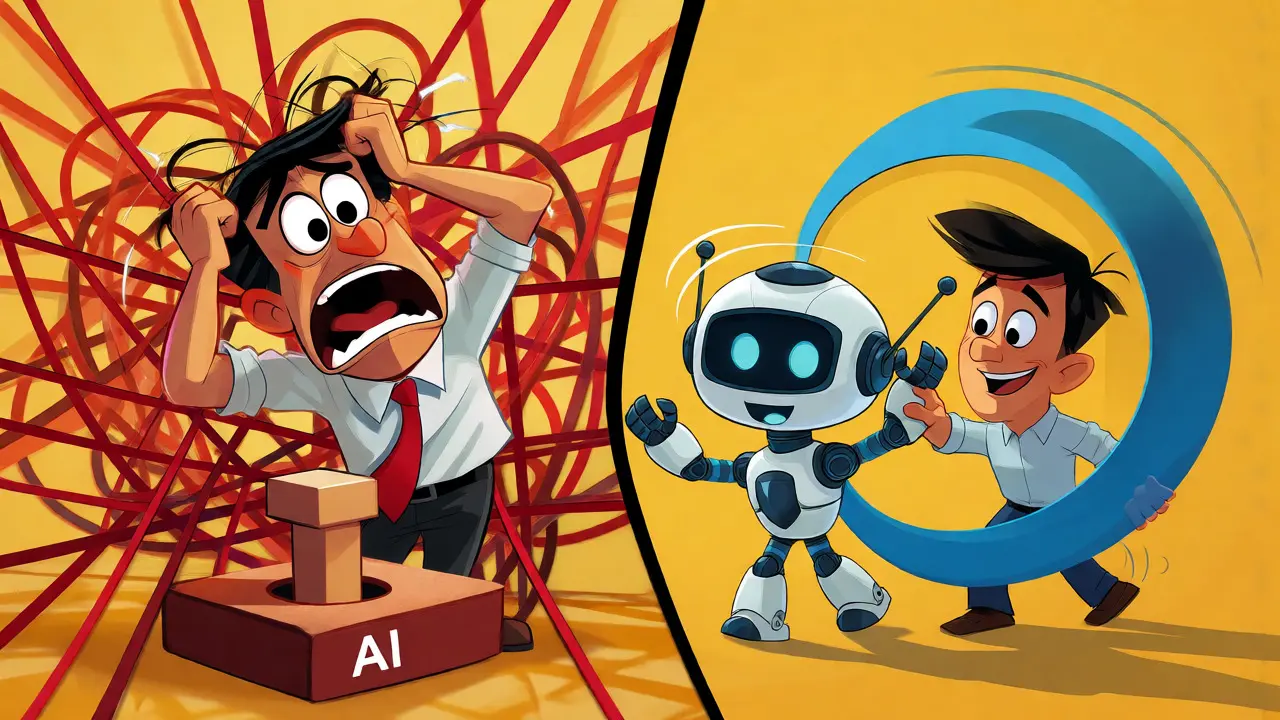
Here’s a hard truth: if you plug generative AI into your existing broken processes, you just get faster broken processes. Process redesign is the core of effective change management. It’s not enough to teach someone how to use the tool; you have to teach them when and why to use it.
Consider the logistics company mentioned in recent case studies. They implemented an AI document processing tool but kept their manual approval steps intact. The result? Bottlenecks. They eventually had to spend extra funds to re-engineer their approval chains, adding three months to their timeline and thousands in consultant fees.
Effective redesign involves:
- Workflow Mapping: Identifying exactly where AI fits in the chain of command.
- Role Definition: Clarifying who owns the output. Is the human responsible for the AI's hallucination?
- Feedback Loops: Creating mechanisms for users to report issues or suggest improvements.
Tools like Prosci ADKAR or Kotter methodology are standard here, but they come with a price. Licensing for change management software platforms ranges from $5,000 to $25,000 annually depending on your size. Plus, you likely need 0.5 to 2 full-time equivalent specialists for every 100 employees during the rollout. These aren't optional add-ons; they are the bridge between technology and value.
Sector-Specific Cost Variances
Your industry dictates your risk profile, which directly impacts your change management budget. Regulated industries like healthcare and finance face higher compliance costs tied to change management.
In healthcare, for example, a provider abandoned a $250,000 AI implementation after eight months due to staff resistance. The root cause wasn't the tech; it was inadequate planning for how nurses would interact with the new diagnostic aids. That was a 100% loss on investment. In contrast, organizations that involve end-users in the design process from day one see significantly lower failure rates.
Manufacturing SMEs also face unique challenges. Integrating AI into legacy factory floors requires bridging a massive cultural gap. The average remediation cost for stalled AI adoption in this sector is $18,000. By contrast, tech-forward startups with fewer legacy systems can implement change strategies more agilely, often reducing costs by 35-45% through phased approaches rather than "big bang" rollouts.
The ROI Argument: Spending More to Save More
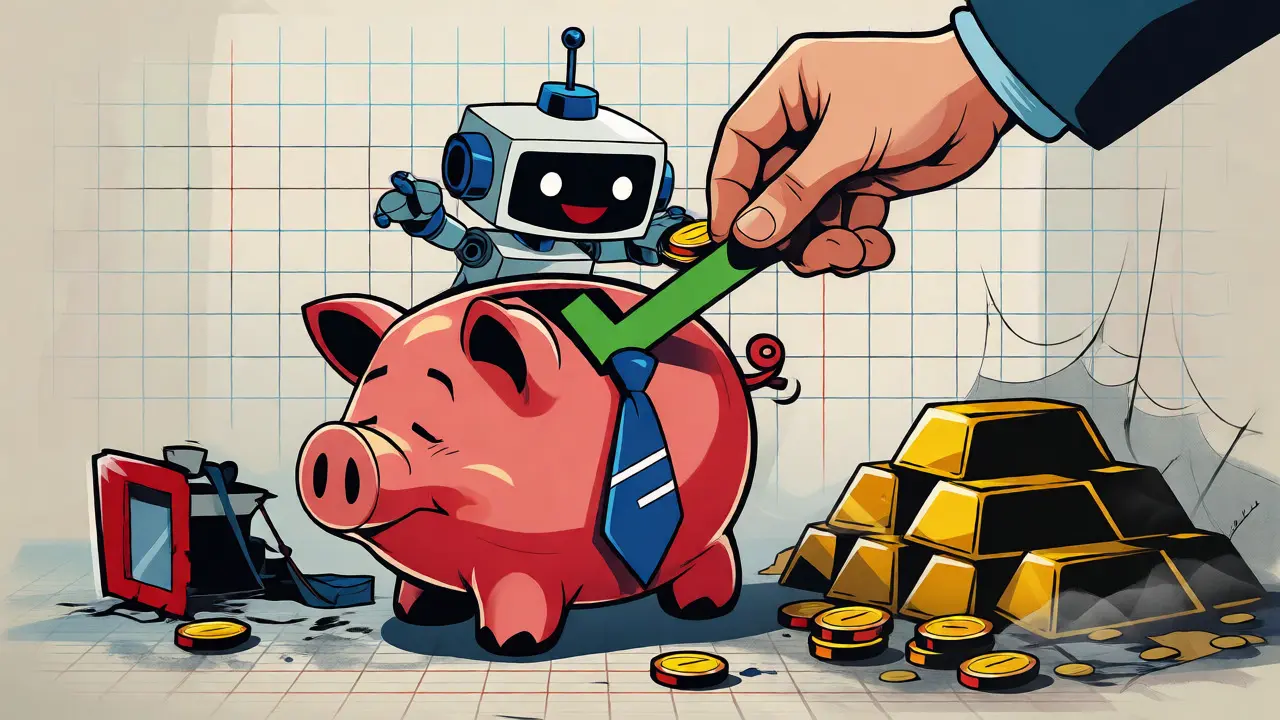
It sounds counterintuitive to increase costs to improve ROI. But look at the data. Companies that allocate 25-30% of their total AI budget to change management achieve 3.2x higher ROI than those sticking to the industry average of 15-20%. Why? Because adoption drives usage, and usage drives value.
A study by GO-Globe found that businesses adopting AI-native workflows with structured change management reported 20-60% reductions in operational spending within the first year. Without that structure, you’re paying for licenses and compute power that sit idle. You’re paying for potential, not performance.
Furthermore, regulatory pressure is mounting. The EU AI Act now requires documented change management processes for high-risk AI systems. This adds 10-15% to compliance costs but protects you from fines. Ignoring this aspect isn't just inefficient; it's risky.
Practical Steps to Control Costs
So, how do you keep these costs manageable while ensuring success? Start with a readiness assessment. Spend $2,000-$8,000 to understand your organization's capacity for change. Identify your champions-those early adopters who can influence peers.
Next, focus on role-specific training. Generic training fails. Marketing teams need different prompts than legal teams. Developing tailored materials costs $3,000-$10,000 but pays off in engagement. Avoid the trap of one-size-fits-all workshops. As one Reddit user noted, generic training led to $18k in retraining costs because it didn't address department-specific needs.
Finally, plan for the long tail. 60% of total AI implementation costs over five years arise from maintenance, training, and scaling. Budget for continuous improvement. AI isn't a project; it's a capability. Treat it as such.
What percentage of an AI budget should go to change management?
Industry leaders recommend allocating 25-30% of your total AI budget to change management activities. While the average is often lower (15-20%), higher allocation correlates with 3.2x better ROI due to improved user adoption and reduced remediation costs.
How much does initial AI training cost for a small team?
For small teams or startups, initial change management and training costs typically range from $5,000 to $15,000. This includes basic workflow mapping, introductory training sessions, and setting up feedback loops.
Why do AI projects fail despite good technology?
Approximately 85% of AI projects fail to deliver business value primarily due to poor change management, not technical flaws. Issues include lack of user adoption, unclear workflows, and insufficient training, leading to tools being ignored or misused.
What are the hidden costs of ignoring process redesign?
Ignoring process redesign leads to high remediation costs, averaging $18,000 per incident for SMEs. It also causes bottlenecks, reduced efficiency gains, and potential compliance risks, especially in regulated industries like healthcare and finance.
Do I need dedicated personnel for AI change management?
Yes. Best practices suggest allocating 0.5 to 2 full-time equivalent change management specialists for every 100 employees during the initial implementation phase. This ensures focused attention on adoption barriers and workflow adjustments.