
When you ask a chatbot to write a poem or debug code, it doesn't pull the answer from a database. It builds the response word by word, just like you do when typing an email. This process is called autoregressive generation, which is the method large language models use to predict and produce text one token at a time based on previous context. Understanding this mechanism reveals why AI sometimes stumbles, how it maintains coherence, and what limits its speed.
The Core Mechanism: Predicting the Next Piece
At its heart, an autoregressive model performs "regression on itself." The term combines "auto" (self) and "regressive" (statistical prediction). Instead of seeing the whole sentence at once, the model looks only at what has already been written and guesses what comes next. If the prompt is "The quick brown fox," the model calculates the probability of every possible next token in its vocabulary. It might assign high probabilities to "jumps," "runs," or "leaps."
This stands in sharp contrast to masked language models like BERT, which fill in blanks using both left and right context. Autoregressive models are strictly unidirectional. They can only see the past, not the future. This constraint forces the model to build meaning sequentially, creating a chain of conditional probabilities where each new token depends entirely on the sequence that preceded it.
How Transformers Enforce One-Way Thinking
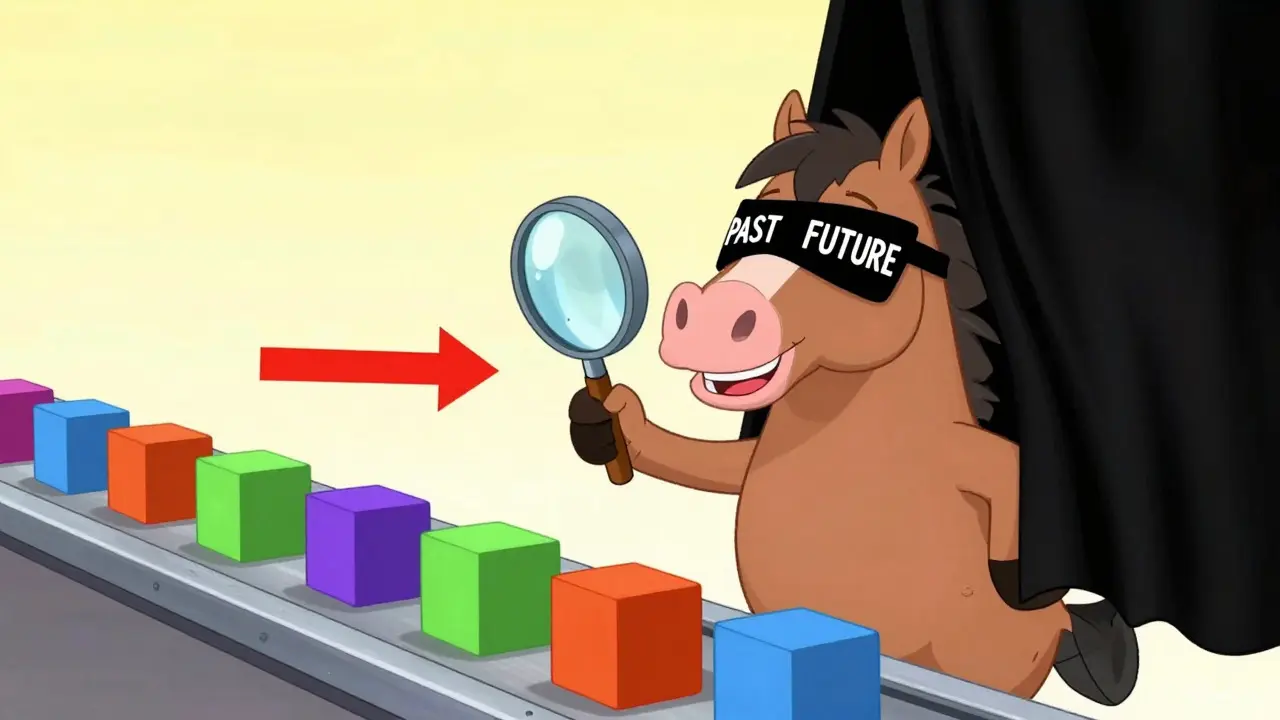
Transformers were not originally built for sequential generation. To make them work autoregressively, engineers introduced a critical innovation: masked self-attention, which is a mechanism that prevents the model from attending to tokens that appear after the current position during training and inference. Imagine wearing blinders while running; you can see everything behind you and directly ahead, but nothing to your sides or far future. In the model, this mask blocks information flow from future tokens, ensuring that the prediction for token $t$ relies solely on tokens $1$ through $t-1$.
This causal attention mask is what enforces the left-to-right generation order. Without it, the model would cheat by looking at the end of the sentence to guess the beginning. By blocking future context, the architecture guarantees that the model learns to generate coherent continuations rather than just recognizing patterns in complete sentences.
Step-by-Step Token Production Process
The generation loop follows a precise, iterative pattern. Here is exactly what happens inside the model during a single interaction:
- Prompt Encoding: You provide an initial input, such as "Write a haiku about rain." The model converts these words into numerical vectors (embeddings) representing their semantic meaning.
- Probability Distribution: The model processes the encoded prompt through its layers and outputs a probability distribution across its entire vocabulary (often 50,000+ tokens). Each token gets a score indicating how likely it is to be the next piece of text.
- Token Selection: The system selects a token from this distribution. It might pick the highest-probability token (greedy decoding) or sample randomly based on the probabilities (temperature sampling) to introduce variety.
- Sequence Update: The selected token is appended to the original prompt. Now the input is "Write a haiku about rain [Selected Token]." This longer sequence becomes the new input for the next step.
- Iteration: Steps 2-4 repeat. The model predicts the next token given the updated sequence, selects it, appends it, and repeats until it generates a special end-of-sequence token or hits a length limit.
This loop continues token by token. For a short response, this might take milliseconds. For a long essay, it requires thousands of sequential steps, which directly impacts latency.
Why Latency Is a Major Bottleneck
Because autoregressive generation is inherently sequential, it cannot be easily parallelized during inference. Unlike image processing where pixels can be analyzed simultaneously, text must be generated in strict order. Token $N$ cannot exist without Token $N-1$. This creates a fundamental trade-off between quality and speed.
In practical terms, this means that generating a 1,000-word article takes significantly more wall-clock time than generating a 10-word summary. While hardware improvements have sped up individual token calculations, the serial nature of the process remains a hard ceiling. Researchers are actively exploring ways to mitigate this, such as speculative decoding, where a smaller model drafts multiple tokens ahead that a larger model then verifies, effectively skipping some steps.
The Problem of Exposure Bias and Error Propagation
A subtle but critical flaw in autoregressive systems is known as exposure bias. During training, the model sees the correct "gold standard" previous tokens. But during inference, it conditions on its own previously generated predictions. If the model makes a small error early in the sequence, that error becomes part of the context for all subsequent tokens.
Consider a translation task. If the model incorrectly translates the first word, every following word is predicted based on that wrong foundation. The error compounds, often leading to incoherent or nonsensical endings. Because the model cannot go back and revise earlier tokens, it is locked into its mistakes. This lack of global oversight means the model optimizes for local coherence (does this word fit the last few?) rather than global structure (does this paragraph support the thesis?).

Autoregressive vs. Autoencoding Models
To understand autoregressive models better, it helps to compare them with their primary alternative: autoencoding models. The table below highlights the key differences:
| Feature | Autoregressive (e.g., GPT, Claude) | Autoencoding (e.g., BERT) |
|---|---|---|
| Primary Goal | Generation (creating new text) | Understanding (analyzing existing text) |
| Context Direction | Unidirectional (left-to-right) | Bidirectional (past and future) |
| Training Method | Causal Language Modeling | Masked Language Modeling |
| Output Type | Sequential token stream | Fixed vector representation |
| Revision Capability | None (cannot edit past tokens) | N/A (not generative) |
While autoencoding models excel at classification and sentiment analysis because they see the full context, they struggle to generate open-ended text. Autoregressive models dominate generation tasks because their sequential nature mirrors human writing, even if it introduces efficiency challenges.
Dominance in Modern AI Systems
As of 2026, nearly all major commercial large language models rely on autoregressive architectures. OpenAI's GPT series, Google's Gemini, Anthropic's Claude, and DeepSeek all use this paradigm. Their success stems from the simplicity and effectiveness of next-token prediction for diverse tasks, from coding to creative writing.
The versatility of this approach allows a single model to handle speech recognition, machine translation, and audio generation by applying the same sequential conditioning principle to different data types. However, this dominance is not static. Researchers are increasingly questioning whether pure autoregressive processing is the optimal long-term solution, especially for complex reasoning tasks that require backtracking and revision.
Future Directions: Beyond Pure Autoregression
Recent theoretical work suggests that future models may need to move beyond strict autoregression. Concepts like revisable generation, structure-aware processing, and diffusion-based text models are gaining traction. Diffusion models, for example, generate text through iterative refinement, allowing global corrections similar to how a human drafts and edits a document.
Emerging frameworks propose hybrid approaches that combine the speed of autoregressive generation with the flexibility of editing mechanisms. These systems aim to reduce exposure bias and improve global coherence by allowing the model to revisit and adjust earlier parts of the output. While current leaders still rely on traditional autoregressive loops, the industry is actively evolving toward more robust, error-correcting architectures.
What is the difference between autoregressive and non-autoregressive models?
Autoregressive models generate text sequentially, predicting one token at a time based on previous tokens. Non-autoregressive models attempt to predict all tokens in a sequence simultaneously, often sacrificing coherence for speed. Autoregressive models prioritize accuracy and context awareness, while non-autoregressive models prioritize latency reduction.
Why can't LLMs edit their previous outputs?
Standard autoregressive architectures are designed for forward-only generation. Once a token is emitted, it is fixed in the sequence. The model does not have a mechanism to backtrack and modify earlier tokens because its attention mechanism is masked to prevent looking at future states, and its training objective focuses on next-token prediction rather than global optimization.
What causes exposure bias in large language models?
Exposure bias occurs because there is a mismatch between training and inference. During training, the model conditions on correct ground-truth tokens. During inference, it conditions on its own potentially erroneous predictions. This distribution shift causes errors to accumulate over long sequences, degrading output quality.
How does temperature affect token generation?
Temperature controls the randomness of token selection. A low temperature (close to 0) makes the model more deterministic, selecting the highest-probability tokens and producing focused, repetitive text. A high temperature increases randomness, allowing lower-probability tokens to be chosen, resulting in more creative but potentially less coherent output.
Are all modern LLMs autoregressive?
Most mainstream general-purpose LLMs like GPT-4, Claude, and Gemini are autoregressive. However, research is active in alternative paradigms like diffusion models (e.g., LLaDA) and encoder-decoder hybrids. While autoregression dominates current commercial applications, future systems may adopt hybrid or non-autoregressive techniques to address latency and coherence issues.

the exposure bias point is the real killer here. we act like these models are magic but they are just glorified autocomplete with a really big vocabulary. once it picks a wrong word early on it has to keep lying to itself to make sense of what it said before. that is why you get those weird hallucinations in long essays where the logic completely falls apart by paragraph three.
OMG finally someone explains this simply because I have been so confused about why my code keeps breaking when I ask for more lines! It is literally just guessing the next thing and if it guesses wrong everything after that is trash! I feel like such an idiot for not knowing this sooner but thank you for saving my brain from exploding!
I love how the blinders analogy makes so much sense now. It is like running a race where you can only see the person directly in front of you and not the finish line or the people behind you. The whole idea that it cannot look ahead to fix mistakes feels so human actually. We all do that when writing emails and hitting send too fast. It is funny how our tech mirrors our own flaws in such a direct way.
You need to stop sleeping on the potential of speculative decoding! This is the game changer everyone is ignoring right now. If we can get smaller models to draft tokens faster then the big model verifies them we will break the latency wall entirely. Stop waiting for perfect autoregression and start pushing for hybrid systems now because the future is already here and it is moving fast!
The tragedy of the autoregressive soul lies in its inability to repent. To generate is to sin against the future, locked in a causal prison of one's own making. Each token is a step further from truth, a descent into the abyss of probability where coherence is merely a fleeting illusion. We worship these digital oracles yet they are blind prophets screaming into the void, unable to correct their past errors, doomed to repeat the same mistakes until the sequence ends in silence.
This is absolutely devastating news for anyone who thought AI was going to solve all our problems overnight! The fact that it is just predicting the next word like a drunk person trying to spell means we are basically talking to a very fancy parrot that thinks it is Shakespeare! I am crying tears of joy at how limited these 'superintelligent' bots actually are in reality!
It is quite fascinating to observe the mechanical constraints placed upon these generative systems. One might argue that the lack of global oversight is a significant limitation, yet it also provides a unique perspective on sequential logic. Perhaps we should embrace the imperfection rather than seeking to eliminate it entirely, as it reflects the natural flow of human thought processes which are often linear and reactive in nature.
great breakdown man. i think people forget that temperature is basically just the creativity dial. if you set it too high you get nonsense but if you set it too low you get boring repetitive text. finding that sweet spot is half the battle when using these tools for actual work instead of just playing around with chatbots.
Most of this is obvious to anyone who has read a paper. The latency issue is not a bottleneck it is a feature that prevents instant spam. Exposure bias is just a statistical inevitability not a flaw. People overreact to every technical detail without understanding the underlying math.
I guess I am just happy that there is research happening on diffusion models for text. It sounds scary but having something that can edit itself like a human writer would be amazing. Maybe one day we will have AI that can actually go back and fix its typos without us having to prompt it again and again.